Condition Report
Contact Information
Lot 79
Lot Description
Isidorus Hispalensis (Isidore of Seville)
De summo bono
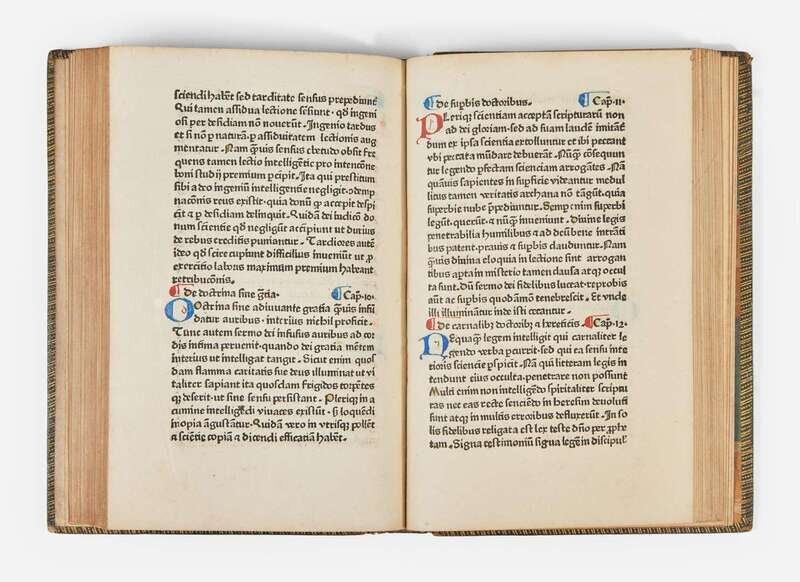
(Cologne: Ulrich Zell, not after 1472). Small 4to. 123 leaves; without Cyprianus's Liber de duodecim abusivis saeculi, sometimes found bound at end. Gothic type; 27 lines. Rubricated initials in red and in blue, capitals highlighted in gilt. Full green morocco, red morocco spine labels, stamped in gilt, rebacked, spine browned, extremities worn, boards rubbed and scratched; upper front joint cracked; all edges gilt; marbled endpapers; armorial book-plate of Charles W.G. Howard on front paste-down; “Bibliotheca Heberiana” ink stamp in top corner of front blank; wear in gutter following front free endpaper; recto of first printed leaf darkened; scattered faint dampstaining in gutter and outer margins throughout; some rubricated initials affected by damp; scattered contemporary marginalia; gutter of leaf 121 repaired. ISTC ii00193000; Goff I193; Hain 9281; Polain 2242; Sheppard 663; BMC I 187; Proctor 856; GW M15291
De Summo Bono is a medieval text written by Isidore of Seville, a prominent Christian bishop and scholar who lived in the late sixth and early seventh centuries. The text is a philosophical and theological treatise on the nature of the highest good, which Isidore identifies as God. In the work, he draws upon classical and Christian philosophical traditions, including the works of Aristotle, Plato, and Augustine, to argue that the highest good can only be found through a deep understanding of God, and a commitment to a virtuous life. This edition of "De Summo Bono," printed by Ulrich Zell in Cologne around 1470, is significant as an early example of the printing press in Europe and a valuable historical artifact of medieval philosophy and theology. Preceded only by the Nuremberg edition of 1470.
Ulrich Zell (d. 1507) was born in Hanau and apprenticed under Johann Fust and Peter Schoffer. He established the first printing press in Cologne in 1464, and during his career he produced upwards of 200 titles, and helped establish Cologne as the center of printing in north-west Germany.