

Condition Report
Contact Information
Lot 4
Lot Description
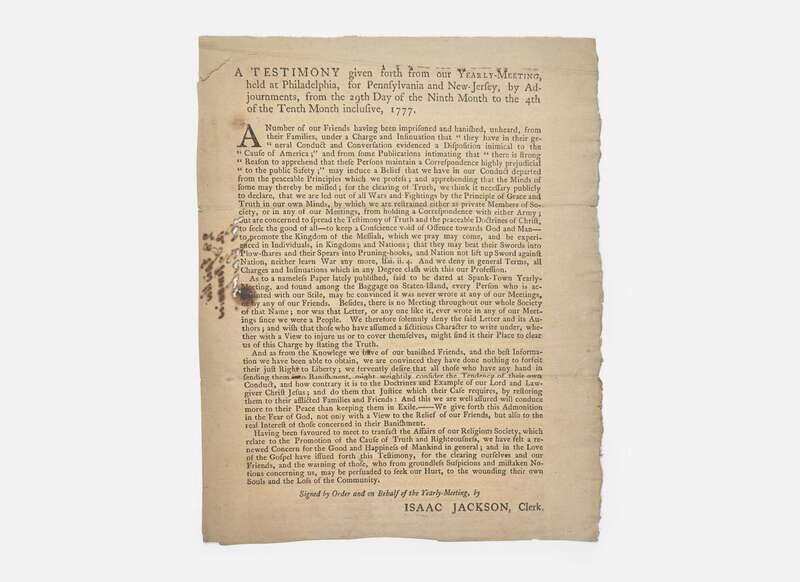
Rare Revolutionary War Handbill Calling for the Release of Quakers Banished by Congress
"A Number of our Friends having been imprisoned and banished, unheard, from their Families, under a Charge and Insinuation that ‘they have in their general Conduct and Conversation evidenced a Disposition inimical to the Cause of America;' and from some Publications intimating that ‘there is strong Reason to apprehend that these Persons maintain a Correspondence highly prejudicial to the public Safety'…we think it necessary publicly to declare, that we are led out of all Wars and Fightings by the Principle of Grace and Truth..."
Jackson, Isaac
A Testimony given forth from our Yearly-Meeting, held at Philadelphia, for Pennsylvania and New-Jersey...from the 29th Day of the Ninth Month to the 4th of of the Tenth Month inclusive, 1777
(Philadelphia), 1777. Printed broadside, 10 1/4 x 7 3/4 in. (260 x 197 mm). Signed in type by Isaac Jackson as Clerk on “Behalf of the Yearly-Meeting”; docketed on verso in manuscript, “28 Epistles / 12 Testimonies / for Goshen”. Creasing from old folds; corrosion to docketing ink with some loss to paper, affecting some type on recto. Sabin 94920; Evans 15302; Hildeburn 3638; Smith, Friends’ Books 1, p. 762; ESTC W5972 (locating only five institutions with copies)
A rare Revolutionary War handbill calling for the release of 20 Quakers banished by Congress and held without trial under charge of a “Disposition inimical to the 'Cause of America'”, and disavowing fabricated papers made to show Quaker collusion with the British Army.
During the war, Quakers faced persecution and economic hardship from non-Quaker Patriots for their religious pacifism, neutrality, and often Loyalist sympathies. Many Quakers refused to take up arms, pay taxes, or use Continental currency that they believed aided the conflict, and were viewed by Congress and the populace as being against the United States--or worse--in collusion with the British. In 1777, Philadelphia Quakers refused to take an oath of loyalty to the new Pennsylvania government, and when British forces threatened to invade Philadelphia later that year, they refused to help provide for the city's defense or donate goods to Patriot soldiers. Animosity between Quakers and non-Quakers reached a breaking point in the fall of 1777 when a fabricated letter from a Quaker “Yearly Meeting” at Spanktown, New Jersey (now Rahway) was intercepted showing that New Jersey Quakers had given military secrets to the British. With British occupation of Philadelphia imminent, the Second Continental Congress had 20 prominent Quaker men imprisoned and exiled for their supposed Loyalist sympathies. From September, 1777 through April, 1778, these men were incarcerated without trial in the frontier town of Winchester, Virginia, near the site of an American prisoner of war camp.
A month into their exile, in October, 1777, members of the Philadelphia Yearly Meeting agreed to send a peace delegation of six Friends to persuade the American and British Generals George Washington and William Howe of their neutrality and their desire for peace. Entrusted to “defend the faith, defend the exiled men, and seek peace” (Donoghue, Prisoners of Congress, p. 91), these men urged Washington to release their exiled brethren, and brought with them copies of this very handbill to give to the high command of both armies. In April, 1778, following the death of two of the exiled Quakers, the remaining Friends were allowed to return to Philadelphia. Their release was largely the result of the efforts of a group of Quaker women who lobbied Congress and Washington for their release.
This rare document was issued to the Goshen Meeting House, in West Chester, Pennsylvania.