Condition Report
Contact Information
Lot 37
Lot Description
(Key, Francis Scott)
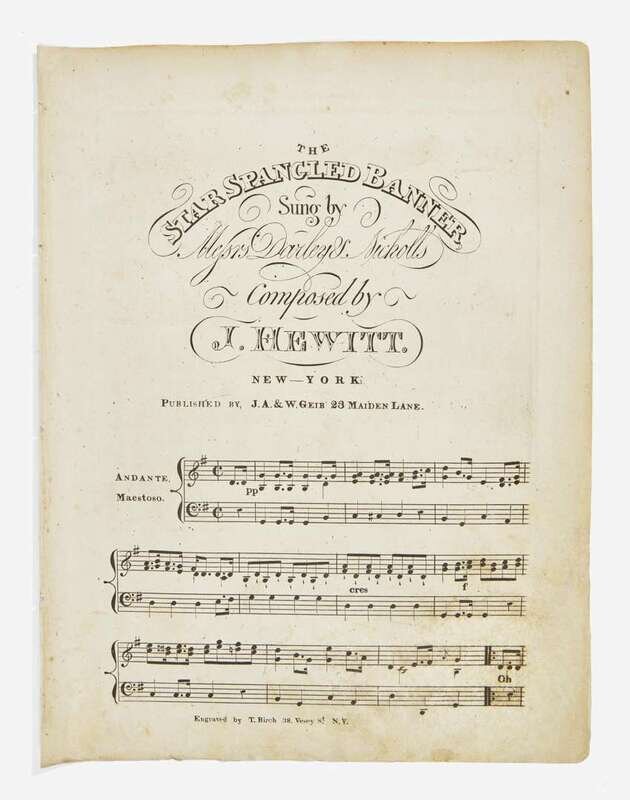
The Star Spangled Banner, Sung by Messrs. Darley & Nicholls Composed by J. Hewitt
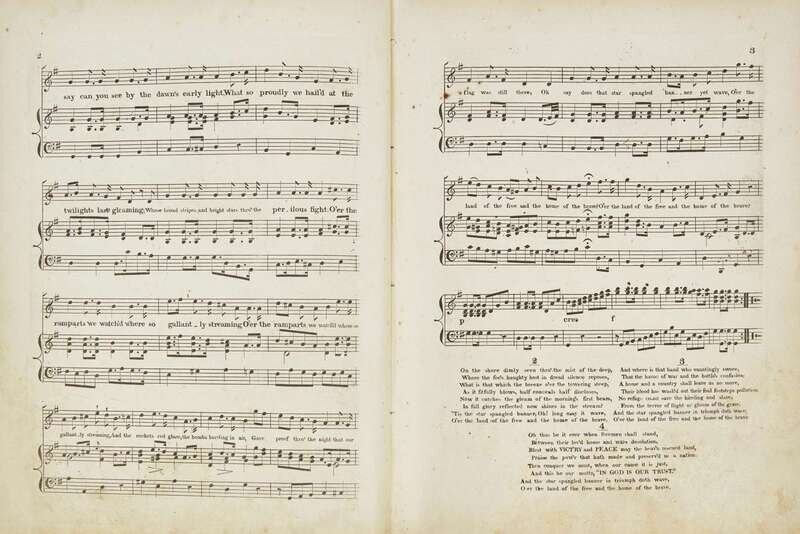
New York: Published by J.A. & W. Geib, (ca. 1818). Engraved sheet music on three pages (final page blank as issued), with lyrics to the complete four stanzas. Engraved by T. Birch. Disbound; expert paper restoration at lower corner and edge of each sheet; scattered soiling and offsetting; in morocco backed box and chemise. J. Fuld, Book of World-Famous Music, pp. 592-534; J. Muller, Star Spangled Banner, 1973, p. 35; Filby & Howard, Star-Spangled Books S10; Sabin 90498; Wolfe, Secular Music in America 3783A
Rare early printing of The Star Spangled Banner.
Francis Scott Key's stirring verses were inspired by a shipboard vigil on the night of September 13-14, 1814, while British warships bombarded Fort McHenry, outside Baltimore. Key, a young lawyer, had boarded a British ship to seek the release of an American physician held prisoner. During the bombardment, Key was detained and spent the night on deck, watching the British rain shells onto the fort. During the assault, a large stars and stripes flag flew over the fort but during the bombardment it was obscured by smoke. Key feared the fort had surrendered. When the smoke of battle died down and the flag could be clearly seen, Key's emotions were powerfully stirred.
His first draft of what became the national anthem was written on the back of a letter, to the tune of an English drinking tune "The Anacreontic Song," by John Stafford Smith. Broadside and newspaper printings of the verses appeared and it was widely performed by a traveling music company. The first sheet music edition, uniting Key's lyrics and Smith's music, appeared no later than October, 19 from the press of J. Carr in Baltimore; a Philadelphia printing from the press of A. Bacon followed. The anthem was next published in New York by the firm of Geib & Co. In 1816, American composer James Hewitt (1770-1827) set out to replace Key's original chosen tune, as The Anacreontic Song, was deemed by him to be too British. Hewitt's tune was first engraved by Birch and published by Nicholls. The present issue was printed from the same plates and followed shortly thereafter.
All early editions of The Star Spangled Banner are rare.