Condition Report
Contact Information
Lot 24
Lot Description
From the Library of New York Politician, Lawyer, and Leading Anti-Federalist, John Lansing, Jr.
Dallas, A(lexander). J.
Reports of Cases Ruled and Adjudged in the Courts of Pennsylvania, Before and Since the Revolution
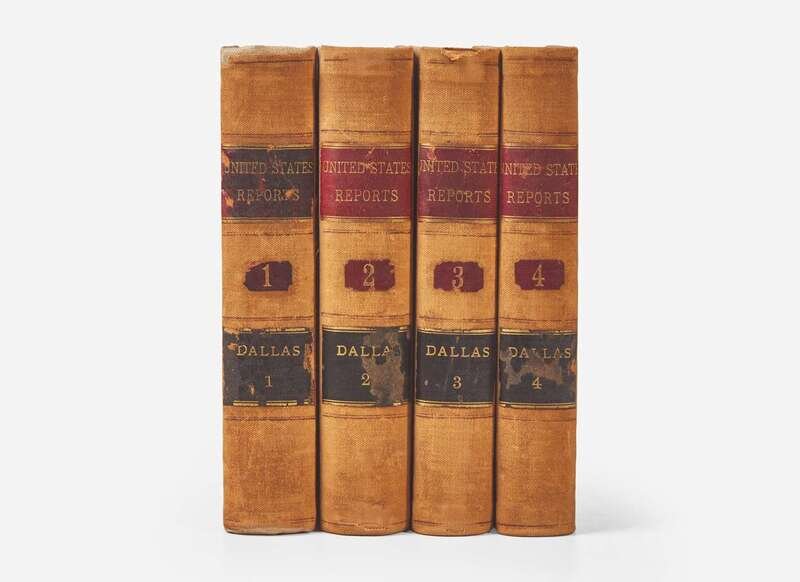
Philadelphia: T. Bradford, 1790 (Vol. I); Aurora Office, 1798 (Vol. II); J. Ormrod, 1799 (Vol. III); For P. Byrne, by Fry and Kammerer, 1807 (Vol. IV); In four volumes. First edition. 8vo. x, (ii), 494, xxiv, (1); (ii), iv, 480, xix; (viii), 519, (1), xiii; (vi), 472, xxxiv, (xiv) pp. From the library of Founding Father from New York, John Lansing, Jr., and with his signature on title-page of Vols. II and III. Full tan buckram-covered boards, red and black morocco spine labels, stamped in gilt, boards lightly soiled, labels chipped; all edges trimmed; ownership ink stamp of Lansing's grandson, John L. Sutherland, at top of p. 200 in Vols. I and IV; book-plate of Frank H. Platt on front paste-down of each volume; ownership inscription at top of title-page in Vol. IV: “Bought this June 8, 1827 from the successors of _______ ”; small loss to corner of pp. 237/238 in Vol. I; small chip and short closed tear in bottom corner of pp. 457-494 in Vol. I; sheets toned and foxed in Vol. IV; scattered minor edge-wear in all volumes. Evans 22445, 33598, 35374; Sabin 18313; Shaw & Shoemaker 12384; Reese, The Federal Hundred 27
A fine association copy of this important series of the first published reports of the United States Supreme Court, from the library of New York Founding Father and leading Anti-Federalist, John Lansing, Jr. “This very valuable work” (Sabin), was compiled by reporter and statesman Alexander J. Dallas, and comprises cases heard before the Supreme Court from its inception in 1790 through to 1800, covering the Chief Justiceships of John Jay and Oliver Ellsworth. The first volume comprises state cases in Pennsylvania before the establishment of the Supreme Court in 1789 while the second and third volumes cover early Supreme Court cases. The fourth volume largely covers cases in Pennsylvania, with a small number regarding the Supreme Court, as well as cases from Delaware, New Hampshire, and Philadelphia. The coverage of the Supreme Court ends when the federal government moved from Philadelphia to Washington, D.C., in 1800. Many important cases are printed within, including Georgia v. Brailsford (1794), Glass v. Sloop Betsy (1794), Hylton v. United States--the first court case to raise the question over judicial review--, and Chisholm v. Georgia, a landmark case in which the Court ruled that the states were subject to the authority of the federal government.
John Lansing, Jr. (1754-1829) was a prominent American lawyer, and statesman from New York, and one of the leading Anti-Federalists opposed to the ratification of the Constitution. A graduate of King's College (now Columbia University), he studied law with Robert Yates in Albany, and with James Duane in New York City. During the Revolution he served as aide-de-camp to General Philip Schuyler. He practiced law in Albany, arguing many cases before the State Supreme court, and from 1781-84 served as a member of the New York State Assembly, and in 1784-85 as a member of the Confederation Congress. He returned to the New York State Assembly in 1786 and 1788 as Speaker, and served as Mayor of Albany, also in 1786. He, along with Yates and Alexander Hamilton were appointed delegates to represent New York during the Constitutional Convention in 1787, but he and Yates quickly withdrew after opposing the Convention's aim to draft an entirely new Constitution. During the ratification debates, he led the Anti-Federalist opposition in New York, during the 1788 Poughkeepsie Convention, and has been credited with ensuring the later inclusion of the Bill of Rights. In 1790, he was appointed by Governor George Clinton an Associate Justice of the New York Supreme Court, and in 1798 was made Chief Justice by Governor John Jay. Concurrent with this role he served as Chancellor of New York State. He retired from public office in 1814, and resumed private practice. Lansing died under mysterious circumstances in 1829, having disappeared without a trace while visiting New York. It has been suggested that he was murdered by political opponents.