Condition Report
Contact Information
Lot 17
Lot Description
Otis, F(essenden). N(ott).
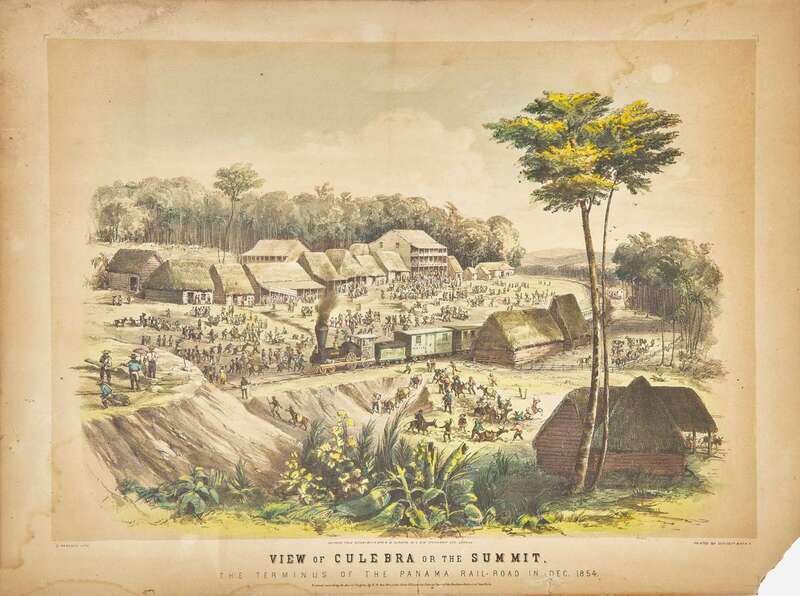
View of Culebra or the Summit, The Terminus of the Panama Rail-Road in Dec. 1854
New York: F.N. Otis, 1854. Lithograph with hand-coloring, by C(harles). Parsons after Otis; printed by Endicott & Co., N.Y. 12 1/8 x 16 1/4 in. (308 x 413 mm). Trimmed along edges and mounted to board; sheet unevenly toned; dampstaining along edges; small loss in bottom right corner, but not affecting image; two tears in bottom edge, affecting some letters. In mat and in frame, 16 1/2 x 20 3/4 in. (419 x 527 mm).
A rare lithographic view of the first transcontinental railroad and precursor to the Panama Canal, depicted at the height of the California Gold Rush. Built over a period of five years beginning in 1850, and at a cost of $8 million and thousands of lives, the Panama Railroad extended 48 miles across the Isthmus of Panama connecting the Atlantic and Pacific Oceans. Before the completion of the transcontinental Pacific Railroad in 1869, there were only two major routes to get to California from the Atlantic Coast: the treacherous 3,000 mile overland journey across the United States by wagon, or the 12,000-plus mile journey by ship around Cape Horn in South America. Both took months to complete and were fraught with danger.
With the surging population and economy in the West and the discovery of gold in California in 1848, the need for a faster and safer route to move people, mail, and supplies became paramount. Despite the danger of disease and thick jungle, by 1851 a route across the Isthmus of Panama by foot and boat became the most popular means of getting to the west coast, with three out of four travelers passing through Panama or Nicaragua. Capitalizing on this popularity, American businessmen William H. Aspinwall and George Law organized a consortium of investors called the Panama Railroad Company to build a railroad through the rough terrain. Upon completion, the railroad reduced the ease of travel across the Isthmus from several days to a mere three hours.
Culebra, depicted here, was a village at the summit of the Continental Divide in Panama, and was newly established in January, 1854, while the railroad was still under construction. Before the railroad's completion in January, 1855, thousands of gold seekers and settlers passed through this town, disembarking from the train to complete their journey to the Pacific by mule, or on foot. In December, 1854, when Otis sketched this view while a surgeon for the United States Mail Steamship Company, the town boasted 2,000 residents and was the only location along the route with hotels, restaurants, and other accommodations.
Fessenden Nott Otis (1825-1900) was an American physician and pioneer in urology. He worked as a surgeon for the United States Mail Steamship Company on their Panama to California route from 1853 to 1859, and then for the Pacific Mail Steamship Company, until 1861. During this time he executed some of the earliest views of American settlements in the West, particularly of San Francisco. He later established a medical practice in New York City, and in 1862 published his Illustrated History of the Panama Railroad, of which a smaller version of the above is depicted.
Very rare, we can locate only one other copy in the available auction record, in 1907.