Condition Report
Contact Information
Lot 137
Lot Description
Mid-19th Century Russian Album of Original Illustrations Depicting the Peoples of the Russian Empire
Heuser, J.M., et al.
Album of Original Illustrations Depicting the Peoples of the Russian Empire
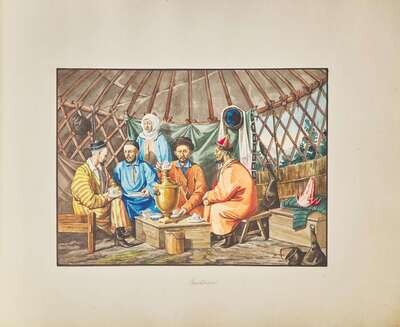
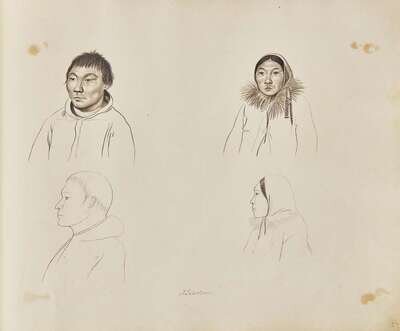
(Russia, etc., ca. 1840s-60s). Oblong folio, 12 3/4 x 16 in. (324 x 406 mm). Comprising 148 original illustrations executed in pen and ink, watercolor, and/or pencil, on 98 sheets (48 in full or partial color; 39 executed directly on album leaves and 109 mounted to same); album leaves and some mounted sheets with J. Whatman watermark, dated 1845 or 1848. Each sheet numbered in manuscript pencil in bottom corner; approximately 17 illustrations signed by Heuser, some signed by others ("Lucien Gottri, 1845", “A. Shirine, 1858”, etc.), with the remainder unsigned; manuscript captions in two or more hands, in Russian and in German, in pen or pencil, below each image; some mounted illustrations with annotations on verso; one period photograph mounted at front, with annotations in pencil on verso. Illustrations measure from 2 3/4 x 1 3/4 in. (70 x 44 mm) to 12 1/2 x 10 1/2 in. (317 x 267 mm). Full contemporary pebbled green morocco, elaborately stamped in blind, with “J.M. Heuser” stamped in gilt on front board, rebacked; blue speckled edges; pink moire silk endpapers; scattered wear and soiling to sheets; some mounted illustrations now loose or starting. Includes a printed Paris Exposition Universelle de 1867 certificate, awarded to Heuser, now separated from rear endpaper ("Le Jury International decerne une medaille de bronze a Heiser (Russie.) Agriculture et Industrie. Group III.--Classes 14 et 15.--Figures en carton-pierre").
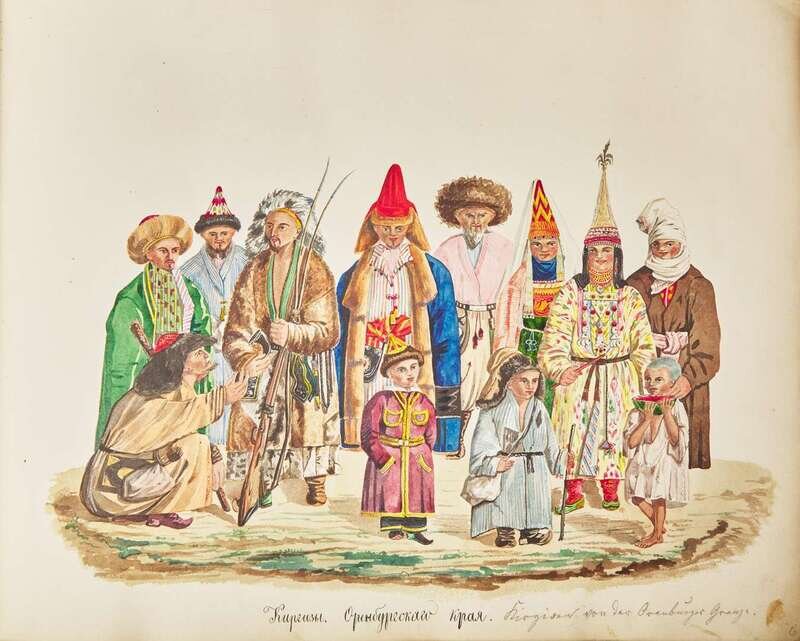
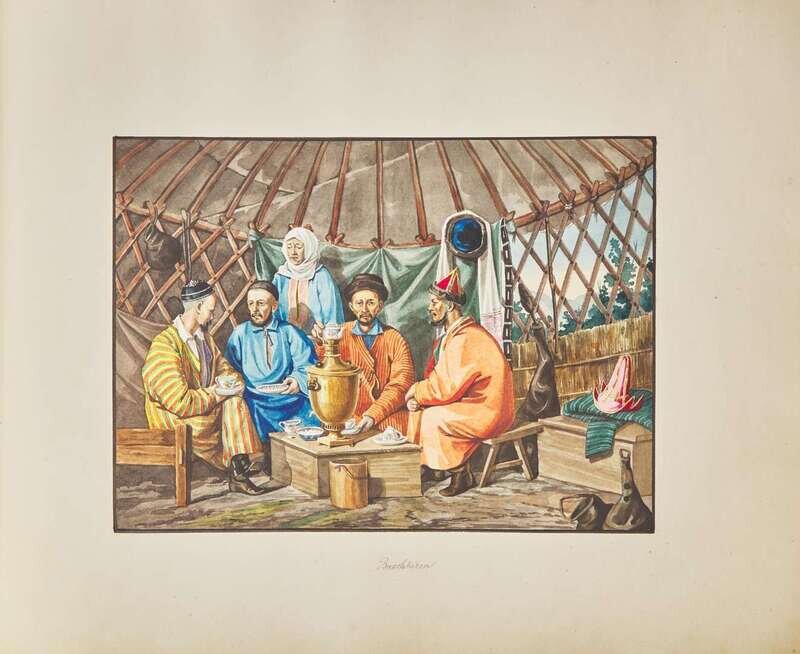
A fine mid-19th century album of original illustrations depicting the peoples of the Russian Empire. Compiled and primarily produced by Baltic German artist and sculptor J.M. Heuser, an associate of Baltic German naturalist-explorer Karl Ernst Von Baer (1792-1876). The album's 148 illustrations are diverse in style, color, finish, and detail, and show the physiognomy, dress, dwellings, and professions of the Empire's numerous peoples. The vast geographical territory of the Empire is represented, including European Russia, the Caucasus, the Volga River and the Ural Mountain regions, as well as the far east, including Siberia, the Amur River region, the Kamatchka peninsula, and more. Various groups are depicted, such as Mordvins, Tatars, Nanai, Bashkirs, Chuvash, Yukaghirs, Khanty, Tungus, Samoyeds, Korayks, Kalmyks, Cossacks, Lezgins, Armenians, Kyrgyz, Finns, and Ukrainians, as well as the peoples of northwest North America and the Aleutian archipelago. Several of the illustrations appear executed from life, while many are copies based on other sources, either printed or photographic, some being notable Russian travel surveys. Reflective of a burgeoning nationalism in Russian society and government during the reign of Tsar Alexander II, and earlier, these images follow a long tradition of Russian ethnographic illustration, from J.G. Georgi, Fedor Solntsev, Emelian Mikhailovich Karnejeff, Auguste Raffet, and more.
Heuser, of Baltic German descent, was connected to the powerful St. Petersburg-based Imperial Russian Geographical Society and the Imperial Academy of Sciences. Established in 1845, the Geographical Society sought to foster the study of the vast range of Russia's geography, climate, languages, and people. In pursuit of this, the Society sponsored numerous research expeditions into the Empire's territories and hinterlands, often with accompanying artists who recorded through photography or drawings the various peoples and places they encountered. Heuser was most notably associated with the Society's co-founder and first Chair of the Ethnography Division, the Baltic German naturalist-explorer, Karl Ernst von Baer. Baer was at the forefront of early Russian ethnography and geography, and carried out several expeditions throughout the Russian Empire from the 1840s-60. In the 1860s-70s he frequently commissioned Heuser for sculptural models depicting various Russian ethnic groups.
Most significantly, the images in this album likely aided in the design of illustrations featured in Theodore de Pauly's important survey of the Russian Empire, Description ethnographique des peuples de la Russie (1862). The lithograph “Russes de L'Ukraine (Petits Russie)” (facing p. 72 in “Pueple Indo-Europeens”), is attributed to Heuser (“dessine dapres les originaux de Mr. Heyser par Viale”). The illustrations on leaves 53-55 in this album appear to be preparatory sketches for that plate, and contain manuscript descriptions by Heuser describing the figure's dress, and are executed in full color.
The brainchild of Baer, Pauly's Description ethnographique was sponsored by the Geographical Society and published in 1862 to celebrate the millennium of the founding of the Russian Empire. Dedicated to Tsar Alexander II, it was a seminal publication and the culmination of 19th century Russian ethnography. It was the first extensive survey of its kind since J.G. Georgi's first ethnographic study of Russia, Beschreibung aller Nationen des Russischen Reichs (1776-80) (see following lot). A magnificent production, Pauly’s work features 62 chromolithographic plates executed by numerous artists. Many of the illustrations feature elements drawn from life, but the overall compositions were certainly created using a variety of sources, like photographs, sketches, and costumes held by the Geographical Society that were then modeled. An imaginative combination of these, and other elements, likely contributed to the finalized images that were transferred to lithographic stone, as can be gleaned from the contents of this album.
Other illustrations within this album closely resemble different figures in Pauly's work. Five figures on leaves 2 and 3 appear in composite in the plate “Tatares de la Crimme. Mollah” (signed “Ch. Huhn d'apres les originaux de la Societe geographique Imperale de Russie par Sitnikoff”). Another figure drawn and signed by Heuser, on leaf 71, appears slightly altered in the plate “Finnois” (signed “dessine daprez nature par Dzierzanovsky”). Several costumes featured on leaves 4 and 5 appear in multiple plates: the dress of the central figure on leaf 5 in plate “Bashkirs” (signed “Desine d'apres nature par Zakharoff”); the dress of the three figures at left on the same leaf appear in the plate “Tartare de Khiva” (signed “Dessine par Ch. Huhn d'apres les originaux de la Societe geographique Imperale de Russie par Bahikoff”); the dress of the figure at right on leaf 4 appears in the plate “Femme Kirghize” (signed ”les originaux et costumes de la Societe geographique Imperale de Russie"). The Lezgin man on leaf 30, executed in 1845 by Lucien Gottri, closely resembles the dress in the plate facing p. 20 in “Peuples du Caucase” (signed “Dessine d'apres nat par Teichel”).
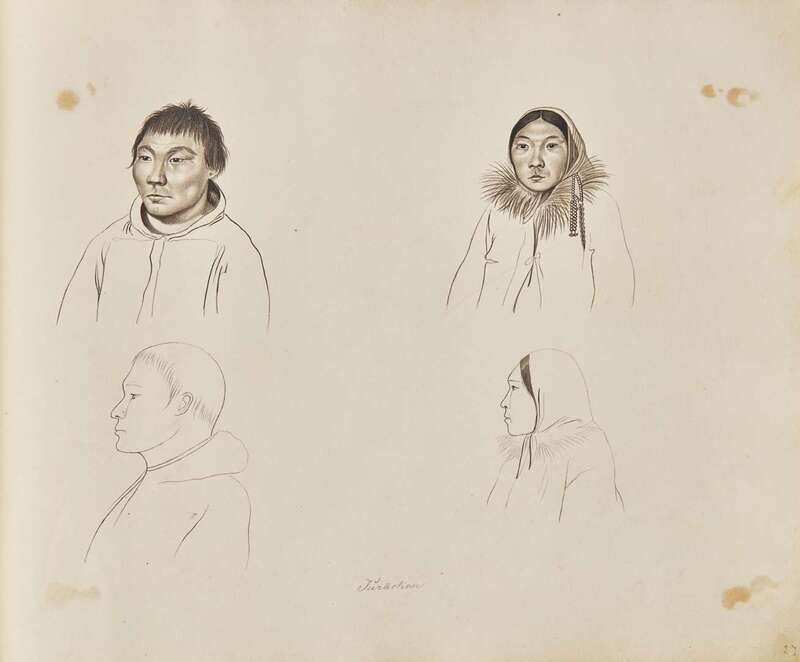
Some illustrations appear to be copies made from notable 19th-century Russian travel surveys. Four physiognomic illustrations appearing on leaves 20, 22, 23, and 25, are copies of field sketches executed by artist Thor Branth while on Baltic German explorer Alexander von Middendorf's expedition to the Taymyr Peninsula in Siberia, in 1842-44 (Reise in den äussersten Norden und Osten Sibiriens…, 1875). One illustration on leaf 94 is found in Ivan Bulychev's 1856 account of Eastern Siberia, Puteshestviye po Vostochnoy Sibiri Chast' 1-ya. Poyezdka v Kamchatku, as plate “Koriaks Nomades”. The costumes of leaf 4 have been attributed to 2nd Lieutenant Bibikov of the Russian Military Corps of Topographers, ca. 1845-46. One image on leaf 41 is a copy of Auguste Raffet's illustration “Berger du Bannat” from Voyage dans la Russie méridionale et la Crimée… Several other images appear in later German periodicals.
Throughout his career Heuser was primarily known for his papier-mâché sculptures, and it is likely that he also used the work within this album as a resource during their construction. In 1853, Prince Anatole de Demidoff of San Donato (1813-70) donated to the Russian Academy of Sciences 59 papier-mâché statues constructed by Heuser that represented the different peoples of Russia. In 1862, the same year as the publication of Pauly's work, Heuser was commissioned by Baer to create papier-mâché sculptures for Baer's publication Types principaux des differentes races humaines… These sculptures were simultaneously exhibited at the 1862 International London Exhibition. Heuser's work was later featured in the Russian Pavilion of the Exposition Universelle of 1867 in Paris (as seen in the certificate included), where he exhibited papier-mâché sculptures of animals and “types des habitants de la Russie” (Catalogue général exposition Universelle de 1867, p. 106). These sculptures are now in the National Museum of Scotland, in Edinburgh, and several of them appear as illustrations in this album.
A unique and extremely rare survival. Similar albums seldom come to market and we can find no example in the available auction record.
Our thanks to Nathaniel Knight and Edward Kasinec for their assistance with this lot.