Condition Report
Contact Information
Lot 158
Lot Description
Harrison, William Henry
Autograph Document, signed
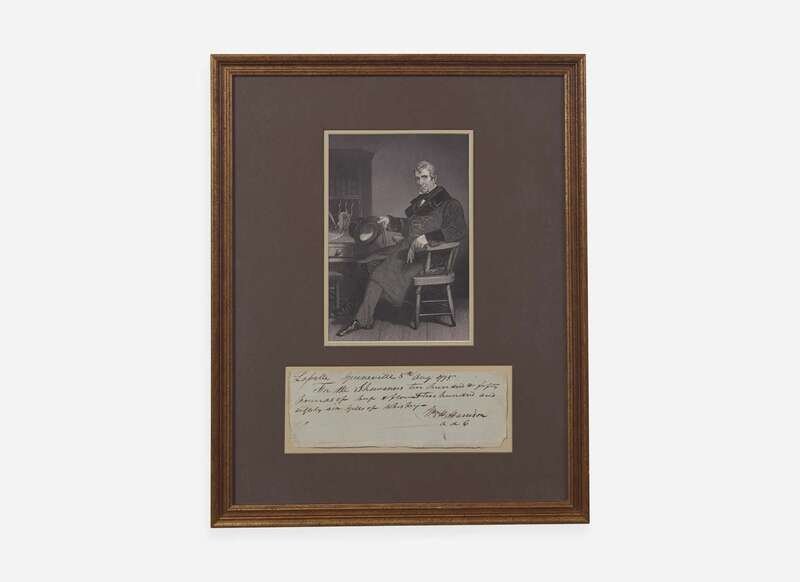
Greenville, (Ohio), Aug(ust). 5th, 1795. Single oblong sheet, approximately 2 3/4 in. x 7 3/4 in. (70 x 197 mm) (sight). Autograph document, signed by William Henry Harrison as aide-de-camp at Fort Greenville, likely for Hyacinth Lassalle (or Lasselle), requisitioning supplies for the Shawnee: "Lassalle...For the Shawanees two hundred & fifty pounds of beef & flour & two hundred and eighty six gills of Whiskey-Wm. H. Harrison a.d.c". Contemporary crease; light edge wear. In mat with engraved portrait of Harrison, and in frame, 16 7/8 x 13 1/2 in. (429 x 343 mm).
A scarce document signed by future president William Henry Harrison two days after the signing of the Treaty of Greenville, requisitioning food and goods for the Shawnee people. Signed on August 3, the Treaty temporarily ended hostilities in the Northwest between the United States and a coalition of Native American tribes, consisting of the Wyandot, Shawnee, Delaware, Ottawa, Chippewa, Miami, Pottawatomi, and others. The Treaty redefined the boundary line between Native American and United States territory, with the tribes ceding most of modern-day Ohio and parts of Indiana, Illinois, and Michigan. The tribes also received $20,000 dollars worth of goods, including a $9,500 annuity divided among each of the twelve tribes, and made up the things such as domestic animals, instruments for husbandry, etc. Here Harrison, then serving as an aide-de-camp to Major General Anthony Wayne, requisitions supplies like beef, flour, and whiskey, with this receipt made out to trader Hyacinth LaSalle.
LaSalle (1777-1843) was the son of French Indian Agent James Lasselle and Therese Berthelet, and was purportedly the first white child born in the Miami village of Kekionga, in present day Indiana. As a teenager he became a clerk to his two older brothers, James and Francis, who were extensive traders in the Detroit region. Following General Anthony Wayne's victory at the Battle of Fallen Timbers in 1794, Hyacinth was sent by his brothers to trade with the numerous Native tribes along the Wabash River and near Fort Wayne.