Condition Report
Contact Information
Lot 134
Lot Description
From the Library of Mark Twain, with His Annotations and Comments
Twain, Mark (Samuel L. Clemens)
A Tramp Abroad…
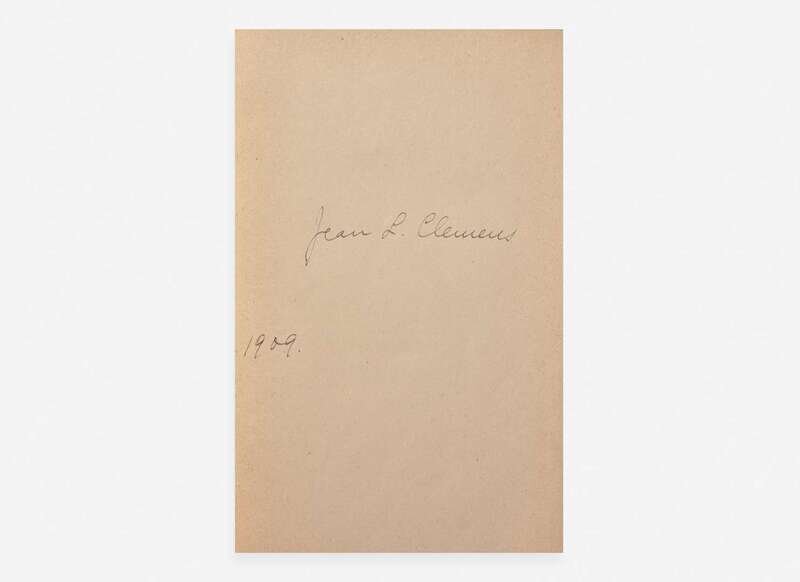
Hartford, Connecticut: American Publishing Company/London: Chatto & Windus, 1880. First edition. Tall 8vo. 631, (1) (ad) pp. From the library of Mark Twain, with his signature on front paste-down ("Mark Twain"), and with his autograph annotations and revisions in pencil throughout text, made by him in preparation for public speaking and lectures; additionally signed and dated by his youngest daughter, Jane Lampton Clemens on front blank ("Jean L. Clemens 1909"). Illustrated with an engraved frontispiece portrait of Twain (BAL State B), first state engraved frontispiece, and numerous in-text illustrations and full-page plates. Publisher's brown cloth-covered boards, stamped in blind and in gilt, boards and extremities rubbed, spine slightly faded, corners and spine ends worn; all edges trimmed; buff endpapers; book-plate of Estelle Doheny on front paste-down; front and rear hinges cracked; front free endpaper through title-page loose; scattered light spotting to text; text leaves lightly toned. BAL 3386
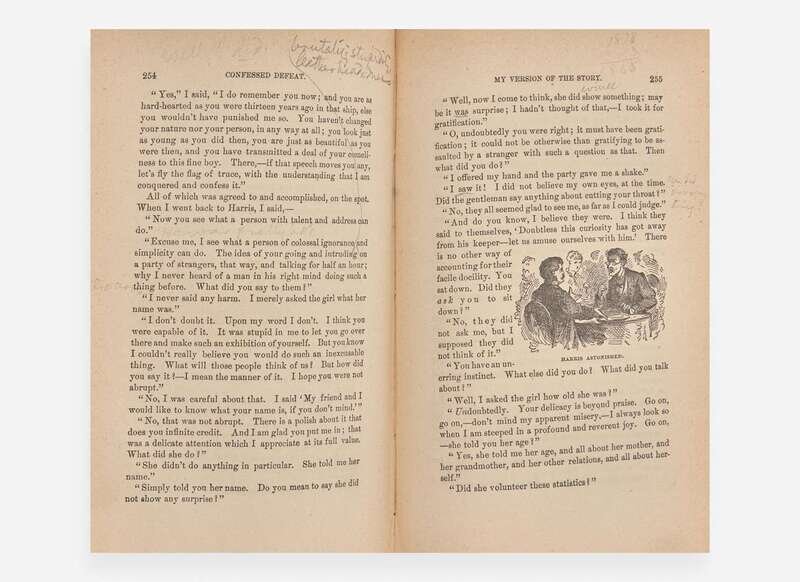
Mark Twain's personal copy of his satiric and entertaining memoir of his travels through Europe, marked throughout with his often humorous autograph annotations, comments, and revisions. The annotations by Twain appear on over 50 pages, and are almost certainly stage directions made by him in preparation for public readings of stories from the book. On the front free endpaper Twain has listed 16 sections from this volume, including “114-Hunting the sock-20 min,” “247-The pretty girl at Schweitzerhof 30 to 35,” "36 The Blue-jays," “215 The Ant," “440 The Grandson,” etc. Further annotations in the text notate pauses, intervals of time, with some markings seeming to emphasize passages and others partially or completely crossing out portions of text.
Some of Twains more interesting textual alterations and annotations include the identification of a character called "Jim Baker" on p. 36 as "Dick Stoker." Stoker was Twain's real life prospector friend he had met in California in the early 1860s, who in turn was the partner of the yarn-spinning Jim Gillis, from whom Twain borrowed the blue-jay tale recounted in that same passage (one of Twain's most often retold tales on the lecture circuit). On page 88 Twain comments on the size of the flea population of Baden: "My! but that country is just full of 'em-full of 'em"; on p. 247 Twain comments in response to the “very beautiful” and "tastefully dressed" young lady illustrated in the vignette, noting that the "artist had another opinion." Several emendations appear in Chapter XIII, where Twain recounts his hilarious attempt to find his way out of his lodging-house in total darkness, with passages crossed out and humorous comments added (Twain is known to have recounted this episode during his speaking engagement in 1906 for the Public Meeting of the New York State Association for Promoting the Interests of the Blind). On p. 279 Twain demotes the text's "good-natured numscull" to an "ass," and at p. 170, he calculates in the margins the number of words in his text (346 to the page). Finally, on the rear endpaper Twain estimates the number of letters per line, lines per page, and words per page in the entire text, concluding that 400 pages at 360 words per page yields a total of 144,000 words.
Twain was one of the most popular public speakers of his day, with one contemporary noting that “not to have heard Mark Twain is to have missed much of the value of his utterance. He had immeasurable magnetism and charm…Nobody could resist him--probably nobody ever tried to.” (p. xxi, Mark Twain Speaking, 1976). Beginning with his first public speech in 1856 at age 21 to his death in 1910, Twain was a tireless and prolific orator alongside his immense literary output, giving lectures small and large across the world, to civic associations, literary groups, banquets, garden parties, even to the President of the United States, where “his presence at a dinner or any other occasion, and the probability of a speech by him, assured a large audience.” (p. xxi) His casual and nonchalant manner of speaking, sometimes interpreted as though he spoke extemporaneously, masked a laborious work ethic spending hours practicing tempo, inflection, phrasing, and emphasis. In preparation for readings from his novels Twain "doggedly…rehearsed a repertoire of stories by talking them off until they lost their literary formality. Revising parts of his own books…he was like a detached stranger limbering up his own narratives. The acme of his study was the discovery that he needed only to remember the outline of a story, then fill it in with detail invented on the spot. The method permitted continual variation, which was one of Mark Twain’s greatest assets as a storyteller.” (p. xxv)
A unique and significant book illustrating Twain's preeminent showmanship.