Condition Report
Contact Information
Lot 122
Lot Description
From the Library of Fanny Brawne, John Keats’s Fiancée and Great Love
Life, Letters, and Literary Remains of John Keats
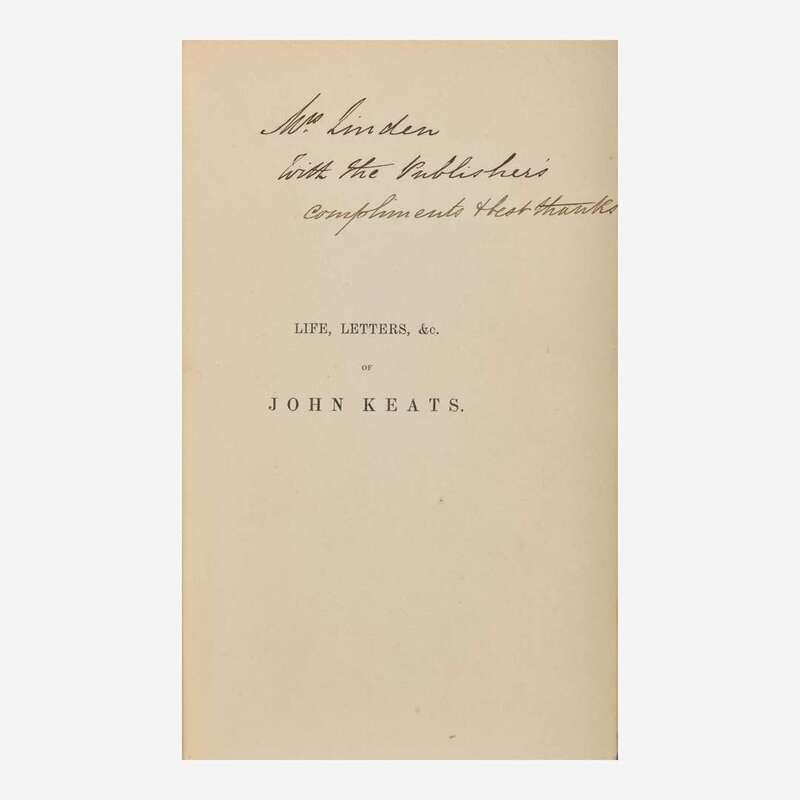
London: Edward Moxon, 1848. In two volumes. First edition. 8vo. 8 (ads, dated September 1, 1848), (ii), xix, (i), 288; (iv), 306, (2) pp.; errata in first volume, and half-titles in each volume. Edited by Richard Monckton Milnes. From the library of Fanny Brawne, fiancée of John Keats, and with her signature on verso of front free endpaper of second volume ("Frances Lindon"), and with the publisher's presentation inscription on half-title of first volume: "Mrs. Linden (sic) with the Publisher's compliments & best thanks." Illustrated with an engraved portrait of Keats by H. Robinson after J. Severn, in first volume, and a facsimile engraving of Keats's handwriting in second volume. Original brown cloth-covered boards, stamped in blind and in gilt, boards and spine faded, tears in cloth of spines of each volume, chipping to spine ends of each volume, extremities and boards of each volume rubbed; all edges trimmed; foxing to plate in second volume; several page corners in each volume creased, many where allusions to Fanny are printed.
A significant association copy: the first full biography of poet John Keats, from the library of his fiancée and great love, Fanny Brawne.
Secretly engaged in 1819, Fanny and Keats's relationship never resulted in marriage, as it was cut short by Keats’s death only two years later from tuberculosis, at the age of 25. Although short-lived, their romance coincided with Keats's most productive period of writing, and inspired many of his most well-known poems, including “Bright Star,” “The Eve of St. Agnes,” and “Ode to a Nightingale.” Following Keats's death, Fanny's mourning was profound. She bore the signs of grief for the remainder of the decade, and in the years that followed devoted herself to study, learning Italian and translating short stories from German, some of which were published. In 1833, twelve years after the poet's death, she began a relationship with Louis Lindo (later Lindon), a family friend 13 years her junior and from a wealthy Sephardic Jewish family. They married in 1834, had three children, and lived primarily in Germany.
During their 30 years of marriage, Fanny largely kept the details of her relationship with Keats a secret from Louis and her children, only revealing it to her husband eight years after they had eloped. In a November, 1848 letter to Mrs. Charles Wentworth Dilke, Fanny touched on this discretion in relation to the publication of this book, writing ”you must not be surprised at Mr. Lindons mentioning the ‘memoirs’. He has a very imperfect idea of the real case. Perhaps thinks his wife had an admirer, the more. He never would have heard of it, had it not happened seven or eight years ago, he noticed the portrait in your room; and asked who it was. As you hesitated in answering, he felt puzzled & I, to prevent awkward mistakes in future, when we got home explained as much as necessary." Fanny similarly kept her mementos of Keats closely guarded, including Keats's letters to her, books he gifted, and other objects. “Whatever comfort and peace she may have found in this marriage, she seems always to have cherished the memory of Keats as something sacred, but not to be spoken of. His letters she guarded with scrupulous care, and later, much later, when her children were grown up, she enjoined them to treasure these same letters…” (Lowell, John Keats, p. 136).
In the years following Keats's death his stature as a poet grew slowly, but the publication of a full biography, which might raise his literary reputation, remained partial or unrealized. Charles Armitage Brown--Keats's close friend and roommate at Wentworth Place (where he met Fanny)--began a biography of the poet in the 1820s, but after two decades and many false starts, it remained incomplete. In 1840, he entrusted his manuscript and papers to his friend and man of letters, Richard Monckton Milnes, to finish the project. Milnes, who never knew Keats, would use these papers as the foundation of the current work, but waited another five years before he began to seriously work on the project. Once begun he gathered additional letters, poems, and other effects from Keats's circle and family. In an October, 1845 letter from Joseph Severn, Keats's friend who was with the poet at his deathbed, he informs Milnes of Keats‘s relationship with Fanny, writing that when Keats died he “was about to be married to a most lovely & accomplished girl…This Lady was a Miss Brawn, she was possessed of considerable property in addition to her beauty & youth & was devotedly attached to Keats & his fame.” (The Keats Circle, Vol. II, pp. 129-130) It is possible that Milnes also learned of Fanny's identity from Brown, who communicated with Fanny in 1829 about mentioning her in his proposed biography, or from Charles W. Dilke, at whose home she and her family lived during her relationship with Keats. It was during this same period, as biographer Joanna Richardson suggests in her biography of Fanny, and perhaps in consequence of Milnes's communication with the aforementioned men, “it seems that Milnes corresponded with Fanny, for he quoted a stanza written by Keats in her copy of Spenser, and perhaps it was she who confirmed her devotion to Keats…” (Fanny Brawne: A Biography, p. 134).
When Life, Letters, and Literary Remains finally appeared in early August, 1848, 27 years after the poet's death, Milnes omitted any mention of Fanny by name, and only printed several allusions to Keats's lover. Richardson states that this exclusion was at Fanny's direction that “her name should be withheld." No letters between Fanny and Milnes are known to survive, if they ever communicated, to elucidate this, or the extent of assistance, if any, Fanny gave to the book's production. Milnes is known to have sent several copies of the book to those who assisted him or were related to the book's contents. Richardson also notes that Fanny “received a copy" of Life, Letters, "from the publisher” (p. 134).
The publication of Life, Letters ensured Keats the eventual fame and respect that eluded him during his life, but his relationship with Fanny remained unknown to the public until 1878 with the publication of his letters to her--long after her death in 1865, Louis’s in 1872 (and 57 years after Keats’s).
Letters and effects from Fanny, especially those associated with Keats, are of the utmost rarity. Keats's letters to Fanny sold at auction in 1885, while other material, including books and letters, were later sold at the Buxton Forman sale in 1920. The majority of this material has found its way into institutional collections like the Keats House or Harvard, or is now lost, with very little ever reaching the market in the past 100 years.
A fine association attesting to one of English literature's most significant romances.