Condition Report
Contact Information
Lot 104
Lot Description
Magna Charta, cum statutis quae Antiqua vocantur, iam recens excusa, & summa fide emendata, iuxta vetusta exemplaria ad Parliamenti rotulos examinata: quibus accesserunt nonnulla nunc primum…
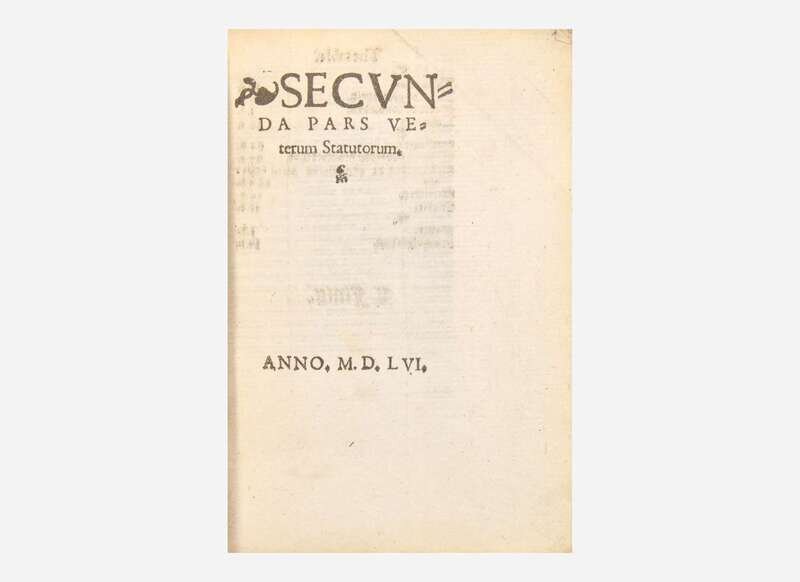
(London): Richard Tottell, 12 June, 1556. Two parts in one: with “Secun- / da pars ve- / terum Statutorum”. First Tottell edition. 8vo, 5 5/16 x 3 3/4 in. (135 x 95 mm). (viii), 170, (ii); (i), 2-72 l. Text printed in gothic type. Illustrated with woodcut initials. Contemporary full brown leather, rebacked, stamped in blind, boards rubbed and worn; all edges trimmed, titled in contemporary manuscript on fore-edge; bottom half of front free endpaper excised, contemporary ownership signature on same; illuminated waste-paper used in gutter; later ownership signature on verso of front free endpaper; contemporary ownership signatures on title-page, crossed out in a seemingly contemporary hand; scattered marginalia; manuscript table on rear free endpaper, dated 1768. Beale S-16 and 24; ESTC S101069
Scarce first edition of the Magna Charta published by Richard Tottell (or Tottel). Tottell (1528-93) was Elizabethan England’s most successful and prolific publisher of law books. In 1553 he was granted an exclusive patent to print all common law books in the English Realm, which was renewed several times over the next forty years. During that time he printed more editions of the Magna Carta than any other 16th century printer. Printed editions of the Magna Carta appeared as early as Richard Pynson’s 1508 edition, with the first edition in English appearing in 1534 by Robert Redman (see lot 102), and other contemporary editions by Thomas Berthelet (1531, 1541) and Thomas Marsh (1556). Tottell served as an editor of Thomas Petit’s 1542 edition (see lot 103) before beginning his own celebrated career.
Another version of this 1556 Tottell edition has variant typography on the title to the second part (“Secunda / Pars Veterum / Statutorum”), and is conjectured in STC to have actually been published in 1560.