Condition Report
Contact Information
Lot 3
Lot Description
Rare Quaker Anti-Slavery Pamphlet, One Of The Earliest Printed in America (Benezet, Anthony)
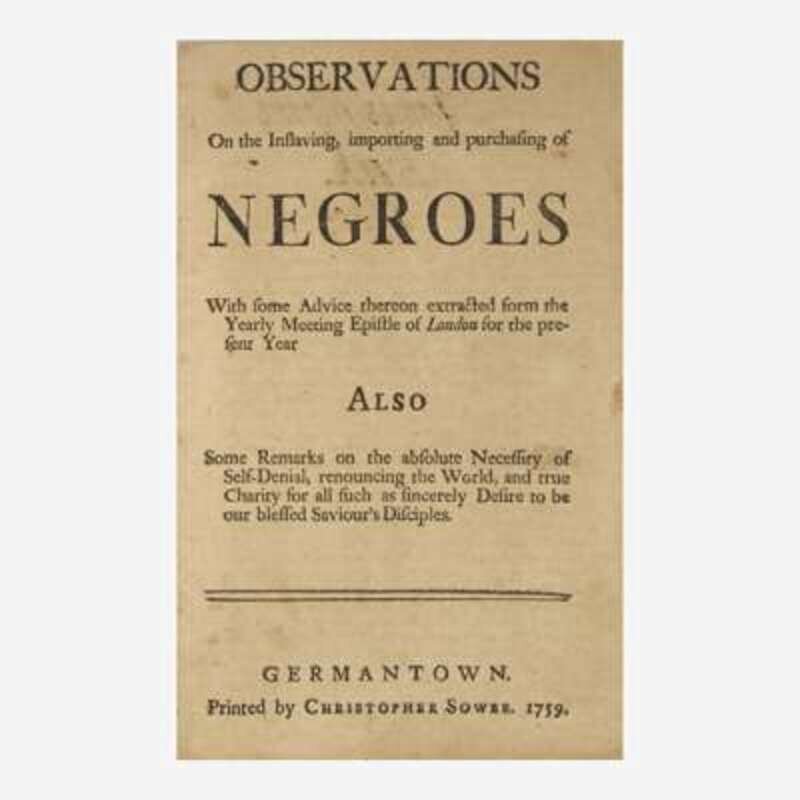
Observations on the Inslaving, importing and purchasing of Negroes...
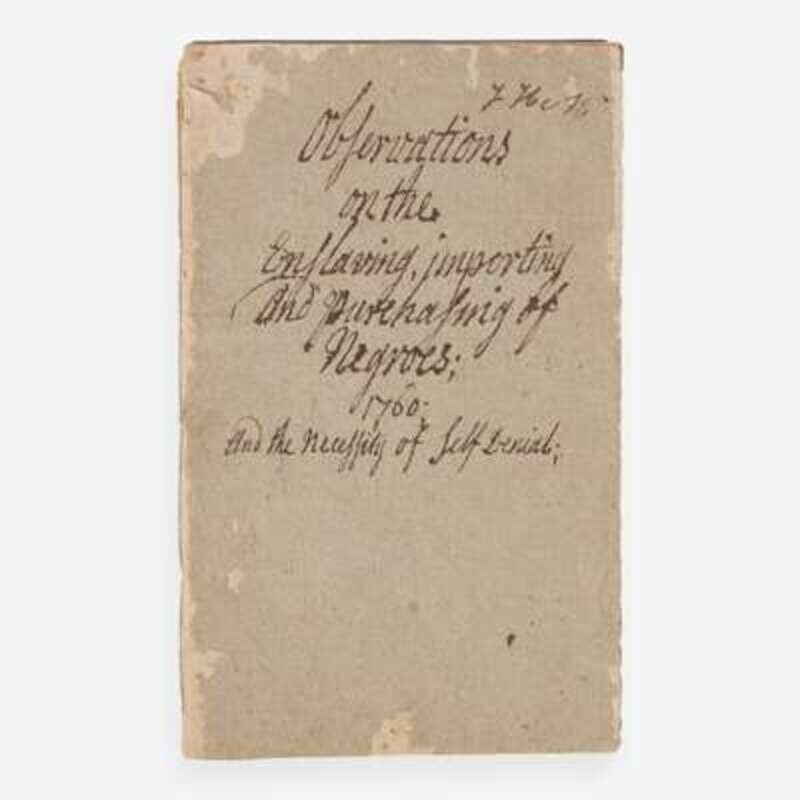
Germantown, (Pennsylvania): Printed by Christopher Sower, 1759. First edition. 8vo. (ii), 15 pp. From the library of James Moon, Bucks County Quaker abolitionist, and with his ownership signature (dated 1760) on inside front and rear wrapper and verso of title-page. Contemporary limp wrappers, title in manuscript on front wrapper (presumably by Moon), additional small old ownership initials on same ("JHM" possibly another Moon), rubbing and fraying to the edges of front wrapper, upper front and rear wrappers separating; all edges trimmed; 11 lines of text at the bottom of p. 7 neatly underlined in later red ink. Sabin 4676; Evans 8298; Smith, Friends’ Books I, p. 240; Hogg, African Slave Trade 1730; Library Company, Afro-Americana 1070. ESTC W1272 (locating only 11 institutions with copies)
Very rare first edition of this important anti-slavery tract, one of the earliest abolitionist texts printed in America. Benezet's first major work, he drew on stories of slave traders and other eyewitnesses to condemn the slave trade and slavery as unjust, unchristian, and inhumane. Offering his reflections and observations on the effects of slavery in the American colonies, Benezet denounces arguments supporting the trade as "all drawn from Avarice or ill founded, none will stand the Test of that divine Rule, To do unto all Men, as we would they should do unto us. Without Purchasers, there would be no Trade; and consequently every Purchaser as he encourages the Trade, becomes partaker in the Guilt of it". Directed to a general audience but especially Benezet's fellow Quakers--many of whom were slaveholders who had amassed great wealth from slave labor--this short pamphlet helped energize the abolitionist movement not only within Quaker ranks, but in North America and England in general.
James Moon (1713-1796) was the eldest son of Roger Moon (1679-1759) and Ann Nutt Moon, and grandson of English Quaker from Bristol, James Moon (1639-1713), who immigrated to Bucks County, Pennsylvania in 1682, purportedly alongside William Penn in the Welcome. A noted nurseryman, James lived on a farm in Middletown Township, now known as Woodbourne, for the majority of his life, but is known to have traveled extensively along the East Coast, keeping a highly detailed journal of his travels and Quaker associations. He married three times: first to Hannah Price (d. 1738) in 1737; Elizabeth Lucas (d. 1748); and to Ann Watson. He had five children in all, three of whom survived to adulthood.
Anthony Benezet (1713-1784) was a French-born Quaker who immigrated to America in 1731, and settled near Philadelphia. At the age of 18, he began preaching on the inconsistencies of practicing a Christian faith while simultaneously owning slaves. After failing as a merchant he became an educator, teaching at a number of different schools, and eventually held classes at night for African Americans, who were not permitted during the day. In 1755 Benezet established his own public school, solely for girls, the first of its kind in America. In 1775 he was a founder of the Society for the Relief of Free Negroes Unlawfully Held in Bondage, one of the world's first anti-slavery societies, later reconstituted by Benjamin Franklin after Benezet's death as the Pennsylvania Society for Promoting the Abolition of Slavery
Rare, this is only the second copy of the first edition we can locate at auction since 1929.