Condition Report
Contact Information
Lot 4
Lot Description
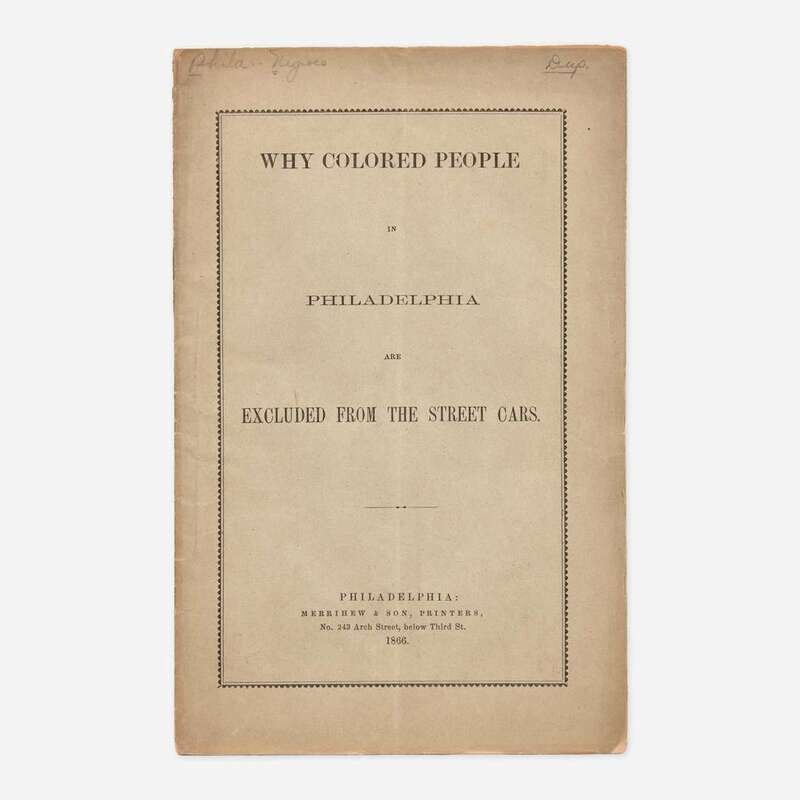
Rare Reconstruction-Era Pamphlet Published to Promote the Desegregation of Philadelphia's Street Cars
"The claim of the colored people to enter the cars, though a local question, is inseparable from the great policy of Equality before the Law, now offering itself to the national acceptance..."
Philadelphia: Merrihew & Son, 1866. Presumed first edition*. 8vo. 27 pp. Publisher's limp printed wrappers, original thread intact, rear wrapper starting, edges of same chipped, vertical crease from when sometime folded, old pencil notations at top of front wrapper: "Phila. Negroes Dup."; all edges trimmed. Blockson 4375; Library Company of Philadelphia, Afro-Americana 5506; Not in Sabin
A significant and rare Reconstruction-era pamphlet published to support the civil rights campaign to desegregate Philadelphia's street car system. By the mid-1860s, 19 private streetcar and suburban railroad companies operated in and around Philadelphia. Of those, 11 prohibited Black ridership outright, while the other eight relegated Black passengers to ride on the open wooden platforms at the front of the horse-drawn cars--no matter the weather conditions. In the early 1860s, as the Civil War raged and Black soldiers fought for the Union and for emancipation, a campaign began in Philadelphia to end this unjust treatment, spurred by abolitionists and civil rights activists like William Still, Robert Purvis, Octavius Catto, Caroline LeCount, and numerous others. Protests started with petitions, essays in newspapers, pamphlets such as this, then grew to public rallies and direct action like mass sit-ins on street cars. When petitions and negotiations between activists and the street car company and city officials failed to make progress, Catto and Still took the fight to the state legislature in Harrisburg. To further their cause for change, Catto helped recruit Radical Republican Congressmen William Darrah Kelley and Thaddeus Stevens to lean on the state legislature to take action. Under pressure from Kelley and Stevens, a bill, penned with the assistance of Catto, was presented to the state legislature on February 5, 1867, and on March 22, it was passed, ending street car segregation statewide.
Published anonymously, this pamphlet is sometimes attributed to Quaker abolitionist and executive committee member of the Pennsylvania Anti-Slavery Society (PASS) Benjamin C. Bacon, as well as to Philadelphia abolitionist Benjamin P. Hunt, but was likely the work of Congressman Kelley, who presumably wrote it while he lobbied for desegregation.
A stunningly well-preserved copy.
*Another version of this pamphlet was also published in 1866, with the imprint of Benjamin C. Bacon. The text, register, and wrappers differ slightly, but priority between the two has not been clearly established, and we have seen both versions declared the first edition. Contemporary ads suggest this Merrihew version was published in October-November, 1866. Merrihew & Son were a leading printer for Pennsylvania Quaker and abolitionist groups during the 1860s, printing numerous abolitionist pamphlets and newspapers, including the Pennsylvania Freemen, and works by Still and the Female Anti-Slavery Society. The imprint of Bacon's version has the address No. 107 N. 5th Street, former headquarters of PASS, and during 1866 the site of Still's stove store and repair shop.