Condition Report
Contact Information
Lot 29
Lot Description
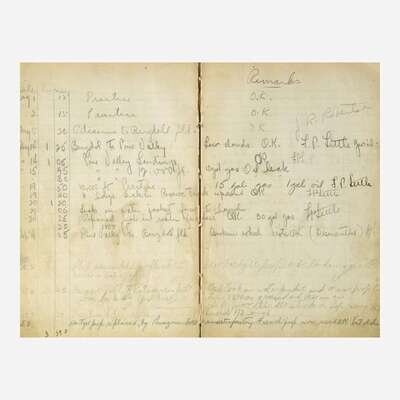
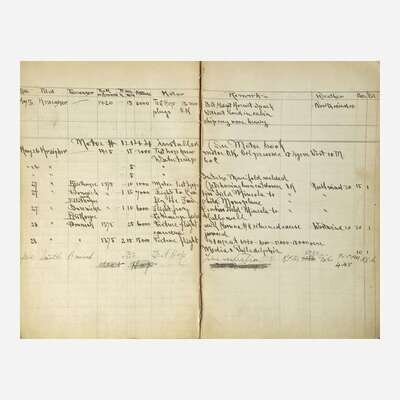
Flight Log From a Pioneering Aerial Photography Firm
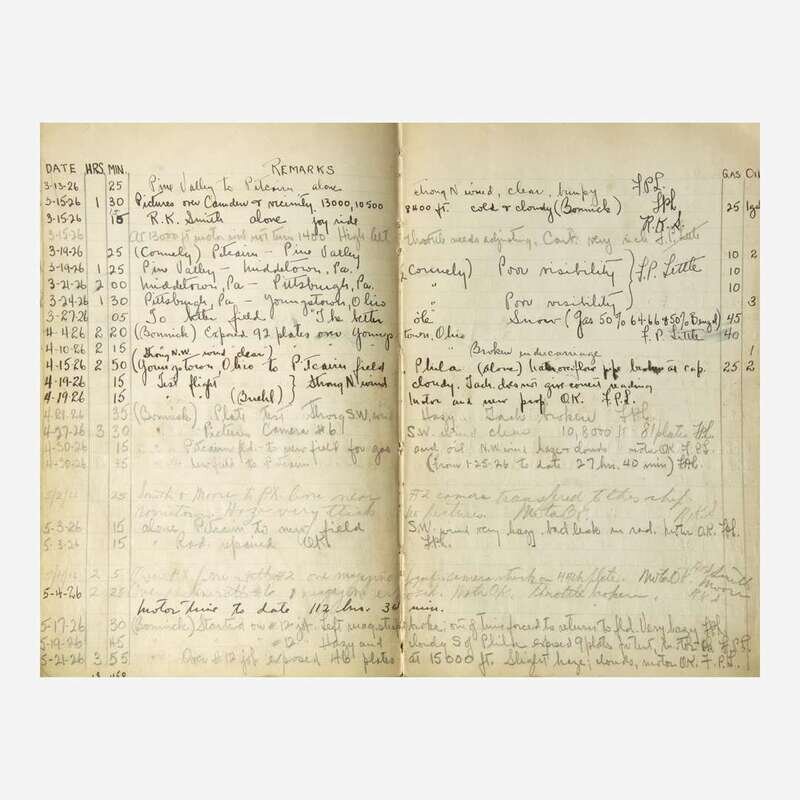
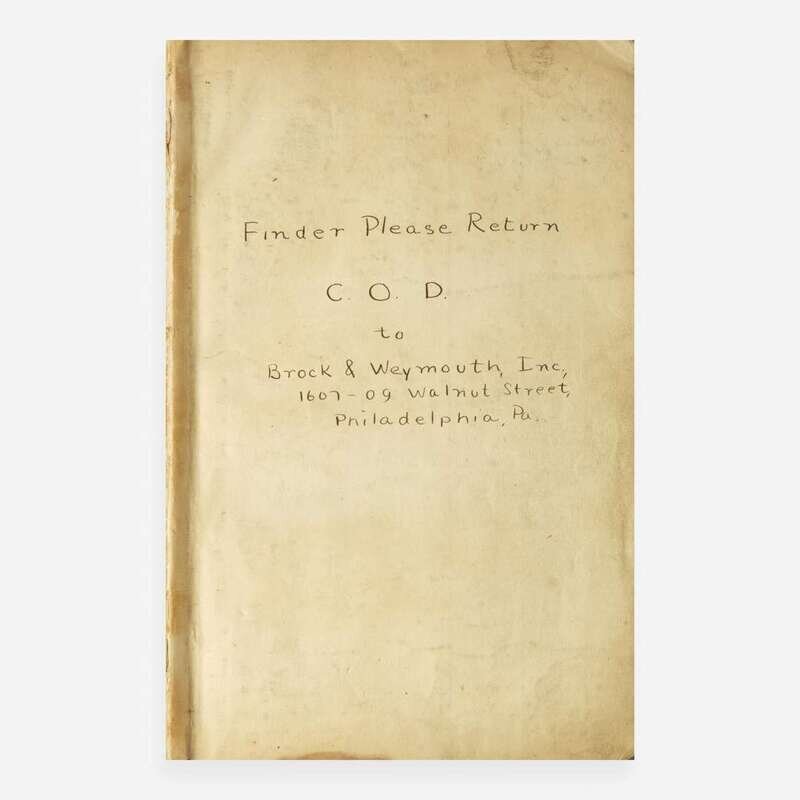
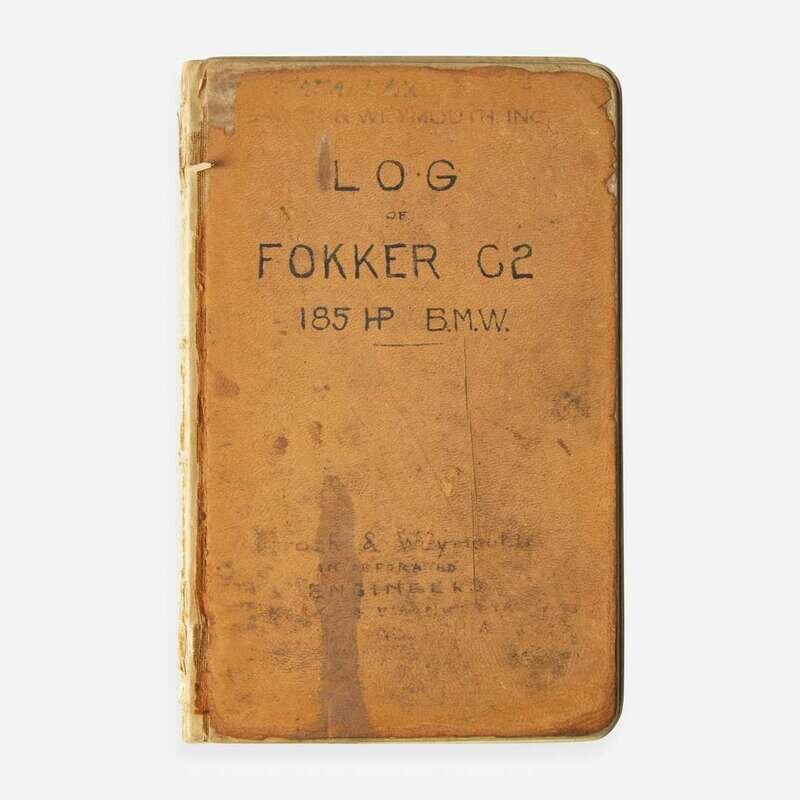
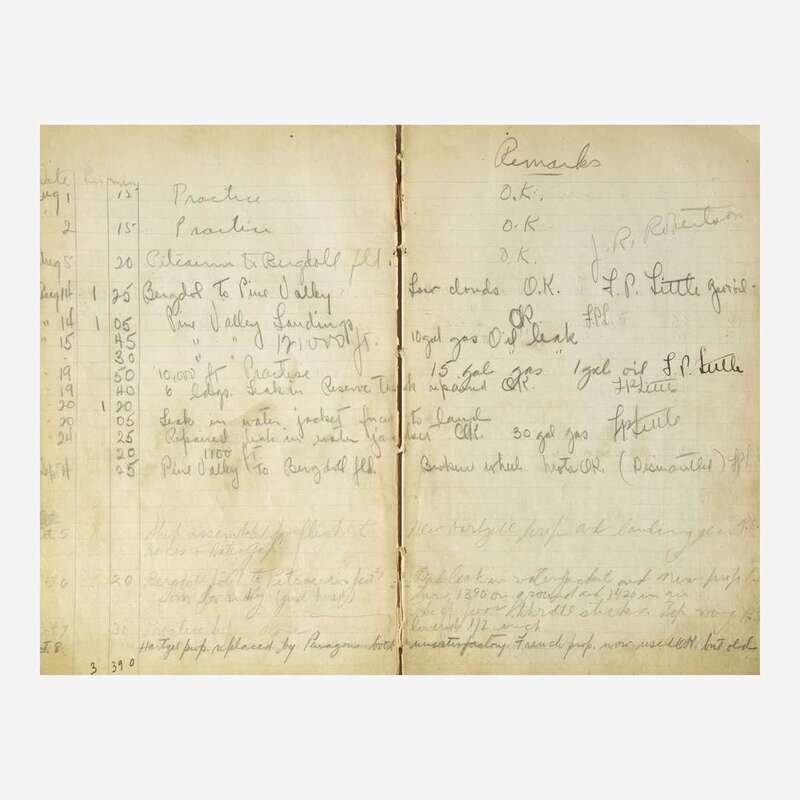
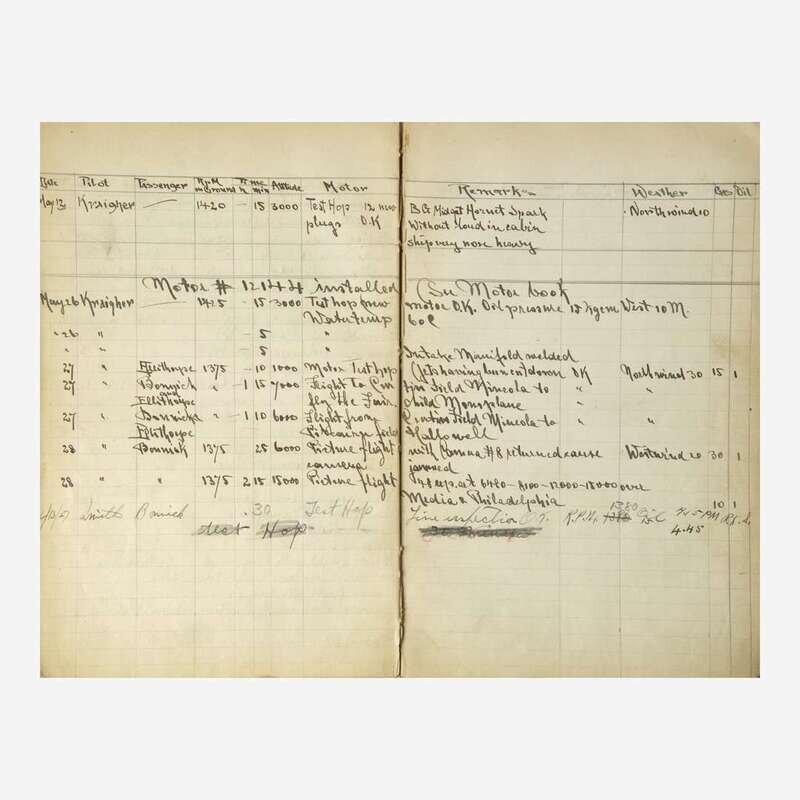
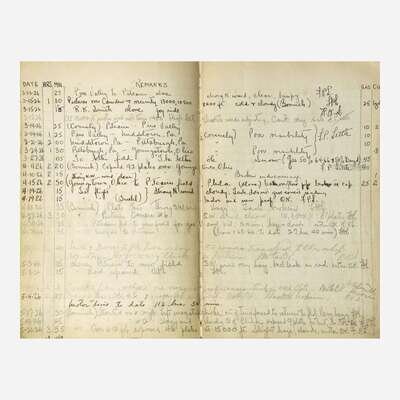
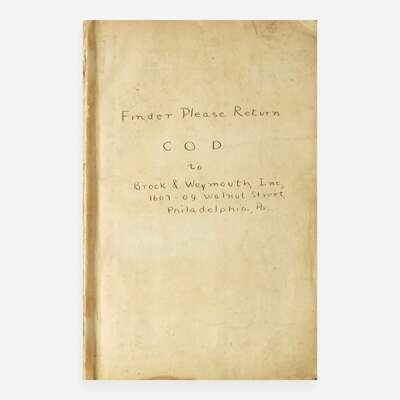
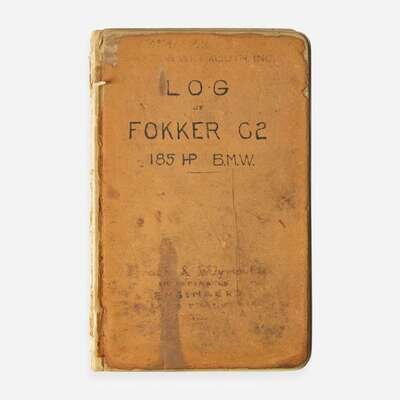
Locations vary, ca. November, 1923-August, 1927. 8vo. Manuscript flight log from the Philadelphia-based engineering company Brock & Weymouth, Inc.'s Fokker C2 aerial surveying aircraft. Executed in the hand of multiple pilots on 43, largely consecutive, pages; many pages hand-ruled in ink or pencil in four to eight columns, listing the details of approximately 275 flights, including the date, length in hours and minutes, altitude, flight routes (Philadelphia, Bryn Athyn, West Virginia, Boston, New York, etc.), quantities of gas and oil, and remarks regarding weather conditions, aerial photography, and mechanical issues; some pages signed with pilot's name and/or initials, as well as accompanying passenger. Original full tan reverse calf-covered boards, manuscript on front board "Log of Fokker C2 185 HP B.M.W. Brock and Weymouth Engineers", faded Brock and Weymouth ink stamp at top of same, front and rear boards detached, spine perished, binding splitting, but holding; scattered minor soiling and smudging to text. From the library of aerial photography pioneer Virgil Kaufmann.
A fascinating and unique 1920s flight log from a pioneering aerial photography and surveying firm. Brock & Weymouth, Inc. were a Philadelphia-based engineering company active in the development of aerial mapping, surveying, and photography, and held patents on a process and equipment that produced highly accurate survey maps. They "made considerable progress in the 1920s toward understanding how to make precision maps from aerial photographs," and "had developed instruments with which high-resolution vertical aerial photographs could be translated--by a method involving steroptics--into contour maps of great detail and accuracy. Differences in elevation as small as half a meter could be plotted with the aid of some ground control." (The Mapmakers, John Noble Wilford, p. 273). This log covers over 200 flights made by the company's Fokker C2, a small lightweight two-seated Dutch-designed biplane, developed after the Fokker C1 reconnaissance aircraft. The log records numerous notes made by Brock & Weymouth pilots while testing photographic equipment onboard, while also evaluating mechanical issues of the plane and weather conditions. Although ahead of their time for their quality of the work, the Great Depression forced Brock & Weymouth to close. Their equipment, including their aerial cameras and contour mapping devices--and this log book--was bought by Virgil Kauffman (1898-1925), president of Aero Service Corporation--Brock & Weymouth's chief competitor.
Virgil Kauffman (1896-1985) was a pioneering figure in the development of aerial photography. During World War I he was a unit photographer in the U.S. Army and was assigned to the Air Service for aerial reconnaissance. In 1924 he joined the Philadelphia-based Aero Service Corporation--then a nearly bankrupt air taxi service--and turned it into a leader in the burgeoning field of aerial mapping and surveying. He became President of the company in 1927, and led several important projects with the Tennessee Valley Authority and the U.S. Geological Survey, including producing the first photostats of an entire U.S. state (New Jersey). During World War II he did mapping work for the European and Pacific theaters, and developed three-dimensional relief maps which were used to train bomber crews. Following the war he was a leader in further developing the field of photogrammetry--the translation of high resolution photographs into contour maps--and made the first commercial surveys with the airborne magnetometer, which made possible subterranean mapping in the search for mineral ores and oil. Kauffman was also the past president of the Explorers Club and of the American Society of Photogrammetry.