Condition Report
Contact Information
Lot 2
Lot Description
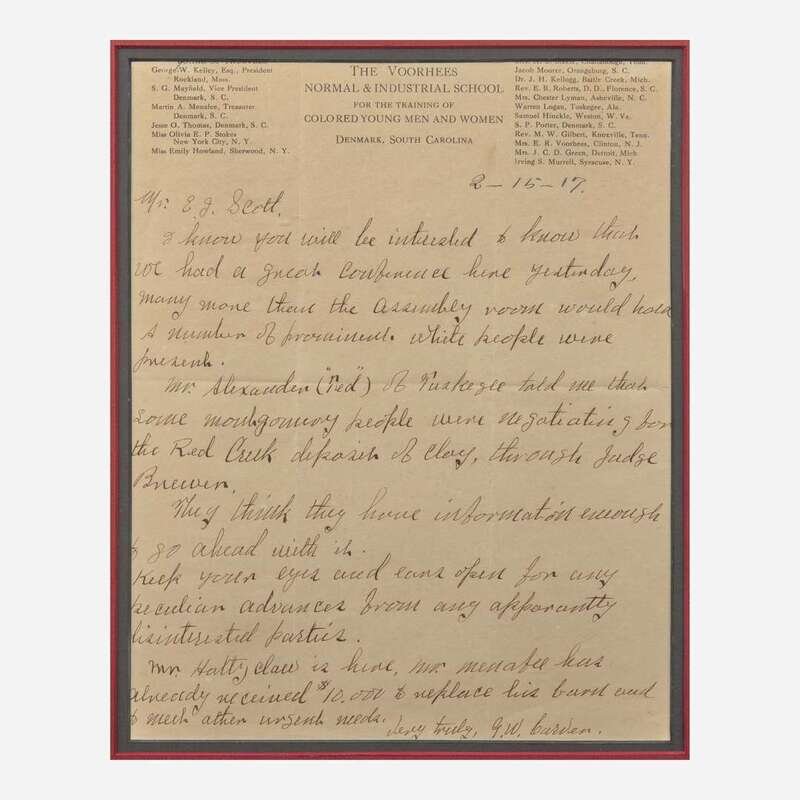
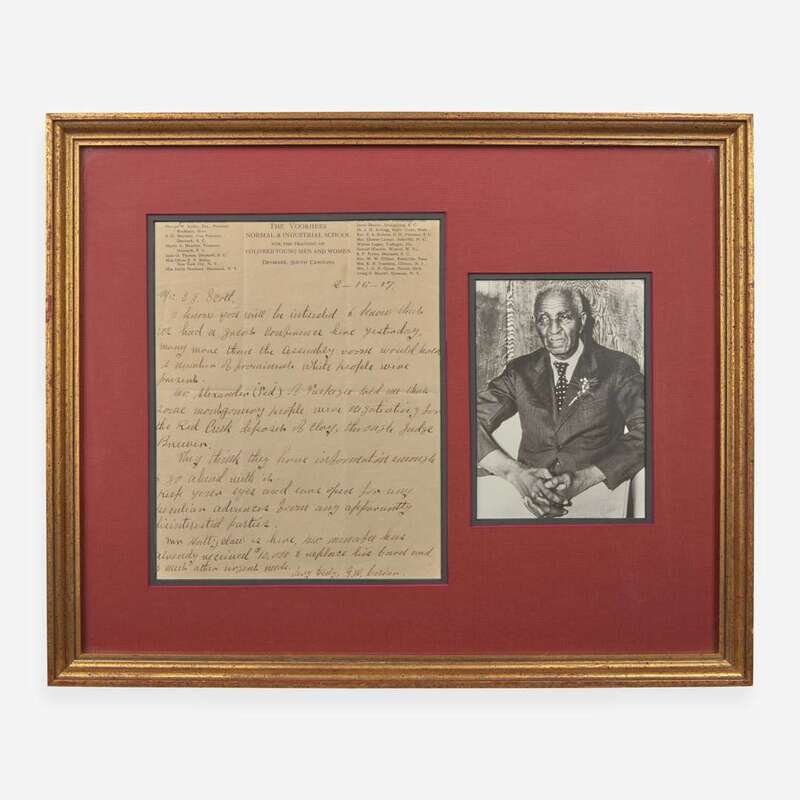
Denmark, South Carolina, February 15, 1917. One sheet, 10 1/2 x 8 1/2 in. (267 x 216 mm). One-page autograph letter, signed by George Washington Carver to his colleague at the Tuskegee Institute, the journalist and editor Mr. E(mmett).J(ay). Scott: "I know you will be interested to know that we had a great conference here yesterday, many more than the assembly room would hold. A number of prominent white people were present. Mr. Alexander ("red") of Tuskegee told me that some Montgomery people were negotiating for the Red Creek deposit of clay, through Judge Brewer. They think they have information enough to go ahead with it. Keep your eyes and ears open for any peculiar advances from any apparently disinterested parties. Mr. Halty('s) class is here, Mr. Menafee has already received $10,000 to replace his barn and to meet other urgent needs. Very truly, G.W. Carver"; on The Voorhees Normal & Industrial School For The Training of Colored Young Men and Women stationery; creasing from contemporary folds. In mat with portrait of Carver, and in frame, 16 1/8 x 19 7/8 in. (410 x 505 mm).
George Washington Carver (1864-1943) writes to his friend and colleague at the Tuskegee Institute, Emmett Jay Scott (1873-1957), regarding an agriculture conference held at the Voorhees Normal & Industrial School in Denmark, South Carolina. Scott served as Secretary at the Tuskegee Institute (now Tuskegee University) where he was known as the “Architect of the Tuskegee Machine”, for his dogged fundraising and dedicated management of the school. He, along with Carver, were Booker T. Washington's closest advisors, before the latter's death in 1915. Carver taught at Tuskegee for 47 years as the head of the Agriculture Department, developing it into a prominent research center that trained hundreds of Black farmers, where he emphasized farming independence, self-sufficiency, and sustainable farming practices. This letter was written at the beginning of Carver's rise to national acclaim, and in the midst of his research into methods of soil replenishment and crop rotation that would prove invaluable for impoverished farmers across the nation. His advocacy of the planting of peanuts, soybeans, and other crops, as well as his practical on-the-ground training, would make him one of the most famous scientists of his day and a household name.
The Voorhees Normal & Industrial School (now Voorhees College) was founded in 1897 by Elizabeth Evelyn Wright (1872-1906) as the Denmark Industrial School for African Americans. Wright, a native of Georgia, attended Tuskegee, and modeled Voorhees after the institution. In 1902 a donation from New Jersey philanthropist Ralph Voorhees was used to buy land and construct buildings for the institution, and its name was changed to Voorhees Industrial School. Its name was changed again, one year before this letter, in 1916, to The Voorhees Normal & Industrial School. In the 1920s it became affiliated with the Episcopal Church.