Condition Report
Contact Information
Lot 137
Lot Description
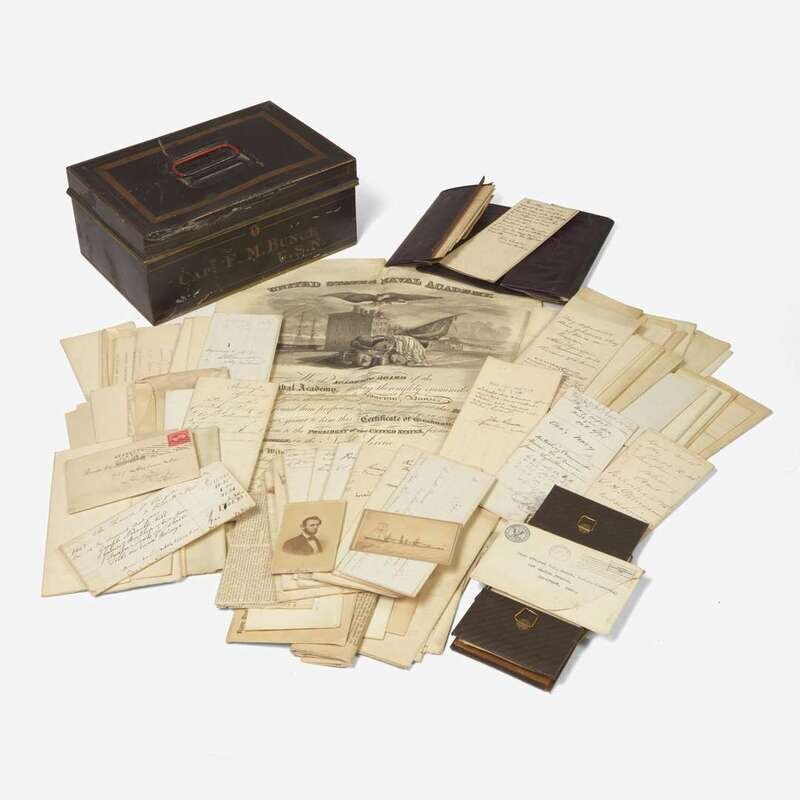
The Personal Papers of Rear Admiral Francis M. Bunce: A Record of His Distinguished Ascent Through the United States Navy
Places vary, ca. 1857-1906. Archive of 90 printed and/or manuscript documents related to the long Naval career of Rear Admiral Francis M. Bunce. Beginning with his 1857 certificate of graduation from the United States Naval Academy, and continuing with over 40 naval department orders, pieces of personal correspondence, promotion and transfer notices, receipts, and other ephemera; with Bunce's leather folding pocketbook and document holder, all together in his metal document case, painted in black and in gold, and with his name and rank painted on front panel, "Capt. F.M. Bunce U.S.N." Size varies, condition generally well preserved unless otherwise noted. Full list of documents available upon request.
Signatures include: Future Supreme Court Justice Oliver Wendell Holmes, Jr. (1841-1935), Secretaries of the Navy Gideon Welles (1802-1878), George M. Robeson (1829-1897), William E. Chandler (1835-1917), William Whitney (1841-1904), Benjamin F. Tracy (1830-1915), Hilary A. Hilbert (1834-1919), and John D. Long (1834-1915); Rear Admirals John Rogers (1812-1882), John A. Dahlgren (1809-1870), George Balch (1821-1908), Daniel Ammen (1820-1898), Thornton Jenkins (1811-1893), Louis M. Goldsborough (1805-1877), Silas Stringham (1798-1876), Thomas H. Patterson (1820-1889), Thomas H. Stevens, Jr. (1819-1896), Lewis T. Kimberly (1830-1892), Kidder R. Breese (1831-1881), Ralph Chandler (1829-1889), Arent S. Crowninshield (1843-1908), James R. Soley (1850-1911); U.S. Naval Academy professors Henry H. Lockwood (1814-1899), William Chauvenet (1820-1870), Arsene Napoleon Girault (1801-1874), and more. Over 50 examples of Francis M. Bunce.
Francis Bunce (1836-1901) was appointed to the United States Naval Academy in 1852 as an acting midshipman. A graduate of one of the Academy's earliest classes, in 1857, he was commissioned a Midshipman (see lot 128) and was assigned to the USS Germantown of the East India Squadron, and served for three years before being assigned to the USS Brooklyn. He was promoted to Lieutenant on April 12, 1861 (see lot 131), one day prior to the attack on Fort Sumter, and the official start of the American Civil War. In 1862 he was sent to serve on the USS Macedonian, and helped enforce the Union naval blockade on the Confederate States. He then became an executive officer on the gunboat USS Penobscot and was involved with the blockade of Wilmington. In the fall of 1862, while aboard the Penobscot, he captured the Confederate blockade runner Robert Bruce, and commanded her as prize master on her voyage to New York City. Following this successful rout, he was appointed executive officer of the sloop-of-war USS Pawnee, and helped enforce a blockade off Stono River, South Carolina. He was then appointed to the USS Patapsco and participated in the siege of Charleston in 1863, and the September 8-9 attack on Fort Sumter, where he again received an honorable mention in the commander's report. In November 1863, Bunce was injured aboard the Patapsco while engaging with Confederate forces and was dispatched to the USS Wabash to convalesce. In 1864 he was assigned to the staff of Rear Admiral John A. Dahlgren--who was commanding the South Atlantic Blockading Squadron--and took command of the monitor USS Lehigh. Bunce's final act of service during the Civil War was aboard the monitor USS Dictator under the command of Commodore John Rodgers, that patrolled the east coast of the United States from December, 1864, until the end of the war.
In 1865, Bunce took command of the monitor USS Monadnock, and led her on her voyage from Philadelphia to San Francisco around the tip of Cape Horn. It was the first-ever extended voyage made by a monitor, and it earned Bunce accolades from the Navy Department and Secretary of the Navy Gideon Welles. From 1866-69, Bunce served in the Boston Navy Yard, and in November, 1869, he took command of the newly commissioned North Atlantic Squadron screw steamer USS Nantasket, stationed in Santo Domingo (now Dominican Republic). In 1870 he was transferred to Pittsburgh for special ordnance duty, when he received a promotion to Commander (see lot 133). In 1873 he took command of the gunboat USS Ashuelot in the Asiatic Squadron, and then served in the Washington, D.C. Navy Yard in June, 1875, before being dispatched to lighthouse duty from July-October of that year. In 1877 he returned to the D.C. Navy Yard and shortly after was appointed to serve at the Torpedo School in Newport, Rhode Island, from January, 1879 to July, 1881. At the end of this service he finally returned to the sea as a commanding officer on the sloop-of-war USS Marion, and then as commander of the USS Wabash, from 1882-85. Bunce received a promotion to Captain while aboard the USS Wabash (see lot 134), which was then a receiving ship in the Boston Navy Yard. In June, 1886, he was made first commanding officer of the new protected cruiser USS Atlanta, a position he held until December, 1889, when he was appointed commanding officer at the naval station in New London, Connecticut. Following this he served at the training station in Newport, Rhode Island, and commanded the training ship there, the sloop-of-war, USS Richmond. In August, 1894, he was appointed a member of the Navy's Board of Inspection and Survey, and assessed the condition of the Navy's fleet. On March 1, 1895 he was promoted to the rank of Commodore (see lot 135).
At the end of June, 1895, Bunce relieved Rear Admiral Richard W. Meade III to become commander-in-chief of the North Atlantic Squadron. He commanded the Squadron until 1897, and his leadership during this period was critical in modernizing the fleet's tactical and operational abilities, transforming it into a cohesive and combat-ready unit. After taking charge of the Squadron, Bunce continued and built upon Meade's novel strategy of training the fleet as a single integrated unit, rather than overseeing individual ships with separate missions. Bunce's intense tactical and blockade training enhanced the fleet's cooperational abilities, features that would prove crucial to the Navy's defeat of the Spanish Navy during the Spanish-American War. On February 19, 1898, Bunce was promoted to the highest rank achieved during his long and storied 40-plus year career in the Navy, Rear Admiral (see lot 136). He was appointed by the Senate to this role only a few days before the fateful sinking of the battleship USS Maine in Havana, Cuba, whose demise contributed to the outbreak of the Spanish-American War, that April. The fate of the Maine was connected to an order made by Bunce while he was Commander of the New York Navy Yard, when on December 8, 1897, he ordered the ship to Key West, Florida to rendezvous with the rest of the North Atlantic Squadron. In January, 1898, the Maine was sent to Havana to assist in the protection of U.S. interests during the Cuban War of Independence, where on November 15 an explosion occurred on board, sinking the vessel. Bunce remained commander of the New York Navy Yard until December, 1898, when he retired. He died on October 19, 1901 in Hartford, Connecticut, and is buried there, in Cedar Hill Cemetery.
By descent in the Bunce family, and never before offered for sale.