Condition Report
Contact Information
Lot 131
Lot Description
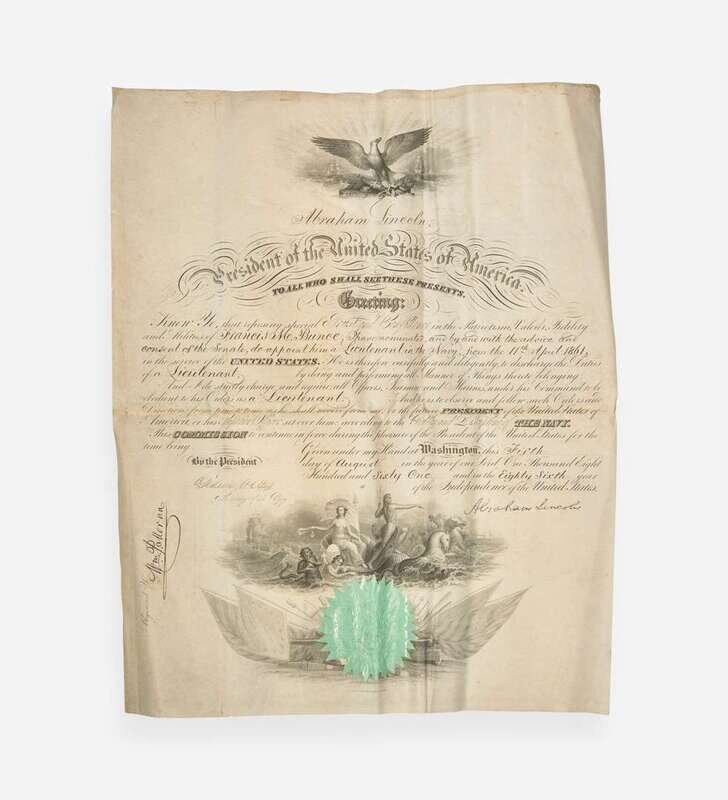
Washington, (D.C.), August 5, 1861. Partially-printed military commission on vellum, signed by Abraham Lincoln as President of the United States, appointing Francis M. Bunce a "Lieutenant in the Navy, from the 11th April 1861, in the service of the United States."; counter-signed by Secretary of the Navy Gideon Welles; manuscript in bottom left registering the document. Green paper seal at bottom; creasing from contemporary folds; scattered spotting along edges.
A fine military commission signed by Abraham Lincoln early during his first year as President and at the beginning of the Civil War, promoting Master Francis M. Bunce to Lieutenant in the United States Navy.
Bunce was appointed by the Senate to the rank of Lieutenant on April 11, 1861--the day before the Civil War broke out at Fort Sumter. Bunce would go on to serve with distinction during the conflict, performing in many roles crucial to the Union's success. In 1862 he was sent to serve on the USS Macedonian, and helped enforce the Union naval blockade of the Confederate States. After this he became an executive officer on the gunboat USS Penobscot and was involved with the blockade of Wilmington, North Carolina, where he engaged Confederates at Fort Fisher and Fort Caswell. In the fall of 1862, while aboard the Penobscot, he captured the Confederate blockade runner Robert Bruce, and commanded her as prize master on her voyage to New York City. Following this successful rout, he was appointed executive officer of the sloop-of-war USS Pawnee, and helped enforce a blockade off Stono River, South Carolina.
Bunce served with distinction during his 40-plus year career in the United States Navy, attaining the rank of Rear Admiral, in 1898. A graduate of one of the earliest classes of the United States Naval Academy in 1857, he gained attention for his service during the Civil War where he served in various roles and assisted in the Union Army's naval blockade of the Confederate States. Immediately after the war, he commanded the USS Monadnock around the treacherous Cape Horn on a voyage to California, the first long distance deployment of an ironclad monitor. Also, he at various points took command of the Boston, Washington, D.C., and New York Navy Yards, as well as commanded several gunboats, cruisers, and sloops-of-war. His leadership as commander-in-chief of the North Atlantic Squadron from 1895-97 saw the fleet modernized into an effective combat unit that would successfully defeat the Spanish Navy during the Spanish-American War in 1898. As Commodore and Commandant of the Navy Yard in New York, he released the famous USS Maine on its voyage to Havana. He died in Hartford, Connecticut, in 1901 and is buried there, in Cedar Hill, Cemetery.
By descent in the Bunce family, and never before offered for sale.