Condition Report
Contact Information
Lot 125
Lot Description
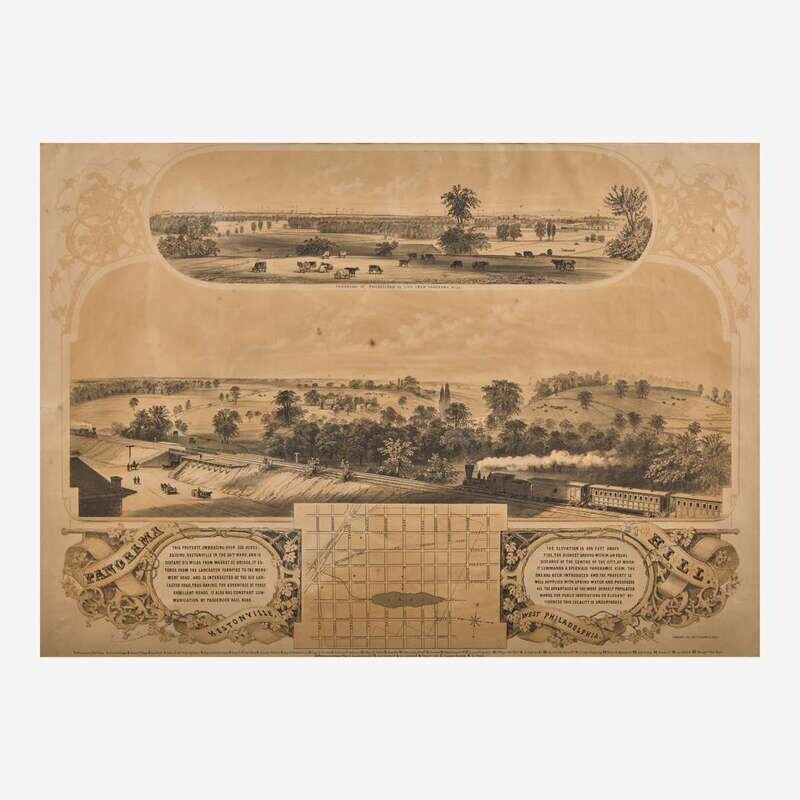
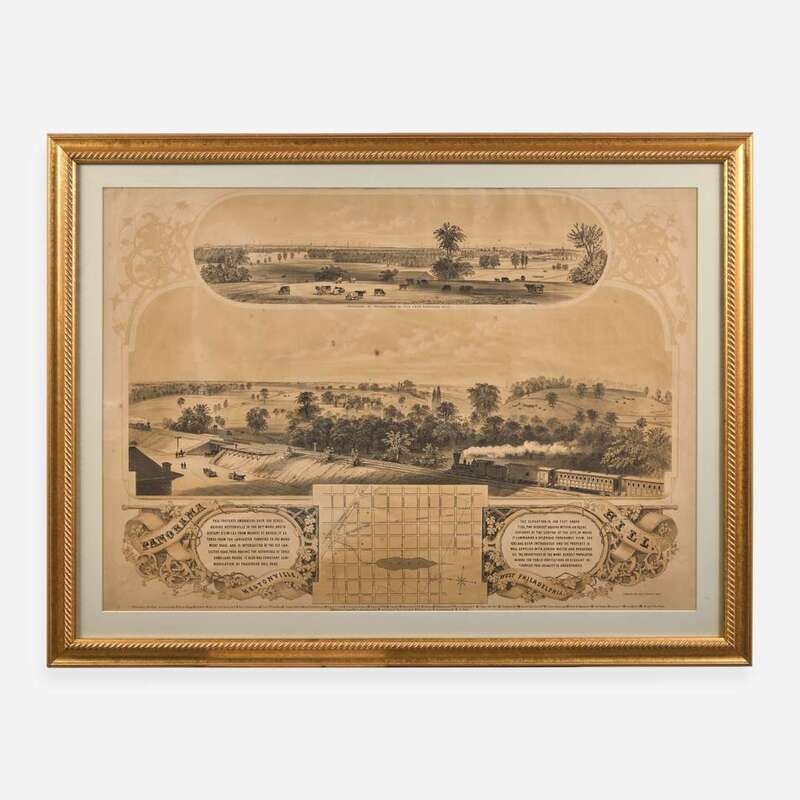
Phil(adelphi)a: F(erdinand). Moras, ca. 1860-66. Tinted lithographic print; 24 1/2 x 33 3/4 in. (622 x 857 mm). Toned; vertical crease traversing left side; scattered spotting on recto; repair on verso, center left; repairs along left edge verso; top left corner repaired, small chips in other corners. Not in Wainwright
A rare mid-19th century lithographic view of Philadelphia, looking southeast from the Hestonville neighborhood in West Philadelphia. Thirty-two landmarks are referenced at the bottom of the image with their locations pinpointed across the panorama, including Girard College, Eastern State Penitentiary, the Pennsylvania State House, as well as numerous churches such as Christ Church, St. Peter's, St. Mary's, and others. The large central view depicts the Pennsylvania Railroad crossing over Old Lancaster Road, while the background recedes into rolling hills and pasture, showing the residences of David George, Jesse George, and Edmund George. The smaller upper view shows the Philadelphia skyline from Panorama Hill, with cows grazing in the foreground, and the steeples of various landmarks in the background. An inset view shows the plan of the neighborhood, running from 56th to 49th Streets from York to Haddington Avenues.
Named after Pennsylvania politician, soldier, and large West Philadelphia landowner Edward W. Heston (1745-1842), Hestonville took shape in the early 19th century, developing as a small farming community around the intersections of Old Lancaster Road (now 54th Street), present-day 52nd Street, and Lancaster Pike. By the middle of the 19th century, as is evidenced in this print, the area was largely grazing farmland with a few scattered residences. With the rise of the trolley car and passenger railroad systems in the latter half of the 19th century, the community quickly developed commercially and residentially. It is presumed that this print was produced for commercial purposes to spur development following the city's consolidation in 1854.
Ferdinand Moras (1821-1908) was a noted and very successful commercial lithographer in Philadelphia in the second half the 19th century. Born in Germany, he apprenticed under Peter Wilhem Kreeft in Elberfeld and subsequently practiced in Belgium, France, and London. He moved to Philadelphia in 1854 and, according to Philadelphia city directories, he operated a print shop at 109 South 4th Street (address in this print) from 1860-66.
Rare. We can locate only one other copy of this print, held at the Library Company of Philadelphia.