Condition Report
Contact Information
Lot 35
Lot Description
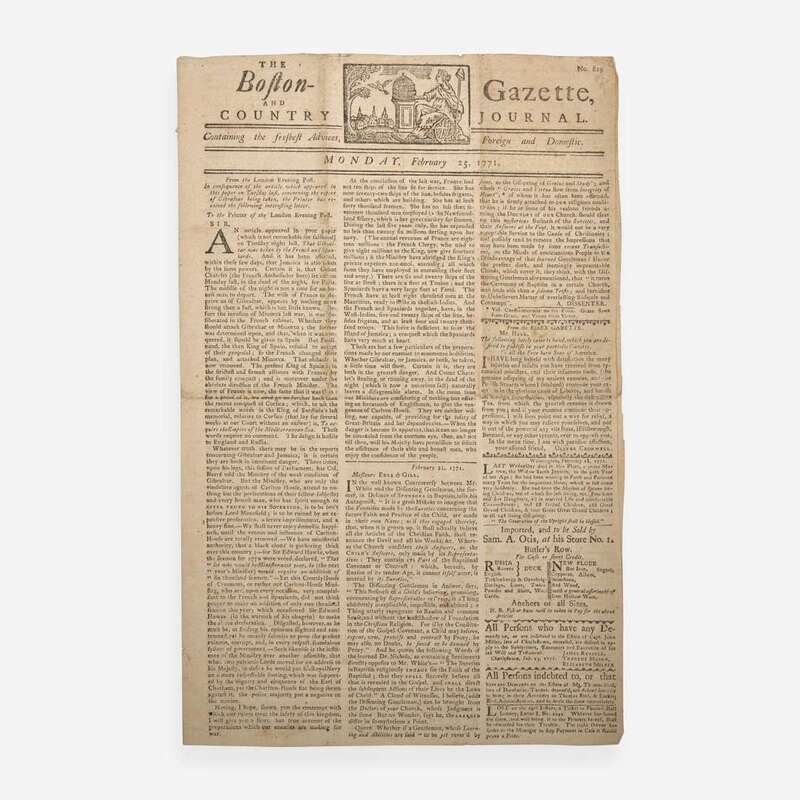
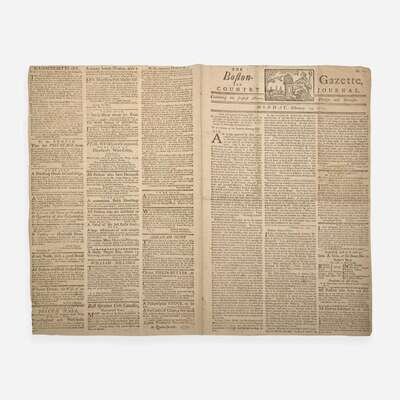
Boston's Most Radical Revolutionary War-Era Newspaper with a Paul Revere-Designed Masthead
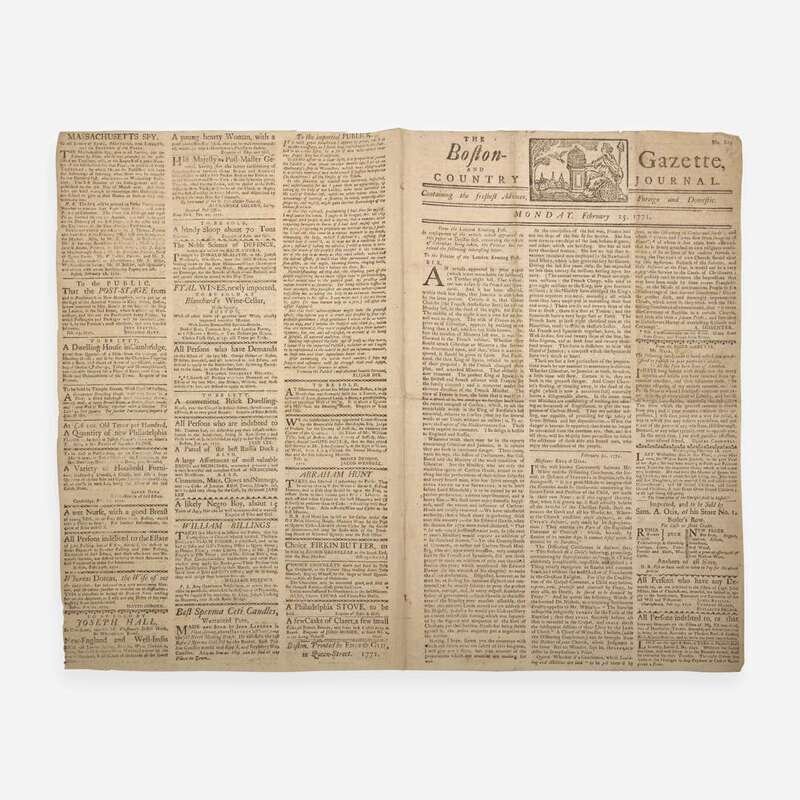
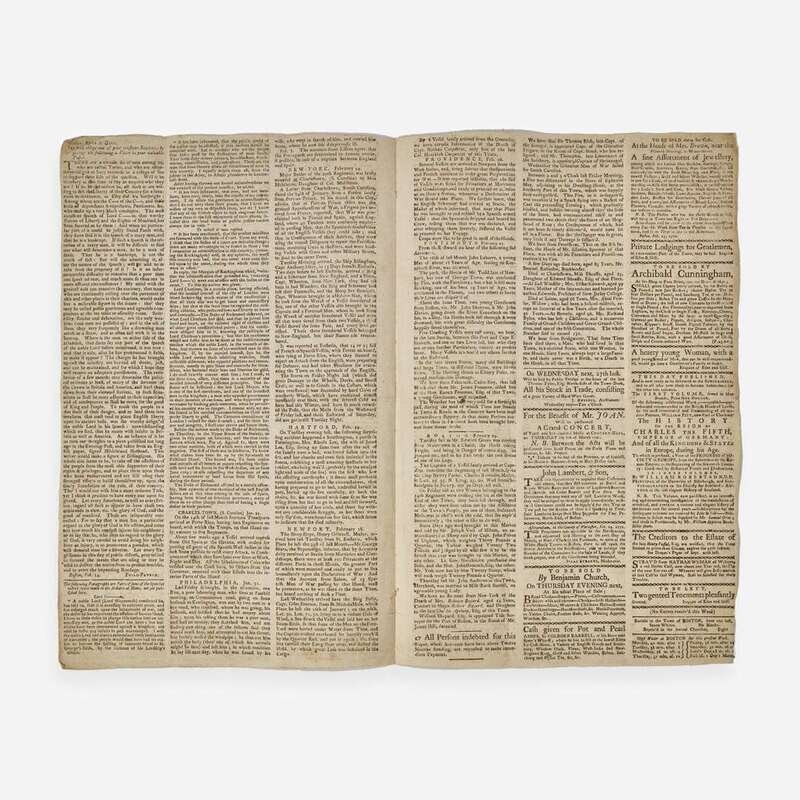
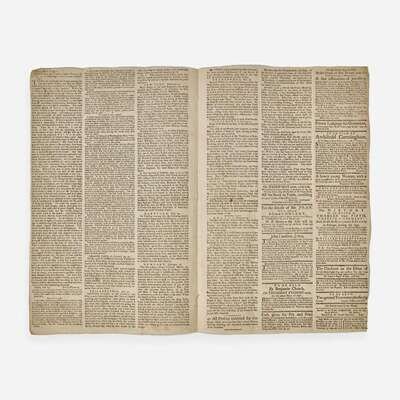
Boston: Printed by Edes & Gill, Monday, February 25, 1771. No. 829. Bifolium sheet, 14 5/8 x 9 1/4 in. (371 x 235 mm). Printed newspaper in three columns, with Paul Revere's masthead design showing a seated figure at right, with liberty cap, bird cage in center, and view of a town at left. Creasing from contemporary folds, some scattered small separations to same; edges unevenly trimmed, touching some letters at bottom corner, pp. (3/4). Brigham, p. 134
Printed on the second page is an article signed "Philo-Patriae", a pseudonym used by Boston patriot Samuel Adams: "There are a certain set of men among us, who are called Tories, and who are often times obliged to have recourse to a refuge of lies to support their side of the question. Will it be necessary at this time of day to enquire who they are? If so, let the answer be, all such as are willing to sell the Liberty of their Country for a luxurious maintenance..." The author is likely responding to a speech made in the House of Lords by William Pitt, Lord Chatham, regarding Spain as well as British relations with her North American colonies. Printed beneath the editorial is an excerpt from a speech by Lord Chatham regarding Spain, likely related to the diplomatic crisis over the Falkland Islands.
In the years leading up to the American Revolution, Benjamin Edes and John Gill's The Boston Gazette became Boston's most radical newspaper and a leading voice of anti-British sentiment, printing editorials from revolutionary leaders like Samuel Adams and John Hancock. Paul Revere's masthead featured in this issue was first used on the January 1, 1770 paper. In his History of Printing in America, Isaiah Thomas describes the symbolism of the engraving as such, "The figure of Brittania was exchanged for that of Minerva, seated; before her was a pedestal on which was placed a cage; Minerva with a left hand supported a spear, on which she placed the cap of Liberty, and with her right opened the door of the cage, and liberated a bird which appeared in the act of flying towards a tree that stood at a distance from a city." (The History of Printing in America, 1874, Vol. 2, p. 55).