Condition Report
Contact Information
Lot 159
Lot Description
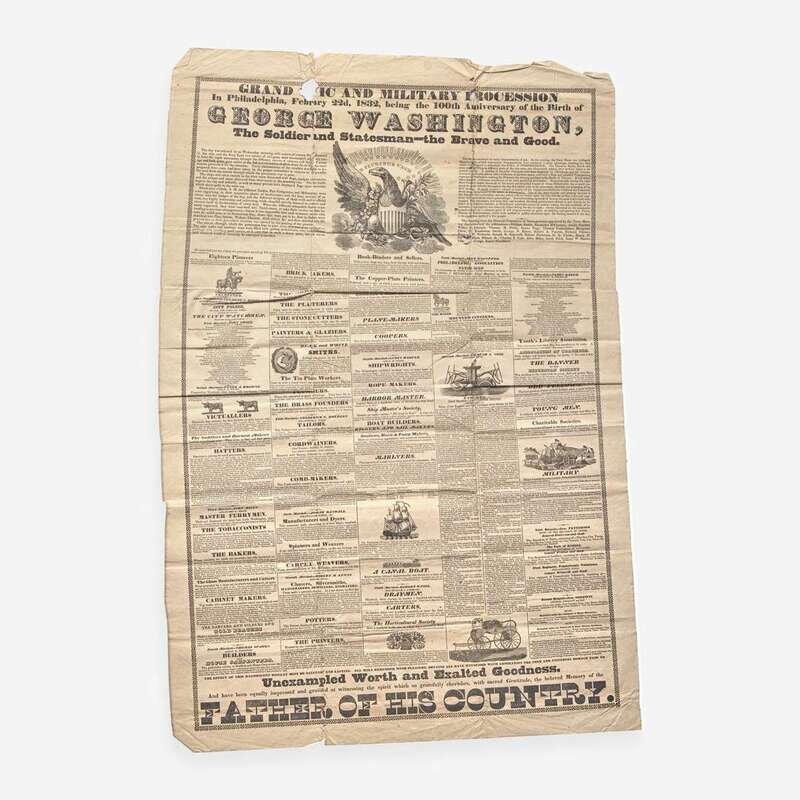
Philadelphia, 1832. Large broadside, 36 1/4 x 24 1/4 in. (921 x 615 mm). Text in five columns with typographic border, woodcuts interspersed representing the various civic and trade groups, and a large wood engraved Seal of the United States at top. Creasing from contemporary folds; scattered creasing and closed tears along edges; a few open tears along vertical folds at top, affecting some small portions of text; hole in top left corner, affecting the word "Civic", and hole in top right affecting the word "Procession". Sabin 101821
A very rare and unsophisticated broadside outlining the massive parade and related festivities held in Philadelphia on February 22, 1832 in celebration of the centennial of George Washington's birth. With an estimated 5,000 participants and over 100,000 spectators, this event was one of Philadelphia's largest public celebrations in the 19th century. The parade brought together a diverse range of about 122 of Philadelphia's various merchant and trade groups, benevolent and scientific societies, civic associations, and military brigades. The line was led by eighteen Pioneers--a body of men armed with axes--and was followed by Chief Marshal Colonel Clement Biddle and Mayor Benjamin W. Richards. They were followed by groups and officials representing the area's various counties; Irish, French, and German immigrant societies; neighborhood fire companies; groups representing Jefferson Medical College, the University of Pennsylvania, the Franklin Institute, and the Academy of Natural Sciences; trade groups representing victuallers, ferrymen, bakers, potters, printers--led by Matthew Carey--booksellers and bookbinders, silversmiths, coopers, shipbuilders, and more; library and teacher associations; and the Horticultural and Hunting Park Associations. The line began at Third and South Streets, and proceeded through downtown Philadelphia before ending at Independence Hall where Philadelphia lawyer William Rawle read Washington's Farewell Address.
Very rare. We can locate only two copies ever offered at auction, here at Freeman's in 2006, and at Bang's Auction in New York in 1896, then catalogued as "very rare." OCLC locates only two institutions with copies: two in the American Antiquarian Society and one at the Huntington Library.