Condition Report
Contact Information
Lot 154
Lot Description
Autograph Album of the 30th United States Congress With Five United States Presidents, Including Then-Congressman Abraham Lincoln
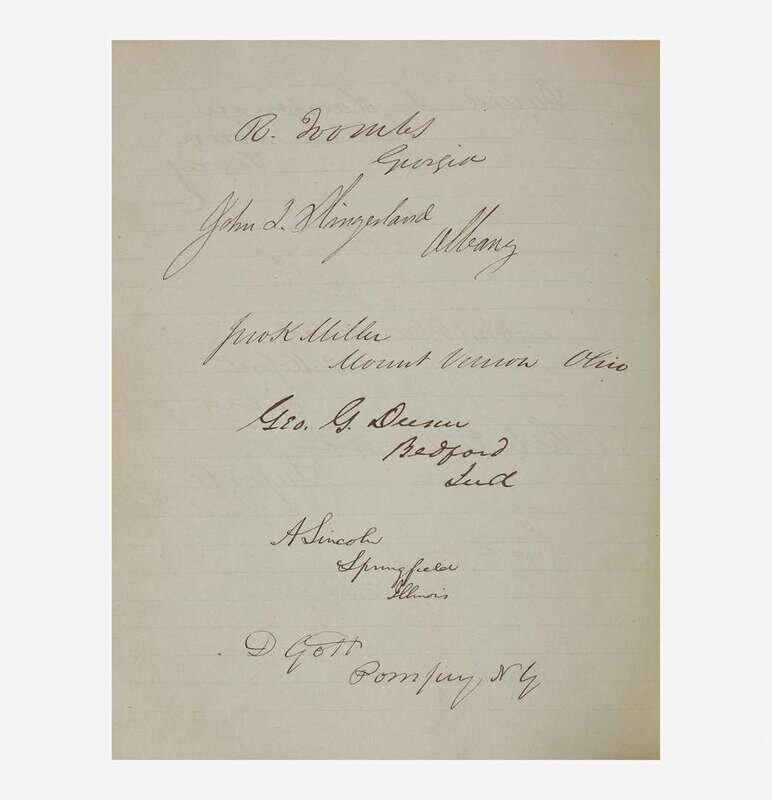
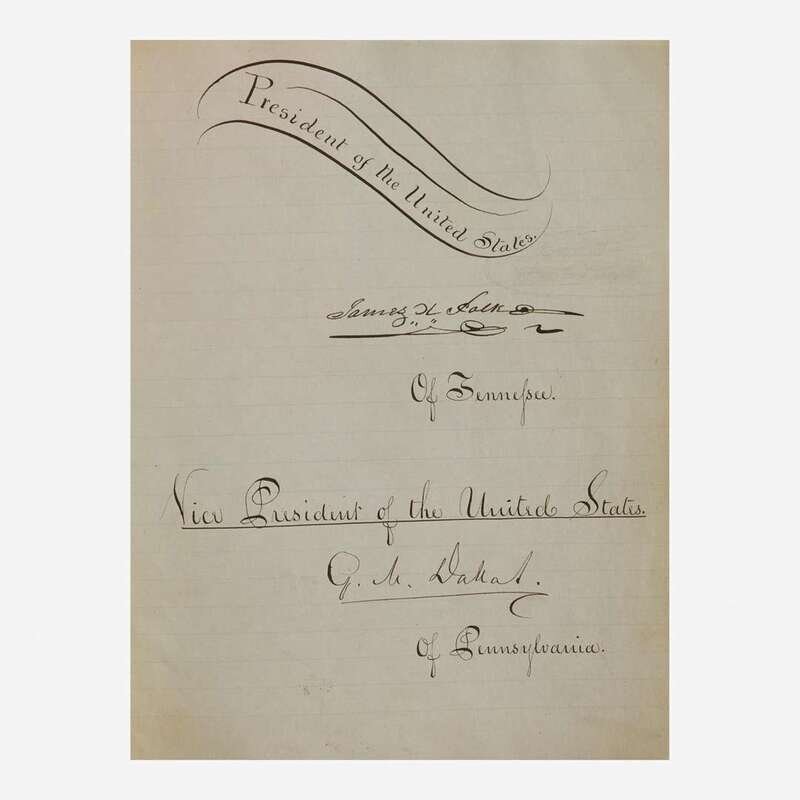
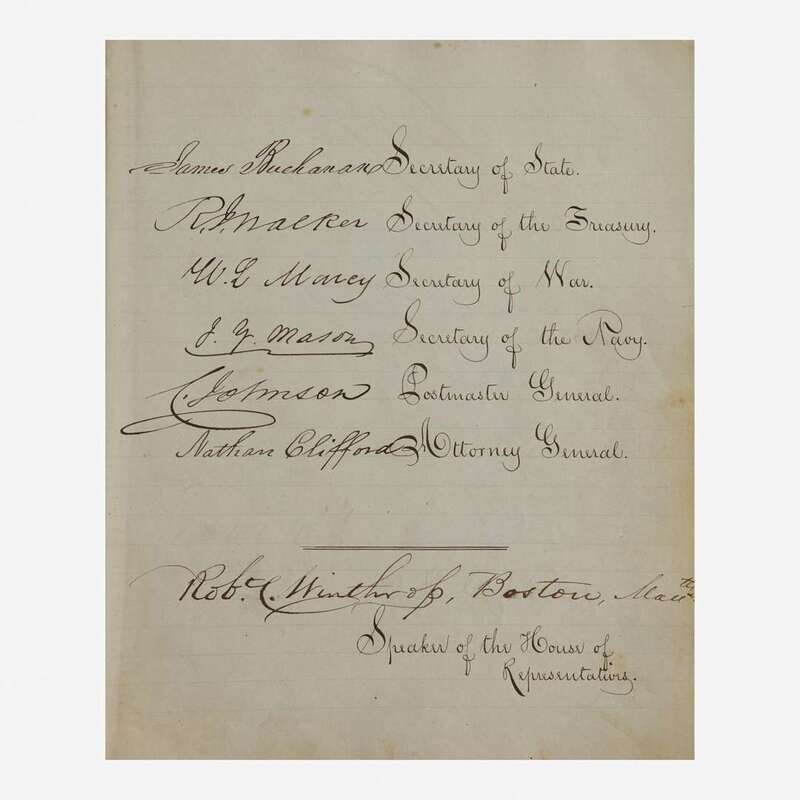
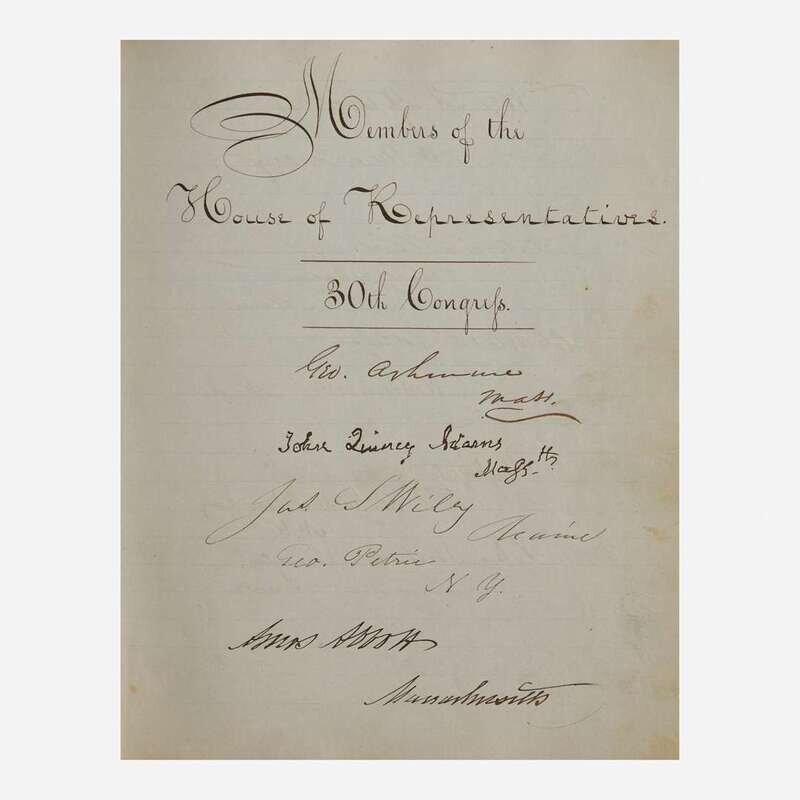
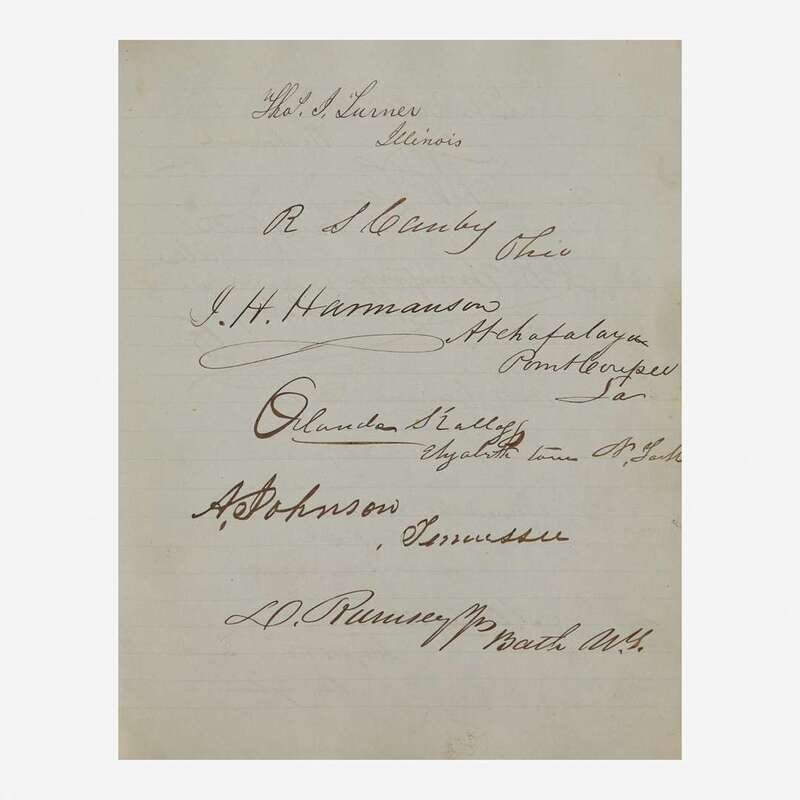
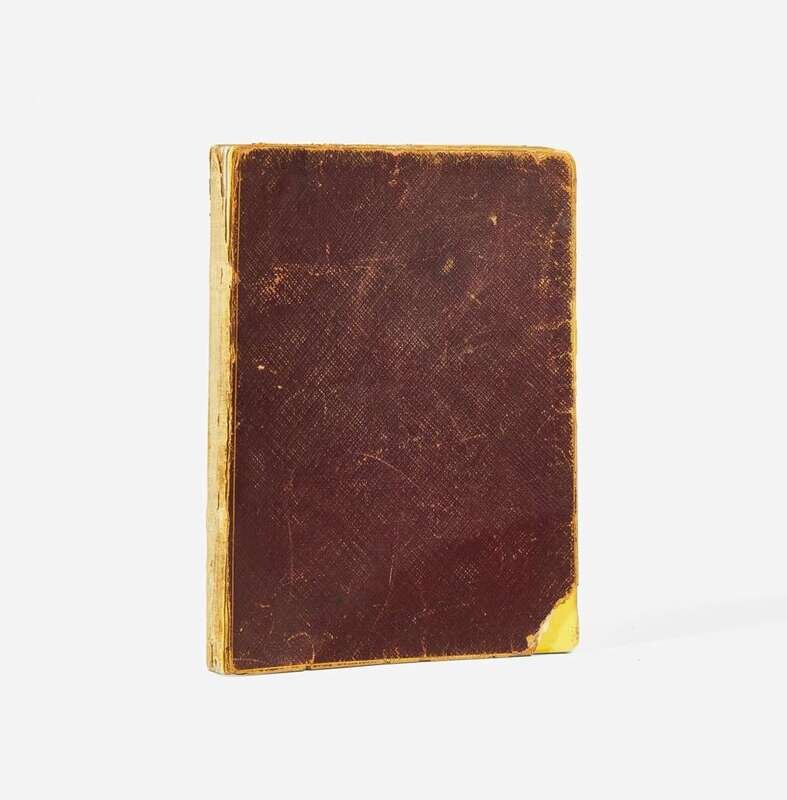
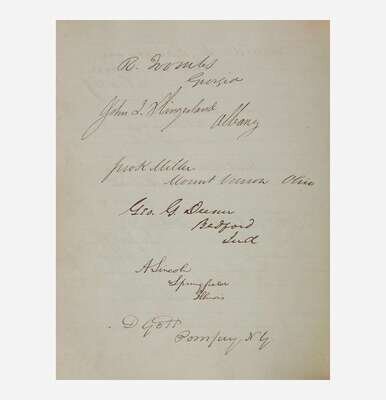
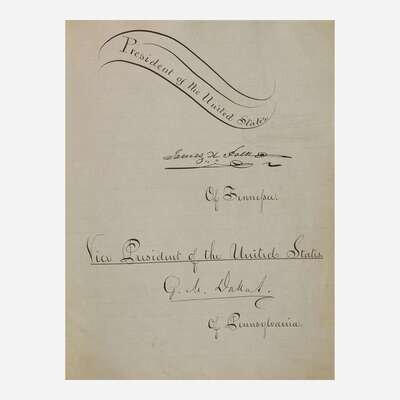
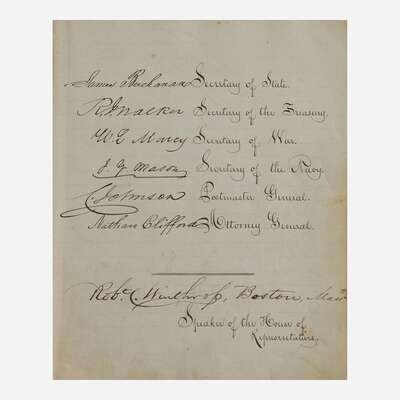
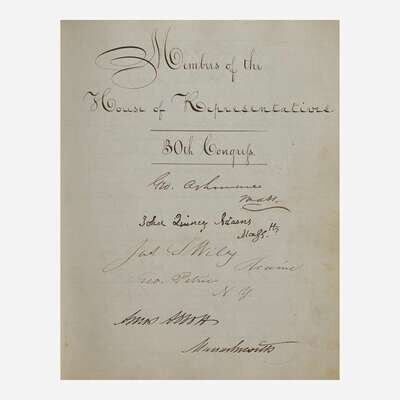
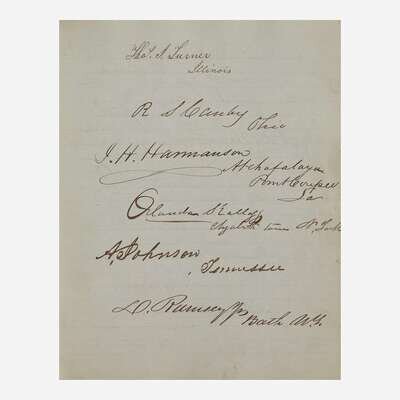
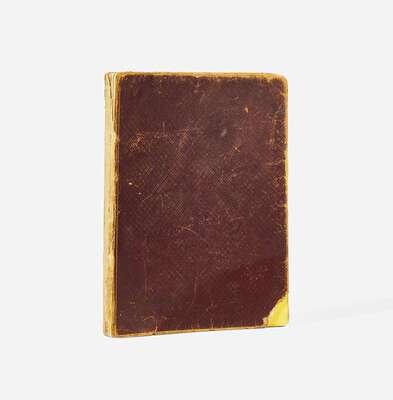
Washington, D.C., ca. 1847-48. Autograph album of the executive and legislative branches of the United States government during James K. Polk's administration. Comprising 293 signatures on 33 leaves, rectos and versos, ranging between two to seven signatures per page. Including five United States Presidents: James K. Polk, as 11th President; James Buchanan, as Secretary of State (15th President); Abraham Lincoln, as a Congressman from Illinois (16th President); John Quincy Adams, as a Congressman from Massachusetts (6th President); Andrew Johnson, as a Congressman from Tennessee (17th President); 210 (of 230) members of the House of Representatives (each signer has added their district); 55 (of 60) Senators (each signer has added their state); Vice-President George M. Dallas; six members of Polk’s Cabinet: Buchanan, Robert Walker as Treasurer, William L. Marcy as Secretary of War, John Y. Mason as Secretary of the Navy, Cave Johnson as Postmaster General, and Nathan Clifford as Attorney General; eight "Officers of the United States Army": Major General John A. Quitman, Benjamin McCulloch of the Texas Rangers, Brigadier General James Shields, Brigadier General John Garland, Colonel William G. Belknap, Brigadier General Frederick Searle, Colonel William S. Harney (later Brigadier General), and, interestingly, U.S. spy of Tampico, Anna Chase (wife of U.S. Consul to Mexico, Franklin Chase)--the only woman to sign this album; Henry Clay, dated January 1848; Secretary and Clerk of the House and Senate; Sergeant at Arms of each chamber. Original brown flexible leatherette binding, stamped in gilt, extremities worn, spine perished, front and rear covers starting, loss at bottom corner of front cover, all edges gilt; yellow endpapers.
A remarkable and unique autograph album: a near-complete representation of the 30th Congress of the United States as well as the administration of James K. Polk. Based on the present signatures this album was presumably compiled sometime between late 1847 and mid-1848, during the final two years of Polk's only term as president. Significantly, this album is signed by five present, past, and future United States Presidents, including Polk, a young Abraham Lincoln during his only term as a United States Congressman, an elderly John Quincy Adams before his sudden death in February 1848, and future presidents James Buchanan and Andrew Johnson, presidential bookends of the Civil War. Other signatures include the "Great Triumvirate" of Henry Clay, Daniel Webster, and John C. Calhoun, three of Antebellum America's three most powerful politicians. Other signatures include, Samuel Houston, first President of the Republic of Texas and then senator from Texas; Hannibal Hamlin, first Vice-President under Lincoln and then senator from Maine; Joshua R. Giddings, leading abolitionist from Ohio, and co-sponsor with Lincoln during this term of a bill to end slavery; Thomas Hart Benton, five-term Senator from Missouri and proponent of Westward Expansion; Jefferson Davis, future President of the Confederate States and then senator from Mississippi.
The vast majority of both legislative chambers are represented. Of the 230 members of the House of Representatives 210 are present, including members such as Robert Charles Winthrop, Speaker of the House and future Senator from Massachusetts; John Alexander McClernand, Union Army General; Caleb B. Smith, future Secretary of the Interior; David Wilmot, prime sponsor of the Wilmot Proviso during the contentious debates over slavery's expansion; Robert C. Schenck, Union Army General and Minister to Great Britain; William Strong, future Associate Justice of the Supreme Court; John Wentworth; Linn Boyd; Charles S. Morehead, future Governor of Kentucky; Robert Milligan McLane, future Governor of Maryland and Minister to France; John G. Palfrey, theologian and historian; Robert McClelland, future Governor of Michigan and Secretary of the Interior under Franklin Pierce; Kinsley S. Bingham, future 11th Governor of Michigan; Jacob Thompson, 5th Secretary of the Interior under Buchanan; Albert G. Brown, former Governor of Mississippi; John S. Phelps, future Governor of Missouri; William A. Newell, future Governor of New Jersey and Washington Territory; Henry C. Murphy; James Thompson, future Chief Justice of the Pennsylvania Supreme Court; George Perkins Marsh, noted environmentalist; James McDowell, former Governor of Virginia; Alexander Stephens of Georgia, future Vice President of the Confederate States. Of the 60 members of the Senate, 55 are present, including David R. Atchison, President Pro Tempore; Thomas J. Rusk of Texas; Lewis Cass, future Secretary of State under Buchanan; John Macpherson Berrien, Attorney General under Andrew Jackson; Herschel V. Johnson, future Governor of Georgia; John J. Crittenden, twice Attorney General, and Governor of Kentucky; Henry S. Foote, future Governor of Mississippi; John P. Hale; John A. Dix, future Governor of New York; Thomas Corwin, future Secretary of the Treasury; Simon Cameron, Secretary of War under Lincoln. Full list below.
The 30th United States Congress sat from March 4, 1847, to March 4, 1849, a period covering the Mexican-American War and during a time of increasing sectional tension within the United States over the spread of slavery. At the tail end of the second party system that would soon see the emergence of the Republican Party, Whigs--led by figures like Clay, Webster, and Adams--controlled the House, while Democrats--led by figures such as Polk, Buchanan, Lewis Cass, and Calhoun--controlled the Senate and Executive branch. It was during this time that future president Lincoln represented Illinois's 7th District--his only term in Congress and only time serving in the federal government before his ascension to the presidency. Of Illinois's seven members in the House, he was the only Whig, and served on the House Committee on Post Offices and Post Roads and the Committee on Expenditures in the War Department (forerunner of the Committee on Oversight and Accountability). In early 1849 he and Joshua Giddings of Ohio (also a signer of this album) introduced a bill to end slavery in Washington, D.C., but it was tabled due to lack of support.
During the compilation of this album the Treaty of Guadalupe Hidalgo was signed, ending the Mexican-American War, and ceding to the United States virtually all of the Southwest, including the present-day states of California, Nevada, Utah, New Mexico, and most of Arizona and Colorado. In the coming decade the debate over the spread of slavery here, and elsewhere, would inflame American politics and divide the nation. The roster of politicians represented here portends this rupture that in 13 years time would, with the election of Lincoln as President, result in the Civil War, with many signers taking up arms against each other by serving either for the Union or the Confederacy. Critically, the three signatures of Buchanan, Lincoln, and Johnson, represent the years preceding, during, and after, this conflict.
An exceptionally rare compilation, Lincoln's signature during this period is rare.
Album comprising:
Executive: President James K. Polk and Vice-President George M. Dallas. Cabinet: James Buchanan, Secretary of State; Robert Walker, Treasurer; William L. Marcy, Secretary of War; John Y. Mason, Secretary of the Navy; Cave Johnson, Postmaster General; Nathan Clifford, Attorney General.
Officers of the Army: Major General John A. Quitman; Benjamin McCulloch of the Texas Rangers; Brigadier General James Shields; Brigadier General John Garland; Colonel William G. Belknap; Brigadier General Frederick Searle; Colonel William S. Harney; Anna Chase, spy and wife of U.S. Consul to Mexico, Franklin Chase (not present).
Senate: Alabama: Dixon H. Lewis, Arthur P. Bagby; Arkansas: Chester Ashley, Ambrose H. Sevier, Solon Borland; Connecticut: Roger S. Baldwin, John M. Niles; Delaware: Presley Spruance; Florida: David Levy Yulee, James D. Westcott Jr.; Georgia: John Macpherson Berrien, Herschel V. Johnson; Illinois: Sidney Breese; Indiana: Edward A. Hannegan, Jesse D. Bright; Kentucky: John J. Crittenden, Joseph R. Underwood; Louisiana: Solomon W. Downs, Henry Johnson; Maine: James W. Bradbury, Wyman B.S. Moor, Hannibal Hamlin; Maryland: Reverdy Johnson; Massachusetts: John Davis, Daniel Webster; Michigan: Lewis Cass, Alpheus Felch; Mississippi: Jefferson Davis, Henry S. Foote; Missouri: Thomas Hart Benton, David R. Atchison; New Hampshire: Charles G. Atherton, John P. Hale; New Jersey: Jacob W. Miller, William L. Dayton; New York: Daniel S. Dickinson, John A. Dix; North Carolina: Willie P. Mangum, George E. Badger; Ohio: William Allen, Thomas Corwin; Pennsylvania: Simon Cameron, Daniel Sturgeon; Rhode Island: Albert C. Greene, John H. Clarke; South Carolina: John C. Calhoun, Andrew Butler; Tennessee: Hopkins L. Turney, John Bell; Texas: Thomas J. Rusk, Samuel Houston; Vermont: William Upham, Samuel S. Phelps; Virginia: James M. Mason, Robert M.T. Hunter; Secretary of the Senate: Asbury Dickens; Sergeant at Arms: Robert Beale.
House of Representatives: Alabama: Henry W. Hillard, Sampson W. Harris, Samuel W. Inge, Franklin W. Bowdon, Williamson R.W. Cobb, George S. Houston; Arkansas: Robert W. Johnson; Connecticut: James Dixon, John A. Rockwell, Samuel D. Hubbard; Delaware: John W. Houston; Florida: Edward C. Cabell; Georgia: Alexander H. Stephens, Howell Cobb, Robert A. Toombs, Thomas Butler King, Alfred Iverson, Sr., John H. Lumpkin, Hugh A. Haralson, John W. Jones; Illinois: John Wentworth, John A. McClernand, Robert Smith, Abraham Lincoln, William A. Richardson, Thomas J. Turner; Indiana: William W. Wick, Caleb B. Smith, Charles W. Cathcart, George G. Dunn, Richard W. Thompson, John L. Robinson, William R. Rockhill, Thomas J. Henley, Elisha Embree; Iowa: Shepherd Leffer, William Thompson; Kentucky: Linn Boyd, Green Adams, Samuel O. Peyton, Richard French, Beverly L. Clarke, Charles S. Morehead, John B. Thompson, John P. Gaines, Aylette Buckner; Louisiana: Emile La Sere, Bannon G. Thibodeaux, John H. Harmanson, Isaac E. Morse; Maine: James S. Wiley, Hezekiah Williams, Asa W.H. Clapp, Franklin Clark, David Hammons, Ephraim K. Smart; Maryland: John G. Chapman, Alexander Evans, Thomas W. Ligon, Robert M. McLane, John W. Crisfield, J. Dixon Roman; Massachusetts: George Ashmun, John Quincy Adams, Amos Abbott, Artemas Hale, Charles Hudson, Daniel P. King (twice), Joseph Grinnell, John G. Palfrey, Julius Rockwell, Robert C. Winthrop; Michigan: Charles E. Stuart, Robert McClelland, Kinsley S. Bingham; Mississippi: Patrick W. Tompkins, Winfield S. Featherston, Albert G. Brown, Jacob Thompson; Missouri: John S. Phelps, James S. Green, Willard P. Hall (twice), James B. Bowlin; New Hampshire: James Wilson, Charles H. Peaslee, Amos Tuck; New Jersey: William A. Newell, John Van Dyke (twice), James G. Hampton, Joseph E. Edsall, Dudley S. Gregory; New York: George Petrie, Hugh White, Daniel B. St. John, Dudley Marvin, William B. Maclay, Elias B. Holmes, Nathan K. Hall, Sidney Lawrence, Ausburn Birdsall, Cornelius Warren, John I. Slingerland, Daniel Gott (twice), Frederick W. Lord, William T. Lawrence, Peter H. Silvester, William Collins, Henry C. Murphy, Frederick A. Tallmadge, George A. Starkweather, William Nelson (twice), Harvey Putnam (twice), Eliakim Sherrill, Harmon S. Conger, Orlando Kellogg, David Rumsey, Jr., Joseph Mullin, Washington Hunt, Gideon Reynolds, David S. Jackson, Timothy Jenkins; North Carolina: John R.J. Daniel, Richard S. Donell, David Outlaw, Daniel M. Barringer, Abraham W. Venable, Thomas L. Clingman, Nathaniel Boyden, James I. McKay, Augustine H. Shepperd; Ohio: John Crowell, Samuel Lahm, Daniel Duncan, William Kennon, Jr., Jonathan D. Morris, Nathan Evans, Joseph M. Root, William Sawyer, John K. Miller, Thomas Ritchey, Joshua R. Giddings, Samuel F. Vinton, George Fries, Robert C. Schenck, James J. Faran, Rodolphus Dickinson, Richard S. Canby, David Fisher, John D. Cummins, John L. Taylor (dated March 22, 1848); Pennsylvania: John Strohm, Joseph R. Ingersoll, John Dickey, George N. Eckert, James Pollock, Abraham R. McIlvaine (twice), James Thompson, Charles Brown, David Wilmot, Richard Brodhead, John Blanchard, Job Mann, John Freedley, William Strong, Andrew Stewart, Chester P. Butler, John W. Farrelly, Moses Hampton, Jasper E. Brady, Samuel A. Bridges, Alexander Irvine, Charles J. Ingersoll, Henry Nes; Rhode Island: Benjamin B. Thurston, Robert B. Cranston; South Carolina: Alexander D. Sims; Joseph A. Woodward, Armistead Burt, Richard F. Simpson, Robert Rhett, Isaac E. Holmes; Tennessee: Meredith P. Gentry, Lucien B. Chase, Frederick P. Stanton, James H. Thomas, Hugh L.W. Hill, John H. Crozier, Washington Barrow, Andrew Johnson, William M. Cocke, William T. Haskell; Texas: Timothy Pilsbury, David S. Kaufman; Vermont: Lucius B. Peck, George P. Marsh, William Henry; Virginia: John S. Pendleton, William B. Preston, R.K. Meade, Thomas S. Flournoy, Andrew S. Fulton, Thomas S. Bocock, James McDowell, William L. Goggin, William G. Brown, Sr., Henry Bedinger, Thomas H. Bayly, Richard L.T. Beale, John M. Botts, Robert A. Thompson; Clerk: Thomas Campbell; Sergeant at Arms: Nathan Sargent.
Other: Henry Clay, dated January, 1848 (signed at rear of volume)