Condition Report
Contact Information
Lot 152
Lot Description
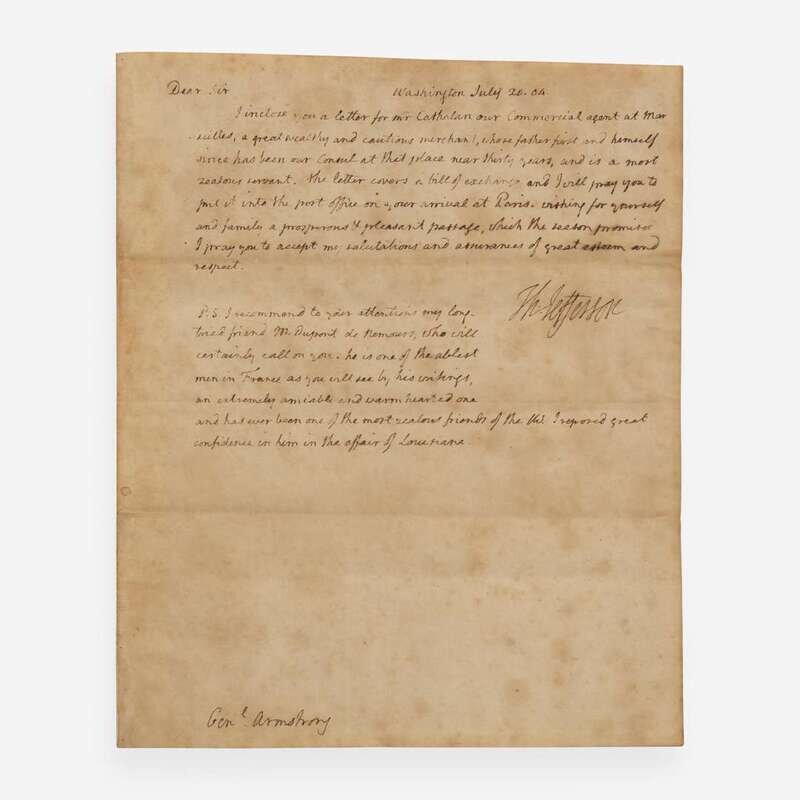
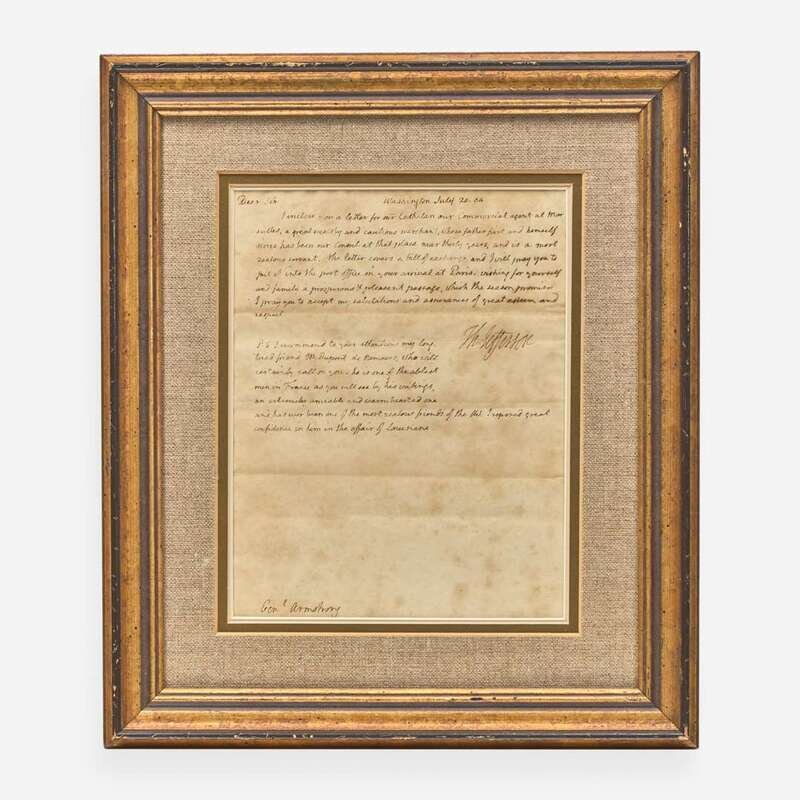
President Thomas Jefferson Praises Pierre Samuel du Pont de Nemours as one of "The Ablest Men in France"
"An extremely amiable and warm hearted one and has ever been one of the most zealous friends of the US. I reposed great confidence in him in the affair of Louisiana."
Washington, (D.C.), July 20, 1804. One sheet folded to make four pages, 9 7/8 x 8 3/16 in. (251 x 208 mm). One-page autograph letter, signed by Thomas Jefferson as President of the United States, to General John Armstrong, Jr., the newly appointed United States Minister to France, directing him to forward an enclosed letter (not included) for the U.S.'s Commercial Agent at Marseille, Stephen Cathalan, Jr., and recommending Armstrong acquaint himself with French-American economist and businessman Pierre Samuel du Pont de Nemours; docketed on verso; creasing from old folds; foxing and toning to each leaf; remnants from old mount on verso of integral leaf. Polygraph copy located in the Library of Congress; published in The Papers of Thomas Jefferson (Vol. 44, 1 July to 10 November 1804, Princeton University Press, 2019, p. 120).
"Dear Sir
I inclose you a letter for Mr Cathalan our Commercial agent at Marseille, a great wealthy and cautious merchant, whose father first and himself since has been our Consul at that place near thirty years, and is a most zealous servant. the letter covers a bill of exchange and I will pray you to put it into the post office on your arrival at Paris. wishing for yourself and family a prosperous & pleasant passage, which the season promises I pray you to accept my salutations and assurances of great esteem and respect.
Th: Jefferson
P.S. I recommend to your attention my long-tried friend M. Dupont de Nemours, who will certainly call on you. he is one of the ablest men in France as you will see by his writings, an extremely amiable and warm hearted one and has ever been one of the most zealous friends of the US. I reposed great confidence in him in the affair of Louisiana.
Genl. Armstrong"
President Thomas Jefferson writes to the newly appointed Minister to France, General John Armstrong, Jr., shortly before his departure for Paris to take up his new position--a role Jefferson himself occupied some fifteen years before. Jefferson directs Armstrong that upon his arrival he is to forward a letter to the United States's Commercial Agent at Marseille, Stephen Cathalan, Jr., regarding the payment of a bill and the shipment of wine and other goods.
Significantly, in his postscript Jefferson introduces to Armstrong his "long-tried friend," Pierre Samuel du Pont de Nemours (1739-1817), and sings his praises as one of "the ablest men in France," and "one of the most zealous friends of the US." Nemours, an economist, writer, and aristocrat, was long active in the corridors of French politics and was a promoter of French-American relations. He and Jefferson first met when Jefferson was French Minister in the 1780s, and over the ensuing years they had become frequent correspondents and confidants. At the time of this introduction Nemours had recently returned to France after being exiled under the Directory, and was serving in the Paris Chamber of Commerce.
As Jefferson suggests here, Nemours had played an instrumental role in the "affair of Louisiana," that only a year before had seen the United States purchase from France the 828,000-square-mile Louisiana Territory, doubling the size of the young nation. Earlier, in 1800, Louisiana had reverted back to French control after a secret treaty with Spain, with Napoleon's intent to reinvigorate it as a French colony. French occupation posed a potential threat to America's trade interests and sovereignty. Nemours advised Jefferson on this matter and helped him devise the strategy whereby the United States would attempt to purchase New Orleans to stave off the possibility of war. Upon Nemours's return to France in 1802, Jefferson entrusted him to act as a back-channel between French and U.S. officials, that helped get the message to Napoleon of the consequences if France should take control of Louisiana. The ploy worked after French ambitions in Saint-Domingue (Haiti) floundered, and in April 1803 the United States purchased the territory for $15 million, the payments of which Armstrong would help facilitate in the following years as French Minister (see lot 32).
Nemours returned to the United States in 1815 after falling out of favor with the French government. By this time his son, Éleuthère, had started his successful gunpowder manufacturing plant in Delaware from which the DuPont chemical conglomerate developed.
John Armstrong, Jr. (1758-1843) was a native of Carlisle, Pennsylvania, and attended the College of New Jersey (now Princeton University). In 1776 he joined the Continental Army and served as an aide to Hugh Mercer and Horatio Gates with the rank of major. In 1783 he was the anonymous author or scribe of the document circulated in the camp at Newburgh, New York that expressed discontent with Congress, known as the Newburgh conspiracy. He returned to Pennsylvania after the war and served as secretary of the state’s Supreme Executive Council and adjutant general. In 1789 he married the sister of Robert R. Livingston (future Minister to France whom Armstrong would later replace), and moved to New York to oversee his newly acquired Dutchess County estate. He remained active in politics and aligned with the Democratic-Republican interests, and later represented New York for two partial terms in the U.S. Senate, from 1800 to 1802, then again from 1803 to 1804. He resigned his seat to accept the appointment as minister to France. He served in that role for six years and returned to the United States in 1810. He then served as secretary of war from 1813 to 1814.