
Condition Report
Contact Information
Lot 1
Lot Description
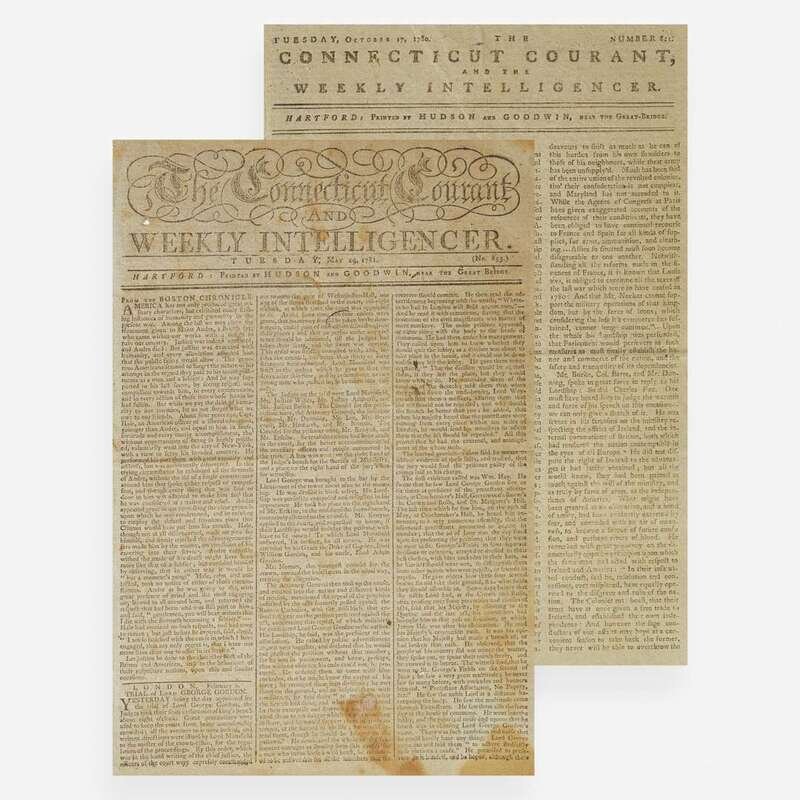
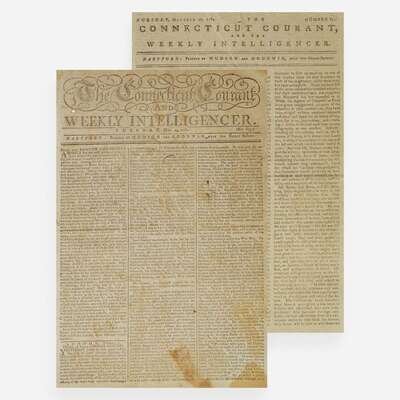
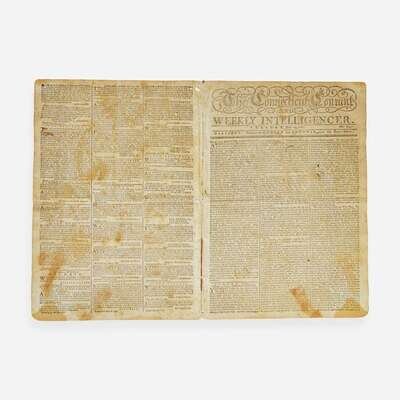
The Connecticut Courant, and the Weekly Intelligencer
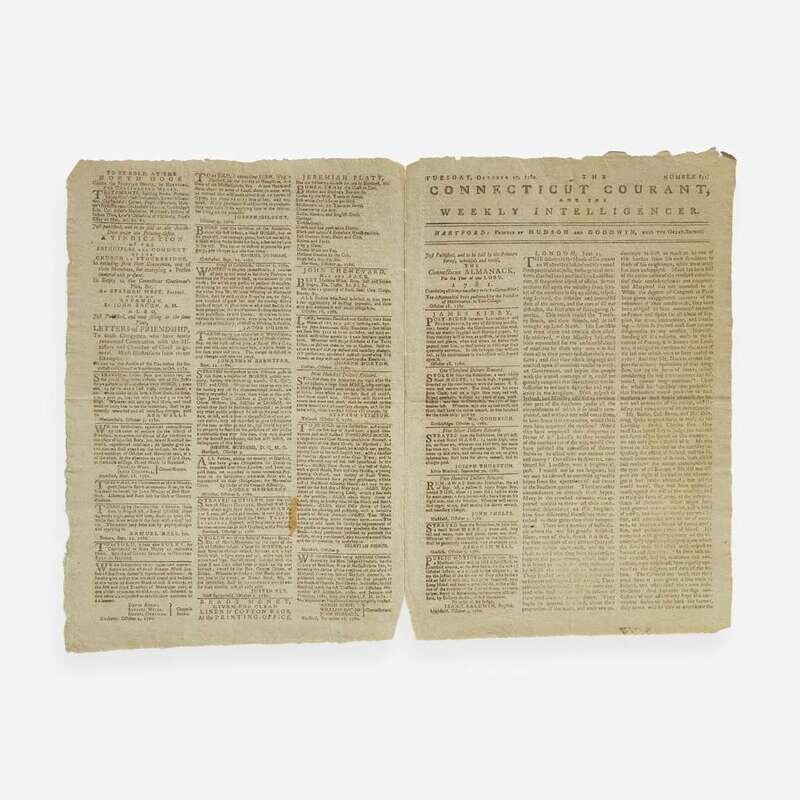
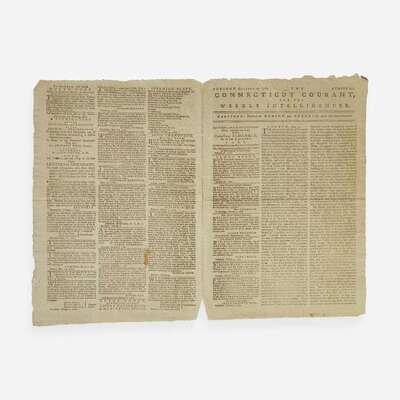
Hartford: Printed by Hudson and Goodwin, Tuesday, October 17, 1780. Number 821. Bifolium leaf, 14 1/4 x 9 7/8 in. (362 x 251 mm). Printed newspaper in three columns. Untrimmed; separated along center fold; small stain in bottom second leaf.
A fascinating edition of this Connecticut newspaper featuring numerous articles on the treason of Benedict Arnold, including an early account of his plan to aid the British. Printed on the second page, this account was given in Philadelphia on October 4, less than two weeks after the discovery of Arnold and British agent John Andre's plot to deliver West Point to the British. It begins with the preface that "the public curiosity and anxiety must naturally be raised to a high pitch, by the providential detection of the perfidy and treachery of a late distinguished general officer of the United States, we shall endeavour to give our readers such particulars as have come to our knowledge and are well authenticated," and then reports, "a scene of the blackest villany had been just disclosed: that Arnold was gone off to the enemy; that Col. Andre, Gen. Clinton's principal aid and confidant, was apprehended in disguise in our camp; that West Point (where Arnold commanded) was to be the sacrifice, and that all the dispositions were made for delivering it upon Monday the 25th ult. at night." The account proceeds with the confiscation of his papers and correspondence, revealing that his time as military commander of Philadelphia "appears to have been a scene of the basest trafic (sic) and public plunder," and that "the illiberal abuse of every character, opposed to his fraudulent and wicked transactions, exceeds all description."
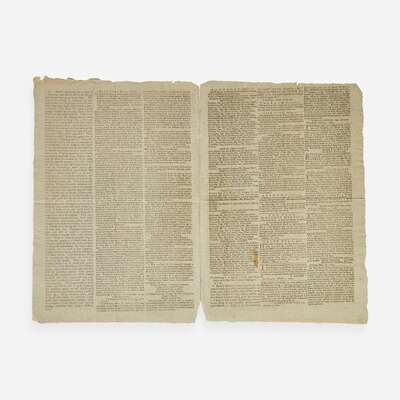
Following this account is printed in full Arnold's infamous letter to George Washington pleading for mercy for his wife, Margaret Shippen. Written on board the sloop-of-war Vulture, where Arnold fled on September 25, he attempts to account for his actions, writing that "The heart which is conscious of its own rectitude, cannot attempt to paliate a step which the world may censure as wrong; I have ever acted from a principle of love to my country, since the commencement of the present unhappy contest between Great-Britain and the colonies, the same principle of love to my country actuates my present conduct, however it may appear inconsistent to the world, who very seldom judge right of any mans actions."
Other news related to the Arnold affair is printed, including on the third page, John Andre's letter to General Washington, written upon his soon-to-be execution, "Buoyed above the fear of death, by the consciousness of a life spent in the pursuit of honor, and fully sensible that it has at no time been stained by any action, which at this serious moment could give me remorse--I have to solicit your Excellency...that I may be permitted to die the death of a soldier:--It is my last request and I hope it will be granted." Other news includes mention of a parade burning Arnold's image in effigy; Arnold's arrival in New York, "saluted with 13 cannon; and dined that day with the commandant of the city."; extract from General Nathanael Greene's September 26 orders, "Treason, of the blackest die..."
Together with:
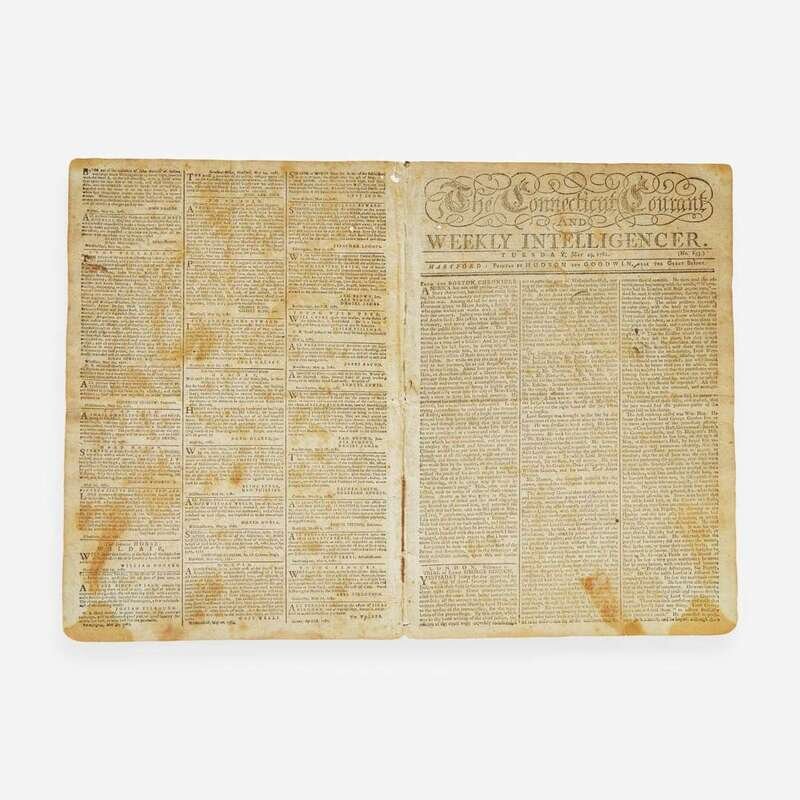
The Connecticut Courant And Weekly Intelligencer
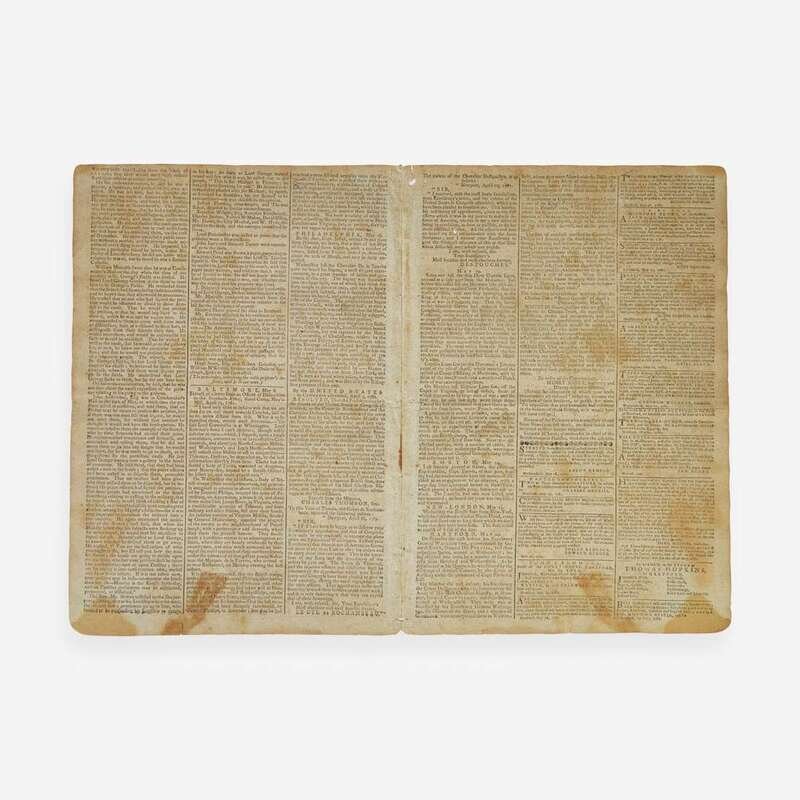
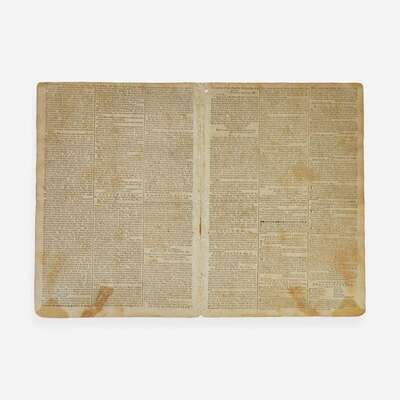
Hartford: Printed by Hudson and Goodwin, Tuesday, May 29, 1781. No. 853. Bifolium leaf, 13 3/4 x 9 11/16 in. (349 x 246 mm). Printed newspaper in three columns. Disbound; a few small holes and open tears at top center edge; sheet toned with scattered foxing.
On the front page is printed an article from the Boston Chronicle comparing the treatment of executed American spy Nathan Hale and British spy Major John Andre: "America has not only produced great military characters, but exhibited many striking instances of humanity and generosity in the present war. Among the last we may place the treatment given to Major Andre, a British spy; who came within our works with a design to ruin our country. Justice was indeed executed, and Andre died: But justice was executed with humanity, and every alleviation afforded him that the public safety would allow...But while we pay the debt of humanity to our enemies, let us not forget what we owe to our friends. About four years ago, Capt. Hale, an American officer...younger than Andre, and equal to him in sense, fortitude and every manly accomplishment...voluntarily went into the city of New-York, with a view to serve his invaded country. He performed his part there with great capacity and address, but was accidentally discovered..."
Other articles report news from the Southern Campaign; a Congressional resolve of thanks to Count de Rochambeau and the Chevalier Destouches; news of the arrival of General George Washington and Rochambeau to Wethersfield, Connecticut, on their march south to Virginia; a note on the "conduct pursued by Cornwallis, Philips and Arnold, to the southward, in plundering, burning and destroying all within their reach, is an evidence that peace is not far distant."