Condition Report
Contact Information
Lot 11
Lot Description
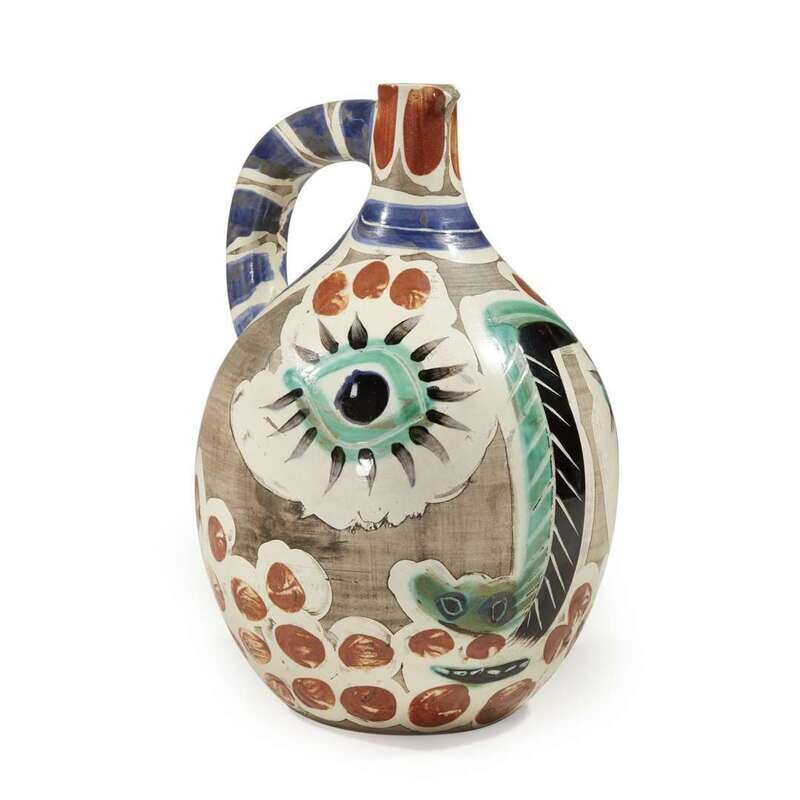
1969, numbered 83/200, inscribed 'EDITION PICASSO' and 'MADOURA' and stamped 'EDITION PICASSO' and 'MADOURA' on the underside. White earthenware clay vase with decoration in engobes by knife under partial brushed glaze with gray patina.
height: 13 in. (33cm)
width: 9 in. (23cm)
depth: 10 in. (25.4cm)
[Ramié, 609]
NOTE:
While best known for his vibrant Cubist paintings and prints, Pablo Picasso was also a prolific designer, poet and ceramicist. Picasso began experimenting with ceramics in the 1940s, going on to design more than 600 ceramics throughout the course of his life. At the time, he spent his summers in the south of France, where—in 1946—he visited the annual pottery exhibition in Vallauris. It was there that Picasso first met Georges and Suzanne Ramié, the couple behind the Madoura pottery workshop whose work initially inspired Picasso to experiment with the medium. The Ramiés opened their workshop to the artist, allowing him use of their tools and equipment. Thus began a long, fruitful collaboration spanning 25 years, ending in 1971.
Picasso took to ceramics and clay work quickly, finding the medium a fascinating departure from paint, and the slow, methodical production of each piece a respite in the summer heat. He started first creating bowls and plates, before turning to forms such as vases and pitchers. These frequently depicted animal shapes like fish, birds and owls, as well as human faces.
In 1953, Picasso met Jacqueline Roque at the workshop; they were married in 1961. Though 44 years his junior, Jacqueline was the muse and prime inspiration for the artist’s prolific output in his later years. Captivated by her large almond-shaped eyes, classical profile and long elegant neck, Picasso created more works of art based on Jacqueline than any of his other lovers; she was his principal subject during the last two decades of his life, a period that has since been referred to as ‘L’Epoque Jacqueline.’
The present piece is an excellent example of Picasso’s exploration of the human face in his ceramic work. It is remarkably detailed and joyfully rendered in bright colors, the figure’s face coming alive through the exuberant brush strokes and swirling patterns that cover the voluminous vessel.