Condition Report
Contact Information
Lot 228
Lot Description
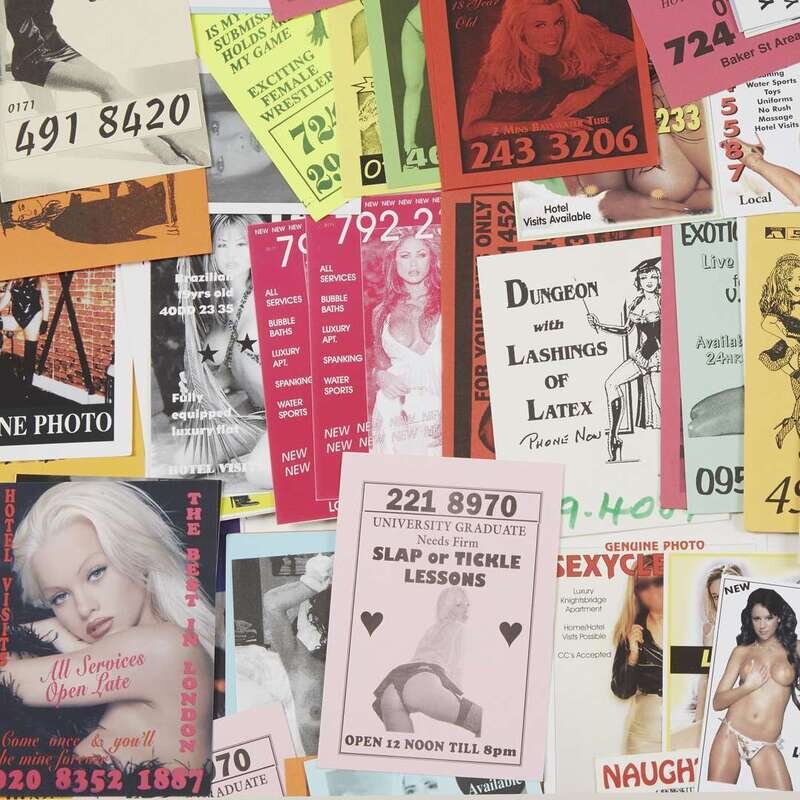
A remarkable collection of approximately 1,070 tart cards (including some duplicates). 1980s–90s. Most are the size of an A6 postcard (6 x 4 in. (15.2 x 10.2cm)) and a few measure approximately 3 3/4 x 4 in. (9.5 x 10.2cm). All are in excellent condition, with the exception of one that was adhered to the back of another, resulting in some surface damage. Some with handwritten phone numbers or additions to illustrations in marker. London sex workers used tart cards to advertise their services in the city’s ubiquitous red phone boxes, which functioned as free advertising space—and encouraged clients to call immediately. They provide an exhaustive catalogue not only of sexual preferences, but also of typography and printing methods from the 1980s through the advent of the personal computer. After street solicitation became illegal in the U.K. in 1956, sex workers began placing printed advertisements in shop windows. They began using tart cards in 1984, when the 1953 Post Office Act was repealed, which had previously prohibited any advertisements inside phone boxes. Early tart cards started as discrete, business card-sized advertisements, but by 1992 the standard size increased to A6 postcards. As printing technology evolved and computers became more accessible, cards transformed from having simple, often appropriated fonts and imagery to featuring more elaborate photographic reproductions. Most were printed on an offset lithography press, and monochrome photographic images became common by 1994. The first four-color photographic cards were produced in 1992, but didn’t become the norm until 1998. Several institutions have extensive collections of tart cards, including the Wellcome Collection in London.