Condition Report
Contact Information
Lot 1060
Lot Description
... Second Army at Weihaiwei,” artist unknown, February 1895
(with details of Chinese, left, and Japanese, right)
[2000_113] Sharf Collection, Museum of Fine Arts, Boston
“The Japanese Second Army Battles at Jinzhou” by Shuko, November 1894
(with details of Chinese, left,
and Japanese, right)
[res_23_294]
Museum of Fine Arts, Boston
“Attacking Pyongyang, Our Troops Conquer the Enemy Fortress ”
by Mizuno Toshikata, September 1894
(with details of Chinese, left, and Japanese, right)
[res_23_344], Museum of Fine Arts, Boston
Such suggestions of relative equality emerge especially clearly in depictions of combat between mounted officers. These figures stand out from the tumult around them by virtue of their horses alone, but this is not the only source of shared identity. On both sides these combatants were men of comparable rank, accomplishment, and ability.
“Great Sino-Japanese
Battle at Fenghuangcheng”
by Toyohara Kuniteru III,
October 1894
(with details of Chinese
officer, left, and Japanese officer, right)
[2000_233] Sharf Collection,
Museum of Fine Arts, Boston
In one print by an unidentified artist, a clash between two cavalrymen is actually turned into a spectator sport. Fighting men pause to watch, and a few Chinese have even climbed a tree to get a better view.
In the midst of battle a crowd has gathered to watch two cavalrymen in one-on-one combat.
“The Battle of Mukden” by Shunsai Toshimasa, 1894
[res_23_312] Museum of Fine Arts, Boston
A few prints detach cavalry combat from the congestion of battlefield tumult and place it alone at stage center, occasionally even giving the names of Chinese generals involved.
“A Great Victory at Port Arthur” by Adachi Ginko, November 1894
[PMOA_055]
“Sino-Japanese Pitched Battles: Two Generals
Fighting at Fenghuangcheng” by Watanabe
Nobukazu, November 1894
[2000_009] Sharf Collection, Museum of Fine Arts, Boston
“Major Sakakibara Fights Fiercely to the South
of Ximucheng” by Adachi Ginko,
January 1895
[21_1549] Museum of Fine Arts, Boston
The single most honorable Chinese singled out in the war prints, however, was not a mounted officer but an admiral—the venerable Ding Juchang, whose fleet was destroyed after hard fighting off Weihaiwei early in 1895. After surrendering in a courteous exchange of messages between the two sides, Admiral Ding Juchang committed suicide by taking poison. When the Chinese warship carrying his body left the harbor, the Japanese fleet dropped their flags to half-mast and fired a salute. Death by one’s own hand held an honorable place in Japan’s own warrior tradition, of course; be that as it may, several woodblock artists commemorated the admiral’s death with respectful renderings. One of the best of these, by Toshikata, imagines Admiral Ding Juchang seated in an elegant room holding a cup of poison in his hand.
The most honorable Chinese opponent depicted in the Japanese war prints was Admiral
Ding Juchang, who committed suicide after his fleet was destroyed in 1895. Here he is
portrayed seated in an elegant room with a cup of poison in his hand.
“Admiral Ding Juchang of the Chinese Beiyang Fleet, Totally Destroyed at Weihaiwei,
Commits Suicide at His Official Residence” by Mizuno Toshikata, February 1895
[IMP_44_74]
In another well-known print, Toshikata pitted his Japanese hero, “Captain Awata,” against a Chinese antagonist of no status but undeniably formidable strength—in this case, a giant on Taiwan whose weapon of choice was a halberd. In his treatment of this celebrated encounter, Toshikata portrays the Chinese foe with respect. More typical, however, was Toshihide’s rendering of the same duel, in which Awata administers the coup de grâce to a twisted figure collapsing from a lethal blow to the head—his straw hat flying through the air, clearly torn where Awata’s sword blade sliced through. (This is the same Captain Awata whom Kiyochika lovingly portrayed cleaving the enemy’s skull.)
These two prints of the same subject — a powerful Chinese with a halberd fighting Captain Awata
on Taiwan — treat the enemy in completely different ways. In one (detail on right), he is a
stalwart and heroic foe. In the other (detail on left), he collapses in grotesque defeat.
“Captain Awata” by Mizuno Toshikata, 1895 (top)
[2000_440] Sharf Collection, Museum of Fine Arts, Boston
“Picture of Captain Awata, Who Fights Furiously with His Celebrated Sword in the Assault
on Magongcheng in the Pescadores” by Migita Toshihide, 1895
[2000_431] Sharf Collection, Museum of Fine Arts, Boston
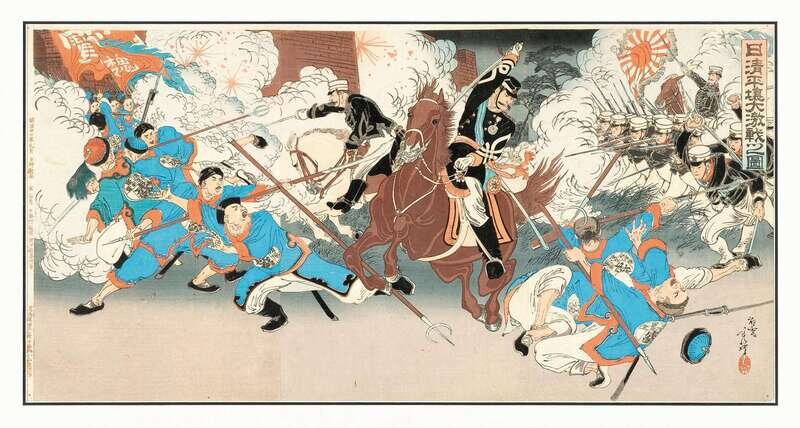
When all was said and done, denigration of the latter sort ruled the day when it came to portraying the Chinese foe. As the prints so graphically reveal, moreover, such disdain frequently carried both a harsh racist charge and an undisguised edge of pure sadism. The devil, as always, is in the details. The Chinese are slashed with swords; skewered with bayonets (often run through from behind, as in Kiyochika’s showing); shot at close range; beaten down with rifle butts; strangled; crushed with boulders; pounded with oars while floundering in the sea. They tumble off cliffs and warships like tiny rag dolls. In one print, a civilian caught in battle lies crumpled on the ground with a still open parasol on his corpse, conspicuous once again by his gaudy and (in Japanese eyes) outlandish clothing.
It is particularly sobering to keep in mind that this was not on-the-scene “realism.” The woodblock artists worked largely out of their own imaginations, tailoring this to news reports from the front. They were commercial artists catering to a popular audience, and this was the war Japanese wished to see.
Admiral Ding Juchang, the Chinese generals on their horses, the occasional battlefield enemies treated as just as human as the Japanese are exceptions that prove the rule. The prototypical Chinese is grotesque. His face is contorted, his body twisted and often turned topsy-turvy, his demeanor in most cases abject. Battlefield scenes routinely include cringing foe pleading for their lives—even while making clear that the emperor’s stalwart heroes should and would pay no heed to such cowardice. The braided queue becomes, in and of itself, a mark of backwardness and inferiority; in more than a few battle scenes, Japanese stalwarts grasp this while dispatching their victim. (Pulling Chinese men by their “pigtail” was also a favorite image among American and English cartoonists until the overthrow of the Manchu dynasty in 1911, after which this hairstyle was no longer mandatory for ethnic Chinese males.)
The Devil in the Details
Although woodblock artists did not personally visit the battle front, their war prints routinely ridiculed the Chinese and depicted Japanese fighting men commiting extraordinary acts of violence against them. Clearly this was the war Japanese at home wished to see.
Chinese prisoners of war, usually bound with thick rope, also drew attention. Okura Koto imagined “Captain Higuchi” (lionized for picking up a Chinese child on the battlefield) confronting three such captured Chinese—a particularly suggestive scene, combining as it did denigration of the “old” China with chivalrously rescuing “young” (or future) China, and all this in front of a piece of heavy artillery. Toshihide and others similarly dwelled on Chinese officers kneeling in supplication before their captors.
“Captain Higuchi, A Fierce Warrior, Ready to Lay Down His Life for Mercy’s Sake at Fort Motianling” by Okura Koto, January 1895
(detail)
[2000_179] Sharf Collection,
Museum of Fine Arts, Boston
“Illustration of Chinese Generals from
Pyongyang Captured Alive” by
Migita Toshihide, October 1894 (detail)
[2000_380_08]
Sharf Collection, Museum of Fine Arts, Boston
“Illustration of Our Righteous Army
Capturing Money and Prisoners,”
artist unidentified (detail)
[2000_380_05]
Sharf Collection, Museum of Fine Arts, Boston
Kokunimasa offered a harsh “Illustration of the Decapitation of Violent Chinese Soldiers” that included a lengthy inscription. The benevolence and justice of the Japanese army, this text explained, equaled and even surpassed that of the civilized Western nations. By contrast, the barbarity of the Chinese was such that some prisoners attacked their guards. As a warning, the Japanese—as depicted in the print—had beheaded as many as thirty-eight rebellious prisoners in front of other captured Chinese. The Rising Sun military flag still fluttered in one panel of Kokunimasa’s print; the stalwart cavalry officer still surveyed the scene; the executioner still struck the familiar heroic pose with upraised sword. The subject itself, however, and severed heads on the ground, made this an unusually frightful scene.
“Illustration of the Decapitation of Violent Chinese Soldiers”
by Utagawa Kokunimasa, October 1894 (detail)
[2000_380_07] Sharf Collection, Museum of Fine Arts, Boston
“Orientalism”
A sample of Western racial stereotypes
of the Sino-Japanese War, as seen in
cartoons (and texts) from the famous
British weekly magazine Punch.
The derision of the Chinese that permeates these prints found expression in other sectors of popular Japanese culture. The scholar Donald Keene, for example, has documented how popular prose, poems, and songs of the war years took similar delight in lampooning the “pumpkin-headed” Chinese and making jokes about their slaughter. (It was around this time that the pejorative Japanese epithets chanchan and chankoro became popular, amounting to a counterpart to the English-language slur “Chink.”)
Even today, over a century later, this contempt remains shocking. Simply as racial stereotyping alone, it was as disdainful of the Chinese as anything that can be found in anti-“Oriental” racism 1894, signed oju Toshihide and with artist's seal. Color woodblock.
Oban triptych
Framed