
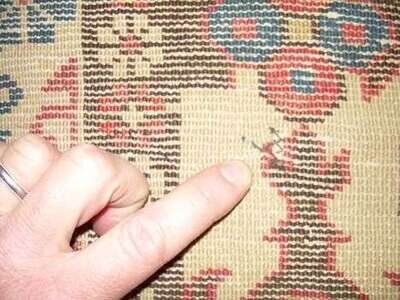

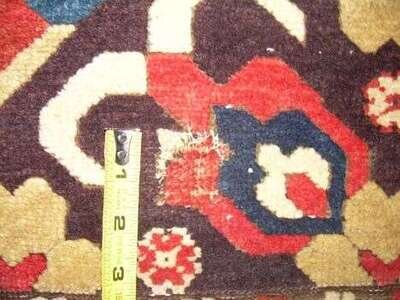
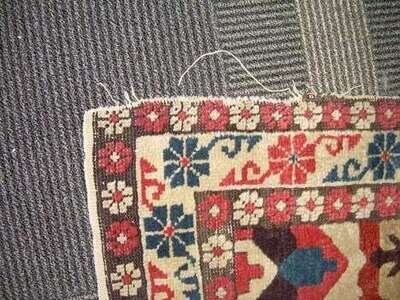
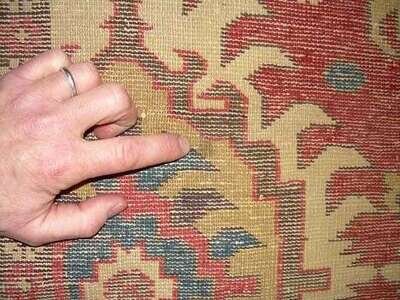
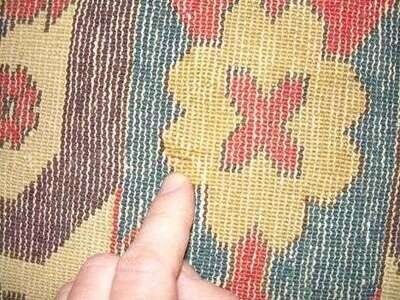
Condition Report
Contact Information
Lot 926
Lot Description
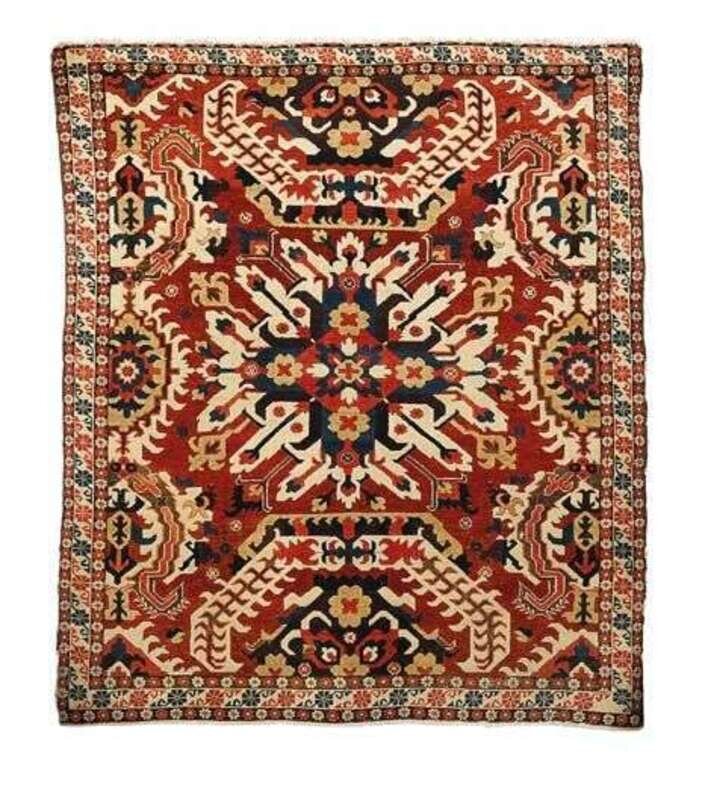
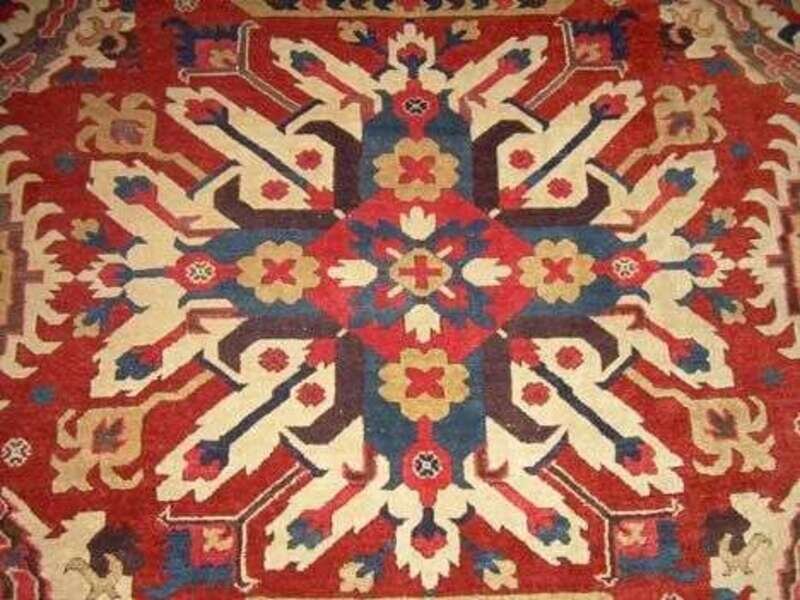
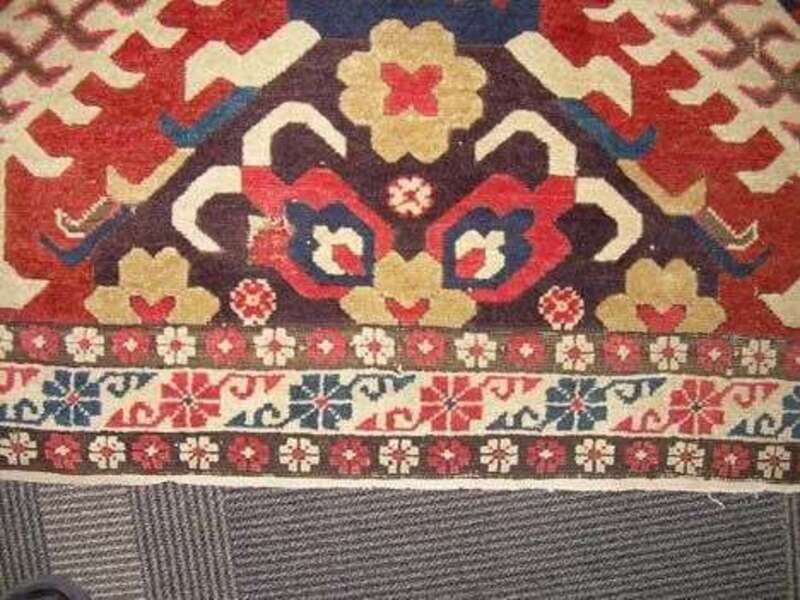
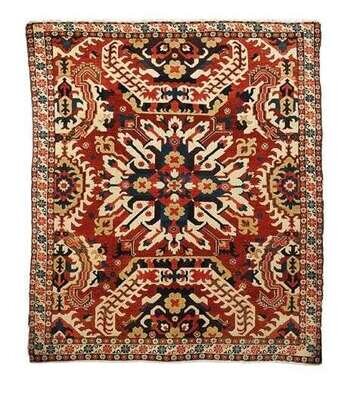
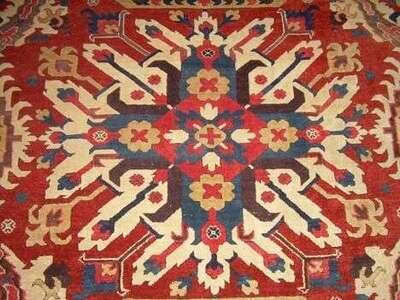
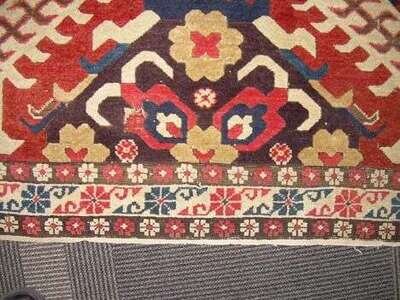
6 ft. 1 in. x 5 ft. 4 in. Note: The present lot is an unusual single medallion Chelaberd rug whose format and design elements relate directly to various types of Chelaberds and other early Caucasian rugs. The single central medallion design is related to the Caucasian ‘Sunburst’ rugs of the late 18th and early 19th centuries, of which at least four examples are known, three of which, like the present rug, have red grounds: the Victoria and Albert Museum, London rug (inv. no. T.264-1927); Caucasian Sunburst Rug, early 19th century, sold Sotheby’s New York, Dec. 14, 1995, lot 58; Caucasian Sunburst Rug, ca. 1800, sold Sotheby’s London, May 29, 1998, lot 13; and Sunburst Kazak Rug, late 18th century, sold Christie’s London, Oct. 18, 2001, lot 277 (Hali 85, Auction Price Guide, p.135, Mar.-Apr. 1996; Hali 120, Jan.-Feb. 2002, Auction Price Guide, p.128). These Caucasian ‘Sunburst’ rugs have a single center medallion ending in palmette pendants centered by angular hooked vines. While the present rug has a nearly identical single central medallion, it’s design differs from the ‘Sunburst’ rugs because at each end of the medallion are three-sided ornamental medallions and angular serrated leaves, and on each side of this central ‘row’ of medallions and serrated leaves are two rows of palmettes – three complete palmettes and two partial palmettes. Published examples of single medallion Chelaberds, often referred to as ‘Eagle Kazaks,’ with three-sided ornamental medallions and angular serrated leaves at each end, but without side rows of palmettes include: Ulrich Schurmann, Caucasian Rugs, Maryland, 1990 (4th printing), no. 29, p. 113 illus., and Christine Close, “Kazak ad Aquile, Origine e evoluzione decorativa,” in Ghereh, International Carpet & Textile Review, no.14, Dec. 1997, fig. 1, p. 8 illus. Chelaberds with this design have been also sold in a number of recent auctions, including: Sotheby’s New York, June 1, 2006, lot 43; Grogan & Co., Massachusetts, Sept. 26, 2005, lot 736; Bonham’s London, Oct. 12, 2004, lot 57; Sotheby’s New York, Mar. 30, 2004, lot 589; Sotheby’s New York, Apr 1, 2003, lot 108; and Rippon Boswell & Co., Wiesbaden, Nov. 16, 2002, lot 65. The two side rows of palmettes have stylistic antecedents in design elements of early Caucasian rugs including: the late 17th century ‘Palmette’ carpet and the mid-18th century ‘Dragon’ rug, Burrell collection, inv. numbers 9/65 and 9/70) (E. Gans-Ruedin, Caucasian Carpets, New York, 1986, pp. 46-7, 50-1); the Dragon carpet, Colonial Williamsburg Foundation, Virginia (Serare Yetkin, Early Caucasian Carpets in Turkey, Vol. II, London, 1978, p.33); the 18th century ‘Medallion’ carpet, Thyssen-Bornemisza collection, Switzerland (E. Gans-Ruedin, pp. 56-7) the ‘Sunburst’ carpets, Textile Museum, Washington, D.C. (inv. no’s. R 36.2.12; R 36.2.3) and in the Museum of Fine Arts, Boston (inv. no. 06.2527) (Charles Grant Ellis, Early Caucasian Rugs, The Textile Museum Fiftieth Anniversary, 1925-1975, Washington, D.C., 1975) and the ‘Transitional’ carpet, E. Cittone collection, Milan (Yetkin, p. 34).