Condition Report
Contact Information
Lot 114
Lot Description
"Vertumnus and Pomona"
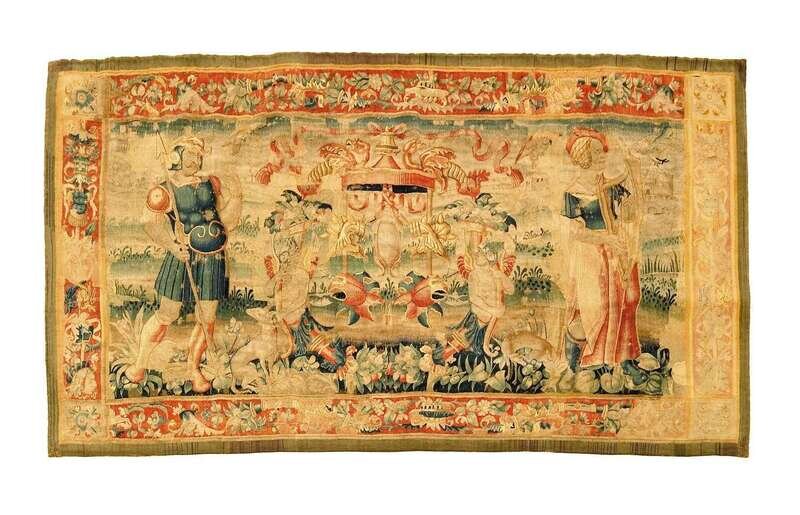
This tapestry depicts a scene from Vertumnus and Pomona from Book XIV of Ovid's Metamorphoses. Pomona was a wood nymph skilled in the care of gardens. She remained secluded in her garden, fending off the advances of suitors. Vertumnus, the Roman god of autumn who had the ability totransform himself, sought to win favor with Pamona. He did so by changing his appearances, including dressing as a fisherman, a reaper, a gardener, a harvester, and as in the present lot, a soldier (W.G. Thomson, A History of Tapestry from the Earliest Times until the Present Day , London, 1930, p. 204). He finally appeared before Pomona disguised as an elderly woman, and then ultimately won her affections by revealing his true self.
The Vertumnus and Pomona tapestry series originally consisted of nine panels (M. Jarry, World Tapestry From its Origins to the Present, New York, 1969, p. 152). The figures depicted in this series are believed to have been designed by Jan Cornelisz Vermeyen (Flemish 1500-1559) (C. Adelson, European Tapestry in the Minneapolis institute of Arts, Minneapolis, 1994, p.153) and the borders are believed to originate from designs by Cornelis Bos (ibid, p. 153, citing H.J. Horn, Jan Cornelisz Vermeyen, Painter of Charles V and His Conquest of Tunis: Paintings, Etchings, Drawings, Cartoons & Tapestries, Doornspijk, 1989). Two sets of Vertumnus and Pomona tapestries, now in the Spanish Royal Collection, were woven by Willem de Pannemaker (Flemish fl. 1535-1578) for Philip II (P. Junquera de Vega and C. Herrero Carretero, Catalogo de Tapices del Patrimonio Nacional Madrid, 1986, Volume I, cat. no's 16 and 17). Two additional sets were woven for Charles V. One of these isnow in the Spanish Royal Collection (ibid, cat. no. 18), one is now in Vienna (L. Baldass, Dier Wiener Gobelinssammlung, Vienna, 1920, cat. no's 146-154).
Five later tapestries, circa 1880-1640, from the series The Garden of Pomona are illustrated in C. Adelson (ibid., cat 14 and figs 65-68)
Another early tapestry from this seris in which Vertumnus appears as a soldier, was in the Kaiser-Friedrich Museum, Berlin. Woven by Jan Raes in the early 17th century; it features Pomona on the left and Vertumnus on the right, the reverse of the composition in the present tapestry (H. Göbel, Tapestries of the Lowlands New York, 1974, no. 104).