Condition Report
Contact Information
Auction Specialist
Lot 118
Sale 1046 - American Historical Ephemera and Photography Featuring the Civil War and American Militaria Collection of Bruce B. Hermann
Lots 1-296
Jun 21, 2022
10:00AM ET
Lots 297-560
Jun 22, 2022
10:00AM ET
Live / Cincinnati
Own a similar item?
Estimate
$500 -
700
Price Realized
$688
Sold prices are inclusive of Buyer’s Premium
Lot Description
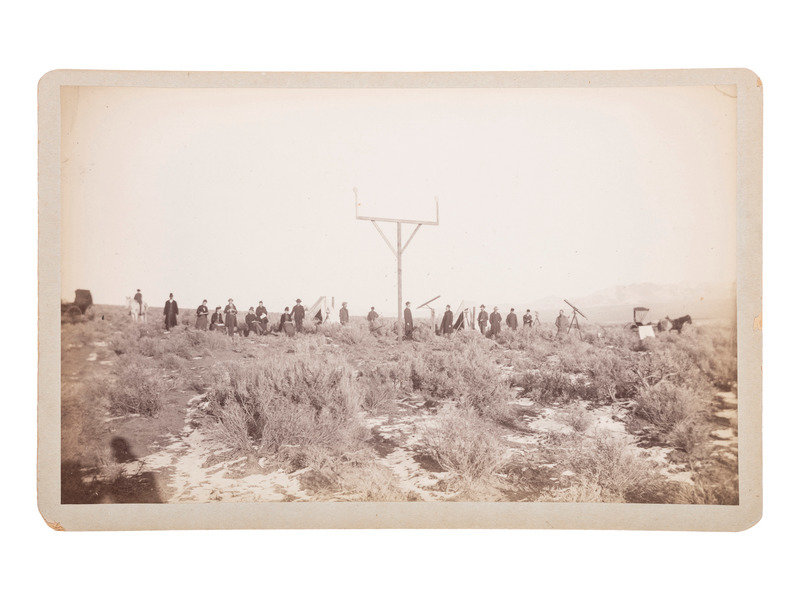
[EARLY PHOTOGRAPHY]. Boudoir photograph of an astronomical party, likely documenting the 1882 transit of Venus.
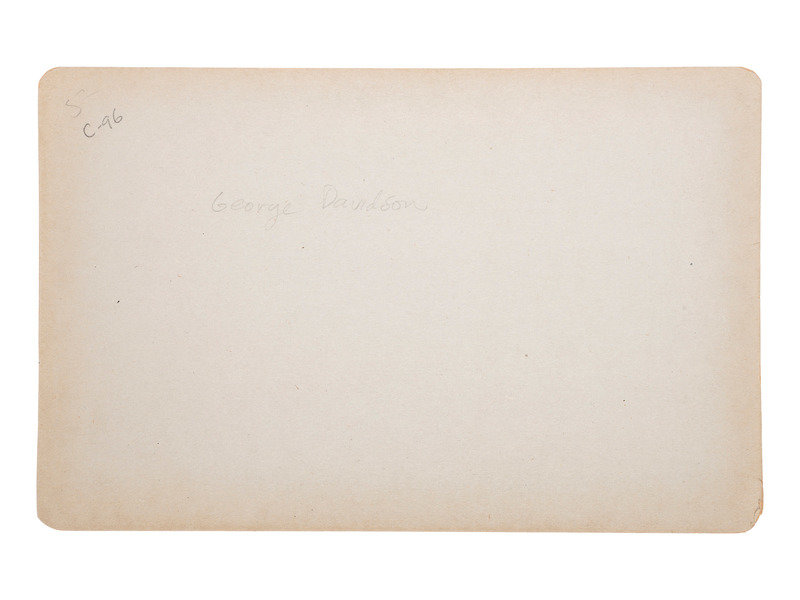
7 7/8 x 4 13/16 in albumen boudoir photograph on 8 7/16 x 5 5/16 in. cardstock mount (minor toning, very light chipping to mount edges). Pencil inscription to mount verso reads: "George Davidson." A pencil inscribed note included with the image identifies the subjects as possibly being the Draper Party observing the 1878 solar eclipse.
An outdoor image of an astronomical survey party of several people, including several seated women, with at least 5 telescopes and observation instruments set up on tripods. Two tents are erected, two horse-drawn buggies are visible in the background, and a telegraph pole is at center.
George Davidson (1825-1911) was an astronomer, geographer, and surveyor. He was a protege of Alexander Bach and joined his work in the United States Coast Survey while also engaging in geodetic fieldwork and astronomy. From 1876 to 1886, he focused on astronomical work on the west coast, including the 1874 U.S. transit of Venus expedition, observation of the total solar eclipse on 7 January 1880, and led the party observing the 1882 transit of Venus in New Mexico.
When in 1874 and 1882 Venus passed in front of the face of the Sun, there was international scientific zeal to observe and record the events. The United States sent out eight well-equipped expeditions for each transit. Under the U.S. Transit of Venus Commission, the responsibility fell to the U. S. Naval Observatory. Relying heavily on photographic methods, the Americans returned 350 plates in 1874, and 1380 measurable plates in 1882, the observations helped to calculate the solar parallax.
While likely an image of the observation party for the 1882 Transit of Venus, it could also be an image of one of the many scientific groups that traveled to the Western United States to view the full totality of the 29 July 1878 solar eclipse. Several groups took advantage of the transcontinental railroad which had opened less than 10 years earlier, setting up multiple camps in Colorado and Wyoming as a way to hedge against potential bad weather. Groups included the Draper Party, which included inventor Thomas Edison, in Rawlins, Wyoming; another set up nearby was led by Étienne Léopold Trouvelot who captured the eclipse and published chromolithographs; astronomer Maria Mitchell led a team of Vassar graduates; a group with planet hunter James Craig Watson.