Claude Mellan
(French, 1598-1688)
The Mockers, ca. 1636-1645
engraving
9 x 7 1/4 inches.
Property from the Joshua B. Kind Trust, Downers Grove, Illinois
Lot Essay:
Claude Mellan’s The Mockers: A Cross Section of Martyrdom and Mythology
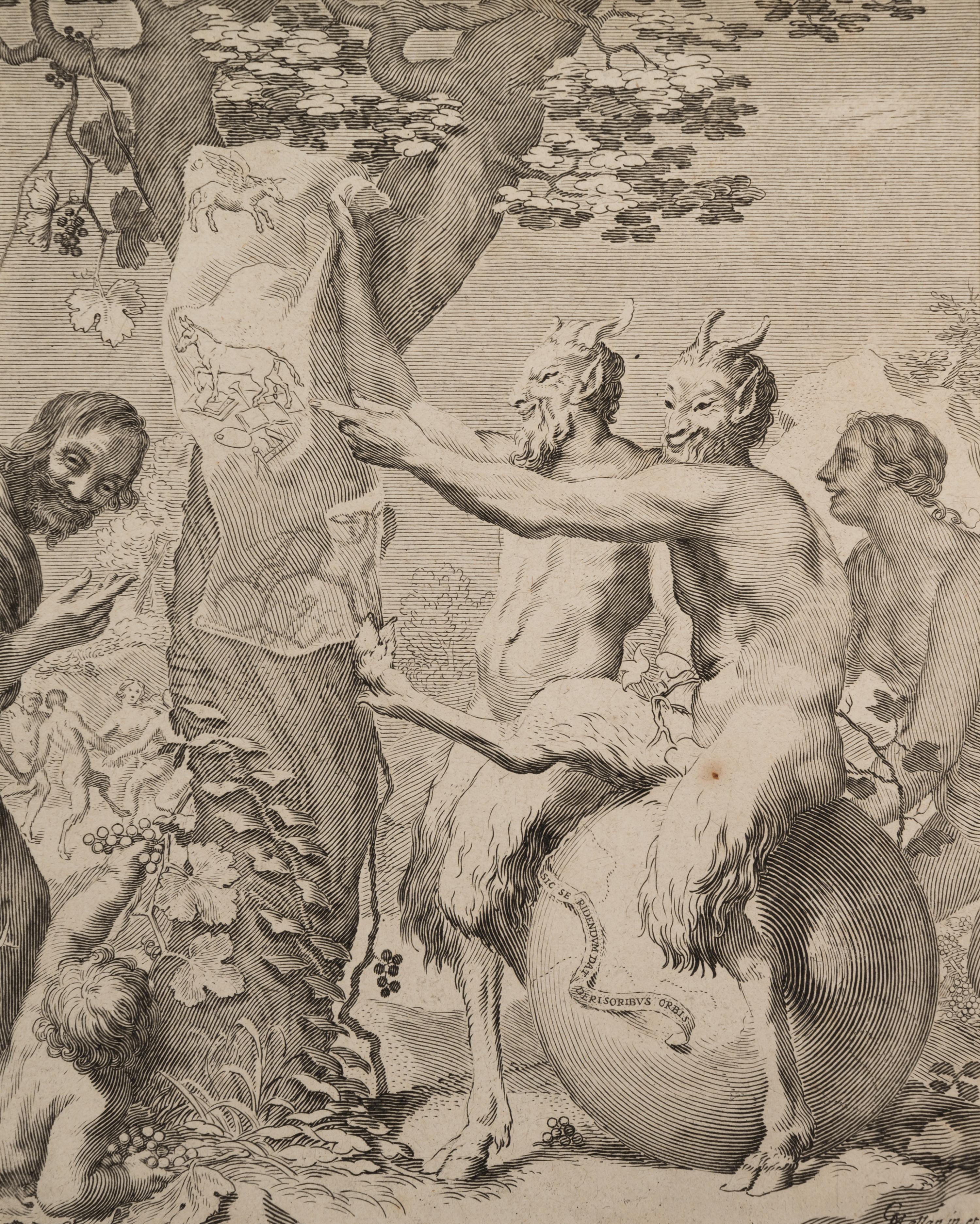
In this impression of Claude Mellan’s engraving, The Mockers (ca. 1636-1645) two satyrs, one sitting on a globe and one standing, gesture to a drawing that they hold pinned to a tree while drunken revelers point and laugh. While this print is an excellent example of Mellan’s signature engraving style, the sources Mellan drew upon in designing the composition are less obvious. To create this novel image of comedic themes, Mellan relied on compositional elements related to the significantly darker scenes of the martyrdom of St. Bartholomew—especially of Jusepe de Ribera’s 1624 etching— and the flaying of Marsyas.
Mellan’s famous engraving style came to be known as "
a une taille," or "with one cut," where, instead of using cross-hatching, the engraver uses a series of hatching in a single direction to define texture and dimensionality.
[i] In
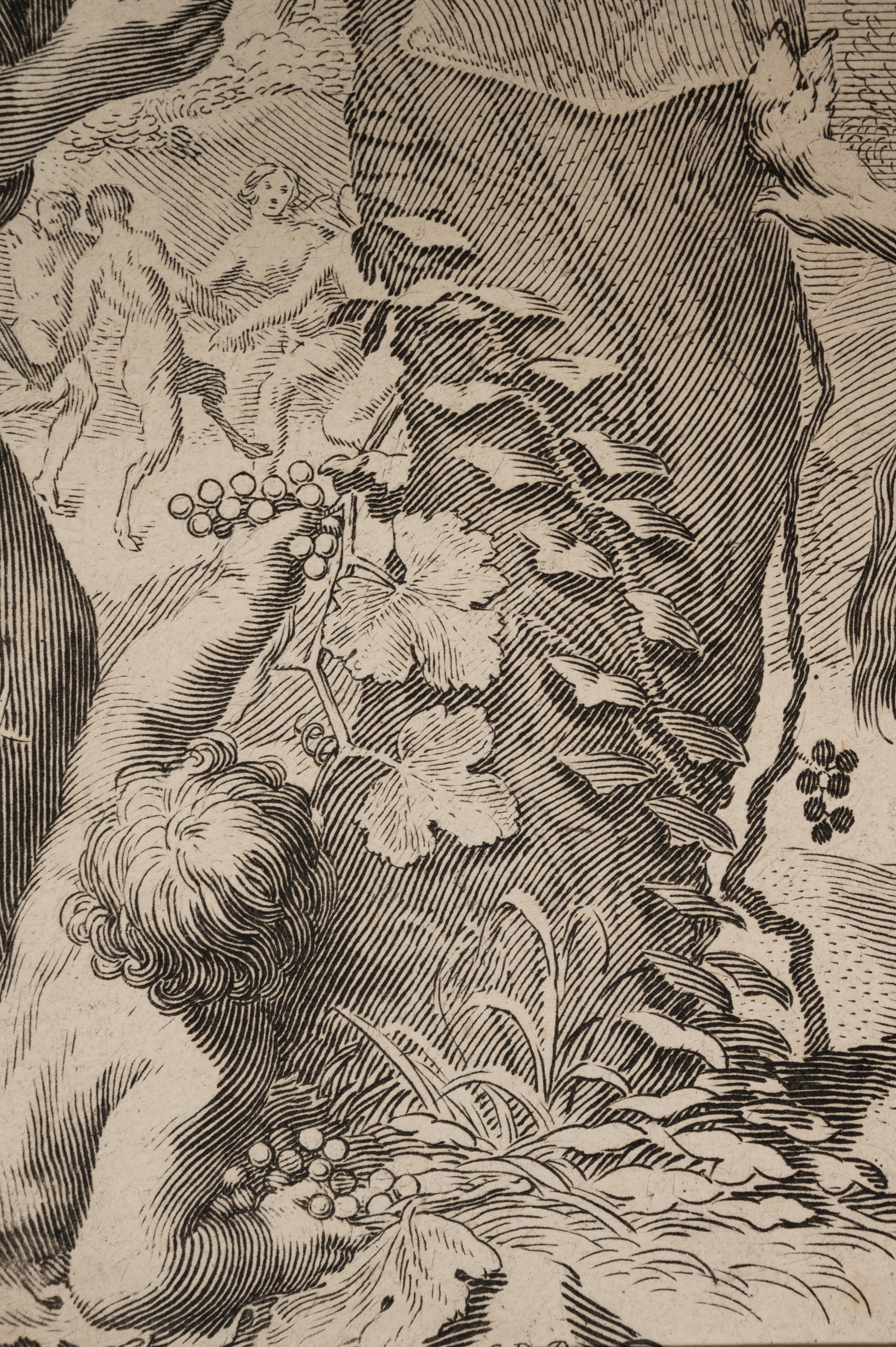
The Mockers, Mellan uses this method of curving series of lines to define form, both varying the density of groups of lines as well as the density of each line itself by exerting different amounts of pressure to the burin. In the lot presented here, a perfect example of this technical skill can be seen in the globe on which the foregrounded satyr sits. Here, Mellan achieves impressive range of depth through the use of parallel line alone, swelling each curved line to create dense shadow and then carving thinner, tapering lines set farther apart on the bottom left of the globe to create larger swathes of negative space and thus more light.
In the bottom right corner are the words “
C Mellan in. et S,” short-hand for “
Claude Mellan invenit et sculpsit,” declaring in Latin that Mellan both invented (
invenit) and engraved (
sculpsit) the work.
[ii] The bottom left bears the initials “
C.P.R,” noting that the work was made “
con privilegio regis” –with royal privilege.
[iii] This engraving was originally used as the frontispiece for the first edition of French writer Paul Scorran’s collection of burlesque plays,
Recueil de quelques vers burlesques (1643).
[iv] Copies of
The Mockers made by Jacques Picart and Stefano della Bella were used for the 1645 and 1648 editions, respectively, of the same publication.
[v] As seen in this lot, by adapting the related themes of the martyrdom of St. Bartholomew and the flaying of Marsyas, Mellan was able to create this image originally suited for a burlesque comedy. He was specifically influenced by Ribera’s 1624 etching,
The Martyrdom of St. Bartholomew. Mellan may have seen this print while lodging with artist and noted print enthusiast, Simon Vouet, while living in Rome.
[vi] In
St. Bartholomew, Ribera depicts the brutal moment where St. Bartholomew is flayed—the vehicle of his martyrdom. The saint is tied to a tree in the composition’s center while a soldier at the right begins to flay him next to another solider and a bystander. A male torso juts into the left of the frame, acknowledging the viewer, while holding a knife towards the saint. This youth was a stock figure of Ribera’s, often playing the role of an executioner, and can be seen in more detail in his 1622 etching,
Small Grotesque.[vii] The similarities between Ribera’s St. Bartholomew and Mellan’s engraving are clear. In both, the main focal point of the composition is pinned to a tree in the print’s center. The setting is outdoors surrounded by rocks and plants. Three figures stand to the right of the tree. The torso of a heavily-shaded man grinning and gesturing towards the central figure draws the viewer into the composition from the left. Even the bend of the front satyr’s hindquarters in The Mockers mimics the bend of the front torturer’s left knee in St. Bartholomew.
Mellan’s engraving is also indebted to the story of St. Bartholomew’s pagan counterpart: the flaying of Marsyas. The flaying of Marsyas, often adapted by early modern artists from the story presented in Ovid’s
Metamorphosis, occurred after Marsyas—a satyr and favorite of Bacchus—lost a musical competition with the god Apollo who, as a punishment for Marsyas’ hubris, proceeded to tie him to a tree and skin him alive.
[viii] While the composition of
The Mockers owes itself to Ribera’s
St. Bartholomew, its characters and props draw inspiration from the mythological themes of the related story of Marsyas.
As seen in this impression, the scene of The Mockers takes place during what appears to be a drunken revelry from mythology, where satyrs like Marsyas are the main focus, while a circle of dancers celebrate in the background underneath the left-most figure’s arm. At the bottom left, a figure reaches up, plucking grapes off the tree. With curly hair and arms defined as small and pudgy by Mellan’s sloping lines, he could be a child Bacchus, Marsyas’ patron. The drawing the figures mock even suits Marsyas’ hubristic theme. The satyrs pin a sheet to the central tree: a drawing of a donkey in three parts. At the bottom, a donkey stumbles over books and drawing materials. In the middle, the donkey turns the book’s pages, appearing to read. Finally, at the top, the donkey—enlightened—has sprouted wings and has begun to fly. The satyrs and fellow Bacchanalian followers laugh at this donkey who has aimed so high above himself, but it is a lesson taught without the brutality of Marsyas’ flaying.
Mellan’s artistic choices and the mockers’ activity are therefore well-suited to the work’s original use as a burlesque frontispiece. Catherine Guillot notes that satyrs and fools often were the focus of seventeenth-century frontispieces of burlesques and comedies.
[ix] Moreover, in describing Della Bella’s 1648 adaptation of
The Mockers, she points out that the Latin inscription spanning the globe beneath the satyr can be translated to mean “The earth makes him laugh at his own face,” meaning that the literal and metaphorical distance created between the comedy on stage and the audience allows viewers to laugh at their own faults.
[x] So, by adapting Ribera’s 1624 format in
St. Bartholomew and the mythological satyrs and themes of hubris in the related story of the flaying of Marsyas, Mellan was able to invert the original violence and tragedy of both stories to instead create a scene of ribald, comic themes, ideal for highlighting the collection of burlesque plays for which this engraving was originally used. This impression gives us a glimpse into the genius of the artist by presenting his adept grasp of these themes while simultaneously highlighting his artistic mastery, awareness of other artistic styles, and unique command of the burin.
-Christina Kiriakos
*for images relating to this text, please request a condition report*
[i] Rebecca Zorach, “‘A secret kind of charm not to be expressed or discerned’: On Claude Mellan's insinuating lines” Res: Anthropology and Aesthetics (2009) 55-56, 240.
[ii] Antony Griffiths, The Print Before Photography. An Introduction to European Printmaking, 1550-1820 (London: The British Museum, 2016), 82-83.
[iii] Ibid., 86.
[iv] Stéphane Lojkine, “Les Satyres, ou les Moqueurs - Claude Mellan,” Utpictura18, last modified January 9th, 2016. https://utpictura18.univ-amu.fr/GenerateurNotice.php?numnotice=A4463. Some writers believe that it was originally made for a work by Charles Coypeau d'Assoucy, another French burlesque writer.
[v] An analysis of Picart’s work can be found here: Barbara Selmeci Castioni, “Analyse - gravure du frontispiece,” Yale University, accessed April 1st, 2021, http://nouvellesnouvelles.yale.edu/gravures/afrontispice.html.Picart’s example can be seen here: Paul Scorran, Recueil de quelques vers burlesques de Mr Scarron, Paris, 1645. Digitized by Bibliothèque Nationale de France, 2007, 4, https://gallica.bnf.fr/ark:/12148/bpt6k72450j/f4.item. Della Bella’s print can be seen here: Catherine Guillot. “Les éditions illustrées d’œuvres dramatiques groupées ou composites, publiées en France dans la première moitié du XVII siècle,” in Le parnasse du thèâtre: Les recueils d’œuvres completes de thèâtre au XVIIesiècle, edited by Georges Forestier, Edric Caldicott, and Claude Bourqui (Paris: Presses de l'Université de Paris-Sorbonne, 2007), 168.
[vi] Zorach, “‘A secret kind of charm not to be expressed or discerned,’” 240.; Griffiths, The Print Before Photography, 259.
[vii] Edward Payne,“Catalogue,” in Ribera. Art of Violence, edited by Edward Payne and Xavier Bray (London: Dulwich Picture Gallery, 2018), 80.
[viii] Ibid., 48.For more information on the artistic relationship between Marsyas and Bartholomew, see: Bray, Xavier. “Ribera. The Shock of the Real.” In Ribera. Art of Violence, 35-54. Edited by Edward Payne and Xavier Bray. London: Dulwich Picture Gallery, 2018.
[ix] Catherine Guillot, “Les éditions illustrées d’œuvres dramatiques groupées ou composites, publiées en France dans la première moitié du XVII siècle,” 167.
[x] Ibid.