To request further details about this lot, please email adamveil@freemansauction.com

Adam Veil
VP, Head of Department, American Art and Pennsylvania Impressionists
Sale 6582
| Philadelphia
| Philadelphia
To request further details about this lot, please email adamveil@freemansauction.com
Adam Veil
VP, Head of Department, American Art and Pennsylvania Impressionists
Estimate$100,000 – $150,000
Provenance:
Gerald Peters Gallery, New York, 1999.
The John and Colles Larkin Collection, Minnesota.
Kramer Gallery, Minneapolis.
Private Collection, Minnesota, acquired from the above.
Exhibited:
New York, Ferargil Galleries, December 1928.
New York, National Academy of Design, 104th Annual Exhibition, March 20 - April 7, 1929, no. 334.
Philadelphia, Pennsylvania Academy of the Fine Arts, 125th Annual Exhibition, January 26 - March 16, 1930, no. 182.
Chicago, Art Institute of Chicago, 43rd Annual Exhibition of American Paintings and Sculpture, 1930, no. 109.
Buffalo, Albright-Knox Art Gallery, 24th Annual Exhibition, 1930, no. 89.
Boston, Casson Gallery, October 13, 1931, no. 2.
Providence, Rhode Island School of Design, December 4, 1932.
St. Louis, St. Louis Art Museum, November 1932.
Literature:
Brooklyn Daily Eagle, December 1928.
Stuart P. Embury, The Art and Life of Luigi Lucioni: A Contribution Towards a Catalogue Raisonné, 2006, no. 28.13; p. 6, 106, illustrated.
Lot Note:
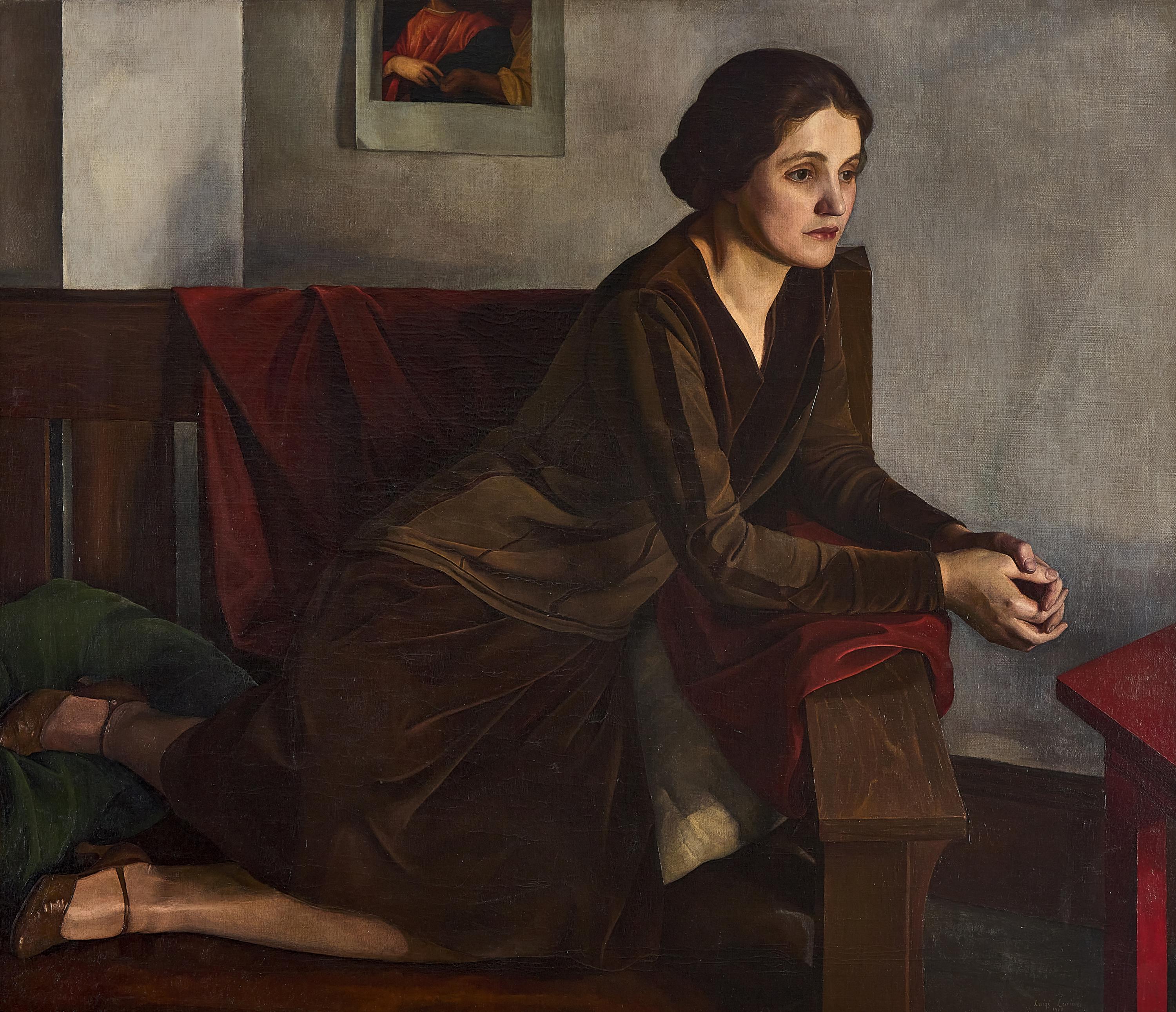
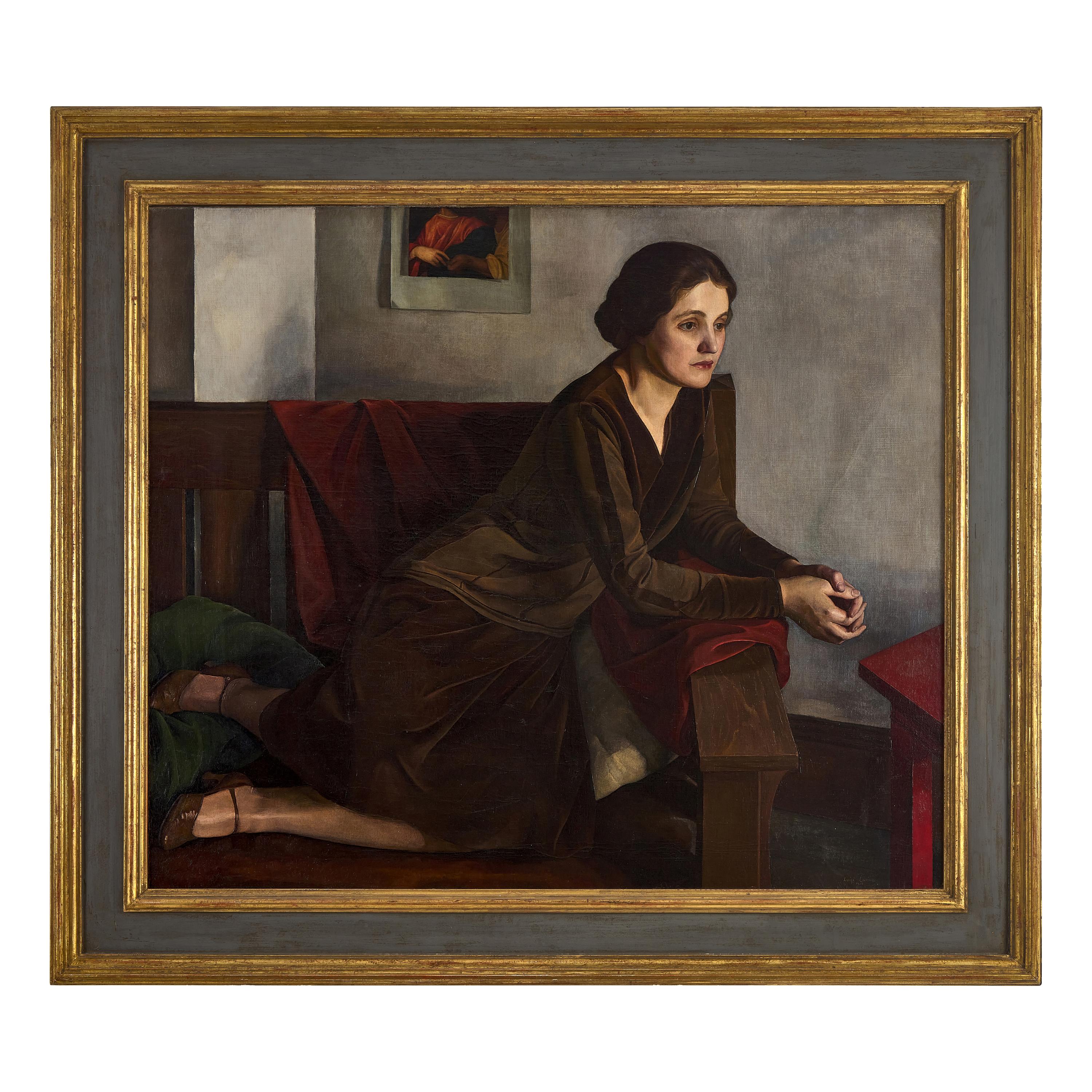
While Luigi Lucioni’s commissioned portraits of society figures and operatic stars rely on theatrical poise and sartorial splendor, the present lot—measuring over three and a half feet wide—strips away public artifice in favor of unguarded familial intimacy. Having emigrated from Italy to New Jersey as a boy, Lucioni maintained deep lifelong ties to his immediate family, frequently turning to his sisters—most notably Aurora, who lived alongside him and managed his household for decades—as trusted studio models. Rather than seating his sitter upright in a conventional frontal pose, Lucioni arranges her diagonally across a heavy wooden settle, kneeling and leaning forward with her forearms resting on the broad armrest and her fingers loosely interlaced. Dressed in a muted olive-brown two-piece ensemble with a dark V-neck trim and brown leather strap shoes, she gazes thoughtfully off to the right, her quiet introspection amplified by the austere, plaster-gray studio walls and the measured geometry of the furniture.
Directly above Aurora, cropped intentionally by the upper edge of the canvas, hangs an unframed reproduction of a detail from Titian’s The Tribute Money (Cristo della moneta, c. 1516, Gemäldegalerie Alte Meister, Dresden)—a deliberate visual quotation that serves as both an art-historical manifesto and a compositional anchor. Focusing on the torso and delicately gesturing hands of Christ draped in vermilion and ultramarine robes, the picture-within-a-picture forms a quiet dialogue with the sister’s own folded hands below while signaling Lucioni’s profound allegiance to Italian Renaissance painting. Following his pivotal 1925 Tiffany Foundation fellowship to Italy, where he studied Giotto, Piero della Francesca, and Titian firsthand, Lucioni rejected the prevailing currents of European modernism in favor of crisp contour, sculptural modeling, and Venetian chromatic richness. Here, he orchestrates a subtle coloristic resonance between Titian’s crimson drapery and the deep red shawl thrown over the wooden bench, echoed once more in the sharp corner of a vermilion table intruding at the lower right.
In its restrained palette, geometric rigor, and hushed psychological atmosphere, My Sister Aurora bridges the domestic realism of seventeenth-century Dutch interiors—recalling Vermeer’s quiet, side-lit rooms—with the cool, structural objectivity of interwar American Precisionism. Lucioni modulates the natural light raking across the gray wall and illuminating the sitter’s face and hands with remarkable subtlety, nowhere more impressively than in his rendering of her olive-brown velvet dress. Rather than relying on heavy impasto, he captures the fabric’s dense, light-absorbing pile through razor-sharp tonal transitions—allowing a soft, silvery sheen to catch the creases of her sleeves and the drape of her skirt while the folds sink into velvety, near-black shadow. Rarely do Lucioni’s canvases achieve this scale while remaining so deeply personal; the work is not only as a tender tribute to a lifelong companion, but as a candid self-portrait of the artist’s own aesthetic convictions.
Framed: 46 x 52 x 2 1/4 in.
The physical condition of lots in our auctions can vary due to age, normal wear and tear, previous damage, and restoration/repair. All lots are sold "AS IS," in the condition they are in at the time of the auction, and we and the seller make no representation or warranty and assume no liability of any kind as to a lot's condition. Any reference to condition in a catalogue description or a condition report shall not amount to a full accounting of condition. Condition reports prepared by Freeman's staff are provided as a convenience and may be requested from the Department prior to bidding.
The absence of a posted condition report on the Freeman's website or in our catalogues should not be interpreted as commentary on an item's condition. Prospective buyers are responsible for inspecting a lot or sending their agent or conservator to inspect the lot on their behalf, and for ensuring that they have requested, received and understood any condition report provided by Freeman's.
Please email adamveil@freemansauction.com for any additional information or questions you may have regarding this lot.