To request further details about this lot, please email adamveil@freemansauction.com
Adam Veil
VP, Head of Department, American Art and Pennsylvania Impressionists
Sale 6582
| Philadelphia
| Philadelphia
To request further details about this lot, please email adamveil@freemansauction.com
Adam Veil
VP, Head of Department, American Art and Pennsylvania Impressionists
Estimate$50,000 – $80,000
Provenance:
Private Collection, New Jersey.
Literature:
Ronald G. Pisano, William Merritt Chase: Portraits in Oil, vol. II, New Haven, 2006, p. 21, no. OP.48, illustrated.
Lot Note:
William Merritt Chase arrived in Munich in 1872 at the age of twenty-three, having briefly studied at the National Academy of Design in New York. His passage was underwritten by patrons in St. Louis. After stops in London and Paris, he settled in Bavaria’s capital, where the Royal Academy attracted a growing number of ambitious Americans. The Munich school favored dark, richly worked canvases, bold handling, and a deep regard for the example of Frans Hals and Velázquez. Chase was initially wary of this idiom but came to master it. Among his teachers was Karl Theodore von Piloty (1826–1886), whose monumental history paintings had made him one of the most celebrated artists in Germany and who became director of the Academy in 1874. Chase regarded the Academy as his true alma mater, and it was there that his talent matured.
In 1877, Piloty commissioned Chase to paint portraits of his children, a distinction reported in the New York Times and one that prepared the way for Chase’s return to the United States the following year as an artist of recognized accomplishment. The date is significant. Chase painted the present work in the same year as Ready for the Ride, the picture that critics would later describe as his “strongest female portrait” and, in 1916, as “equal to any portrait ever painted by an American.” The catalogue raisonné suggests that its success may well have recommended Chase to his teacher. If so, this portrait stands close to the origin of the commission, painted at the moment Chase’s reputation was being established.
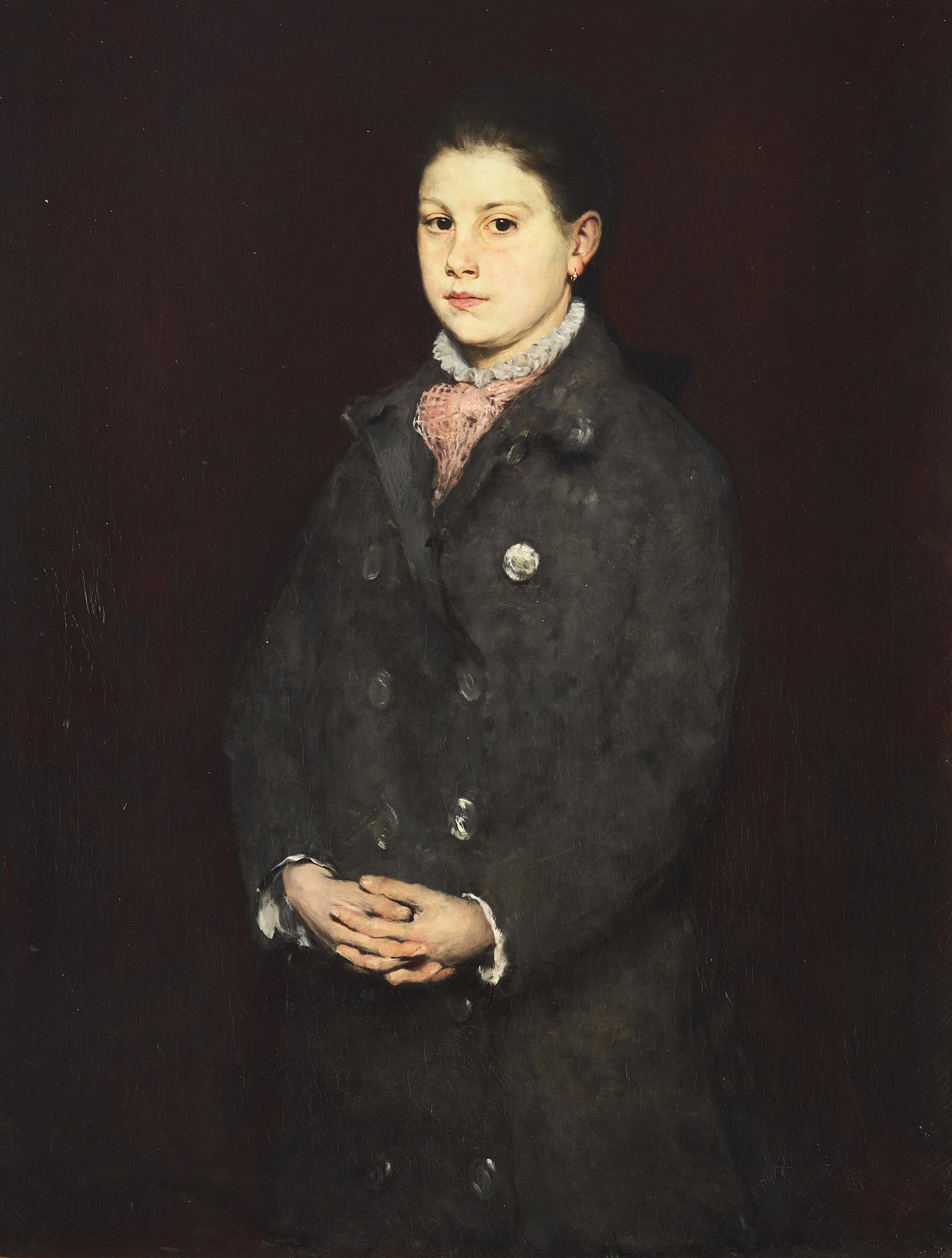
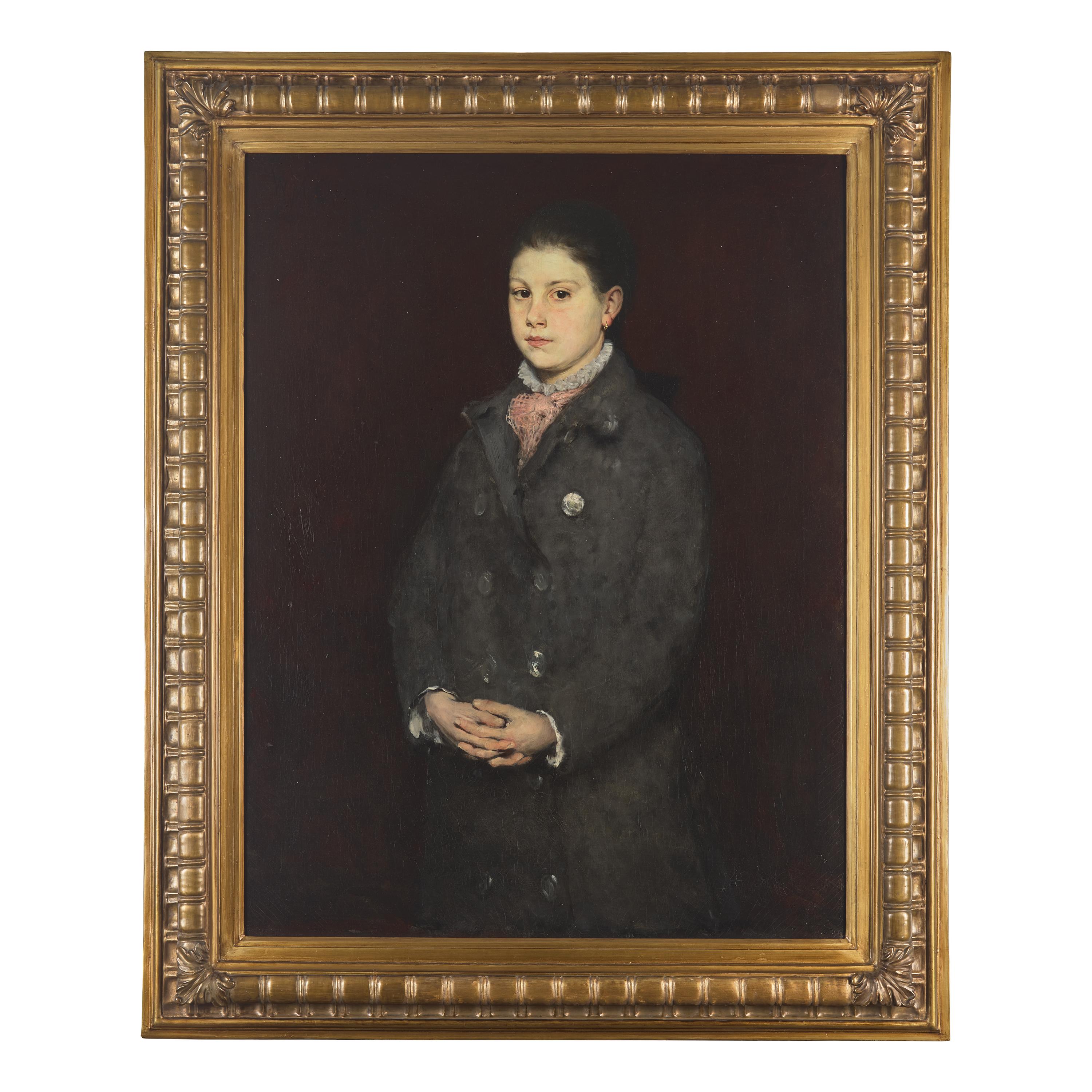
The work also reflects the dual character of Chase’s Munich years. Much of what he absorbed there was the school’s loose, “slapdash” brushwork, seen at its most exuberant in “Keying Up” – The Court Jester (1875, Pennsylvania Academy of the Fine Arts), the picture that won a medal at Philadelphia’s 1876 Centennial Exhibition and first brought him recognition at home. Alongside it, Chase was developing a more refined manner of his own, distinguished by delicate modeling, restrained gesture, and a quieter authority. The Piloty portrait belongs firmly to this second strand. The sitter stands before a dark, atmospheric ground, a device Chase favored throughout his Munich period, turned a quarter-turn to her right while her gaze returns to the viewer. Her clasped hands are drawn with a delicacy that contrasts with the broader handling of her gray double-breasted coat and its large buttons. White ruffles appear at the collar and cuffs, and a pink scarf tied in a bow at the neck supplies the composition’s single note of color, leading the eye upward to the face, the fair hair, and the small loop earrings. Everything is subordinated to the sitter’s presence, and the result is a child portrayed with adult formality yet unmistakably individual.
The painting’s history is of considerable interest. In 1904, two of the Piloty portraits were exhibited at the Grosse Kunstausstellung Dresden, a vast exhibition of thousands of works by leading artists, at which, according to the Chase scholar D. Frederick Baker, Chase was the only American represented. One of the two portrayed Ernst von Piloty, the sitter’s brother. The portraits were subsequently lost from view for more than 125 years and were long presumed lost. Both reappeared in the early 2000s from the same estate in the Allgäu region of Bavaria. The portrait of Ernst was offered at Sotheby’s in May 2004, and the present work was authenticated by Baker that same year and published in the Chase catalogue raisonné as OP.48. Baker recounted the rediscovery in Antiques & Fine Art in 2007. These are the only two of the Piloty portraits known today.
The portrait also anticipates the course of Chase’s later career. Returning to New York in 1878, he took his place among the founders of the Society of American Artists, established his celebrated Tenth Street studio, and became one of the most sought-after portraitists and teachers of his generation. The dark, tonal grounds of Munich gave way in time to a lighter palette and a freer touch, yet the concerns evident here remained central to his portraiture: the careful modeling of a face, the economy of a single accent of color, and the psychological immediacy of the sitter. They can be traced from the society portraits of the 1880s through his affectionate studies of his own children. His association with Philadelphia reinforces the connection. The Centennial Exhibition first brought him to national attention, and from 1896 he taught at the Pennsylvania Academy of the Fine Arts, extending his influence within the city’s artistic community. Seen in this light, the Piloty portrait is both a document of his formative years and an early statement of themes he would pursue for the rest of his career.
The sitter is a daughter of Karl von Piloty, whose household, according to the family chronology in the Neue Pinakothek’s 2003 catalogue, Großer Auftritt: Piloty und die Historienmalerei, included two daughters, Elisabeth, born in 1862, and Johanna, born in 1864. Following its conservation in 2004, the portrait was placed on long-term loan at the Philadelphia Museum of Art, where it remained for more than two decades–a fitting association for the work of an artist whose reputation was first made at the city’s Centennial Exhibition.
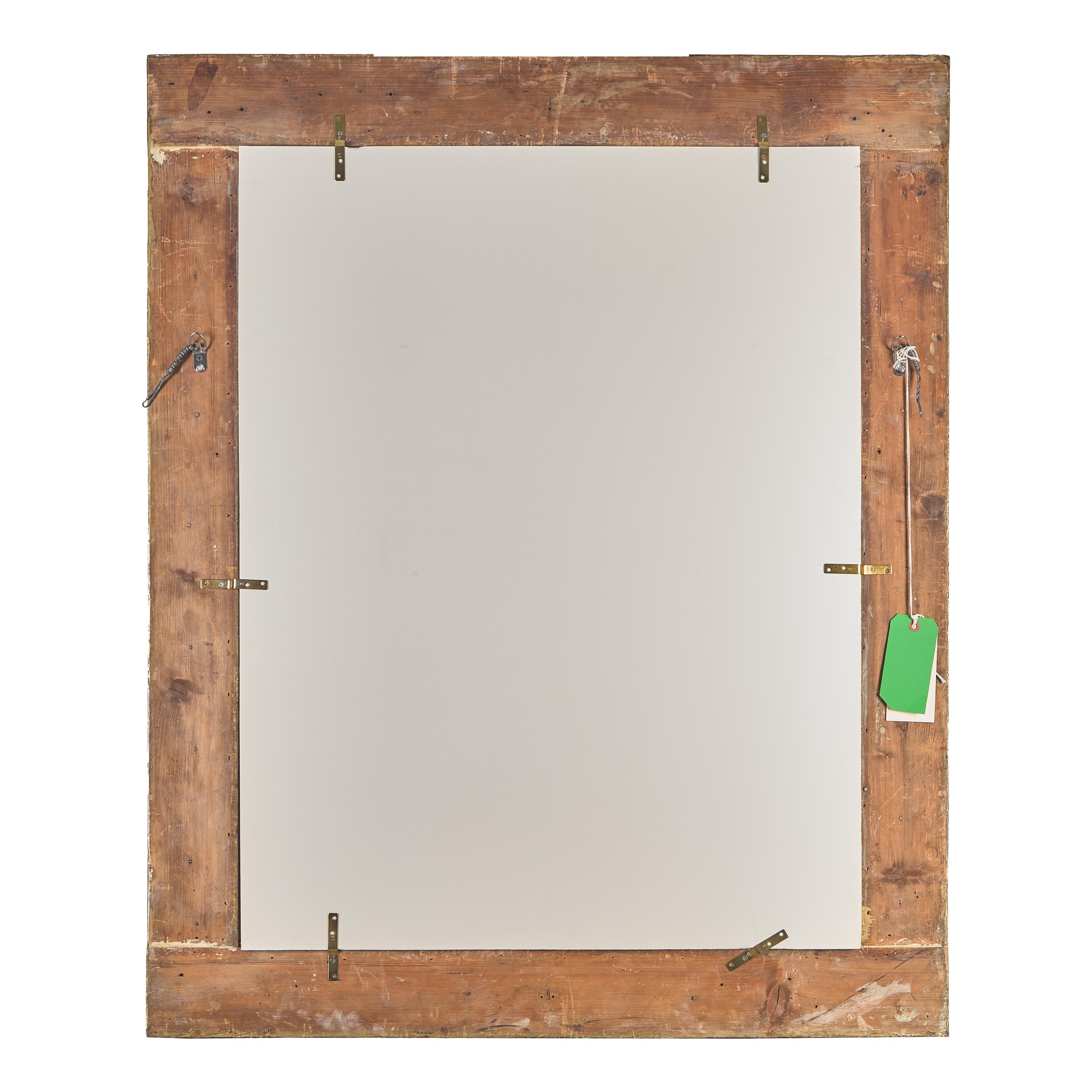
Framed: 49 x 40 x 3 in.
The physical condition of lots in our auctions can vary due to age, normal wear and tear, previous damage, and restoration/repair. All lots are sold "AS IS," in the condition they are in at the time of the auction, and we and the seller make no representation or warranty and assume no liability of any kind as to a lot's condition. Any reference to condition in a catalogue description or a condition report shall not amount to a full accounting of condition. Condition reports prepared by Freeman's staff are provided as a convenience and may be requested from the Department prior to bidding.
The absence of a posted condition report on the Freeman's website or in our catalogues should not be interpreted as commentary on an item's condition. Prospective buyers are responsible for inspecting a lot or sending their agent or conservator to inspect the lot on their behalf, and for ensuring that they have requested, received and understood any condition report provided by Freeman's.
Please email adamveil@freemansauction.com for any additional information or questions you may have regarding this lot.