To request further details about this lot, please email Antiquities@freemansauction.com
Please email Antiquities@freemansauction.com for any additional information or questions you may have
Sale 6578
| Chicago
| Chicago
To request further details about this lot, please email Antiquities@freemansauction.com
Please email Antiquities@freemansauction.com for any additional information or questions you may have
Estimate$7,000 – $9,000
Provenance:
Ward Gallery, New York; where acquired by the present owner, 3 April 1997.
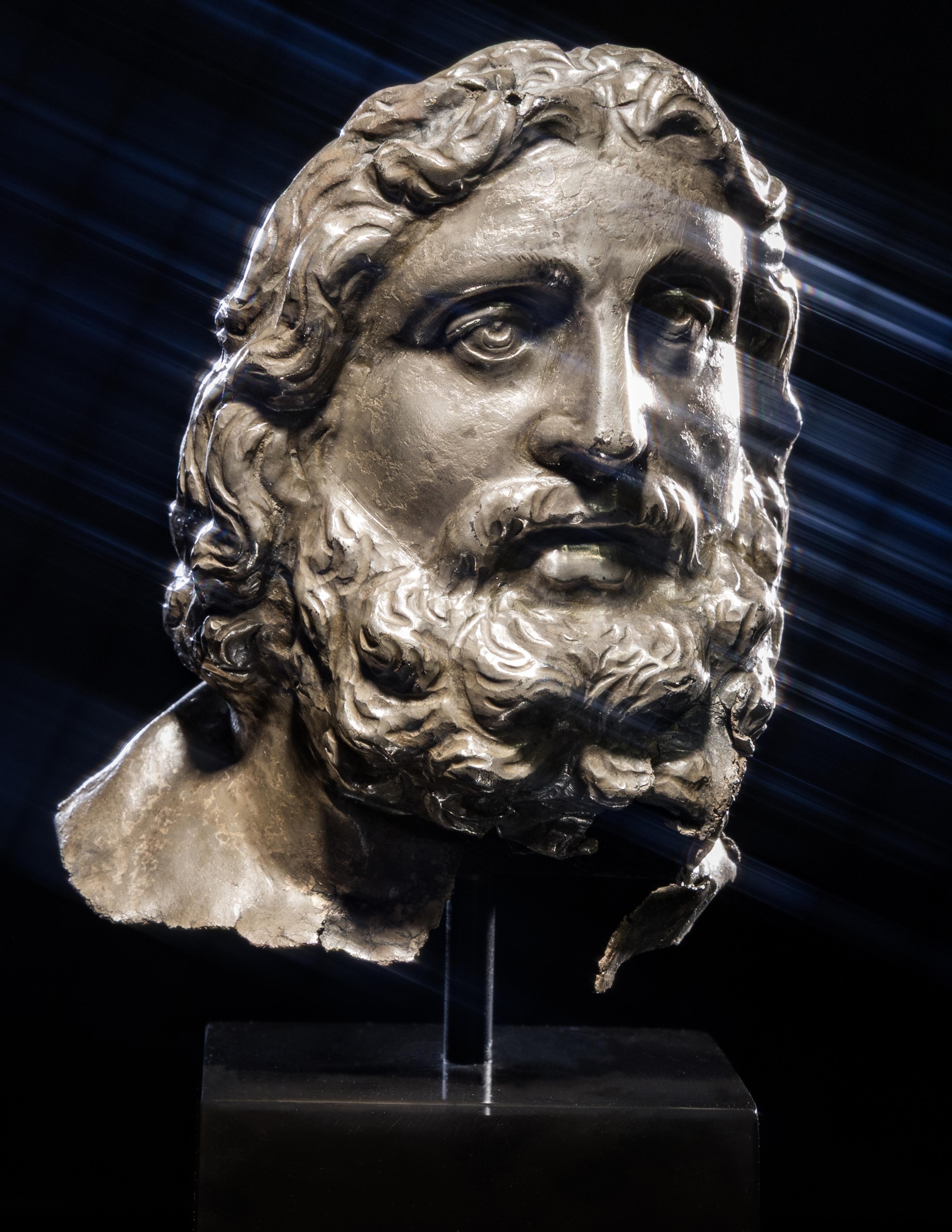
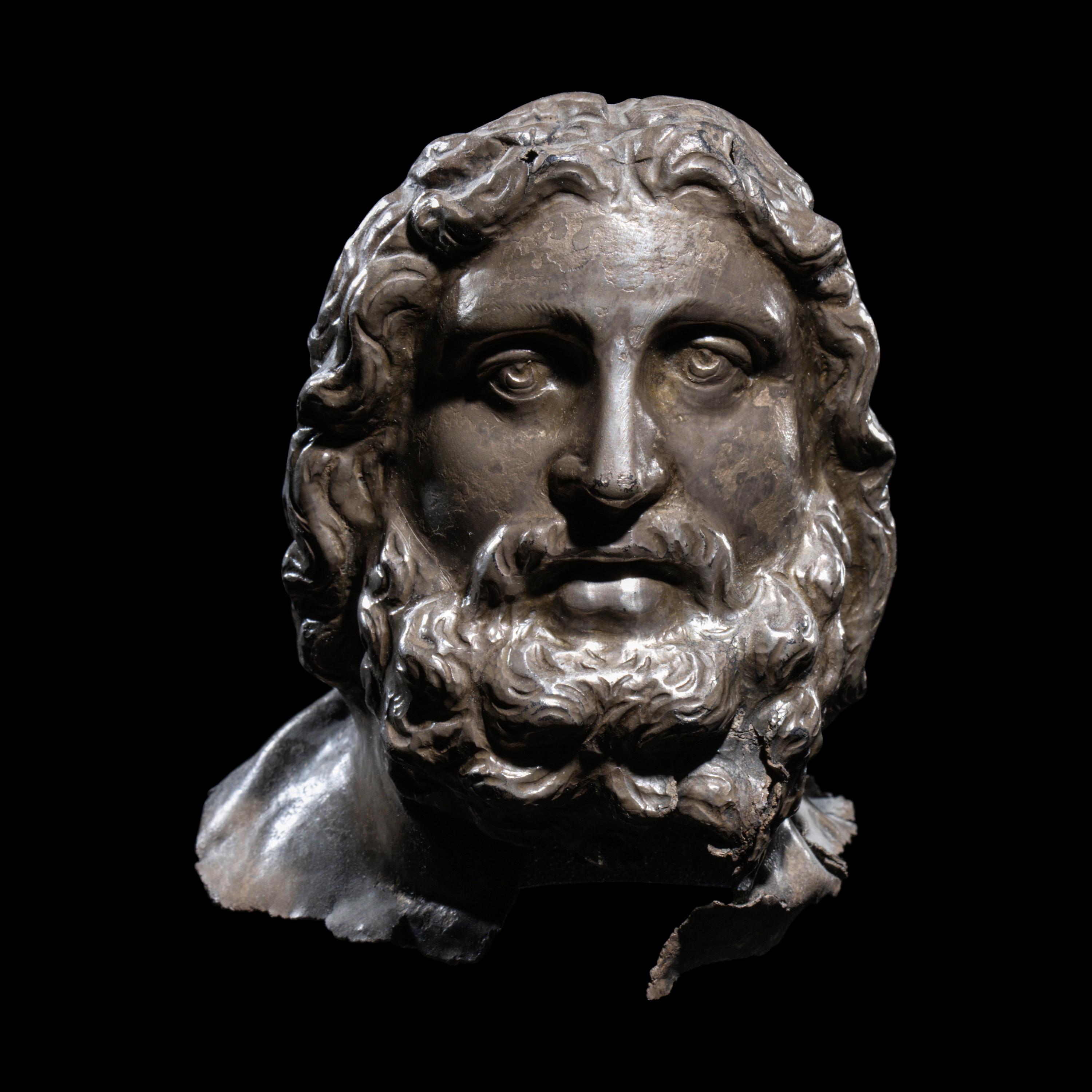
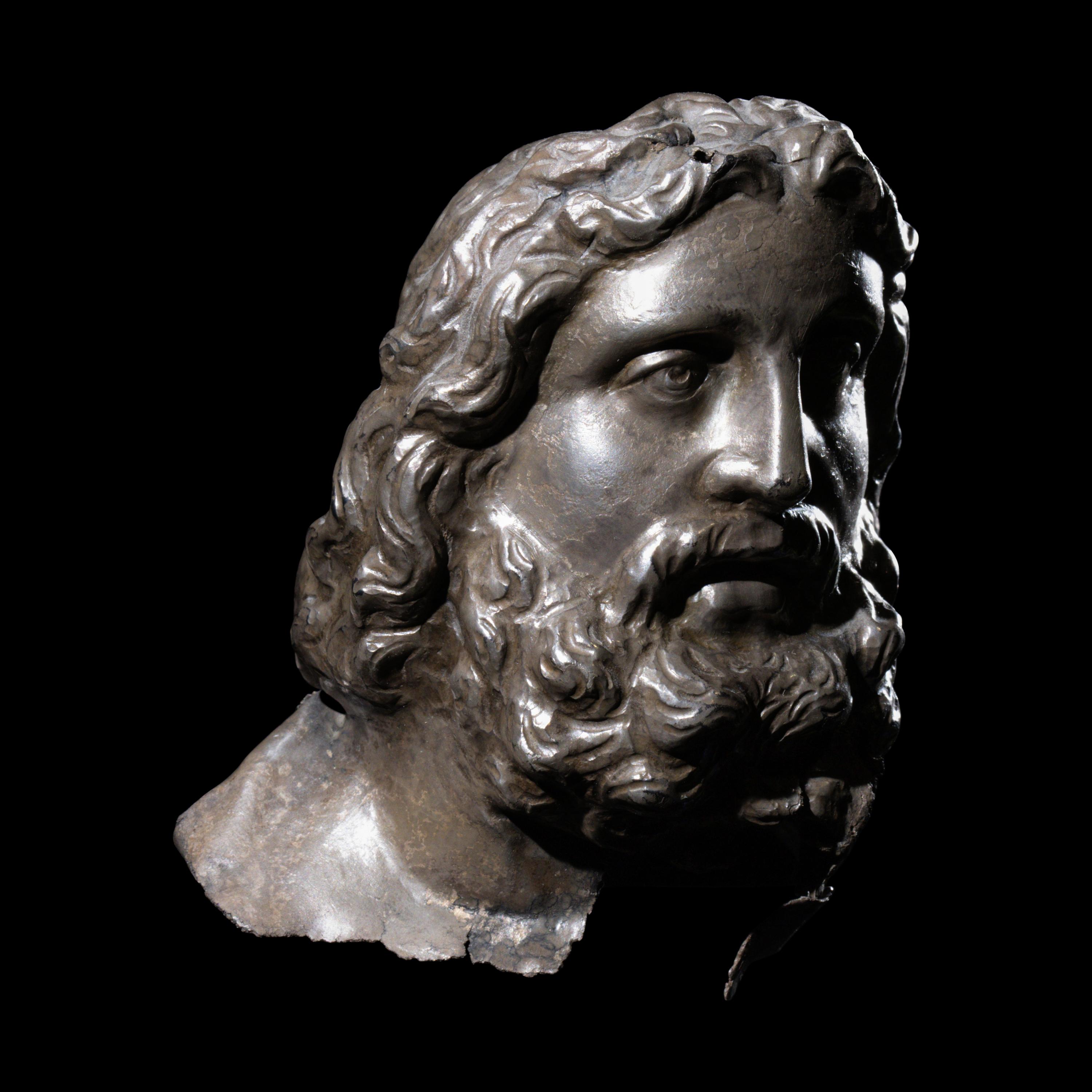
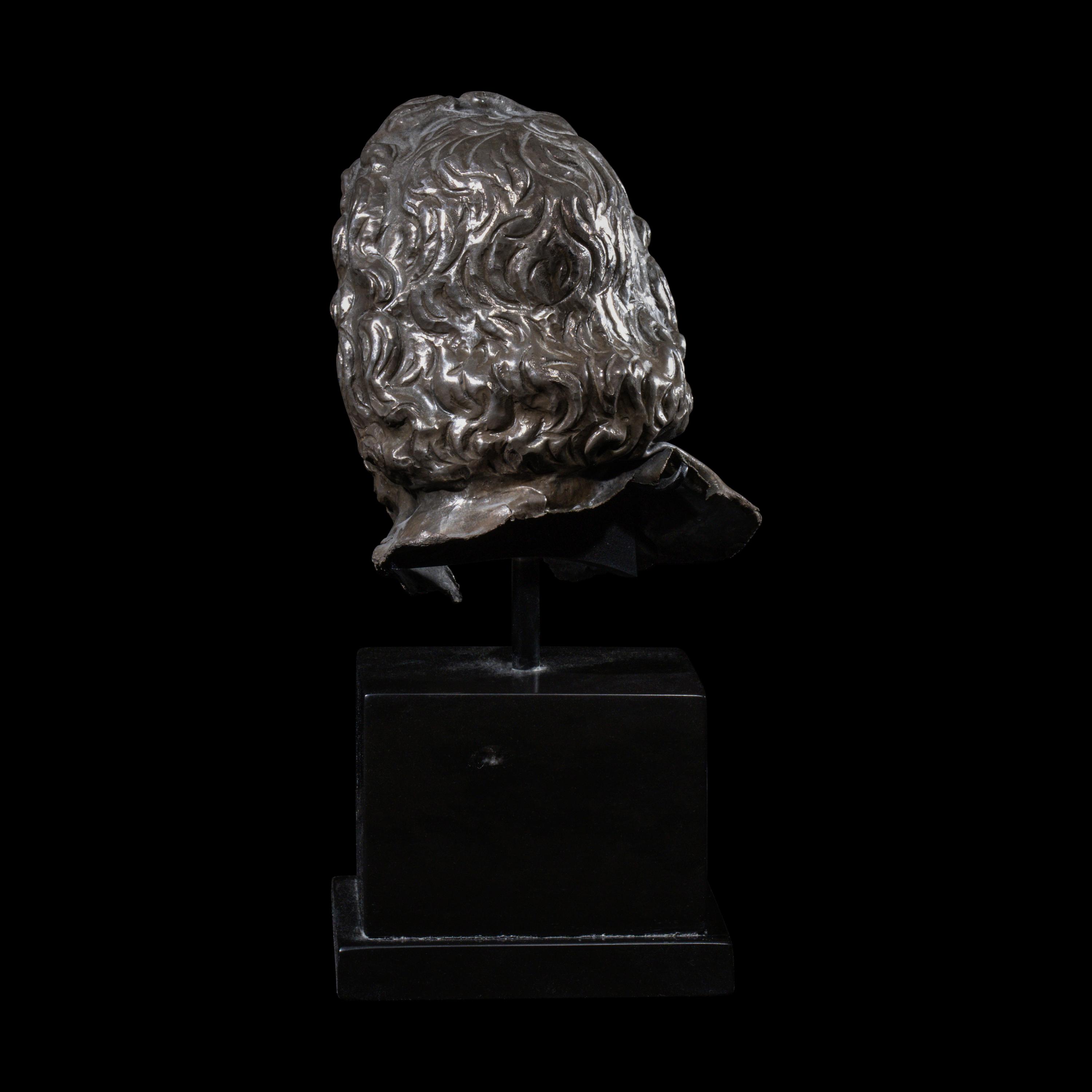
A head of a mature male divinity wrought from hammered silver sheet. Centrally parted, wavy locks frame the face and cascade down the rear of the head in somewhat flatter curls, perhaps a clue that this portrait was made to be seen from front and three-quarter view. A robust moustache descends to a full, layered beard marked with abundant incision. Heavy-lidded eyes, with incised irises and plastically modeled pupils, lend an intense but benevolent gaze and are deeply set beneath the brow ridge and lightly incised eyebrows. The neck is broken irregularly, and the way in which it flares outwards could indicate that the head was once incorporated within (perhaps by insertion) a full-length composition, likely draped.
Determining the identity of the present bearded deity is a challenge in the absence of attributes and more clues as to his original pose. Likewise, the mutability with which Roman artists used the “father-god” mode is not particularly illuminating. Two gods seem most likely: Jupiter (Romanized Zeus, apex of the Olympian pantheon) and Asclepius, the healing god who remained highly popular from his introduction in the late 5th century B.C. Both could be shown seated or standing, and were typically draped in suitably dignified himations. While they are always shown heavily bearded, they notably lack the elaborate bifurcated beard and headgear that characterized Serapis, and share none of the fluidity and wildness typical of Poseidon and other aquatic gods.
The preserved height of the head suggests that the full-sized statuette to which it once belonged would have been outstanding in size, matched only by the most famous works in silver to have survived from antiquity. Among these are the statuette of Mercury from the Berthouville Treasure (Paris, Cabinet des médailles, Inv. no. 56.1; see K. Lapatin, ed., The Berthouville Silver Treasure and Roman Luxury, Los Angeles, 2014, pp. 18–21) and the spectacular bust of Lucius Verus from the Marengo Treasure (Turin, Museo di Antichità). Additional notable statuettes of deities in bronze are relevant to the present head, imposing in scale and quality of craftsmanship. Most have been found in sanctuary settings in Rome’s Gallic provinces, among them the so-called ‘Dinéault Minerva’ (Rennes, Musée de Bretagne, Inv. no. 972.0059.1; see A. Kaufmann-Heinimann, “Function and Use of Roman Medium-Sized Statuettes in the Northwestern Provinces,” in Artistry in Bronze, Los Angeles, 2017). The majority of such votive statuettes have been found in fragmentary states (see M. Witteyer, Göttlicher Baugrund, Mainz, 2003), and one imagines the high cost of the raw materials involved means that yet others were melted down in antiquity.
For a similar example of a bearded deity on this scale, dated to the mid-2nd century A.D. and found in the temple precinct at Dalheim, see the so-called ‘Dalheim Jupiter,’ Paris, Musée du Louvre, Inv. no. MNC 1018 (Br 36).
Height with stand 20.2 cm (8 inches).
The physical condition of lots in our auctions can vary due to age, normal wear and tear, previous damage, and restoration/repair. All lots are sold "AS IS," in the condition they are in at the time of the auction, and we and the seller make no representation or warranty and assume no liability of any kind as to a lot's condition. Any reference to condition in a catalogue description or a condition report shall not amount to a full accounting of condition. Condition reports prepared by Freeman's staff are provided as a convenience and may be requested from the Department prior to bidding.
The absence of a posted condition report on the Freeman's website or in our catalogues should not be interpreted as commentary on an item's condition. Prospective buyers are responsible for inspecting a lot or sending their agent or conservator to inspect the lot on their behalf, and for ensuring that they have requested, received and understood any condition report provided by Freeman's.
Please email Antiquities@freemansauction.com for any additional information or questions you may have regarding this lot.