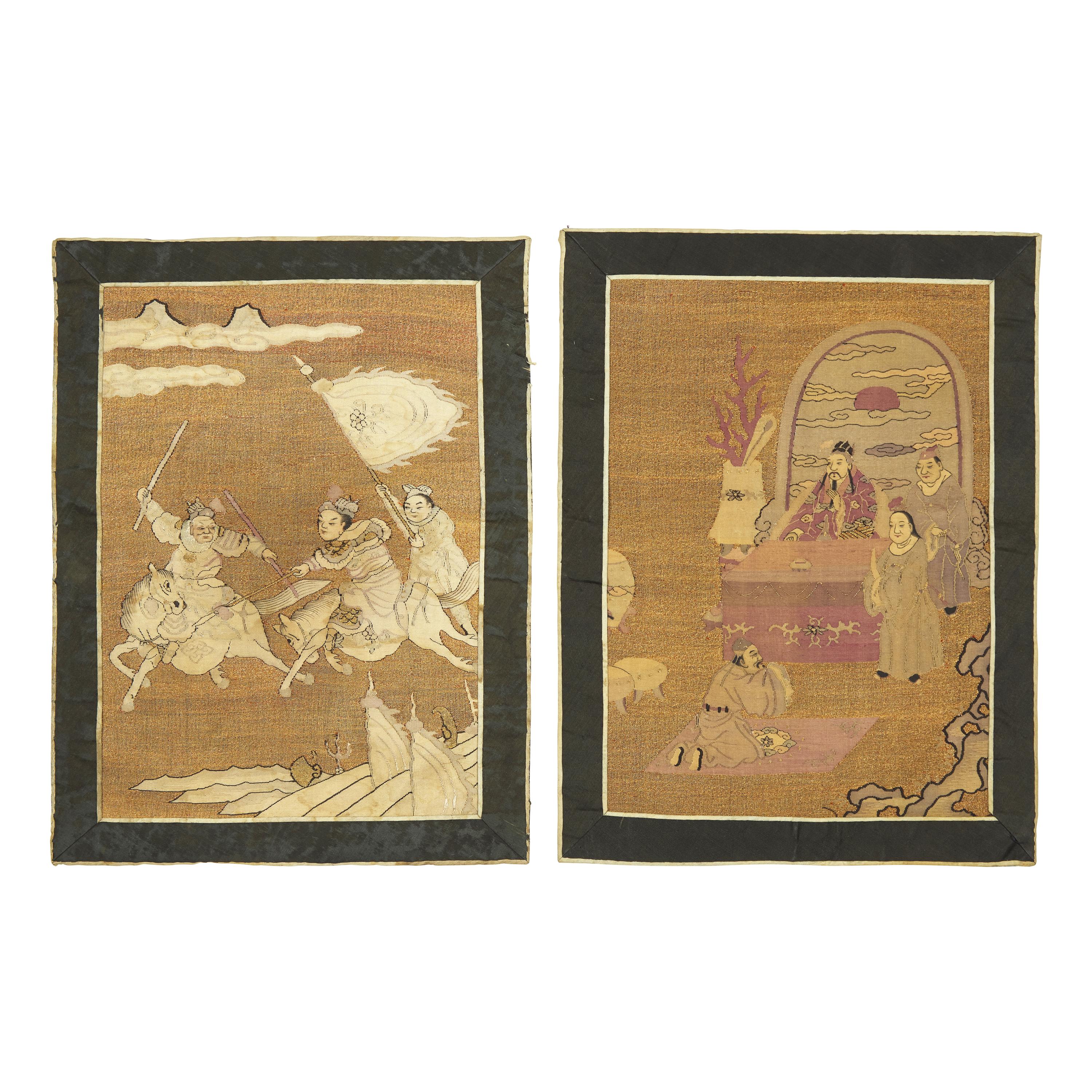
To request further details about this lot, please email asian@freemansauction.com
Please email asian@freemansauction.com for any additional information or questions you may have
Sale 6566
| Chicago
| Chicago
To request further details about this lot, please email asian@freemansauction.com
Please email asian@freemansauction.com for any additional information or questions you may have
Estimate$600 – $800
Property from the Collection of Esther Haviland Farrior (1921–1996) and John Farrior (1920–1989), New York.
The Haviland–Farrior Collection was formed by Esther Underhill Haviland Farrior (1921–1996) and John McMullen Farrior (1920–1989), whose lives were deeply intertwined with China during a period of profound historical transition. The majority of the works were acquired in China between 1947 and 1950 and have since descended within the family.
Esther Haviland Farrior belonged to the inaugural cohort of Fulbright scholars in China. After completing graduate study in Chinese studies at Columbia University under Professor Carrington Goodrich (傅路德), she traveled to Beijing in 1947 and enrolled at Tsinghua University, where she studied ancient Chinese inscriptions under the eminent scholar Chen Mengjia (陳夢家). Specializing in Shang dynasty oracle bones and early bronze culture, she pursued research at a moment when the intellectual and political landscape of China was rapidly shifting. As Communist forces approached Beijing in 1948, she relocated to the Tsinghua campus to continue her studies, supporting herself by teaching English while remaining immersed in archaeological research.
Her relationship with Chen Mengjia extended well beyond the seminar room. In July 1949, when Esther married John McMullen Farrior in a garden ceremony in Beijing, it was Chen Mengjia who walked her down the aisle. Their wedding invitation was preserved among Chen’s personal papers, later encountered by scholars researching his life and work.
John McMullen Farrior, raised in China as the son of Presbyterian missionaries who lived there from 1910 to 1949, returned to Beijing in 1948 as a career U.S. Foreign Service Officer. Following their marriage, the couple’s diplomatic postings took them across East and Southeast Asia, including Seoul, Bangkok, Hong Kong, Kuala Lumpur, Tokyo, and Ankara. Throughout decades of movement across cultures, they continued to collect with discernment and scholarly sensitivity.
Shaped by Esther’s archaeological training and John’s lifelong familiarity with China, the Haviland–Farrior Collection reflects not only aesthetic appreciation but lived experience. It stands as a testament to a generation of scholars and diplomats whose personal histories were inseparable from the cultural worlds they inhabited.
來源:
Esther Underhill Haviland Farrior(1921–1996)與 John McMullen Farrior(1920–1989)夫婦遺產。1947-1950年間購於中國,此後家族遞藏。
Esther Haviland Farrior 為最早一批赴華的傅爾布萊特學者。早年就讀於哥倫比亞大學,師從漢學先驅傅路德(Carrington Goodrich),1947年前往北京,入清華大學,師從著名學者陳夢家,研習商代甲骨文與早期青銅文化。
她與陳夢家的關係不僅止於師生。1949年7月,Esther 與 John McMullen Farrior 於北京成婚,陳夢家主婚,牽著她步入禮堂。婚禮請柬保存於陳夢家的私人檔案,後來成為研究其生平的學者所見的史料之一。
John McMullen Farrior 出生長老會傳教士之家,父母于20世紀早期長期駐扎中國,從事傳教活動於中國。1948年他以美國外交官身分重返北京任職。婚後,夫婦二人隨外交任命輾轉東亞與東南亞多地,包括首爾、曼谷、香港、吉隆坡、東京與安卡拉。所蓄藏品見證了一代學者與外交官的生命軌跡,個人歷史與所置身的文化世界密不可分。
Additional photos are updated before the sale via this link https://asian.smugmug.com/Sale-6566. Please read the above or contact us to request a complete condition report.
品相细图见链接 https://asian.smugmug.com/Sale-6566,品相报告见上文。图录中未说明品相的拍品并不等没有磨损、瑕疵等问题,请买家拍前自行检查。落槌无悔,请对您的竞拍行为负责。如有其他问题,邮件asian@freemansauction.com。
The physical condition of lots in our auctions can vary due to age, normal wear and tear, previous damage, and restoration/repair. All lots are sold "AS IS," in the condition they are in at the time of the auction, and we and the seller make no representation or warranty and assume no liability of any kind as to a lot's condition. Any reference to condition in a catalogue description or a condition report shall not amount to a full accounting of condition. Condition reports prepared by Freeman's staff are provided as a convenience and may be requested from the Department prior to bidding.
The absence of a posted condition report on the Freeman's website or in our catalogues should not be interpreted as commentary on an item's condition. Prospective buyers are responsible for inspecting a lot or sending their agent or conservator to inspect the lot on their behalf, and for ensuring that they have requested, received and understood any condition report provided by Freeman's.
Please email asian@freemansauction.com for any additional information or questions you may have regarding this lot.