To request further details about this lot, please email fineart@freemansauction.com
Please email fineart@freemansauction.com for any additional information or questions you may have
Sale 6565
| New York
| New York
To request further details about this lot, please email fineart@freemansauction.com
Please email fineart@freemansauction.com for any additional information or questions you may have
Estimate$8,000 – $12,000
Provenance:
The Artist.
Mrs. C. M. Cooke, probably directly from the Artist, 1915.
Honolulu Art Museum, gift from the above, 1927.
An unknown New York dealer, deaccessioned by the above, 1954.
Lyman P. Johnson, Minneapolis, acquired from the above, by 1957.
Walter & Lois Hopf, Minneapolis, acquired from the above, 1960.
Hess Fine Arts, St. Petersburg, Florida, acquired from the above, 2003.
Acquired from the above by the present owner, 2003.
Exhibited:
Chicago, Art Institute of Chicago, October 19 - November 28, 1909, p. 28, no. 167 (as Waiting).
Paris, Salon de Société des Artistes Français, 1910, no. 1251.
San Francisco, Panama-Pacific International Exposition, 1915, no. 2464 (as Waiting).
Lot Note:
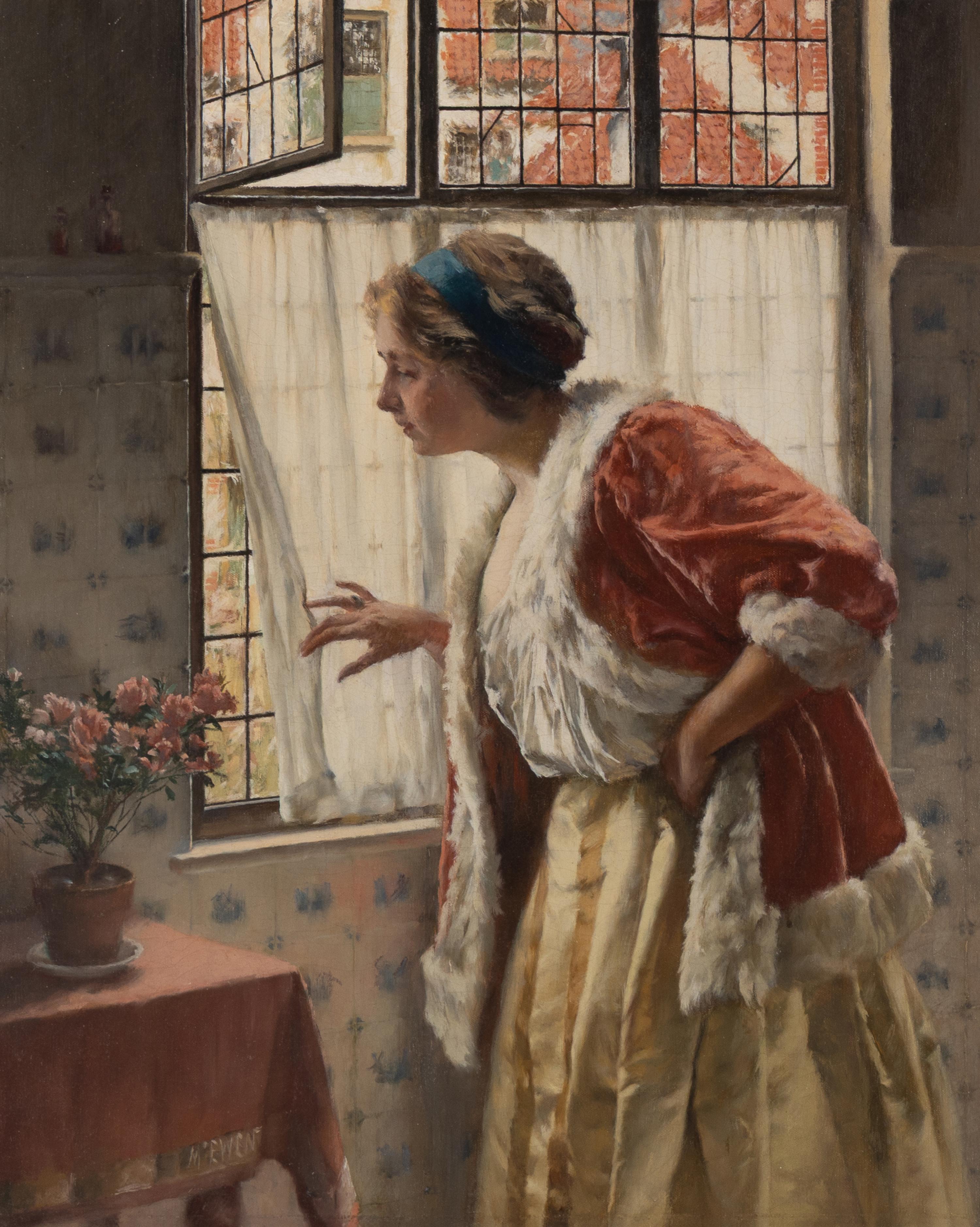
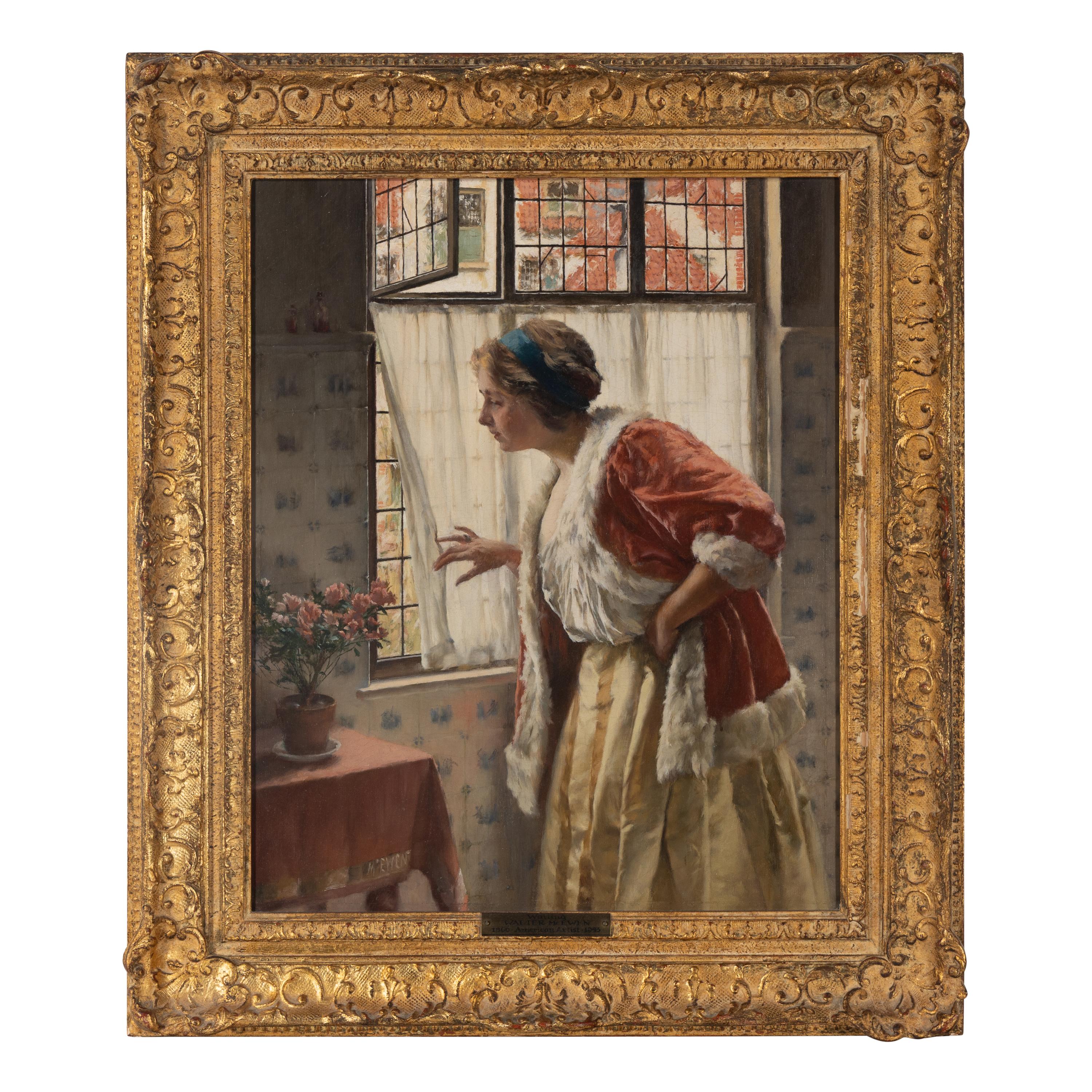
L’Attente showcases Walter MacEwen at his finest, featuring a young and attractive woman posed in a charming interior, the wall partially lined with Delft tiles and a flowering potted plant atop a small table draped with a cloth. The woman gently pulls the sheer curtain aside as she peers expectantly out the mullioned windows. Her attire of a brick-red velvet jacket trimmed with fur atop a yellow satin skirt conveys a sense of soft femininity, as well as a comfortable station in life. A pleasing visual contrast is created by the color of the velvet jacket, echoed in the tablecloth and the roof tiles visible through the windowpanes, which are complemented by the blue of the woman’s headband and the bright yellow of her skirt.
The meticulous rendering of the present work exemplifies MacEwen’s training. Originally from Chicago, he left America as a teenager in 1877 for Munich, where he studied at the Royal Academy under Cincinnati artist Frank Duveneck. MacEwen then moved to Paris in 1881 for further studies at the Académie Julian, where he received instruction from Fernand Cormon and Tony Robert-Fleury. It was from Munich he absorbed the method of painting figures in interiors cast in dramatic chiaroscuro, and from Paris he learned to render the figure with strong, carefully delineated accuracy.
In 1883, MacEwen took a transformative trip to Holland with fellow American expatriates George Hitchcock and Gari Melchers. The three artists went on to co-establish an art colony in the small town of Egmond aan Zee, about 20 miles northwest and west of Amsterdam. With its coastal, sandy dunes, the area had been attractive to artists, including Jacob van Ruisdeal, since the seventeenth century. Melchers, Hitchcock, and MacEwen eventually became the most prominent American expatriates in Holland, with a preference for Dutch subjects. However, his counterparts favored more colorful, high-key, often impressionistic, painterly styles, with the landscape being a significant component of their paintings, while MacEwen mostly adhered to a polished style of figure painting set in interiors.
MacEwen spent three years in Egmond, but ultimately moved his permanent residence to Paris, returning to Holland frequently to paint in Haarlem, Volendam, and Hattem, where he briefly maintained a studio. The artist exhibited both internationally and in America and he became one of the most awarded and decorated American artists of his time. MacEwen exhibited the present work in Chicago in 1909, the 1910 Paris Salon, and in 1915, at the Panama-Pacific International Exposition in San Francisco. It was likely from San Francisco exhibition that the first owner, Mrs. C. M. Cooke, acquired the painting. Once in the collection of the Honolulu Museum of Art, to whom it was gifted by Mrs. Cooke, the work has a direct line of provenance leading to the current owner.
Framed: 28 1/2 x 24 1/4 in.
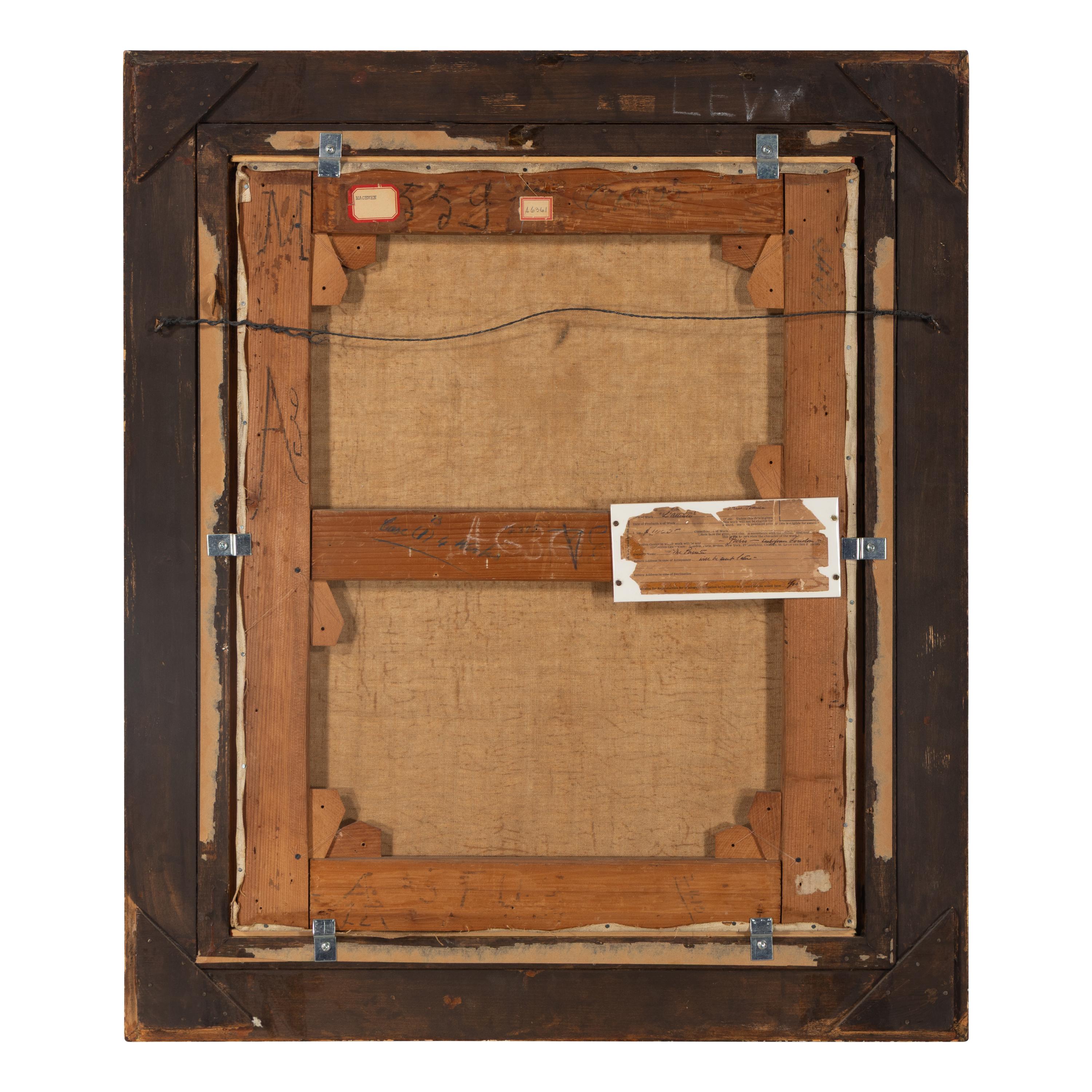
Canvas is unlined. Moderate deposits of surface dirt and dust; network of craquelures throughout. Pinpoint white droplets in scattered areas. A thin horizontal line of inpainting extending along the upper and lower edges, visible under normal viewing conditions. Under UV light: the aforementioned lines of inpainting fluoresce; inpainting along the edge of the woman's nose and a small area to her upper cheek, as well as in her hair along the headband edge; pinpoint spots of inpainting within the woman's jacket and lower edge of the skirt, the curtains, and left portions of the wall; additional dots of inpainting in scattered areas along the left edge. Additional images available upon request.
The physical condition of lots in our auctions can vary due to age, normal wear and tear, previous damage, and restoration/repair. All lots are sold "AS IS," in the condition they are in at the time of the auction, and we and the seller make no representation or warranty and assume no liability of any kind as to a lot's condition. Any reference to condition in a catalogue description or a condition report shall not amount to a full accounting of condition. Condition reports prepared by Freeman's staff are provided as a convenience and may be requested from the Department prior to bidding.
The absence of a posted condition report on the Freeman's website or in our catalogues should not be interpreted as commentary on an item's condition. Prospective buyers are responsible for inspecting a lot or sending their agent or conservator to inspect the lot on their behalf, and for ensuring that they have requested, received and understood any condition report provided by Freeman's.
Please email fineart@freemansauction.com for any additional information or questions you may have regarding this lot.