To request further details about this lot, please email adriannewolkenberg@freemansauction.com
Raphaël Chatroux
VP, Head of Department, Impressionist & Modern Art
Sale 6559
| New York
| New York
To request further details about this lot, please email adriannewolkenberg@freemansauction.com
Raphaël Chatroux
VP, Head of Department, Impressionist & Modern Art
Estimate$60,000 – $100,000
We would like to thank Roswita and Viktor Pontzen, Archiv und Werkbetreuung Albert Birkle, Salzburg, for their research and kind support.
Provenance:
The Artist, until 1978.
Neue Münchner Galerie, Munich, by 1980.
Marvin and Janet Fishman Collection, Milwaukee.
A gift from the above.
The Cardinal Stritch University, Milwaukee.
A gift from the above to the present owners.
Exhibited:
Berlin, Johannes Hinrichsen im Künstlerhaus Berlin, Bellevuestraße, Sonder-Ausstellung Albert Birkle, Sept. 3 - 30, 1927, no. 22.
Berlin, Preußische Akademie der Künste zu Berlin, Frühjahrsausstellung, May - June 1928, no. 18.
Tuttlingen, Germany, Kleine Galerie Stadt Tuttlingen, Albert Birkle, June - July 1979.
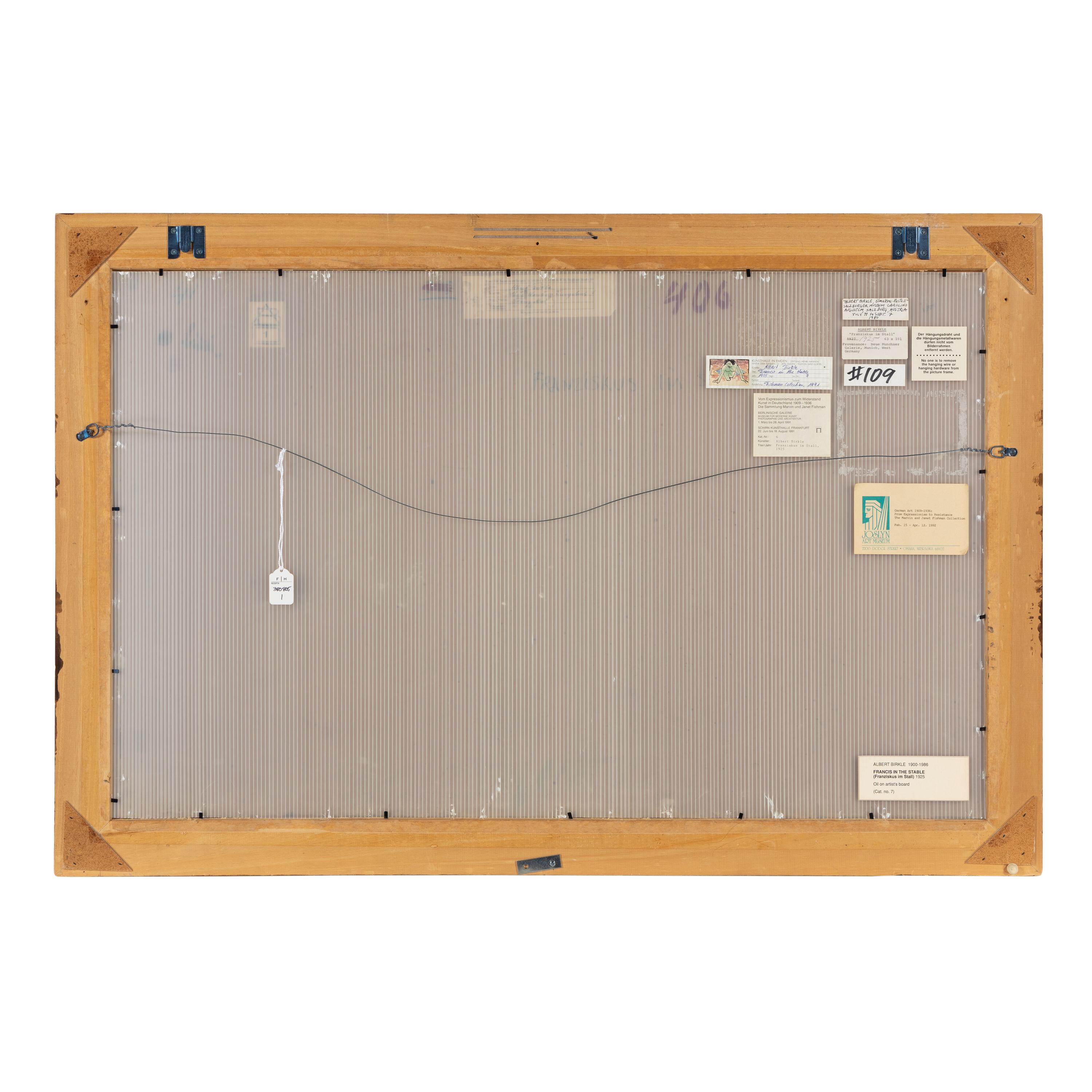
Salzburg, Germany, Salzburger Museum Carolino Augsuteum, Albert Birkle, Ölmalerei und Pastell, July 11 - Sept. 7, 1980, no. 20, illustrated.
Milwaukee, Milwaukee Art Museum, German Art 1909-1936: From Expressionism to Resistance, The Marvin and Janet Fishman Collection, Dec. 6, 1990 - Feb. 3, 1991, pp. 28-29; 164-165, no. 7, illustrated (erroneously dated to 1925; and traveling to Berlinische Galerie, Museum fur Moderne Kunst, March 1 - April 28, 1991; The Jewish Museum, New York, Nov. 21, 1991 - Jan. 25, 1992; Joslyn Art Museum, Omaha, Nebraska, Feb. 15 - April 19, 1992; High Museum, Atlanta, June 6 - Aug. 30, 1992).
Literature:
Listed in the digital catalogue raisonné by Roswita and Viktor Pontzen, Salzburg, under no. 772.
Sylvia Kraker, Albert Birkle, 1900-1986, Ph.D. dissertation, Leopold-Franzens-University, Innsbruck, 1992, no. 653.
Essay:
Albert Birkle was born in Charlottenburg (later part of Berlin), Germany in 1900, and raised
in a family of artists. His maternal grandfather and father were both painters, and Birkle grew up working as a decorative painter alongside his father, apprenticing at his company. In 1918, he attended the Hochschule für die bildenden Künste (College of Fine Arts) in Berlin, the present Universität der Künste, and studied with Arthur Kampf and Ferdinand Spiegel. Later, he joined the Berlin Secession and the Association of Berlin Artists in 1921, studying with Max Liebermann.
Birkle was associated early in his career with the Neue Sachlichkeit (New Objectivity) artists, a group which included George Grosz, Otto Dix, and Max Beckmann. The group formed during the Weimar Republic (1919-1933), the era between the two World Wars and before the rise of the Nazi Party. During this period, artists moved away from Expressionism and its visual language of Romanticism toward a realism they felt was more befitting of the new circumstances they faced in the aftermath of the First World War.
While Birkle’s work did include some of the common themes of the group, portraits of workers and scenes of urban decay, he diverged from his counterparts by dedicating significant time to religious themes, particularly crucifixions, while still employing a style characterized by elongated, often malnourished-looking, haunting figures. In the post-World War II years, he made a living painting church murals and frescoes while living in Austria.
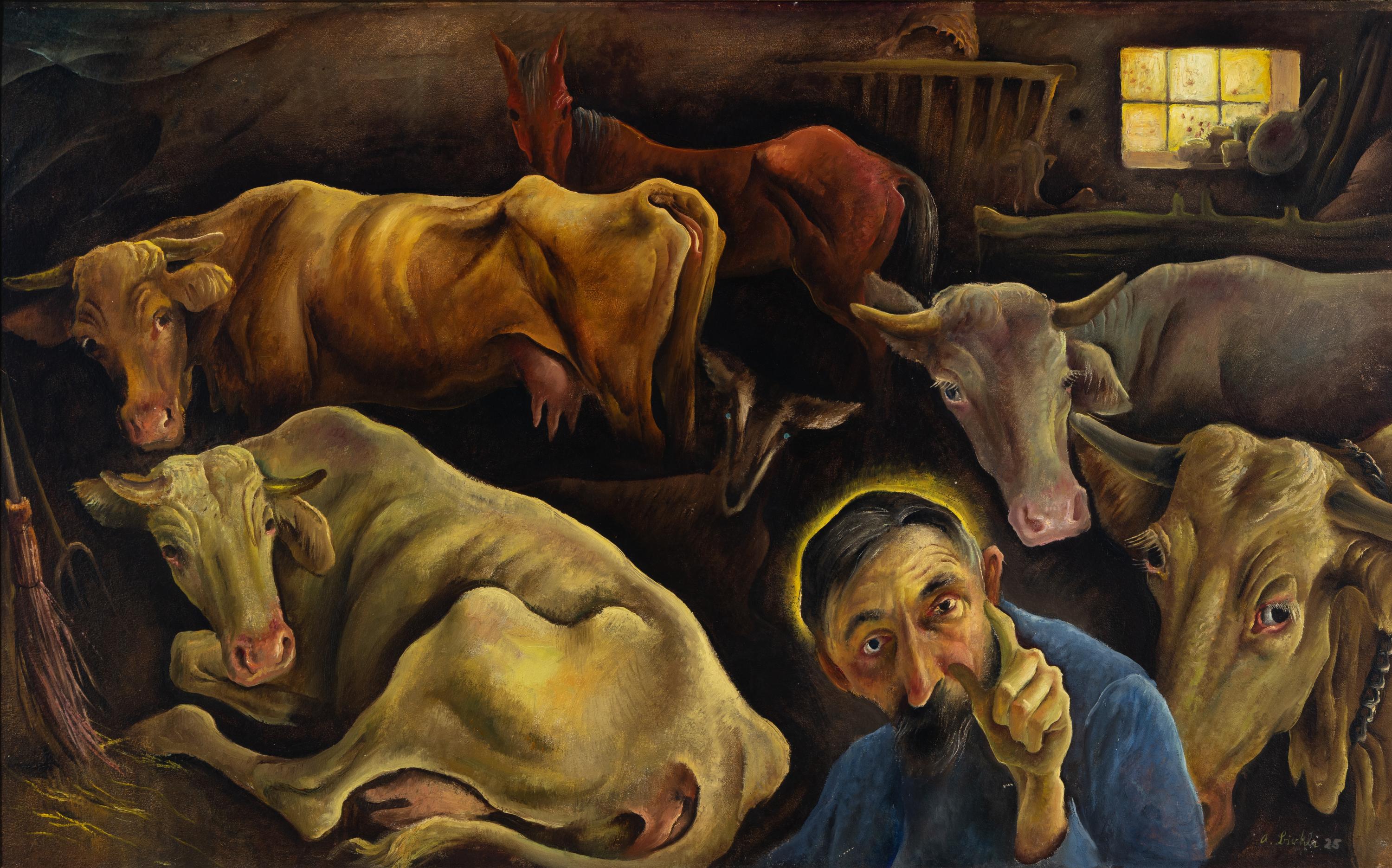
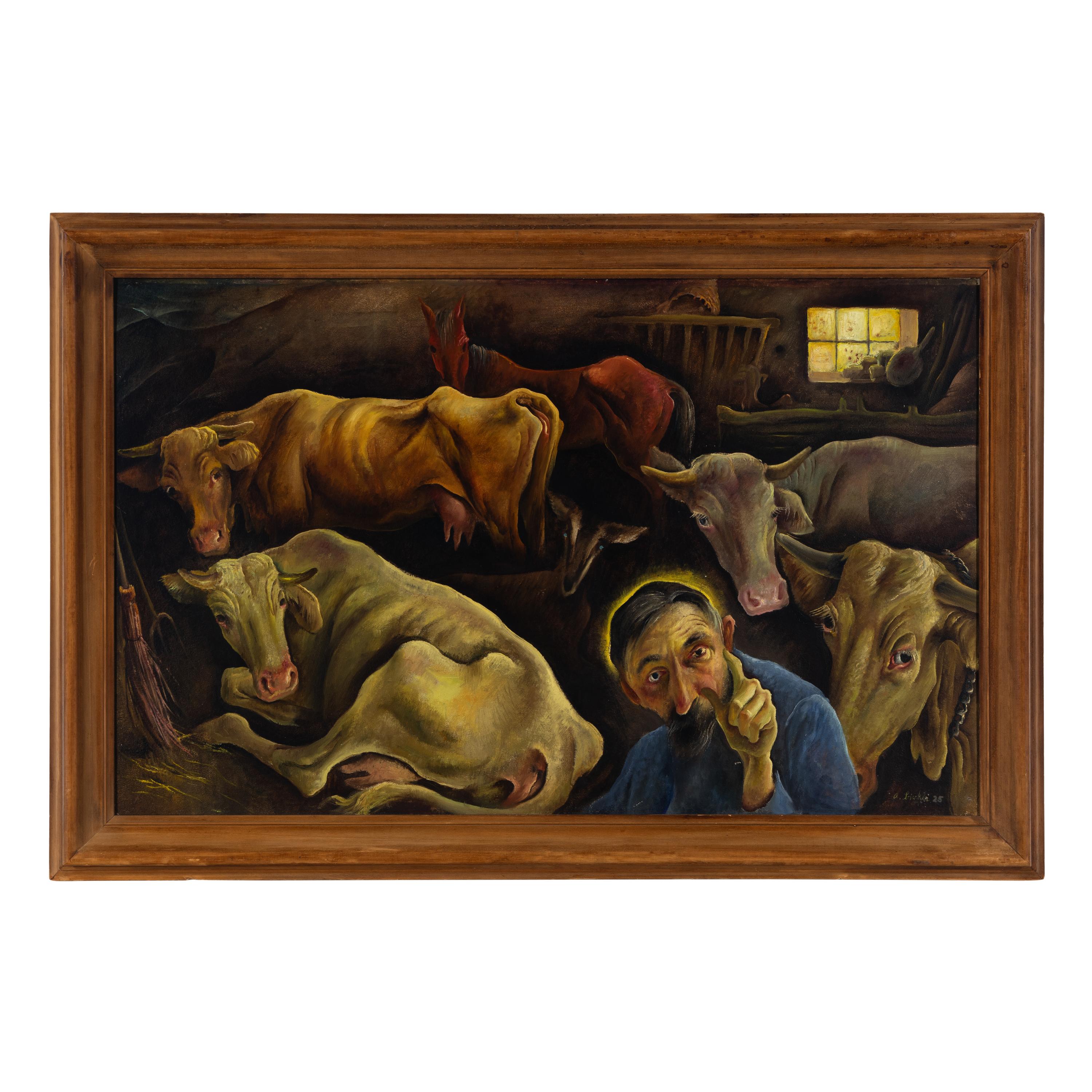
In the present painting, Francis in the Stable (Franziskus im Stall) from 1925, Birkle places Saint Francis of Assisi in a barn surrounded by cows, a goat, and a horse, with only the glow from a high window behind him, and the saint’s small halo, to light the intimate scene. St. Francis lifts a finger to the viewer as well as to the animals, in instruction,
benediction, or warning, as St. Francis understood all creatures to be children of God and therefore the brothers and sisters of man. Preaching humility, simplicity, and piousness, St. Francis sheds a single tear for humanity, for the ills of society.
Birkle believed the artist had a responsibility to “bring something of the breath of a higher spirituality. It is no more than a very modest contribution, but it seems to me that the artist today is called upon more than anyone else—and I hope that he shall succeed with his meager powers—to preserve the human for humanity” (Pfefferkorn, Albert Birkle: Leben und Werk, 1983, p. 97).
The painting was formerly part of the Marvin and Janet Fishman Collection, acquired during the artist’s lifetime from the Neue Münchner Galerie in Munich. The Fishmans later donated the work to Cardinal Stritch University, a school founded and sponsored by the Sisters of St. Francis of Assisi and the Franciscan religious order, which closed in 2023.
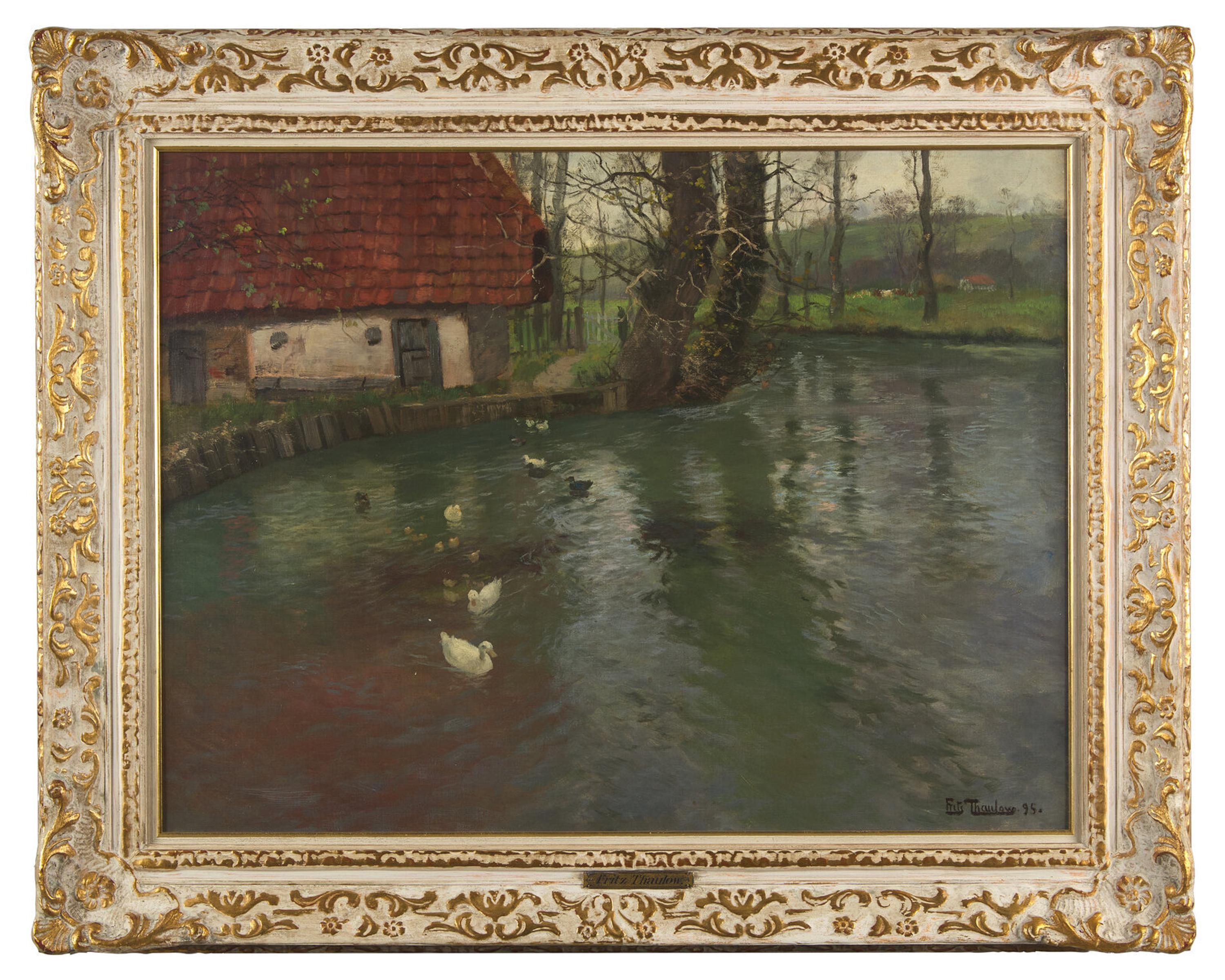
Framed: 30 1/2 x 45 1/2 in.
The physical condition of lots in our auctions can vary due to age, normal wear and tear, previous damage, and restoration/repair. All lots are sold "AS IS," in the condition they are in at the time of the auction, and we and the seller make no representation or warranty and assume no liability of any kind as to a lot's condition. Any reference to condition in a catalogue description or a condition report shall not amount to a full accounting of condition. Condition reports prepared by Freeman's staff are provided as a convenience and may be requested from the Department prior to bidding.
The absence of a posted condition report on the Freeman's website or in our catalogues should not be interpreted as commentary on an item's condition. Prospective buyers are responsible for inspecting a lot or sending their agent or conservator to inspect the lot on their behalf, and for ensuring that they have requested, received and understood any condition report provided by Freeman's.
Please email adriannewolkenberg@freemansauction.com for any additional information or questions you may have regarding this lot.