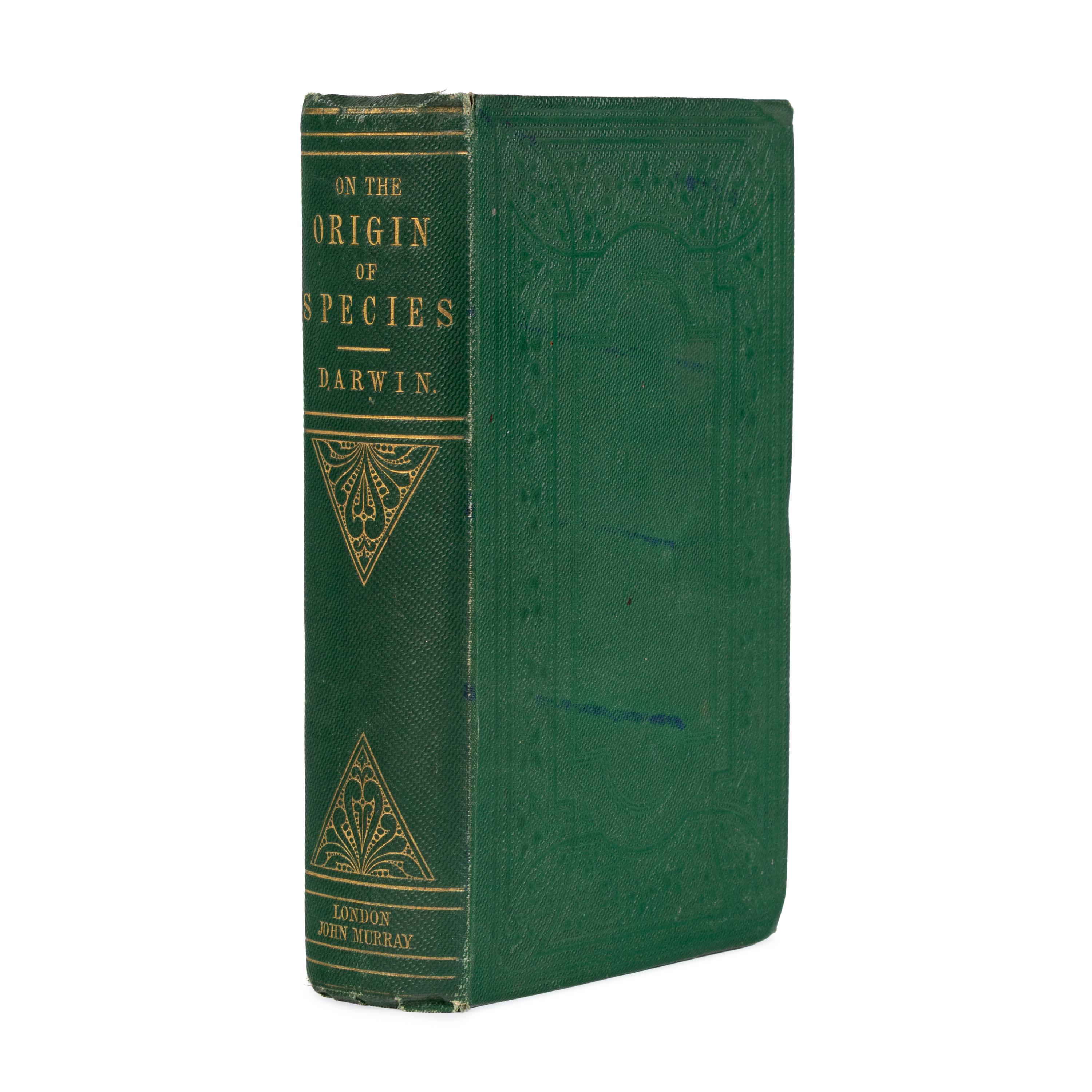
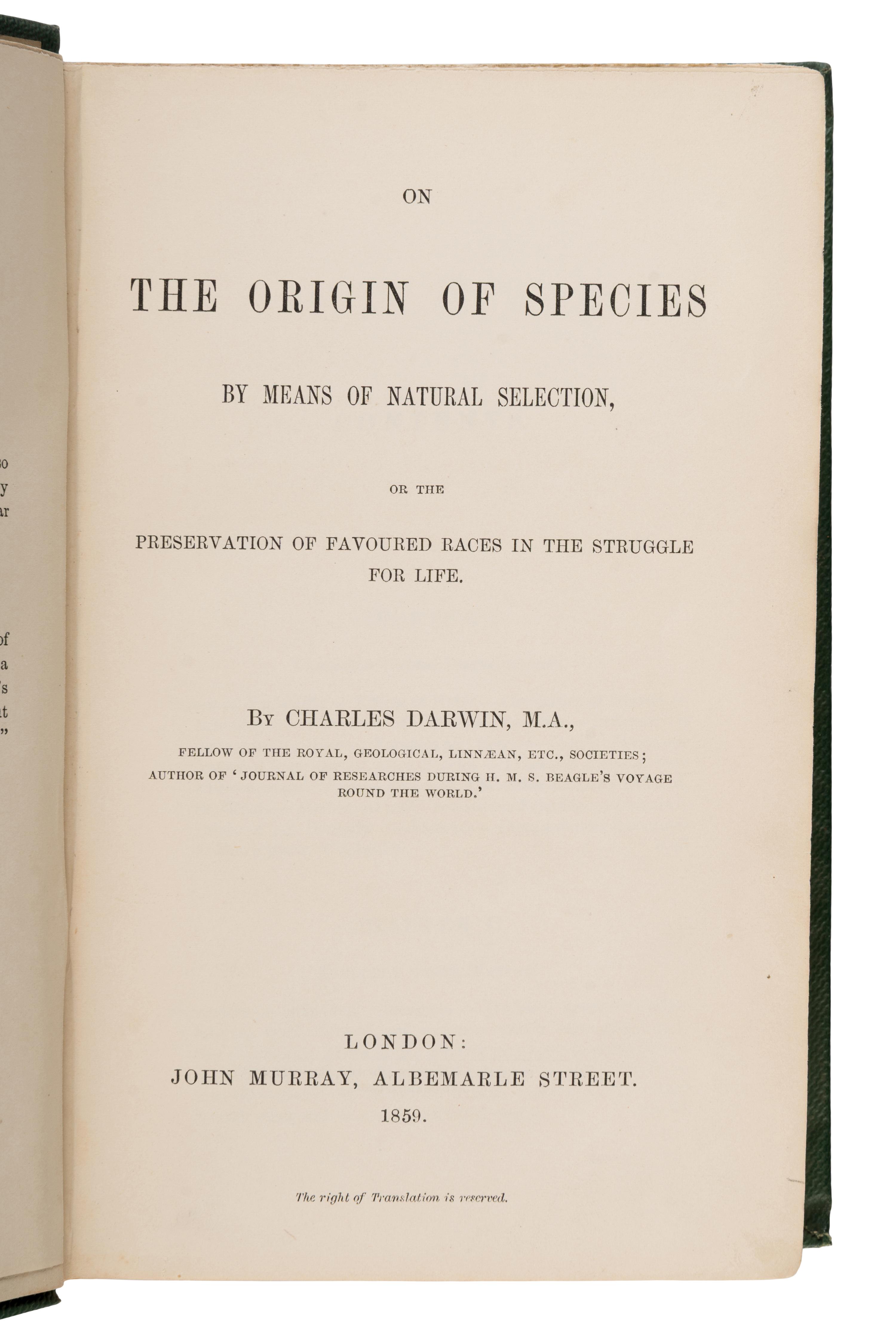
Darwin, Charles (1809-1882). On the Origin of Species by Means of Natural Selection, or the Preservation of Favoured Races in the Struggle for Life. London: John Murray, 1859.
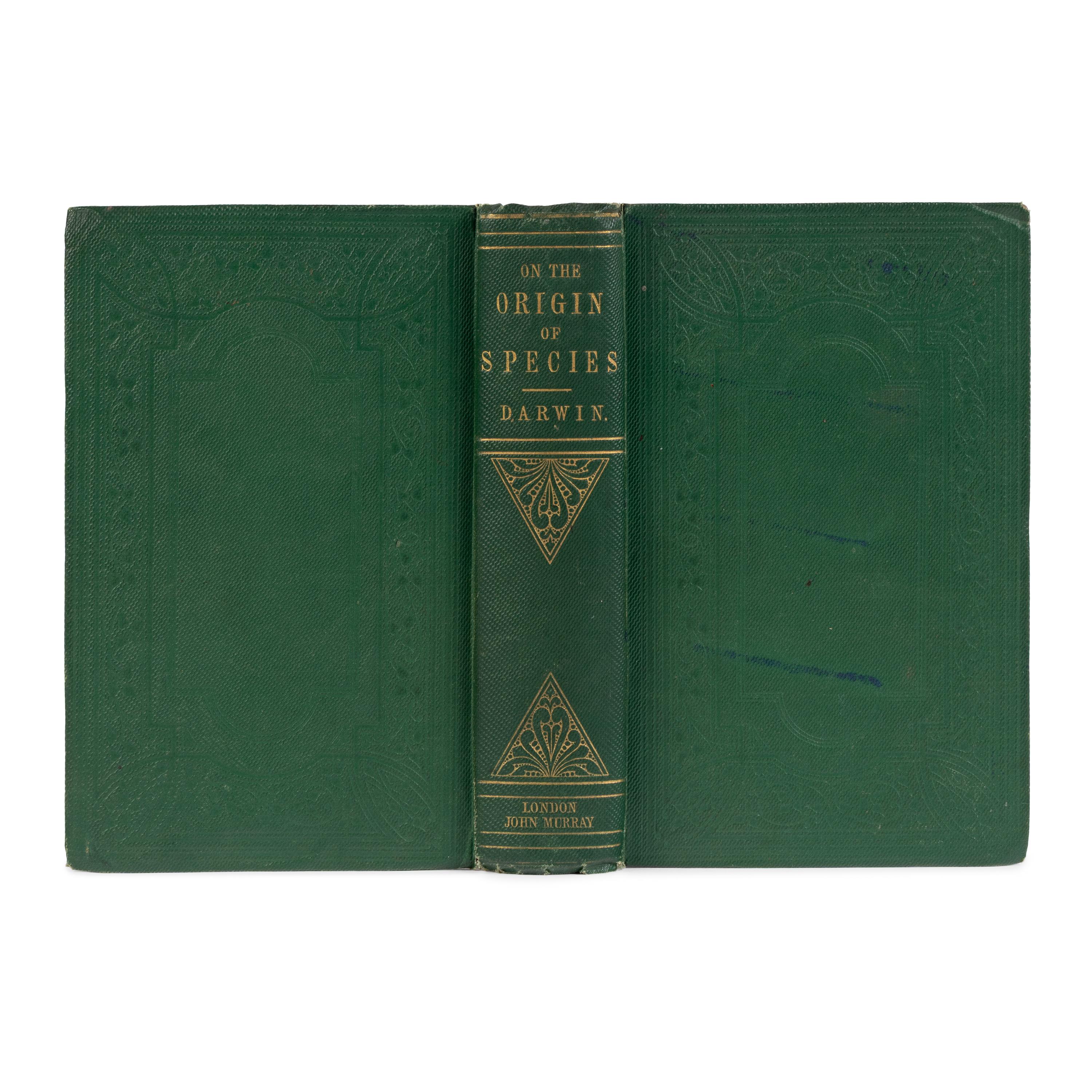
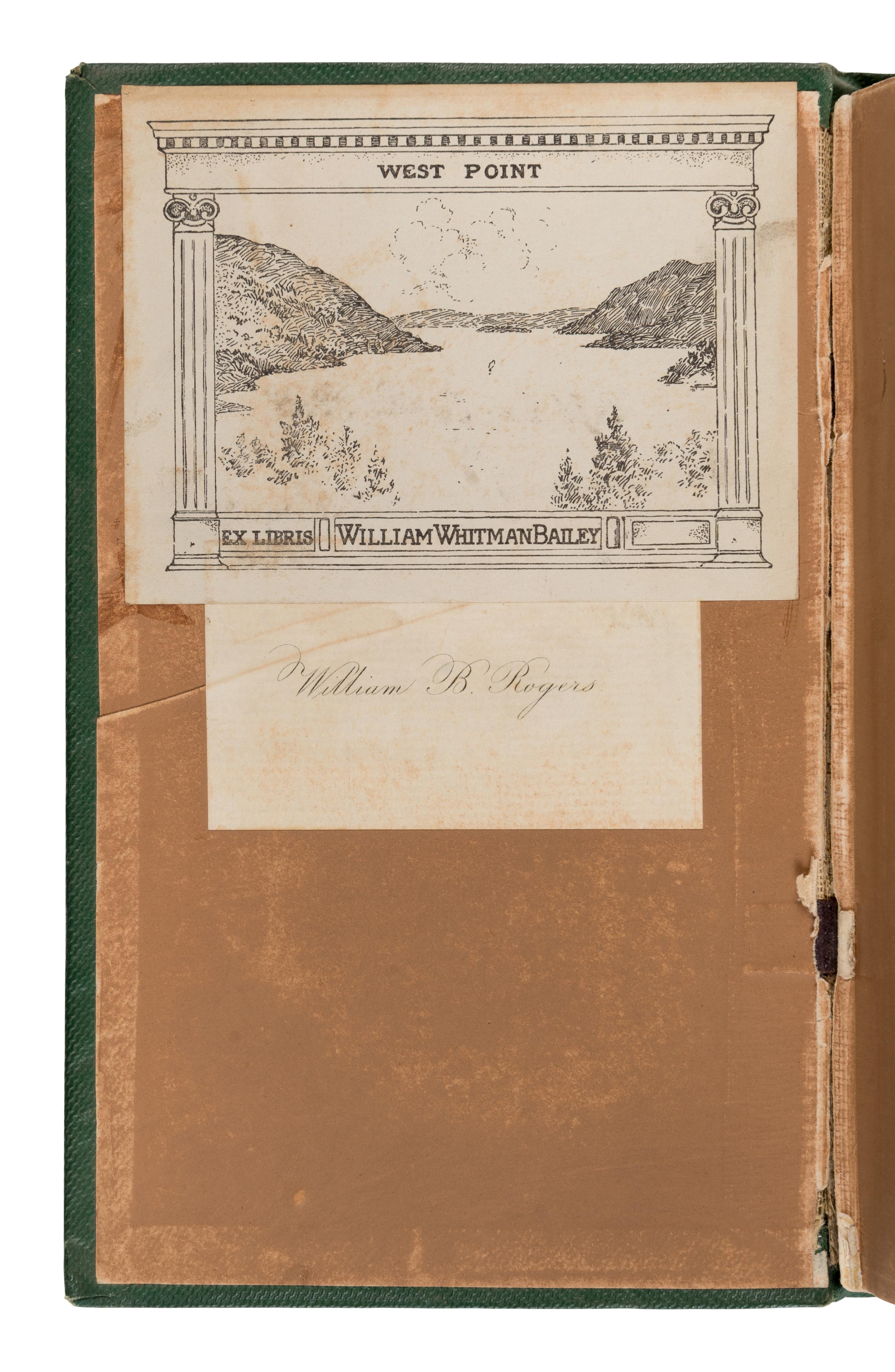
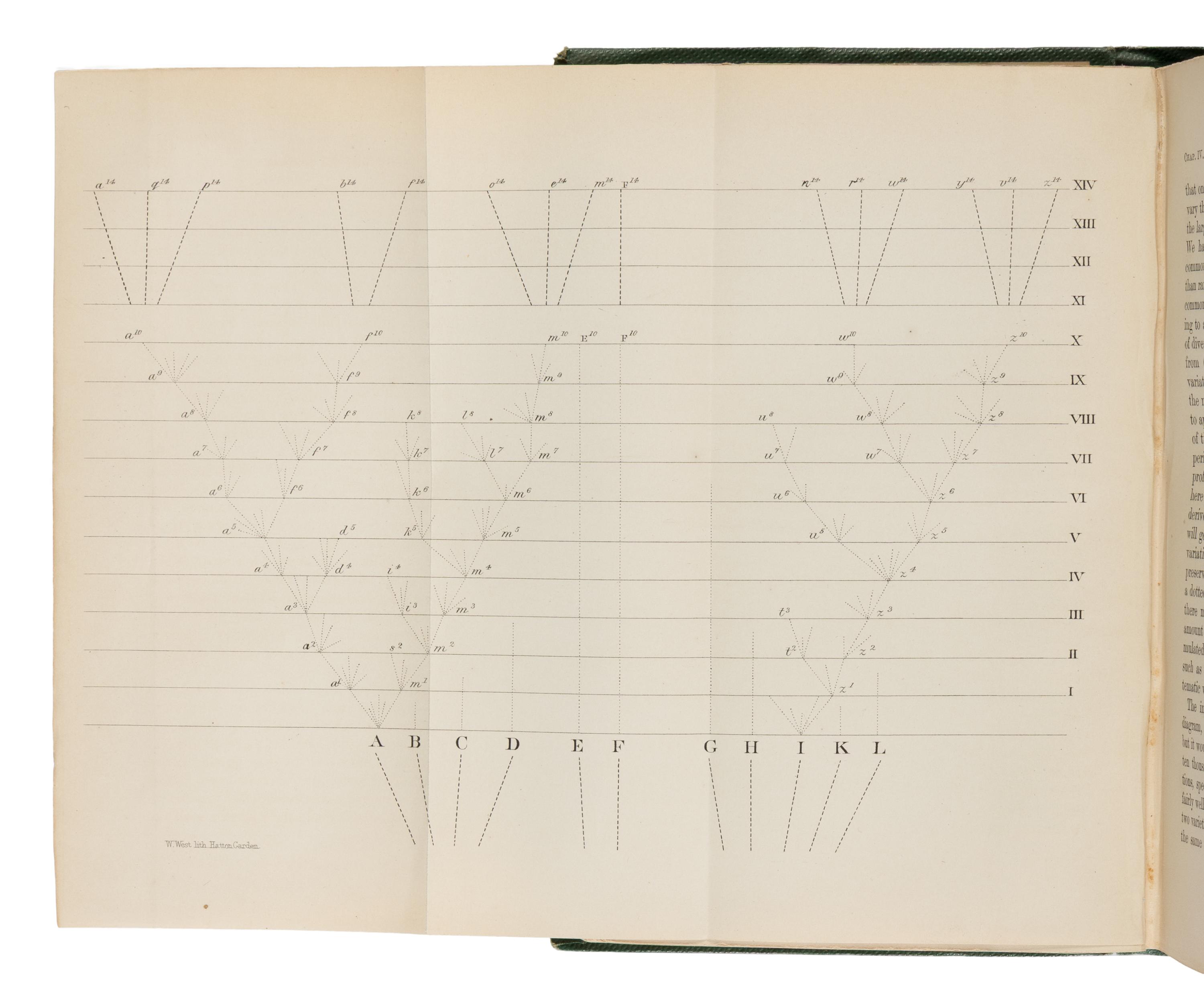
8vo. Half-title with quotations from "W. Whewell" and Bacon only on verso; folding lithographic diagram by William West after Darwin bound to face p.117; 32pp. publisher's catalogue at end, dated June 1859 [Freeman variant 3]. Original green cloth, covers decorated in blind, spine gilt by Edmonds and Remnants with their ticket [Freeman variant a], brown coated endpapers, uncut (hinges slightly cracked, front hinge starting, slightest rubbing to joints and fore-corners, upper cover with four small streaks of discoloration, fore-corners lightly bumped); folding case. Provenance: William Barton Rogers (1804-1882), American geologist and founder of the Massachusetts Institute of Technology (bookplate, neat penciled initials on half-title); by descent to his wife, Emma Rogers (1820-1911); by bequest to William Whitman Bailey (1843-1914), American botanist (“Left to me by the Will of Mrs. Wm. B. Rogers of Boston, June 1911,” inscription and bookplate).
THE WILLIAM BARTON ROGERS COPY
FIRST EDITION OF "THE MOST IMPORTANT SINGLE WORK IN SCIENCE" (Dibner). Although some key observations and findings from the voyage of the Beagle acted as his initial inspiration, Darwin's ideas about the beneficial mutation of species did not coalesce into the theory of evolution until his reading of Thomas Malthus's Essay on the Principle of Population in the latter half of 1838. In his Essay, Malthus presented a statistical argument that unrestrained human populations breed beyond their means and struggle to survive; Darwin related Malthus's argument to the competition for resources among wildlife and to botanist de Candolle's "warring of the species" in plants. It became clear to him that general competition among living things was part of the "struggle for existence," and only the best-adapted survived. Although the idea of species evolution can be traced to the Greek "great chain of being," Darwin's eventual argument for the existence of a viable mechanism - natural selection - made the concept acceptable to the scientific community.
He completed a 35-page sketch of his evolutionary theory in June 1842, which he converted into a 231-page essay by February 1844. He returned to his notes in late 1854, and after consulting Charles Lyell, began writing an extended treatise for his scientific peers on 14 May 1856. Nearly two years later, in March 1858, "Natural Selection" was two-thirds complete at 250,000 words, and was projected to be published as a three-volume work. In June of the same year, he received a letter from Alfred Russell Wallace regarding his own independent conclusions about evolution. Both scientists presented papers to the Linnean Society on 1 July 1858. At Joseph Dalton Hooker's suggestion, Darwin completed an abbreviated manuscript of "Natural Selection," comprising 155,000 words, in April 1859. Stripped of references, the new work was not aimed at specialists, but rather the general reading public. The work was published as On the Origin of Species on 24 November 1859 in an initial print run of 1250 copies, and has since become regarded as "a turning point, not only in the history of science, but in the history of ideas in general" (DSB). With "species" misspelled "speceies" on page 20, with the whale-bear story in full on p.184.
A SUPERB ASSOCIATION COPY OWNED AND READ BY THE FOUNDER OF MIT, WHO PUBLICLY DEFENDED DARWIN AND REVIEWED ORIGIN OF SPECIES WITHIN MONTHS OF ITS PUBLICATION
William Barton Rogers (1804-1882), geologist, physicist, educator, and founder of the Massachusetts Institute of Technology, was one of the leading figures in nineteenth-century American scientific education. Born in Philadelphia into a distinguished scientific family, Rogers succeeded his father as professor of natural philosophy and chemistry at the College of William and Mary before joining the University of Virginia in 1835, where he taught natural philosophy for two decades. As director of the Geological Survey of Virginia, he conducted extensive geological investigations and, together with his brother Henry Darwin Rogers, made important contributions to the understanding of the structure of the Appalachian Mountains. His longstanding ambition to establish an institution uniting scientific theory with practical and technical education ultimately culminated in the incorporation of the Massachusetts Institute of Technology in 1861, of which he became founder and first president.
Rogers was among the earliest American scientific readers of Darwin's Origin. On 2 January 1860, only thirty-nine days after its publication in London, he wrote from Boston to his brother Henry: "I have been reading the early chapters of Darwin's book with great interest." Rogers was already engaging critically with its central arguments, objecting to what he regarded as Darwin's neglect of violent and sudden physical changes while otherwise responding enthusiastically: "The more I look into Darwin's argument the more I like it," he wrote, praising "the calmness and truth-loving spirit of the book" as "truly admirable."
Within months Rogers carried his private enthusiasm into the public debate. On 5 March 1860, the Boston Courier published his review of Origin of Species. He predicted that Darwin's arguments would "command the earnest attention of scientific men" and recognized that the book had opened what he called a "grand contest of observation and argument." Rogers was thus not merely an early reader of Origin, but an active participant in the discussion surrounding Darwin's theory during the first months following its publication.
The debate also connected Rogers directly with some of the principal figures confronting Darwin's ideas. His brother Henry Darwin Rogers (1808-1866), an eminent geologist and then Regius Professor of Natural History at the University of Glasgow, corresponded with Thomas Henry Huxley concerning Darwin and William's response to the book. Writing to William on 24 February 1860, Henry referred explicitly to "Darwin's book and your liberal defence of it," adding that Huxley was "much pleased." William subsequently asked his brother to communicate directly to Darwin "how much I have enjoyed his book" and expressed his pride in counting himself, if not entirely among Darwin's disciples, then "among the defenders of his leading doctrine."
Dibner, Heralds of Science 199; Heirs of Hippocrates 1724; Freeman 373; Garrison-Morton (1991) 220; Grolier Science 23b; Norman 593; PMM 344b; Sparrow Milestones 49; Waller 10786.
From the library of Dr. Braydon "Brad" Charles Guild, Concord, Massachusetts
This lot is located in Chicago.
![Robert Boyvin workshop (fl. 1480-1536). Book of Hours, in Latin and French, illuminated manuscript on parchment, [Rouen, ca 1490].](https://assets.basta.app/accounts/4832eb18-f9a7-4c12-8295-871abe232696/images/4d82e9cb-89be-43dc-a190-4d343d06eb32?format=auto&width=3840&quality=75)
![Robert Boyvin workshop (fl. 1480-1536). Book of Hours, in Latin and French, illuminated manuscript on parchment, [Rouen, ca 1490].](https://assets.basta.app/accounts/4832eb18-f9a7-4c12-8295-871abe232696/images/e99696c0-83be-4d83-8d91-7b0ae0a1b749?format=auto&width=3840&quality=75)
![Robert Boyvin workshop (fl. 1480-1536). Book of Hours, in Latin and French, illuminated manuscript on parchment, [Rouen, ca 1490].](https://assets.basta.app/accounts/4832eb18-f9a7-4c12-8295-871abe232696/images/8be28875-89d4-48df-b4fc-0ac495e0f02c?format=auto&width=3840&quality=75)
![Robert Boyvin workshop (fl. 1480-1536). Book of Hours, in Latin and French, illuminated manuscript on parchment, [Rouen, ca 1490].](https://assets.basta.app/accounts/4832eb18-f9a7-4c12-8295-871abe232696/images/2353950e-db5f-4777-afd5-81f265030993?format=auto&width=3840&quality=75)

![Williams, Tennessee (1911-1983). Typed letter signed ("Tennessee Williams") to Marilyn Monroe, [New York], 8 February 1956.](https://assets.basta.app/accounts/4832eb18-f9a7-4c12-8295-871abe232696/images/4b7d2e6d-15e2-46a8-aa04-6f5517aeddd9?format=auto&width=3840&quality=75)
![Williams, Tennessee (1911-1983). Typed letter signed ("Tennessee Williams") to Marilyn Monroe, [New York], 8 February 1956.](https://assets.basta.app/accounts/4832eb18-f9a7-4c12-8295-871abe232696/images/b302e4c3-308e-4c8f-b680-0a233b6d80c7?format=auto&width=3840&quality=75)






