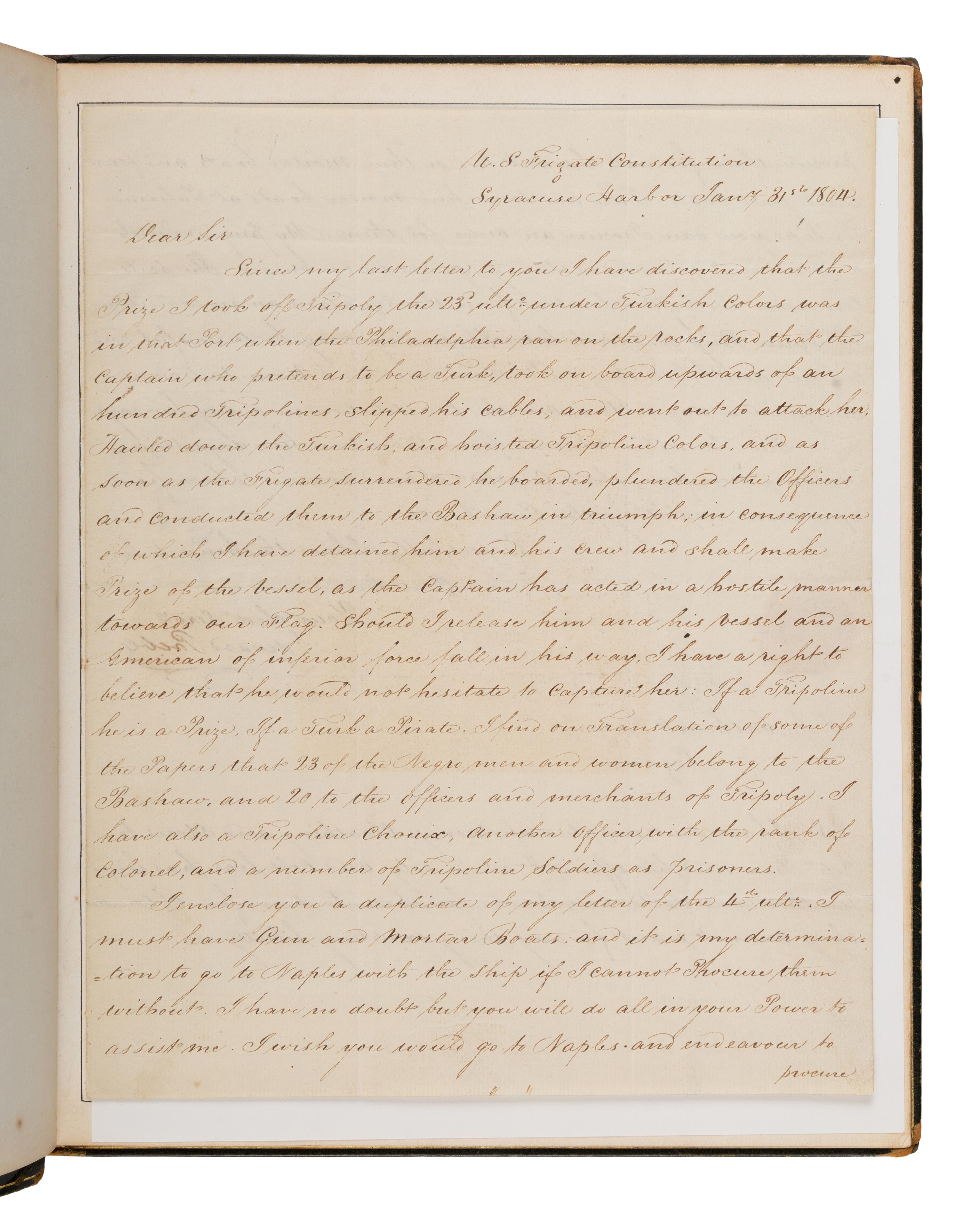
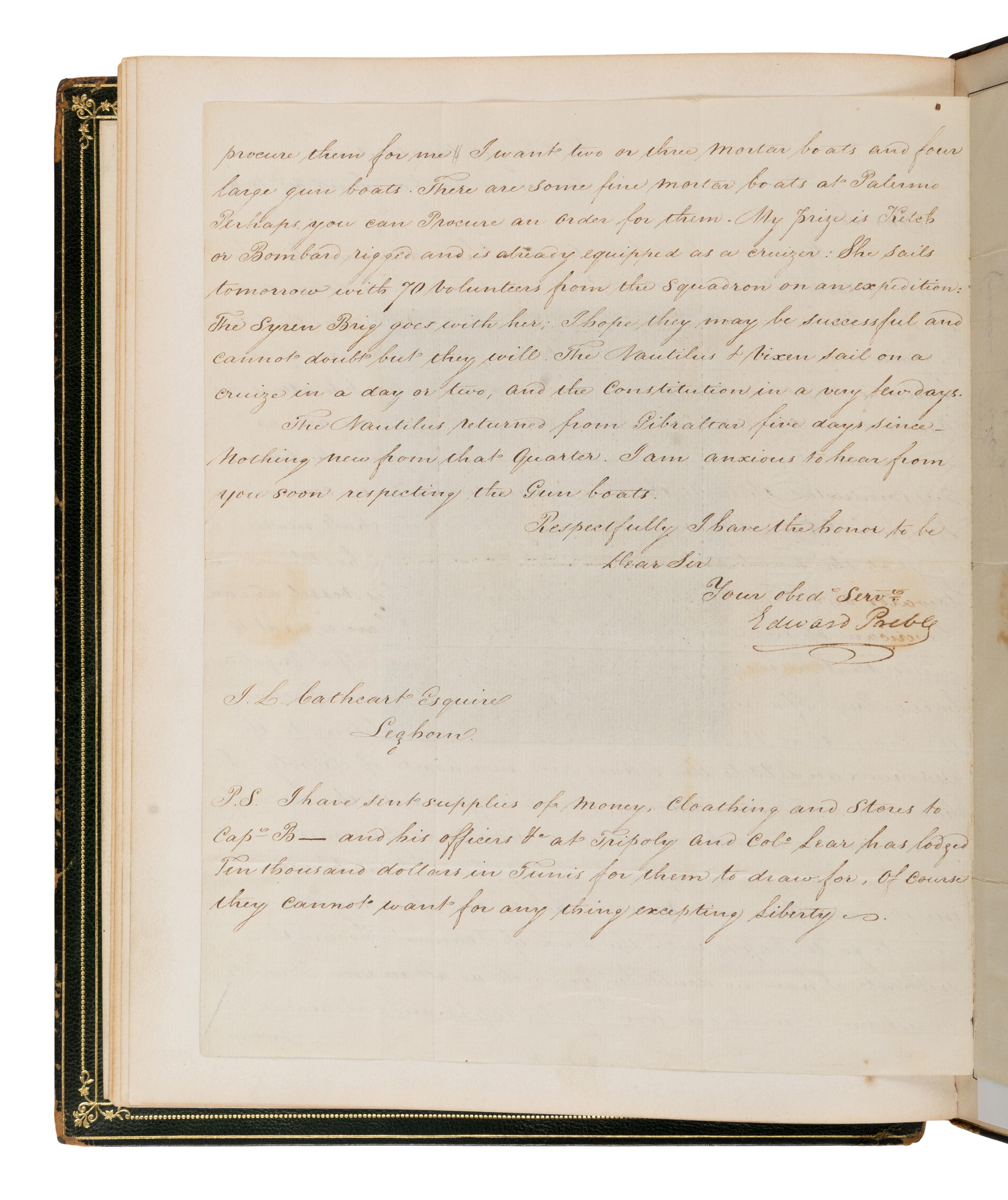
Preble, Edward (1761-1807). Autograph letter signed ("Edward Preble") to James Leander Cathcart, U.S. Frigate Constitution, Syracuse Harbor, 31 January 1804.
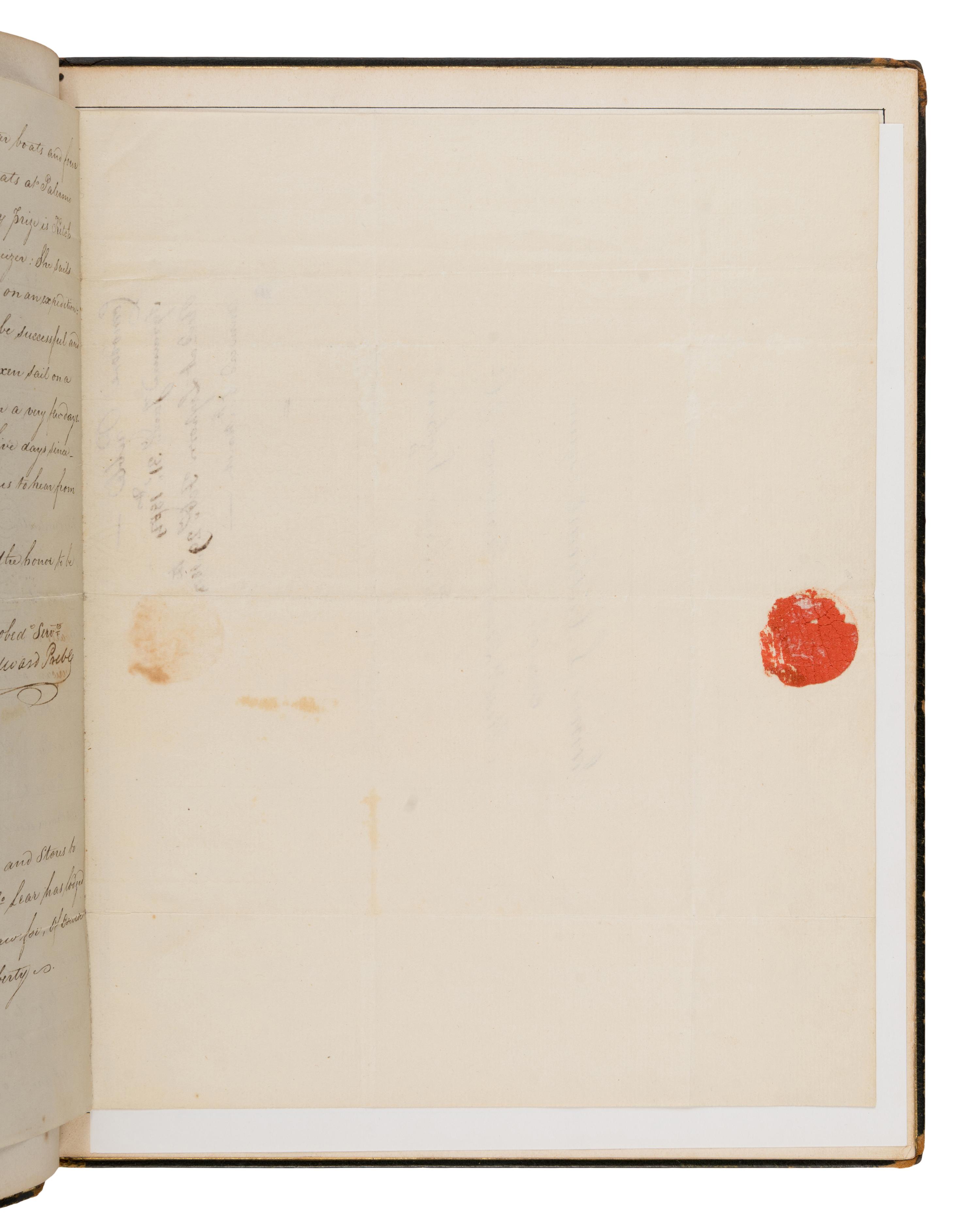
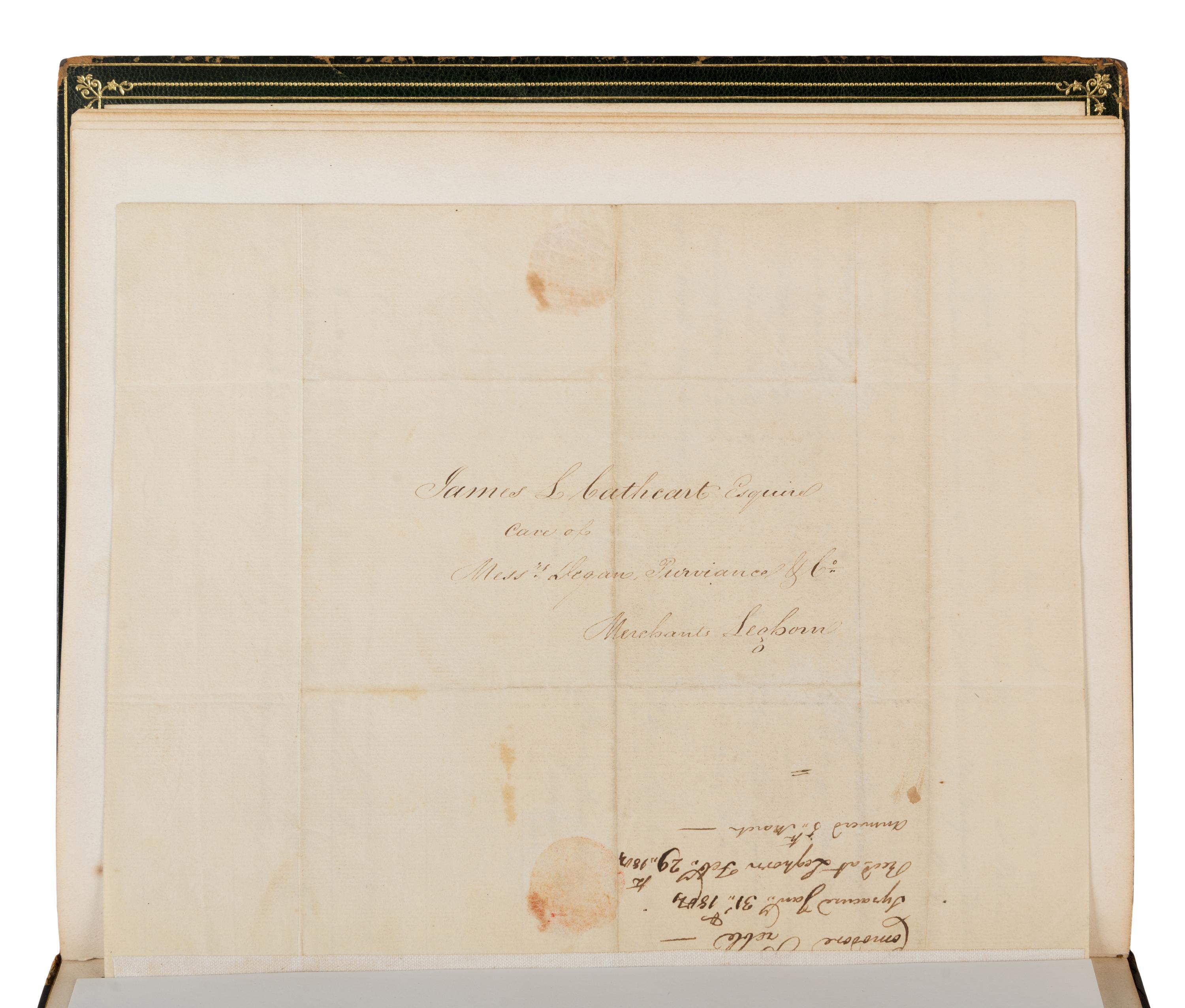
2pp. on bifolium, 8vo (244 x 197 mm), retaining remnants of wax seal, old folds, minor toning, partial split along fold; bound into a full green morocco case gilt (extremities rubbed, front cover detached). Provenance: Elsie O. and Philip D. Sang (Sotheby's Parke-Bernet, 3 June 1980, Sale 4387, Lot 996).
COMMODORE EDWARD PREBLE WRITES OF THE CAPTURE OF A TRIPOLINE BOMB SHIP INVOLVED IN THE TAKING OF THE USS PHILADELPHIA TWO MONTHS EARLIER.
In part: "Since my last letter to you I have discovered that the Prize I took off Tripoly [sic] the 23 under Turkish Colors was in that Port when the Philadelphia ran on the rocks, and that the captain who pretends to be a Turk, took on board upwards of an hundred Tripolines, slipped his cables, and went out to attack her. Hauled down the Turkish and hoisted Tripoline Colors, and as soon as the frigate surrendered he boarded, plundered the Officers and conducted them to the Bashaw in triumph, in consequence of which I have detained him and his crew and shall make Prize of the vessel, as the captain has acted in a hostile manner towards our Flag. Should I release him and his vessel and an American of inferior force fall in his way I have a right to believe he would not hesitate to capture her..."
The First Barbary War was a conflict fought between the United States and a loose alliance of European nations against the Maghreb countries known collectively as the Barbary States. The dispute began over a longstanding issue in which American vessels were captured by Barbary pirates and their crews and cargo held for ransom. With the United States Navy now established, President Thomas Jefferson decided to confront those nations offering aid and comfort with force, and in 1803 sent the USS Philadelphia to enforce a blockade of the Port of Tripoli. While giving chase to a Tripoli Navy ship she ran aground on an underground reef. Thinking quickly, Captain William Bainbridge ordered his crew to jettison all heavy cargo and munitions, drill holes in the ship's bottom and sabotage the pumps before surrendering.
On 23 December the Constitution and the USS Enterprise under the command of Lieutenant Stephen Decatur came upon the Tripoline bomb ship Mastico while sailing to Constantinople under Turkish colors. Preble claimed the ship for the U.S. Navy and renamed her the USS Intrepid.
By this point the heavily damaged Philadelphia had lain in Tripoli Harbor for months, its captors working to fit her out for their own use. To prevent this from happening, Preble decided that the Intrepid, as the only ship in the U.S. naval fleet that could pass for a North African vessel, would infiltrate the harbor with Decatur in command, and then destroy the Philadelphia. The present letter is dated January 31, 1804 - the same day Preble placed Decatur in command of the Intrepid. On February 16 the Intrepid infiltrated Tripoli Harbor, came alongside the Philadelphia, and led sixty men aboard to disarm those aboard. Without a shot fired, they took control of the ship and set it ablaze, Decatur remaining onboard until he was certain that it was beyond saving. Lord Horatio Nelson, upon hearing of the feat, called it "the most bold and daring act of the age." The scene was gloriously captured in an 1897 painting by Edward Moran entitled The Burning of the USS Philadelphia, now in the collection of the U.S. Naval Academy at Annapolis, Maryland.
James Leander Cathcart (1767-1843) was an American diplomat, lawyer, and sailor who was captured by Barbary pirates aboard The Maria Boston in 1785, who subsequently pressed him and twenty of his fellow sailors into slavery. Gradually Dey improved his circumstances by ingratiating himself to the Dey, and eventually acted as chief mediator for his freedom and that of his fellow slaves (now reduced from twenty to twelve) with Joseph Donaldson, Jr., official representative of U.S. Minister to Portugal David Humphreys. His efforts resulted in the signing of the Treaty of Algiers in 1796. In 1802 he was appointed U.S. Consul to Tunis and Tripoli, and in this capacity helped to negotiate an end to the First Barbary War.
Property from the Estate of Ambassador J. William Middendorf II, Rhode Island
This lot is located in Chicago.
![Robert Boyvin workshop (fl. 1480-1536). Book of Hours, in Latin and French, illuminated manuscript on parchment, [Rouen, ca 1490].](https://assets.basta.app/accounts/4832eb18-f9a7-4c12-8295-871abe232696/images/4d82e9cb-89be-43dc-a190-4d343d06eb32?format=auto&width=3840&quality=75)
![Robert Boyvin workshop (fl. 1480-1536). Book of Hours, in Latin and French, illuminated manuscript on parchment, [Rouen, ca 1490].](https://assets.basta.app/accounts/4832eb18-f9a7-4c12-8295-871abe232696/images/e99696c0-83be-4d83-8d91-7b0ae0a1b749?format=auto&width=3840&quality=75)
![Robert Boyvin workshop (fl. 1480-1536). Book of Hours, in Latin and French, illuminated manuscript on parchment, [Rouen, ca 1490].](https://assets.basta.app/accounts/4832eb18-f9a7-4c12-8295-871abe232696/images/8be28875-89d4-48df-b4fc-0ac495e0f02c?format=auto&width=3840&quality=75)
![Robert Boyvin workshop (fl. 1480-1536). Book of Hours, in Latin and French, illuminated manuscript on parchment, [Rouen, ca 1490].](https://assets.basta.app/accounts/4832eb18-f9a7-4c12-8295-871abe232696/images/2353950e-db5f-4777-afd5-81f265030993?format=auto&width=3840&quality=75)

![Williams, Tennessee (1911-1983). Typed letter signed ("Tennessee Williams") to Marilyn Monroe, [New York], 8 February 1956.](https://assets.basta.app/accounts/4832eb18-f9a7-4c12-8295-871abe232696/images/4b7d2e6d-15e2-46a8-aa04-6f5517aeddd9?format=auto&width=3840&quality=75)
![Williams, Tennessee (1911-1983). Typed letter signed ("Tennessee Williams") to Marilyn Monroe, [New York], 8 February 1956.](https://assets.basta.app/accounts/4832eb18-f9a7-4c12-8295-871abe232696/images/b302e4c3-308e-4c8f-b680-0a233b6d80c7?format=auto&width=3840&quality=75)






