“Perugian Missal” (fragment)
in Latin, illuminated manuscript with two historiated initials, on parchment [Italy, Perugia, c. 1315–1320
Four rediscovered leaves from Otto Ege’s “Perugian Missal,” an important Dominican manuscript now newly connected to Venturella di Pietro, one of the defining illuminators of early fourteenth-century Perugia.
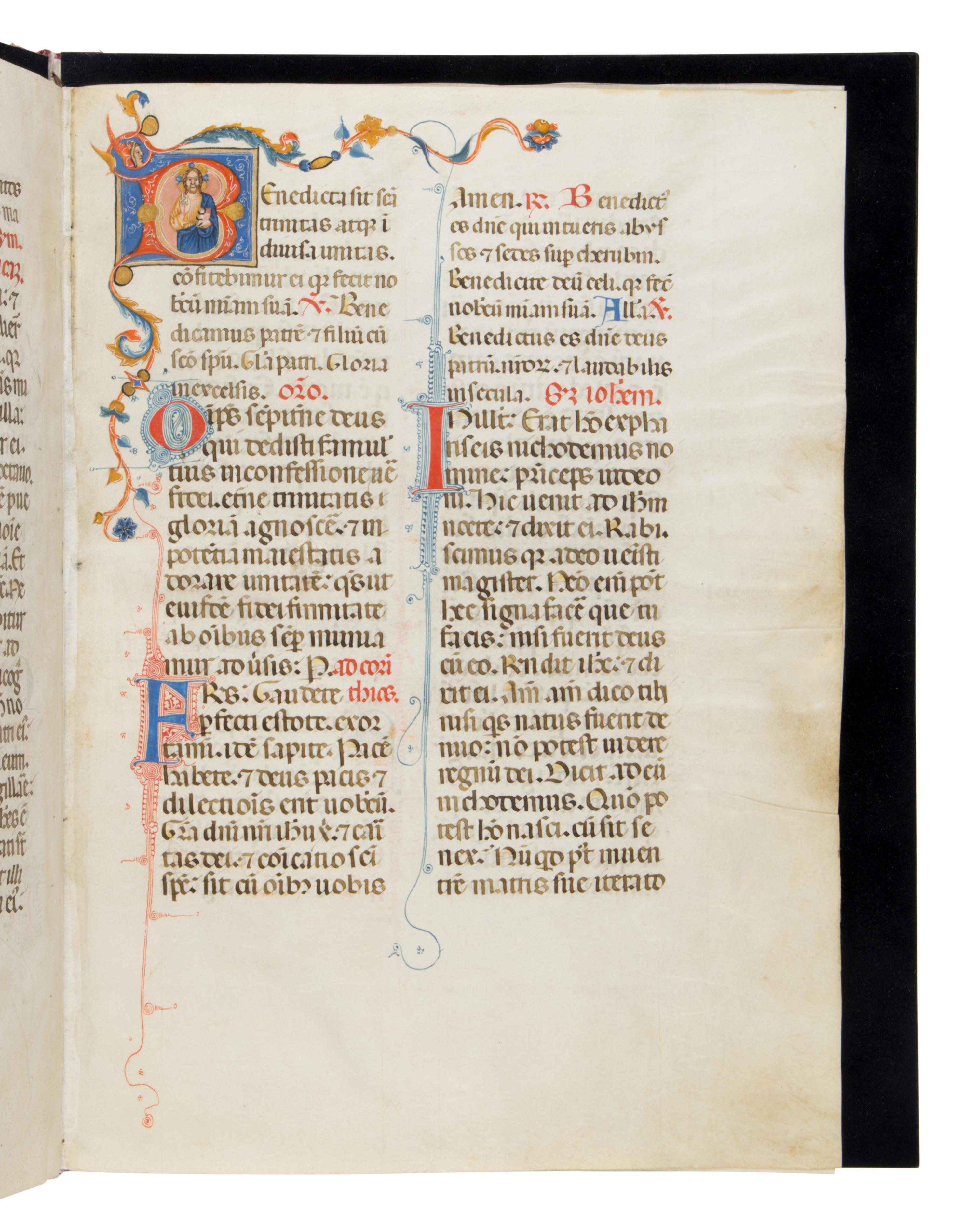
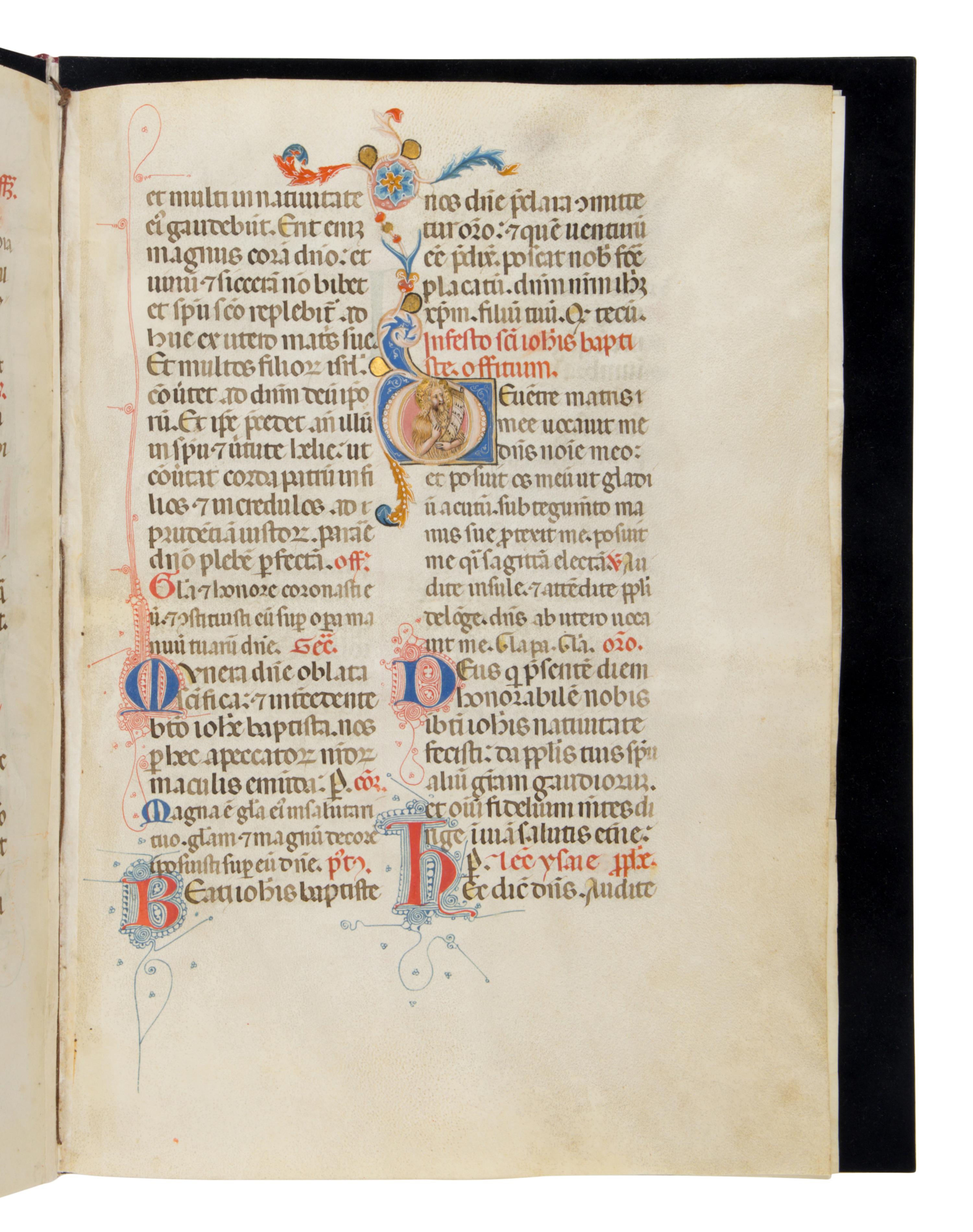
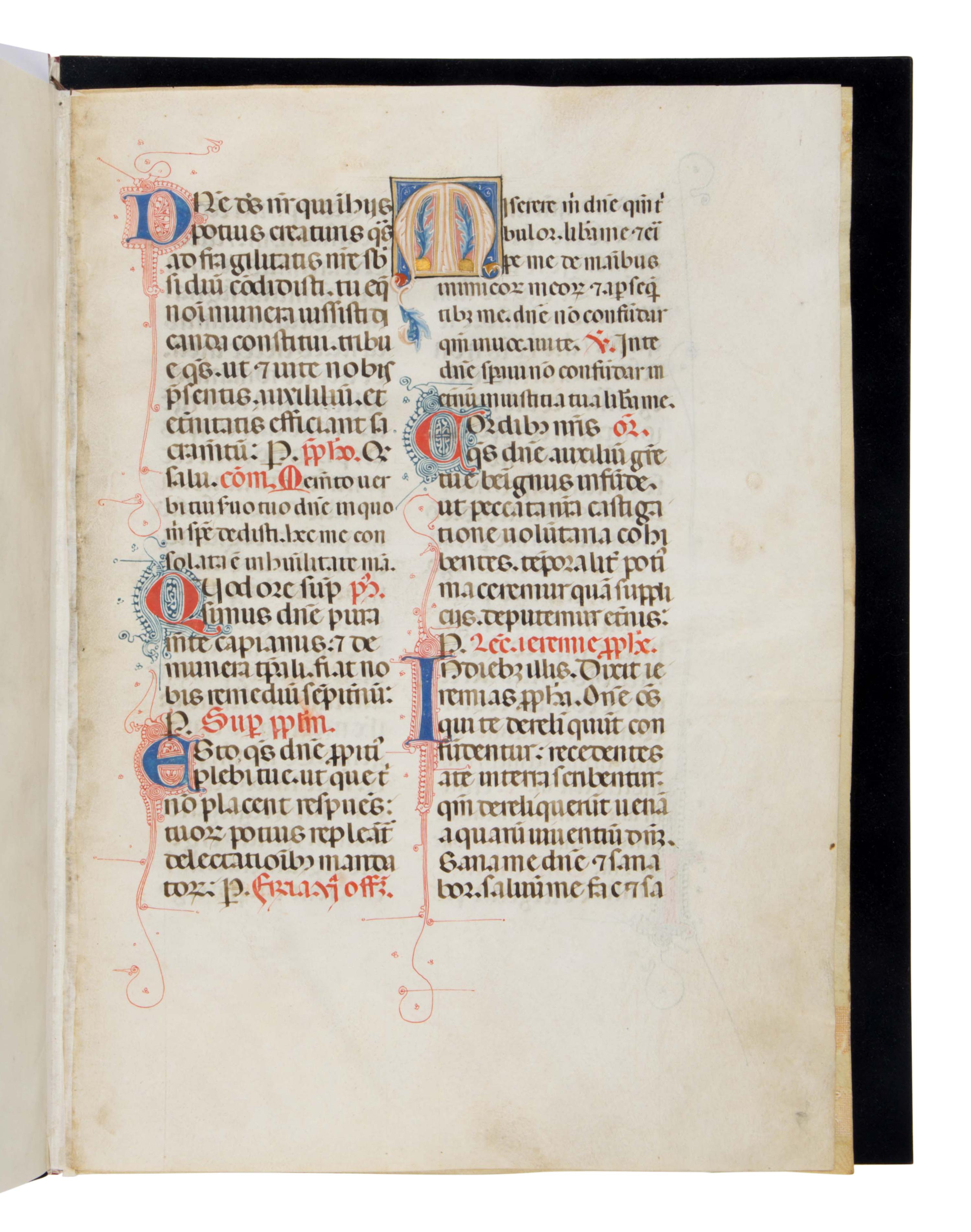
i (vellum) + 4 + i (modern paper) leaves, unfoliated [collation: single leaves in modern guarded binding], ruled in drypoint in two columns of 26 lines (justification: 212 mm × 150 mm), written in black ink in a Gothic textualis script, rubrics in red, capitals in red and blue ink with penwork flourishes, 2 ILLUMINATED INITIALS of four lines in vermillion, rose, and blue on crimson ground with decorative infill of blue foliage emerging from gold discs, frames in shell gold with black outline, one with foliate extensions into margins, 2 HISTORIATED INITIALS of three and four lines in rose and vermillion, with white stippling and filagree, on crimson ground, frames in shell gold with black outline embellished with white fillagree, long foliate extensions into margins with acanthus, bezants and a drollery. Bound in modern black cardboard with red velvet and gold spine, light cockling discoloration to margins, adhesive residue present on f. 2 from previous mount, else in good condition. Dimensions 320 mm × 230 mm.
Provenance
(1) The manuscript was produced for a Dominican community in Perugia, possibly San Domenico. The calendar (formerly Sotheby’s, 26 November 1985, lot 66) is clearly Dominican in content, with its highest-ranking feasts including the principal Dominican celebrations of Saint Dominic, his Translation, and Saint Peter Martyr.
(2) Examined in 1880 by the Prefect of the Marciana Library, Venice.
(3) Marsden J. Perry (1850–1935) one of the major American private collectors of books and manuscripts at the turn of the twentieth century. His sale at American Art Association & Anderson Galleries, New York, 11 March 1936, this manuscript lot 349 (described as “on 328 leaves of vellum,” recording four missing leaves).
(4) Philip C. Duschnes (1897–1970), New York rare book dealer specializing in fine books and illuminated manuscripts. Active from the 1930s through the 1960s, Duschnes was a major figure in the American medieval manuscript trade and collaborated closely with Otto F. Ege in the acquisition and dispersal of manuscript leaves.
(5) Otto F. Ege (1888–1951), Cleveland educator, collector, and manuscript dealer; acquired and subsequently dismembered by him, probably by December 1937. When recorded by Seymour de Ricci in 1937, the manuscript remained substantially intact, comprising 323 leaves with only four leaves noted as missing. Individual leaves were later included by Ege as no. 31 in his portfolio 101 Original Leaves & Sets of Leaves from Medieval Manuscripts. The manuscript subsequently became known colloquially as Ege’s “Perugian Missal.”
(6) Collection of Dr. Scott Schwartz, New York, his bookplate and catalog number “MS 61” on the inner cover.
Text
f. 1, Mass for Wednesday after the Third Sunday of Lent, including a reading from Jeremiah (17:13–14: ‘Domine, omnes qui te derelinquunt…’), with accompanying collects, Communio, postcommunion (‘Quod ore sumpsimus…’), Oratio super populum, and psalm versicles; f. 2 Mass for Ember Saturday in Lent, including Gospel (Luke 14:1), Offertory texts (Daniel 9; Psalm 80), Secret (‘Munera, Domine…’), Communion (Psalm 75, “Vovete et reddite Domino …”). and Postcommunion (‘Purifica, Domine…’); f. 3, Mass for the Nativity of Saint John the Baptist, including epistle (Isaiah 49:1–3, 5–7 “De ventre matris meae vocavit me..”) and accompanying, oratio (“Deus, qui praesentem diem honorabilem nobis…”), prophetic incipit (Isaiah 49:1, “Haec dicit Dominus..”), and gospel reading (Luke 1:57–68) “in illo tempore compete sunt dies ut pareret Elisabeth”); f. 4, Mass for Trinity Sunday, with introit (“Benedicta sit Sanctae Trinitatis”), oratio (“Omnipotens sempiterne Deus”), epistle (2 Corinthians 13:11, “Fratres, gaudete…”), gospel reading (John 3:1, “In illo tempore erat vir Pharisaeorum..”) and Secret (“Sanctifica, quaesumus…”).
Illumination
The present group of leaves derives from a celebrated Dominican Missal produced in Perugia, possibly for the convent of San Domenico and subsequently dismembered in 1937 by the American manuscript dealer Otto Ege. Since its dispersal, the manuscript has been known colloquially as Ege’s “Perugian Missal,” with sister leaves identified in at least eight North American institutional collections and additional examples appearing on the market. The calendar, sold at Sotheby’s, London (26 November 1985, lot 66), confirms its Dominican use through the prominence of major feasts of the Order, including those of Saint Dominic, the Translation of Saint Dominic, and Saint Peter Martyr. The dating of the parent manuscript has remained uncertain. Ege assigned the remarkably specific date of 1353, although no evidence for this date has been identified, and it does not appear in earlier descriptions of the manuscript. De Ricci (1937, vol. 2, no. 64) instead dated the codex broadly to “c. 1400,” while sister leaves in North American collections have been assigned dates ranging from the second quarter of the fourteenth century into the fifteenth century. These varying assessments reflect the fact that the manuscript has traditionally been treated only broadly within the Perugian school of illumination. Stylistically, however, the decoration points convincingly toward the artistic culture of Perugia in the first decades of the fourteenth century. The historiated initials reveal a sophisticated engagement with the new pictorial language introduced by Giotto at Assisi. Figures are monumental and physically present, their gestures naturalistic, and their draperies arranged in broad rhythmic folds that articulate the underlying forms.
These qualities invite a close comparison with the work of Venturella di Pietro, one of the principal illuminators active in Perugia during the first quarter of the fourteenth century. Venturella is documented in May 1311, when he received 30 soldi from the municipal treasurer for painting the arms of Ottaviano dei Brunelleschi in the Libro dei Massari. By January 1313, he had risen to the position of chamberlain (camerlengo) of the Perugian Guild of Illuminators, and he remained active until at least 1323, when his son Pietro was appointed rector of the same guild. The closest comparisons for the present leaves may be found among Venturella’s liturgical manuscripts, particularly the Roman Missal and Ritual with the Office of the Dead preserved in the Archivio Diocesano of Gubbio (ms. II C 20 A; ms. II C 15; see Lusanna, Lunghi, and Benazzi 2018, p. 192, no. 20). Like the present leaves, these manuscripts display saints and biblical figures with rounded facial types, softly modeled flesh, large expressive eyes, compact yet substantial bodies, and a heightened sense of corporeal presence. The treatment of drapery with heavy, sweeping folds that both describe and animate the figure beneath, is especially characteristic of Venturella’s assimilation of Giottesque models. The secondary decoration provides further points of comparison. The initials employ the same ornamental vocabulary found in Venturella’s established works with supple scrolling letterforms with scalloped edges, curling acanthus extensions, and vegetal ornament emerging from circular gold terminals.
The relationship between these leaves and Venturella’s documented corpus therefore suggests a significantly earlier date than has traditionally been assigned to Ege’s “Perugian Missal.” Rather than a work of the later fourteenth century, the manuscript appears closely aligned with the artistic production of Perugia during the first quarter of the Trecento, when Venturella and his workshop were producing ambitious liturgical commissions for the city’s Franciscan and Dominican communities. If accepted, this attribution would place the manuscript among the important surviving examples to the transformation of Umbrian illumination in the wake of Giotto and redefine Ege’s dispersed “Perugian Missal” to the circle of one of Perugia’s most accomplished early fourteenth-century illuminators.
The subjects of the two historiated initials are: f. 3, Saint John the Baptist wearing a hair shirt and holding a scroll in a three-line initial ‘D’ (Mass for the Nativity of Saint John the Baptist); f. 4, Christ blessing, holding a book in a four-line initial ‘B’ (Mass for Trinity Sunday).
Sister leaves
Known sister leaves from the parent manuscript are preserved in at least eight North American institutions, as recorded by Gwara (2013, Handlist no. 122): Boston University School of Theology Library, MS leaves 65–66 (2 folios); University of North Carolina at Chapel Hill, Wilson Library, MS 257; Dartmouth College, Rauner Special Collections Library, MS 002273; University of Minnesota, Elmer L. Andersen Library, MS 56; Rutgers University, Special Collections and University Archives, MC 1220:02; Phoenix Public Library, MS Fragment 55 (4 folios); Rhode Island School of Design, MS 43.438; and Reading Public Museum, acc. 1956.32.11/30. Additional leaves from the manuscript have appeared on the market, including Sotheby’s, 26 November 1985, lot 66; Sotheby’s, 5 July 2011, lot 60; and Sotheby’s, 15 June 2021, lot 14.
LITERATURE
Published: Seymour de Ricci, Census of Medieval and Renaissance Manuscripts in the United States and Canada, vol. 2, New York, 1937, p. 1947, no. 64; Related literature: Judith Oliver, Manuscripts Sacred and Secular from the Collections of the Endowment for Biblical Research and Boston University, Boston, 1985, no. 73; Marina Subbioni, La miniature perugina del Trecento: Contributo alla storia della pittura in Umbria, Perugia, 2003 (especially pp. 55–71); Barbara Shailor, “Otto Ege: His Manuscript Fragment Collection and the Opportunities Presented by Electronic Technology,” Journal of the Rutgers University Libraries 60 (2003), pp. 1–22, fig. I.8; Barbara Shailor, “Otto Ege: Portfolios vs. Leaves,” Manuscripta 53 (2009), pp. 13–27, col. pl. 1; Scott Gwara, Otto Ege’s Manuscripts, Cayce (SC), 2013, Handlist no. 122, and figs. 36–37, 49, 90; Annika Elizabeth Welch, “Franciscan Liturgy and Identities: The Codex Sancti Ludovici and Artistic Patronage in Fourteenth-Century Perugia,” Ph.D. dissertation, University of St Andrews, 2016, pp. 31–33; Enrica Neri Lusanna, Elvio Lunghi, and Giordana Benazzi, eds., Gubbio al tempo di Giotto: Tesori d’arte nella terra di Oderisi, Perugia, 2018, p. 192, no. 20.
We thank Senior Consultant Sandra Hindman and Peter Bovenmyer for their assistance in preparing this sale and Francesca Manzari and Marica Tacconi for consultation on this entry.
Collection of Dr. Scott Schwartz
This lot is located in Chicago.