CIRCLE OF WILLIAM DE BRAILES
Bible (fragment), in Latin, illuminated manuscript on parchment [England, Oxford, c. 1250–1270
An important fragment of fifty leaves from a thirteenth-century Oxford Bible, illuminated in the circle of William de Brailes, one of the earliest named artists in medieval England.
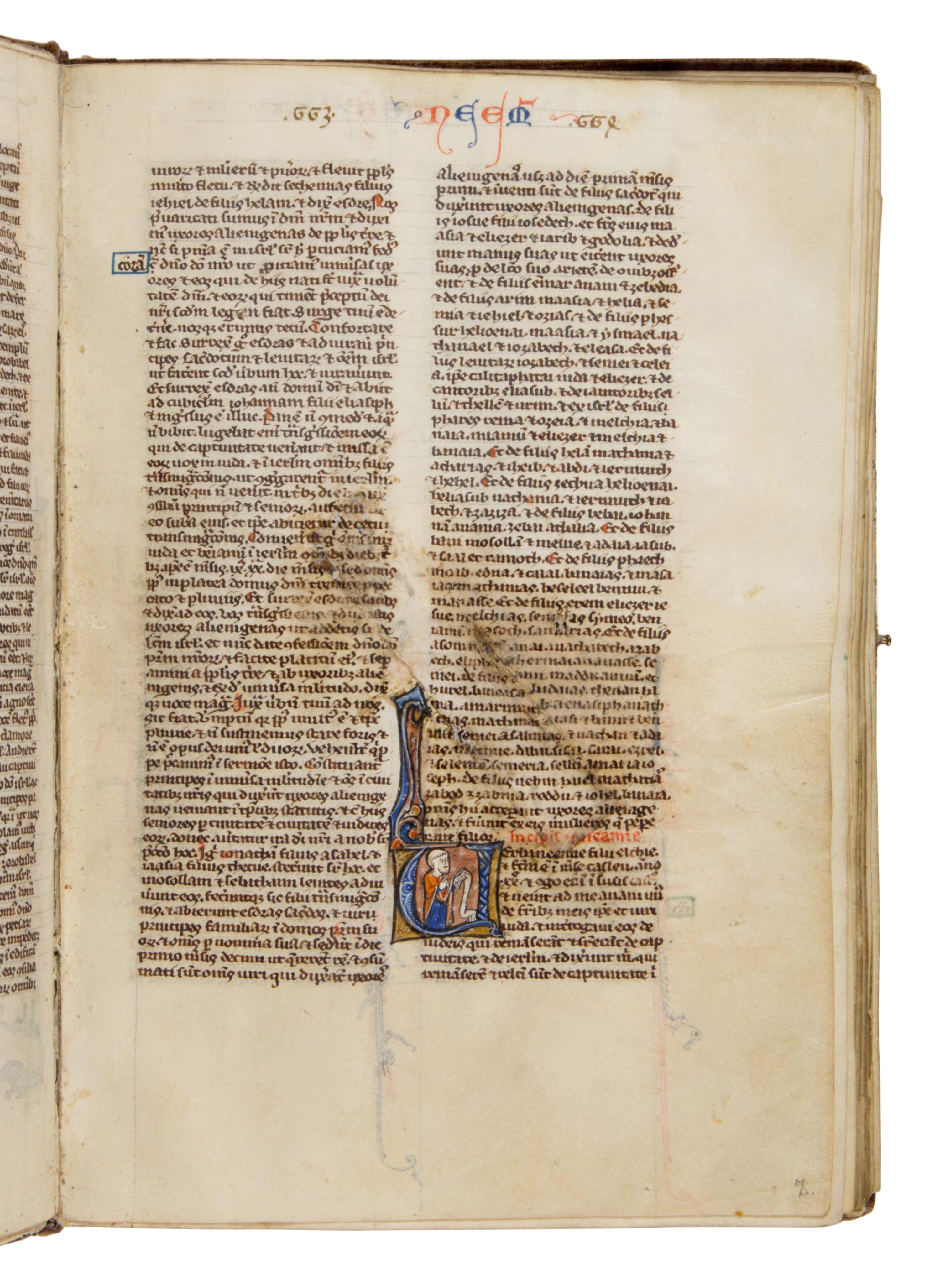
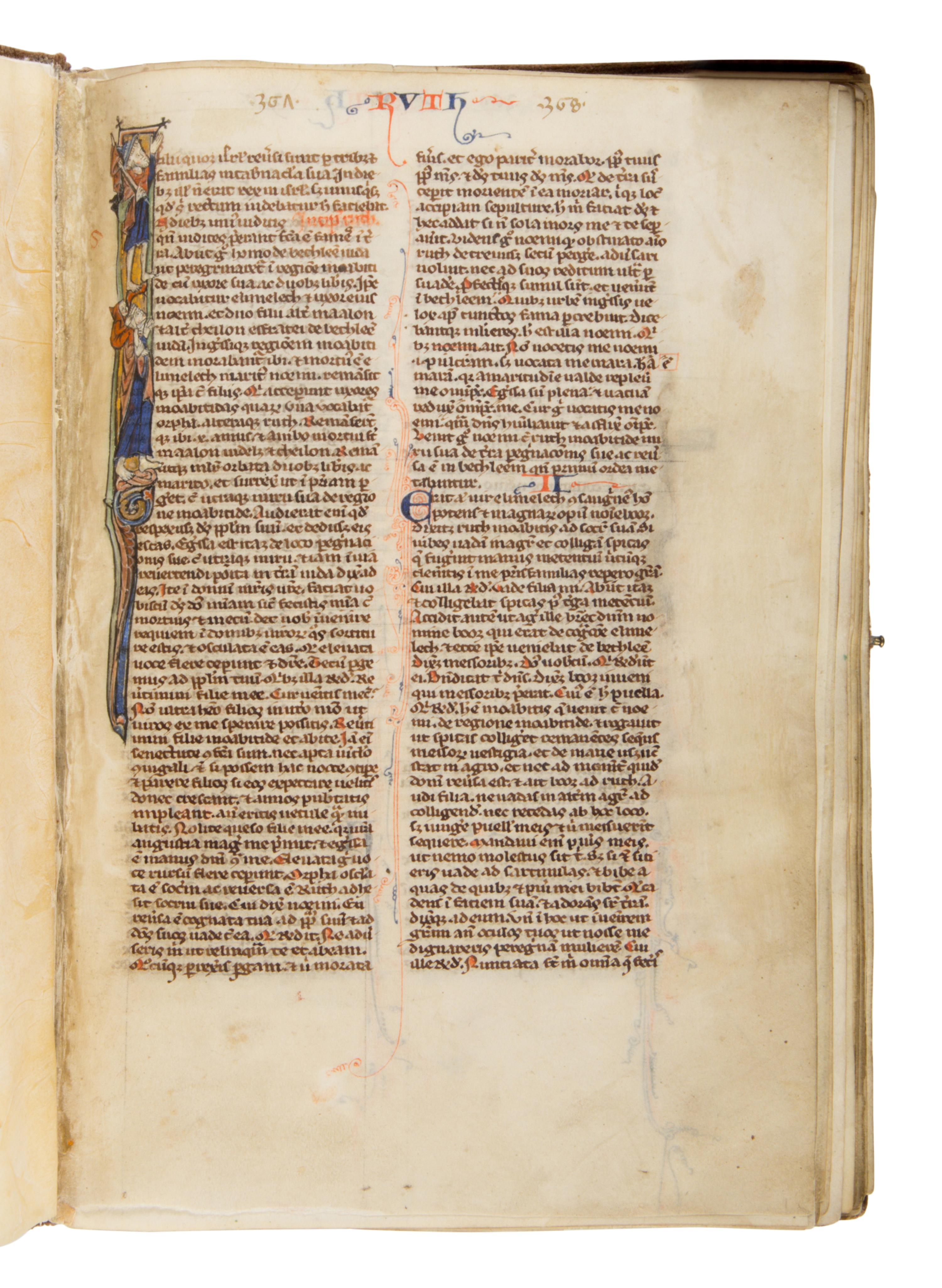
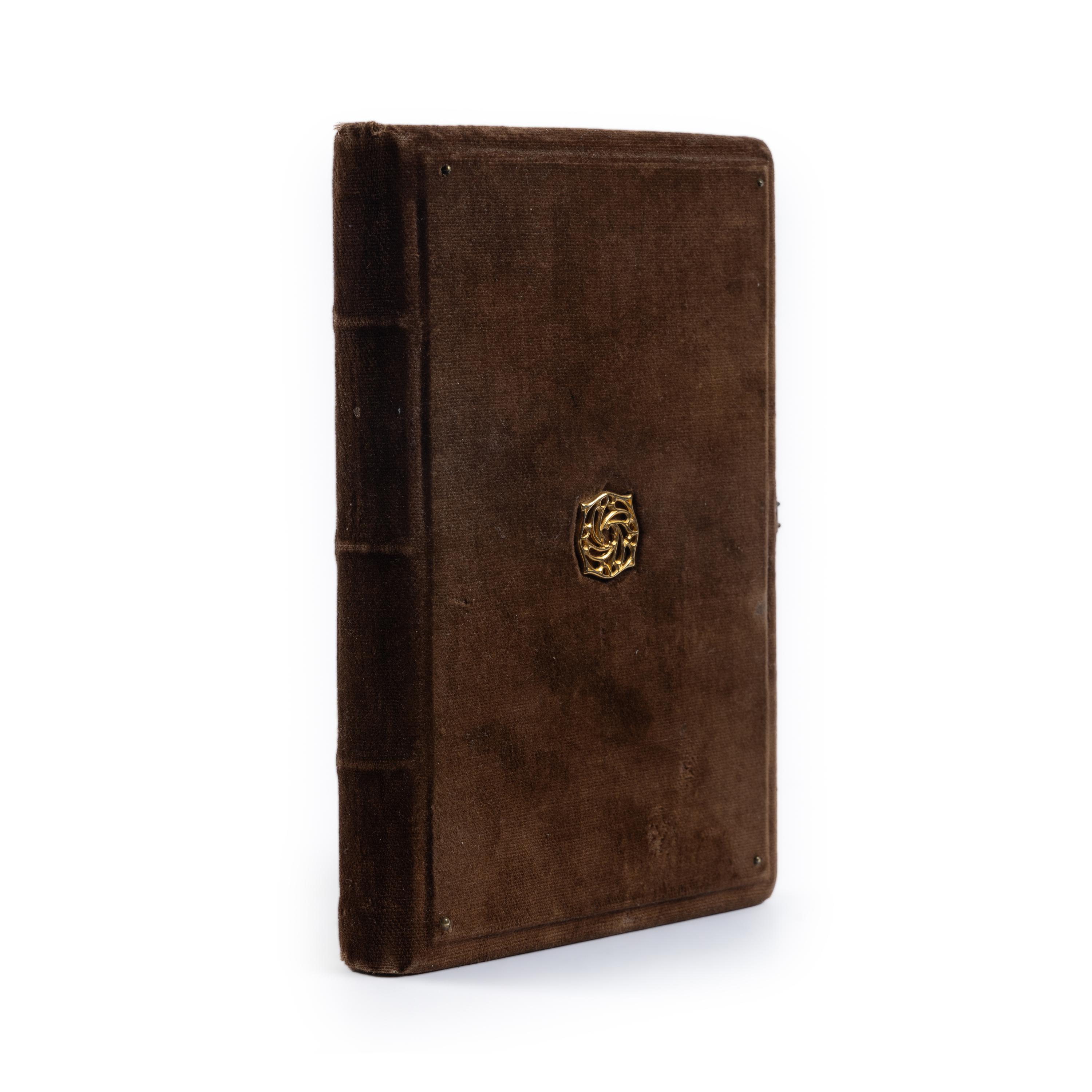
ii (modern paper + 1 vellum) + 50 + ii (modern paper) leaves, foliated intermittently in a modern pencil on lower right corners (largely erased), folios 41–42 fractionally cropped, [collation: single leaves in modern guarded binding], ruled in drypoint in two columns of 54 lines (justification: 132 mm × 88 mm), written in a brown Gothic textualis script, concordance markings in red with slightly later additions in brown, marginal notations outlined in blue ink, column numbers added in a later medieval hand, running titles in alternating red and blue ink, rubrics in red, capitals in red and blue ink with penwork embellishments, 10 ILLUMINATED INITIALS of 4 lines marking prologues, on blue and rose ground with curling acanthus infill in some places populated with zoomorphic forms, eight with long extensions terminating in foliage executed in blue and rose ink with white penwork, 27 HISTORIATED INITIALS of 6 lines marking chapter headings in rose and blue ink on burnished gold ground, 22 with long extensions terminating in foliage and zoomorphic figures executed in blue and rose ink with white penwork. Bound Denis Gouey in brown velour over boards, the covers framed by blind-pressed fillet secured at corners by metal studs, a small gilt metal openwork boss with scrolling foliate design at center, single gold clasp. Cockling, stains, and discoloration throughout, water damage on folios 8, 23, repairs to folios, 5, 26, 28, 29, 30, 31, some losses to gold, else in fair condition. 186 mm × 124 mm.
Provenance
(1) Parent volume created for unidentified Dominican(?) house. The original volume contained a note referring to use in the refectory (f. 107v), and several surviving leaves include marginal annotations indicating liturgical readings. For example, the beginning of the present leaf features a note indicating the first reading on Friday (“p. feri[a] vi”), while the verso includes a similar note at Revelation 2:18 for Saturday (“p. sabbato”). Numerous folios bear marginal letters ‘p’ ‘s’ and ‘t’ (for primus, secundus, tertius, not the canonical hours of Prime, Terce, and Sext), a system characteristic of Dominican Bibles.
(2) Parent volume with sixteenth-century ownership inscriptions including: William George (fols. 56r, 206v), Robert Wyet (f. 151r), and Henry Consteny (fols. 264v, 296v, and 340r).
(3) Charles M. Manning, with his late eighteenth- or early nineteenth-century signature and shelfmark “B” above “c.4.”
(4) Charles Kirkpatrick Sharpe (1781–1851), eccentric Edinburgh literary figure and associate of Sir Walter Scott; his signature appears on a flyleaf.
(5) Sir John Jaffray (1818–1901), Scottish journalist and newspaper proprietor. His signature appears beneath Sharpe’s.
(6) Sold anonymously at Sotheby’s, 14 October 1946, lot 147; purchased by Alan G. Thomas (1911–1992), the English book dealer who worked under Grace G. Commin in Bournemouth from 1936, later establishing his own firm and relocating to London in 1964. He retained the Bible in his private collection for more than twenty-five years.
(7) Posthumously sold at Sotheby’s, 22 June 1993, lot 6; purchased by Sam Fogg, and later broken (possibly by Bruce Ferrini).
(8) Purchased from Bruce Ferrini (1949–2010), Akron, OH, by Dr. Scott Schwartz, New York, his bookplate and catalog number “MS 55” on the inside of the front cover.
Text
f. 1, Ruth (i-iii); ff. 2-3, 1 Samuel (xii-xiiv; xxii-xxiv); f. 4, 2 Kings (viii-x); ff. 5-6, 2 Chronicles (xxii-xxv; xxv-xxx); f. 7, Ezra (i-iii); f. 8, Nehemiah (i-iii); ff. 9-14v, Nehemia (xiv-xv), 2 Ezra, Tobit (i); f. 15, Job (xlii), Esther (i-iii); f. 16, Psalms (i-vii); f. 17, Psalms (xxxiii-xxxviii); f. 18, Psalm (li-lviii); f. 19, Psalms (xcvi-ciii); f. 20, Psalms (cvi-cxi); f. 21, Proverbs (xxxi), Ecclesiastis (i-iii); f. 22, Ecclesiastes (ix-xii), Song of Songs (i); f. 23, Isaiah (lxvi), Jeremiah (i-ii); f. 24, 2 Kings (ixx-xxi); f. 25, Jeremiah (iii-v); f. 26, Lamentations (iii-v), prologus, Baruch (i); f. 27, prologus, Ezekiel (i-ii); f. 28, Ezekiel (ix-xii); f. 29, Ezekiel (xlvi-xlvii) prologus; f. 30, Daniel (i-ii); f. 31, Ezekiel (xxi-xxiii); f. 32, Zaccariah (vi-xi); f. 33, Habakkuk (iii), Zephaniah (i); ff. 34-35, Micah (vi-vii), prologus, Nahum, prologus, Habbakuk (i): f. 36, Micah (iv-v); f. 37, 1 Corinthians (xvi), 2 Corinthians (i-ii); f. 38, 1 Macabees (xv-xvi), 2 Macabees (i-ii); f. 39, 2 Machabees (v-vii); f. 40, 2 Corinthians (xi-xii), prologus, Galatians (i-ii); f. 41, 1 John (i-v); f. 42, Acts (xxviii), prologus, Romans (i-iii); f. 43, 1 Corinthians (i-iv); f. 44-50, Interpretationes nominum (A, C-H, L-N, P-S).
Illumination
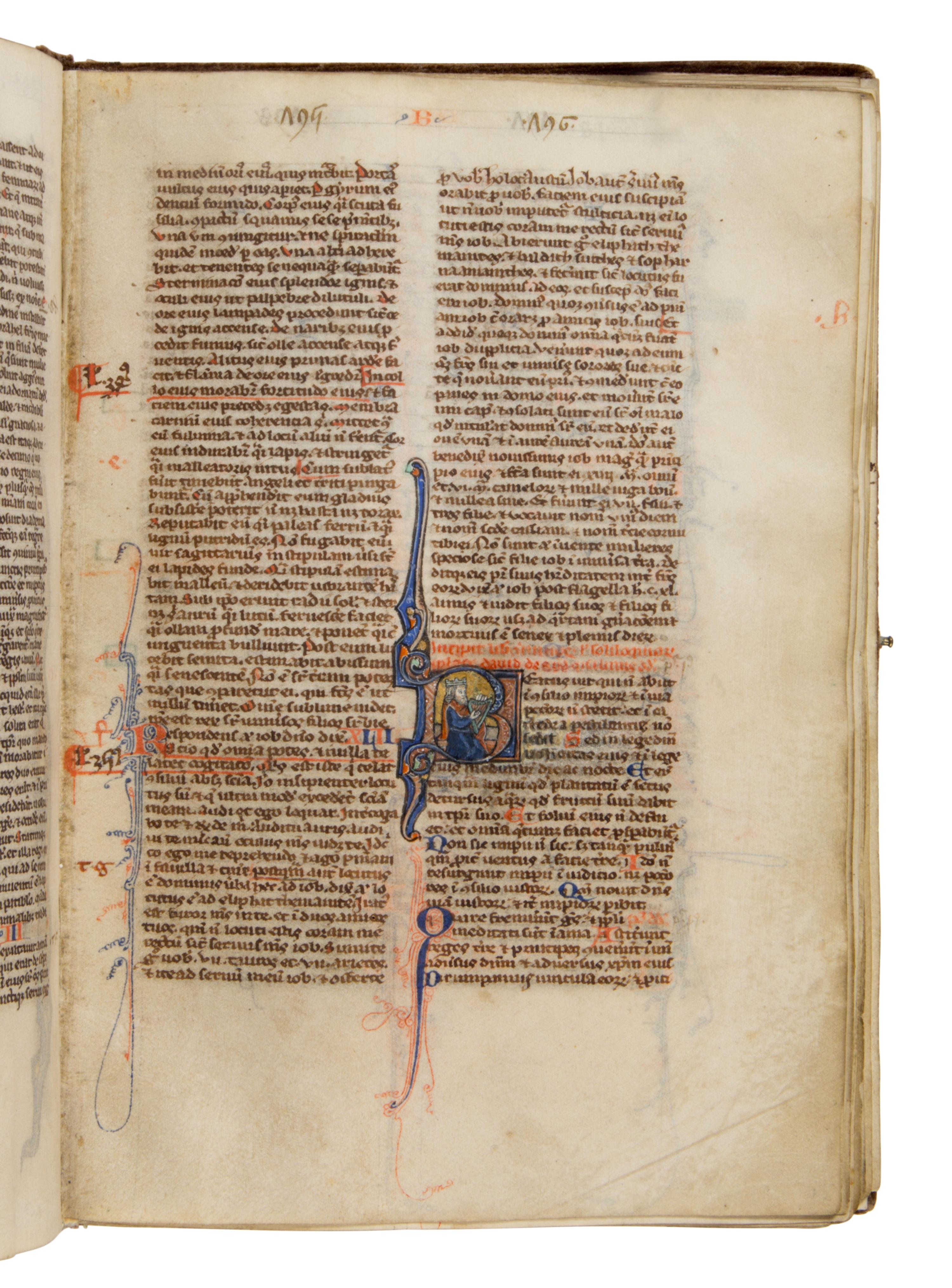
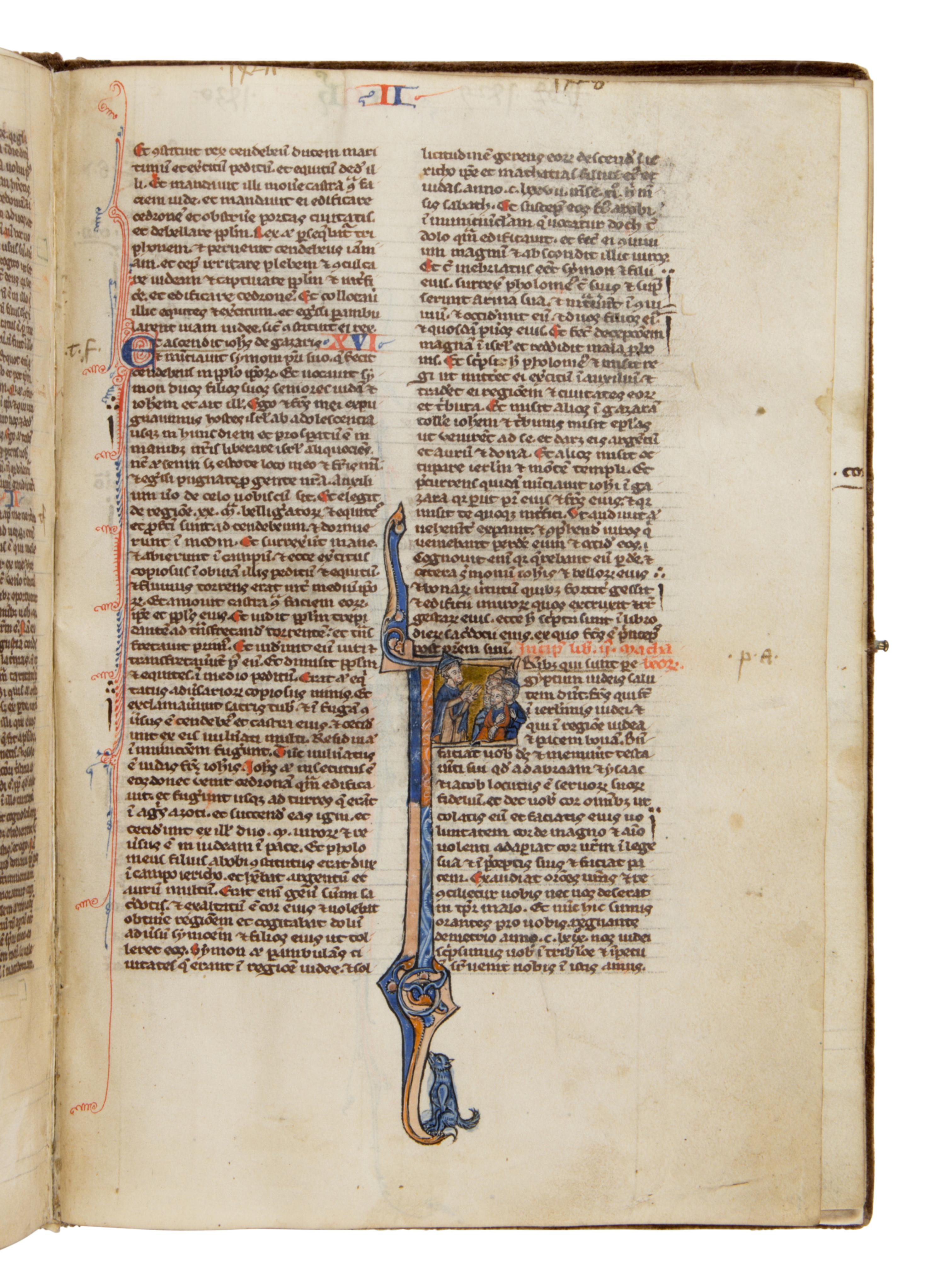
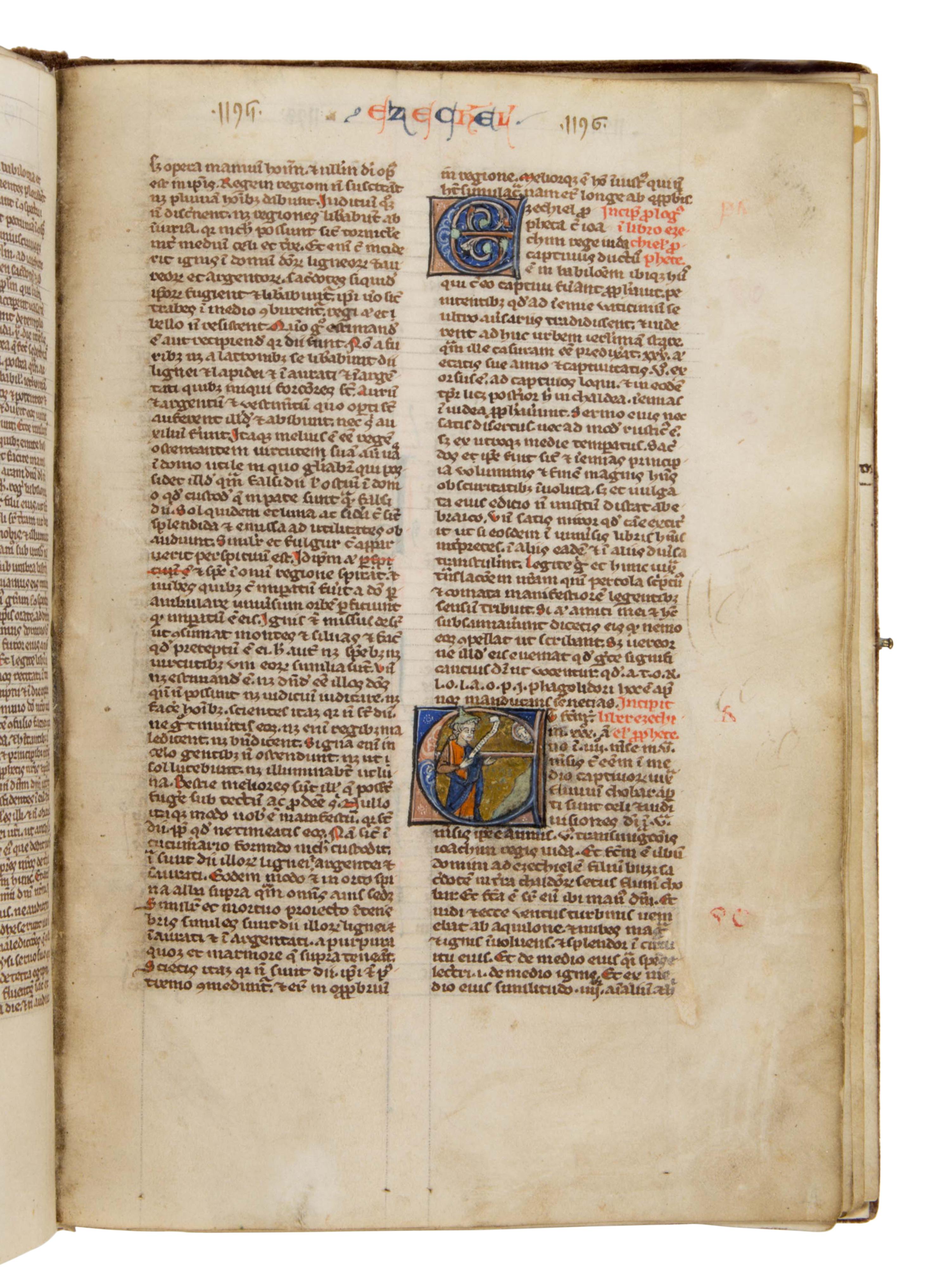
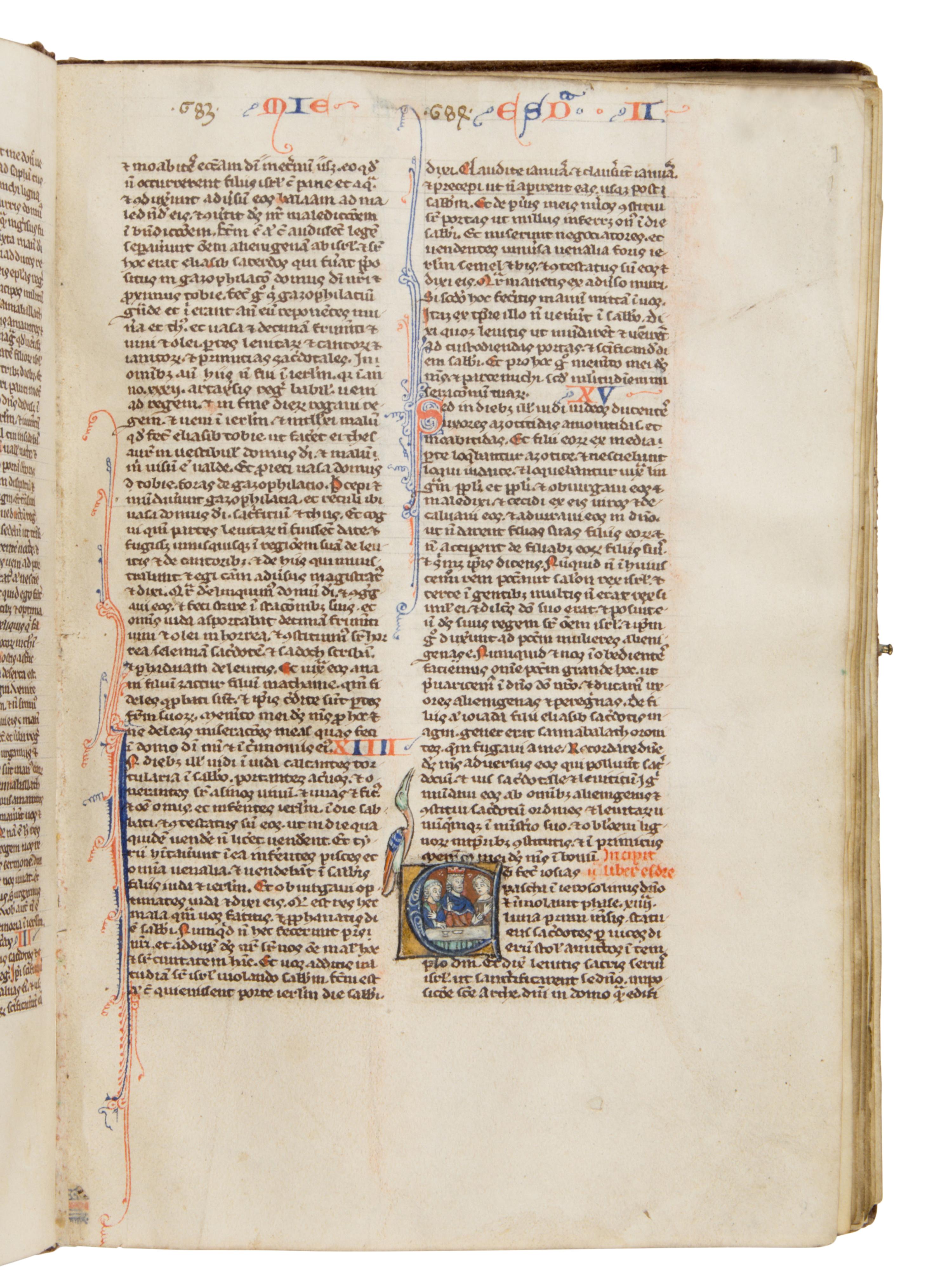
An album of fifty leaves derives from a now-dispersed English Bible, which can be firmly placed within the circle of William de Brailes, the leading figure in Oxford manuscript illumination during the second quarter of the thirteenth century. One of the earliest named artists in medieval England, de Brailes is best known for his richly narrative compositions, compact figure style, and expressive gestures, as seen in such manuscripts as the De Brailes Psalter (British Library, Add. MS 49999). His workshop played a crucial role in shaping Gothic manuscript illumination within the expanding intellectual environment of the medieval university. The present initial shares the distinctive vocabulary of this milieu: lively, animated figures contained within compact architectural spaces; expressive faces articulated with fine linear modeling; and elongated letterforms terminating in thick, weighty tendrils, a decorative flourish characteristic of Oxford illumination around the middle decades of the thirteenth century.
This fragment represents the largest surviving group of leaves from this Bible, which is widely dispersed among private and institutional collections. Notably, a single leaf from the same parent volume is also offered in this sale (lot 9). A consistent group of codicological features allows the original manuscript to be partially reconstructed. Most distinctive are the medieval Arabic numerals written above the columns, which do not mark every fifth line (as in some Oxford Bibles) but instead number each column, creating a system of reference for concordances and scholarly consultation. Many leaves are also divided into seven sections marked in the margins with letters “a” through “g,” corresponding to a reference system developed in the 1230s for the Dominican Concordance of Saint-Jacques in Paris. The presence of both systems demonstrates that this Bible was designed for intensive scholarly use and strongly suggests a context connected with the emerging Dominican intellectual culture of the thirteenth century. Founded in Oxford in 1221, the Dominican community quickly became a major center of biblical study, and this manuscript survives as an important witness to the tools and visual culture that supported medieval scriptural scholarship.
The subjects of the 27 historiated initials are: f. 1, Elimelech and Naomi with one of their children in an initial ‘I’ (Book of Ruth; formerly f. 9); f. 7, King Cyrus directing a man building the Temple of Jerusalem in initial ‘I’ (I Ezra; formerly f. 80); f. 8, Nehemiah with a scroll in an initial ‘U’ (Nehemiah; formerly f. 83); f. 9, Josias celebrating Passover with two men in an initial ‘E’ (II Ezra; formerly f. 88); f. 14v, Raphael leading Tobit in an initial ‘T’ (Tobit; formerly, f. 93v); f. 15, King Ahasuerus and Esther in an initial ‘I’ (Esther; formerly f. 102); f. 16, King David with his harp in an initial ‘B’ (Psalms I; formerly f. 116); f. 17v, David pointing to his mouth in an initial ‘D’ (Psalm 38, formerly f. 121v); f. 18, David with the fool in an initial ‘D’ (Psalm 5f. 124); f. 19, Three priests singing at a lectern in an initial ‘C’ (Psalm 97; formerly f. 131); f. 20v, God and Christ in an initial ‘D’(Psalm l09; formerly f. 133v); f. 21, Ecclesia as a crowned queen in an initial ‘V’ (Ecclesiastes; formerly f. 147); f. 22v, the Virgin and Child in an initial ‘O’ (Song of Songs, formerly f. 149v); f. 23, Jeremiah and God in an initial ‘V; (Jeremiah; formerly f. 189); f. 26, Jeremiah writing in an initial ‘R’ (Prayer of Jeremiah, f. 210); f. 26v, Baruch writing at a desk in an initial ‘A’ (Baruch; formerly f. 2I0); f. 27, Ezechiel seeing his vision in an initial ‘A’ (Ezechiel; formerly f. 213); f. 30, Daniel in the lions’ den in an initial ‘A’ (Daniel; formerly f. 233); f. 33v, Zephaniah with a scroll in an initial ‘V’ (Zephaniah; formerly f. 252v); f. 34v, Nahum with a scroll in an initial ‘O’ (Nahum; formerly f. 250v); f. 35v, Habakkuk kneeling before God in an initial ‘O’ (Habakkuk; formerly f. 251v); f. 37v, Saint Paul with book and sword in an initial ‘P’ (II Corinthians; formerly f. 332v); f. 38, a prophet speaking to a group of people in an initial ‘F’ (II Maccabees; formerly f. 271); f. 40v, Saint Paul with a book and sword in an initial ‘A’ (Galatians; formerly f. 335v); f. 41, Saint John with a book in an initial ‘Q’ (I John; formerly f. 366); f. 42, the Conversion of Saint Paul in an initial ‘P’(Romans; formerly f. 323); f. 44 a king with a book (Interpretationes nominum; formerly f. 375).
Parent manuscript and sister leaves
The parent volume of 402 leaves is described in Sotheby’s 1993 catalogue (22 Jun, lot 6). It contained fifty-five large painted initials for prologues and seventy-eight historiated initials for books, beginning imperfectly at Joshua 7:20. Ninety-one leaves from the parent manuscript are identified in Kidd 2019, including the present fragment. The remaining leaves are listed here with folio numbers and subject descriptions based on Kidd’s list. Cleveland Museum of Art: 7 leaves: (f. 339v) Colossians; (f. 341r) I Thessalonians; (f. 342v) II Thessalonians; (f. 344r) I Timothy; (f. 345r) Titus; (f. 345v) Philemon; (f. 345v) Hebrews; University of Iowa: 2 leaves: II Kings (end)–Prologue to I Chronicles; II Maccabees 2–4; Charles Puckett: 3 leaves: IM-mo5; IM-mo8; IM-mo9; 7 leaves McCarthy Collection: Apocalypse of John; (f. 24) King David; (f. 126r) Jonah, (f. 245r) Amos; (f.41) Saint Pual; (f. 349v) Ascencion of Christ; (f. 362v) Saint James; Unknown Collections: 29 leaves: (f. 7v) Judges; (f. 24r) II Samuel; (f. 34r) I Kings; (f. 57r) I Chronicles; (f. 97r) Judith; (f. 119v) Psalm 26; (f. 126r) Psalm 68; (f. 128v) Psalm 80; (f. 151r) Wisdom; (f. 157r) Ecclesiasticus; (f. 210r) Prayer of Jeremiah; (f. 241r) Hosea; (f. 244r) Joel; (f. 245r) Amos; (f. 247v) Obadiah; (f. 248r) Jonah; (f. 253v) Haggai; (f. 258r) Malachi; (f. 280r) Prologue to Matthew; (f. 286r) Matthew; (f. 292v) Mark; (f. 300r) Luke; (f. 313v) John; (f. 337r) Ephesians; (f. 338v) Philippians; (f. 362v) James; (f. 363v) I Peter; (f. 365r) II Peter.
Literature
Published: Sotheby’s, Autograph Letters and Historical Printed Books, London, 14–16 October 1946, lot 147; Sotheby’s, Fine Books and Manuscripts from the Library of the Late Alan G. Thomas, London, 22 June 1993, lot 6; Peter Kidd, The McCarthy Collection, Vol. 2, Spanish, English, Flemish & Central European Miniatures, London, 2019, no. 11; Related literature: Sydney C. Cockerell, The Work of William de Brailes, Cambridge, 1930; Nigel Morgan, Early Gothic Manuscripts (I): 1190–1250, vol. 4, London, 1982, pp. 29–31; Claire Donovan, The de Brailes Hours: Shaping the Book of Hours in Thirteenth-Century Oxford, London, 1991.
We are grateful to Peter Kidd for permission to quote from his catalogue for this entry, and we thank Senior Consultant Sandra Hindman and Peter Bovenmyer for their assistance in preparing this sale.
Collection of Dr. Scott Schwartz
This lot is located in Chicago.