To request further details about this lot, please email Fineart@freemansauction.com
Please email Fineart@freemansauction.com for any additional information or questions you may have
| Philadelphia
| Philadelphia
To request further details about this lot, please email Fineart@freemansauction.com
Please email Fineart@freemansauction.com for any additional information or questions you may have
Estimate$100,000 – $200,000
Please note that in order to remove the lot from the lobby of the Inland Steel Building, Buyer will need to pay the owner of the Inland Steel Building’s glass contractor (or another reputable, experienced glass contractor acceptable to the owner) to remove glass panels from the Inland Steel Building’s façade and reinstall the glass panels upon removal. Additionally, the vendor Buyer selects to transport the lot from the lobby must be a reputable, experienced transporter. All contractors and vendors are required to be union and carry insurance meeting the Inland Steel Building’s standard insurance requirements for contractors and vendors. Timing of removal of the lot must be coordinated with the owner of the Inland Steel Building based on the timing of delivery of a replacement desk, which is expected to be delivered in mid-September, 2026. By bidding on the lot, you agree to these conditions.
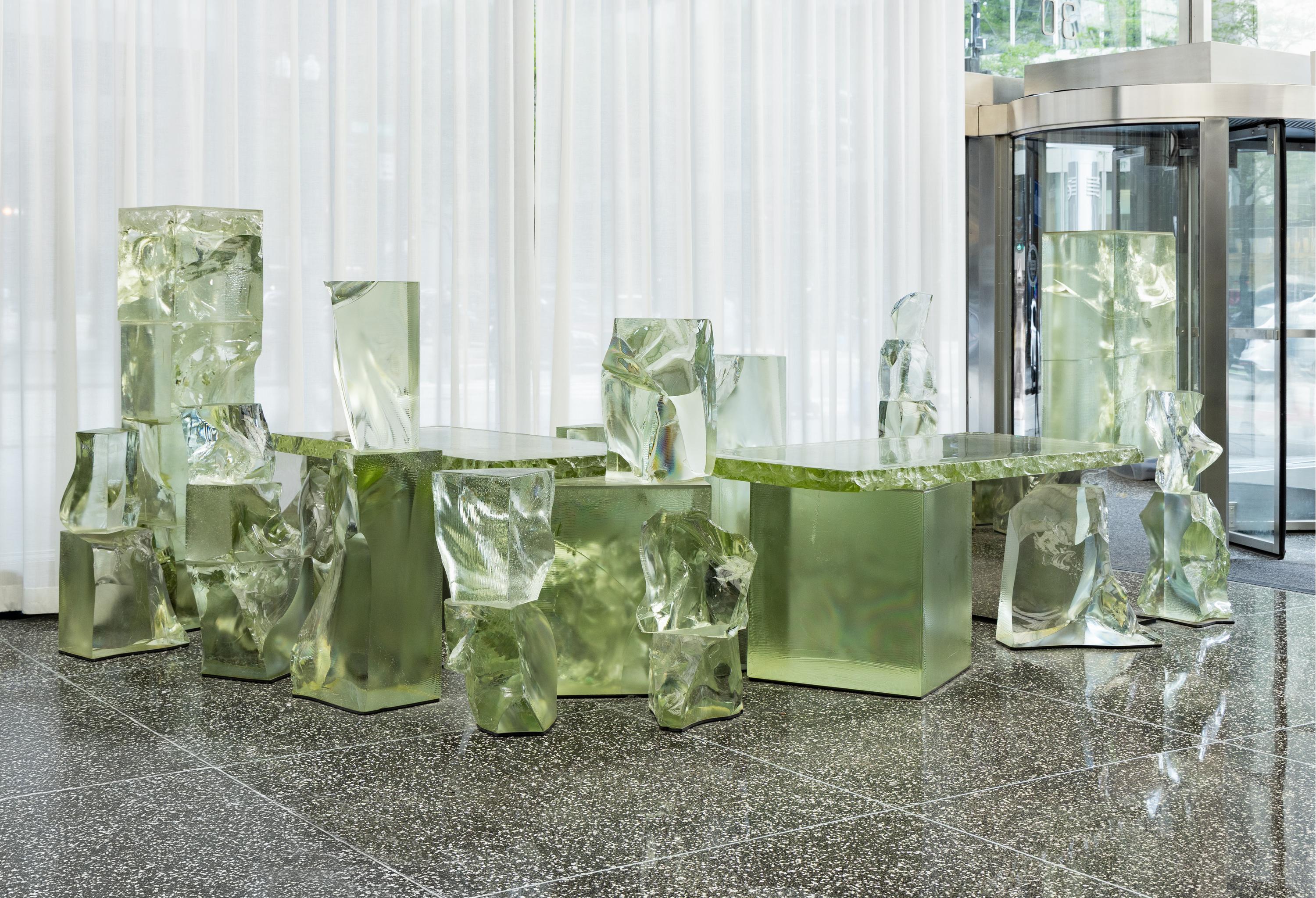
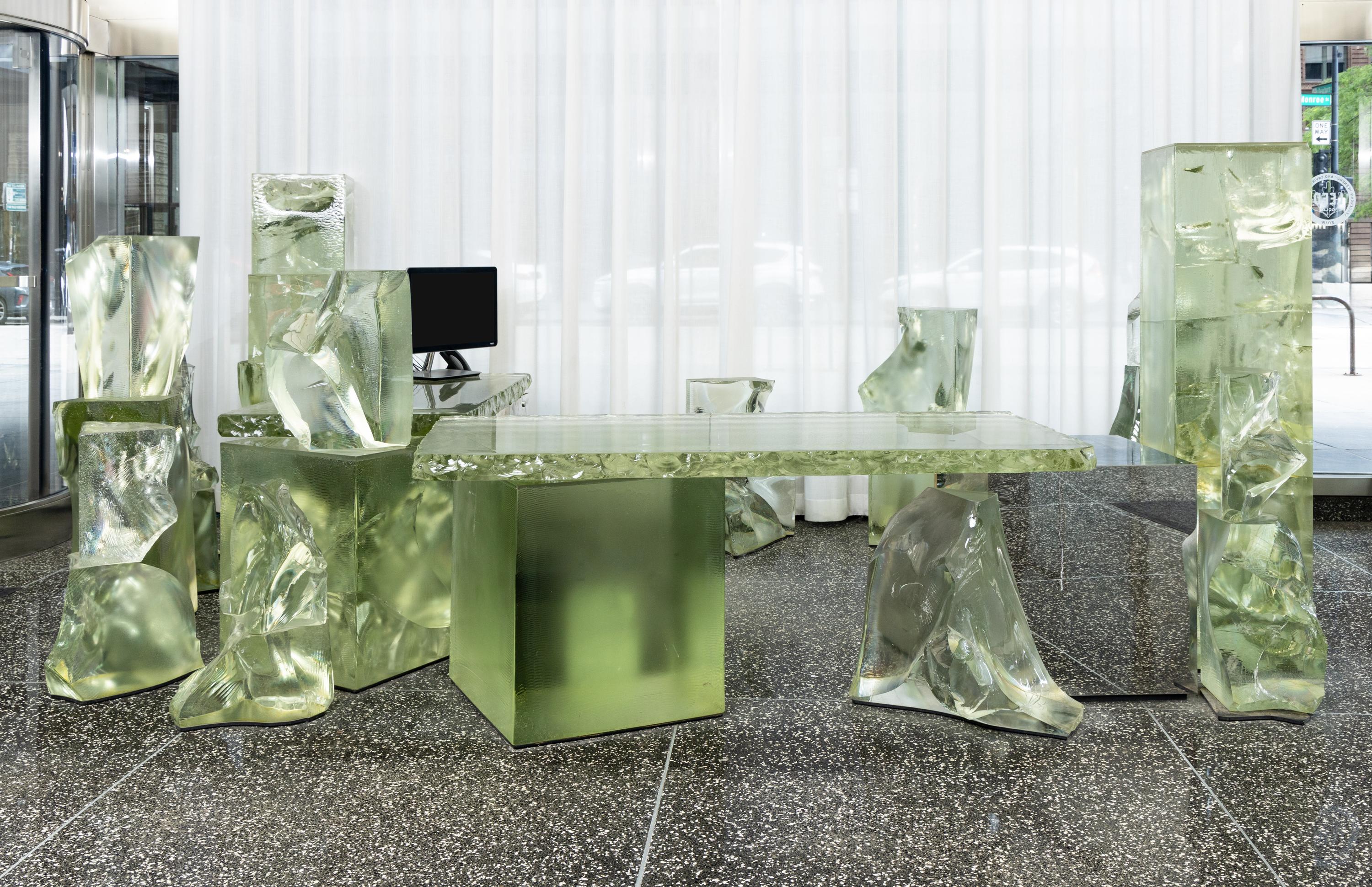
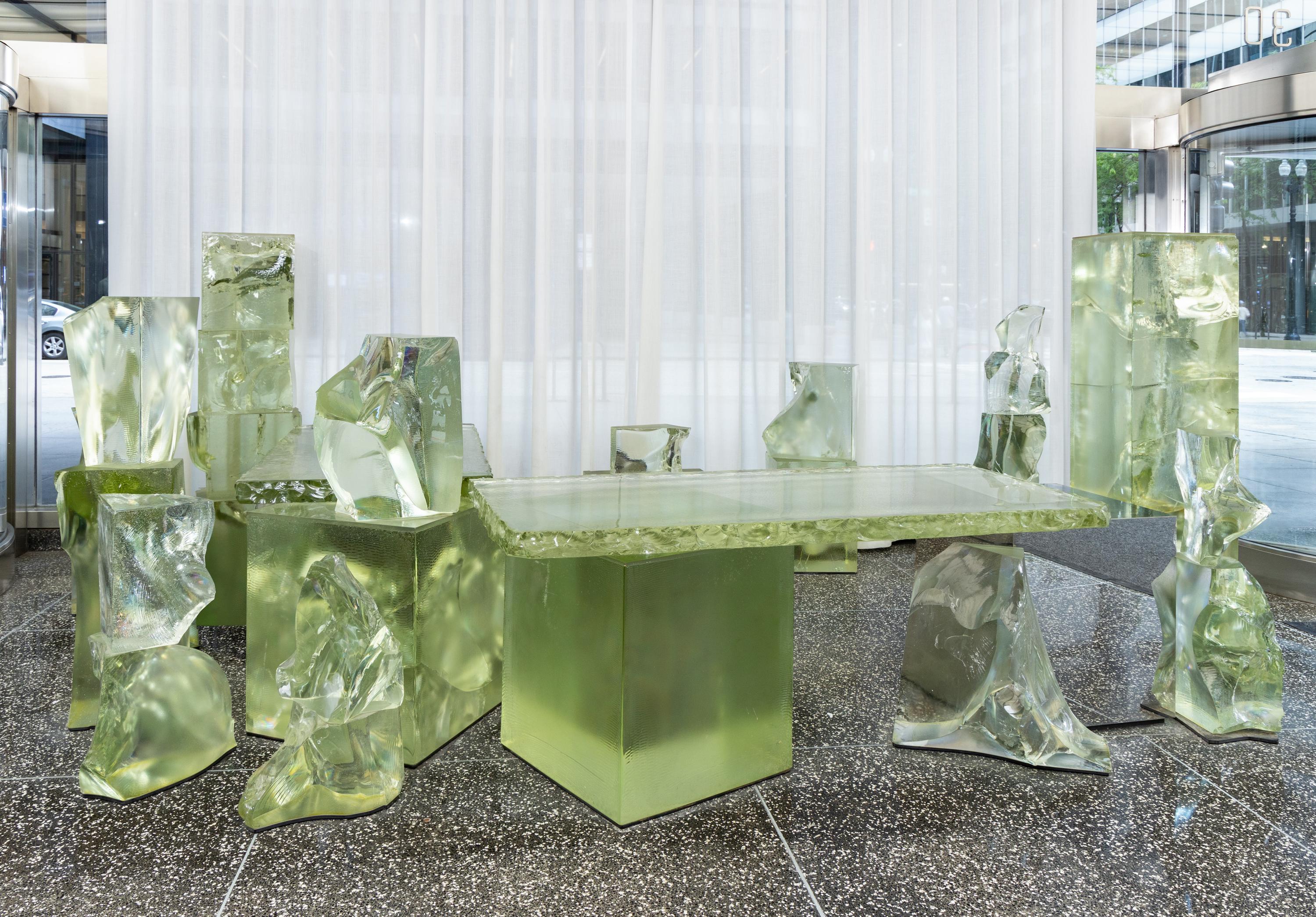
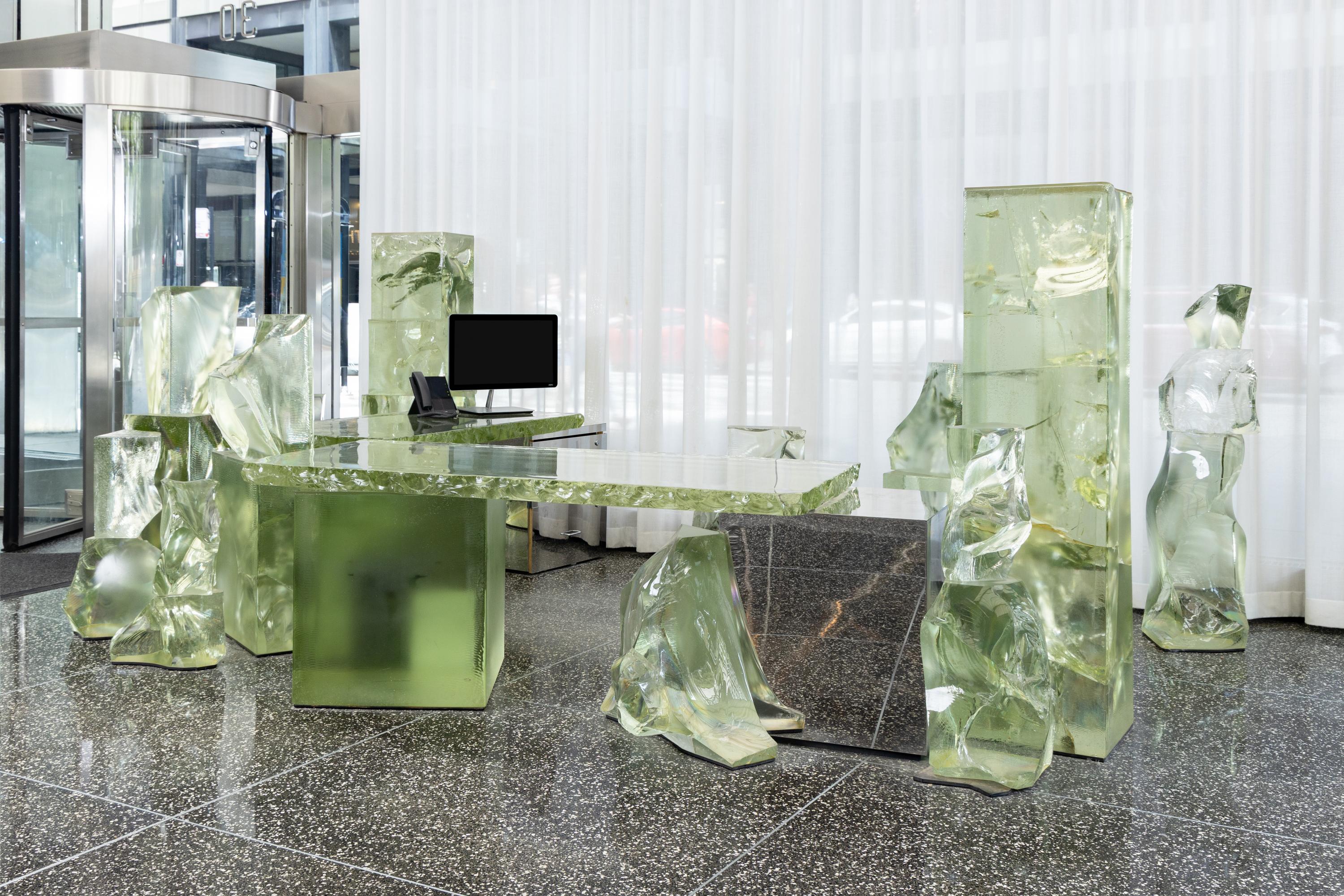
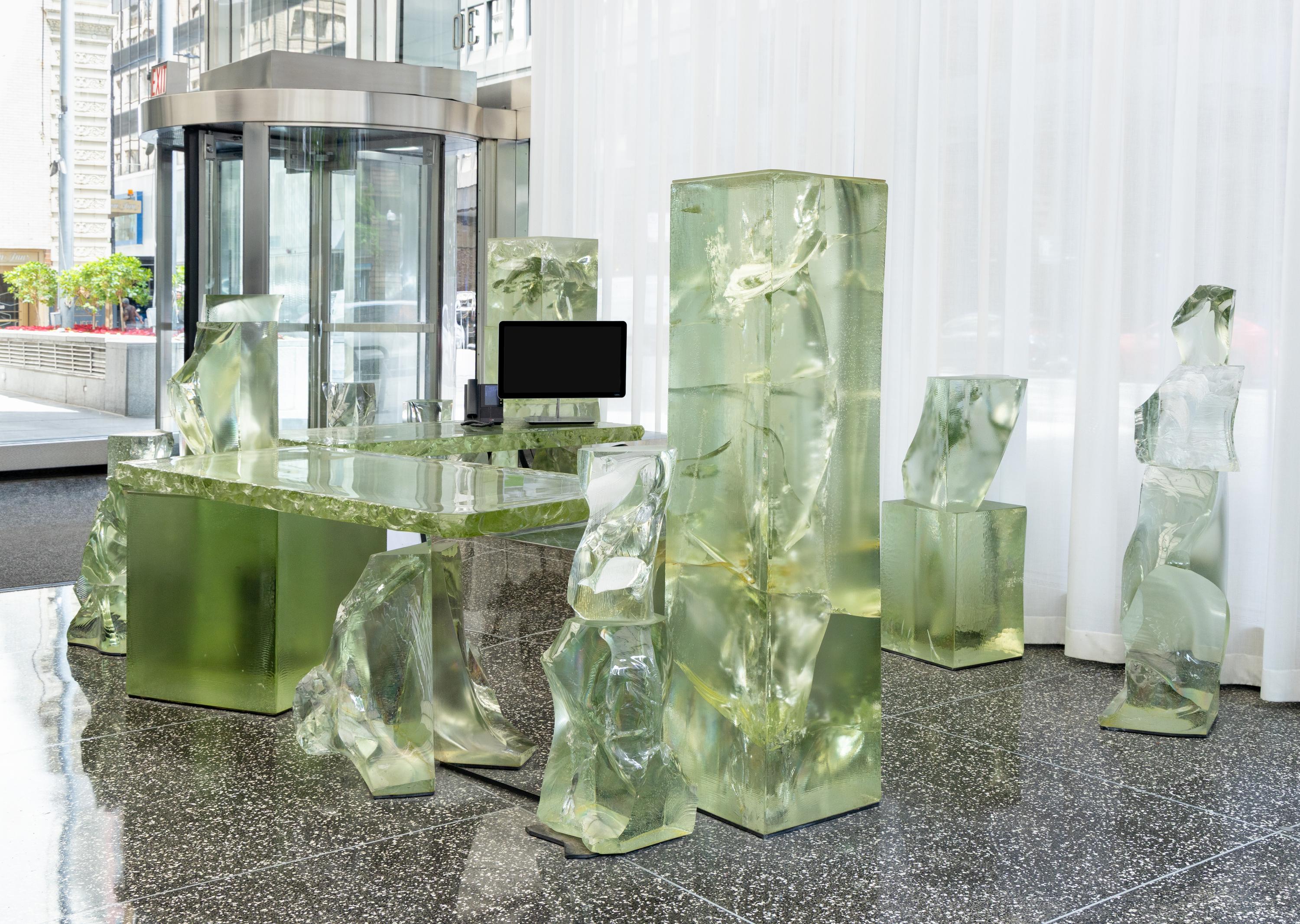
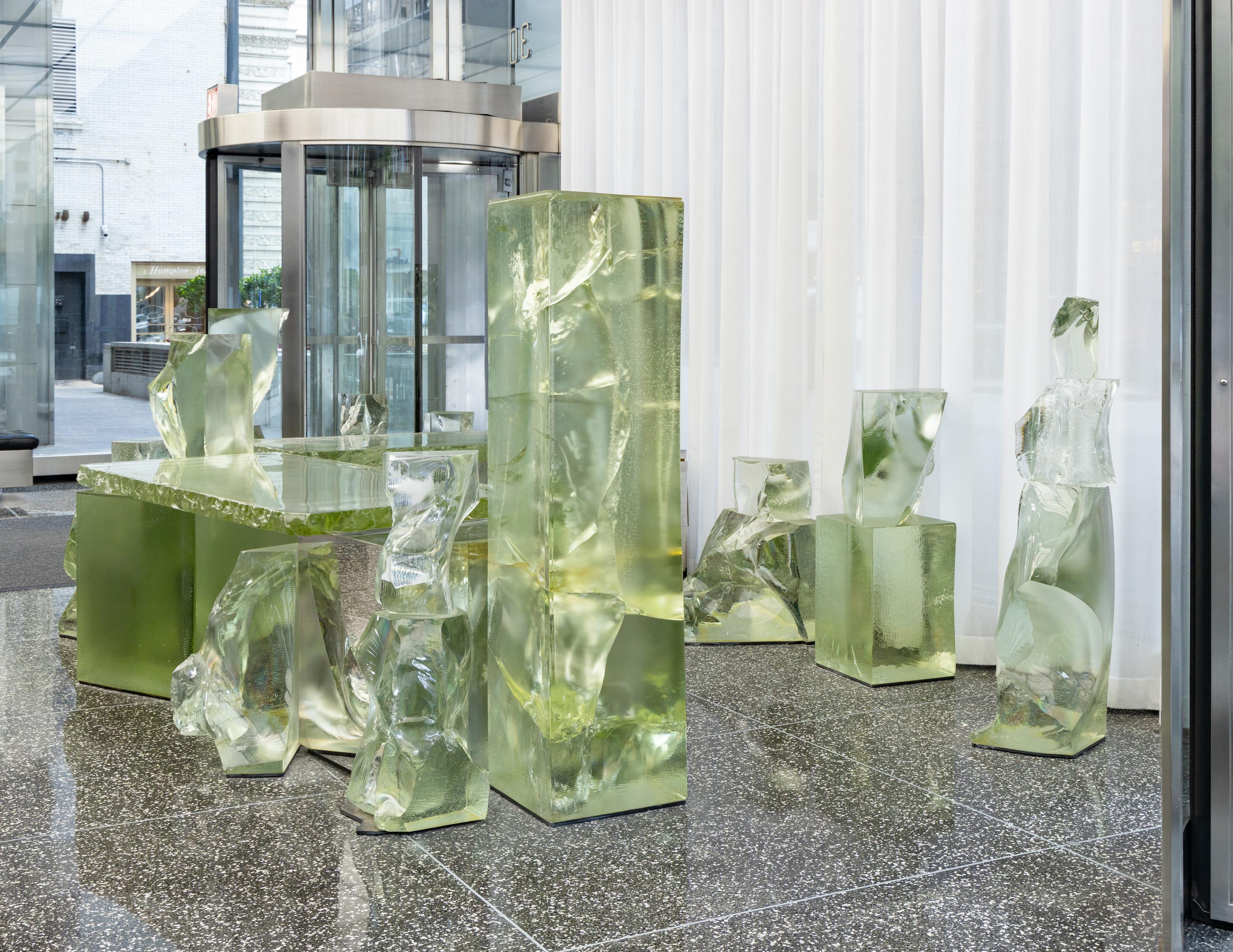
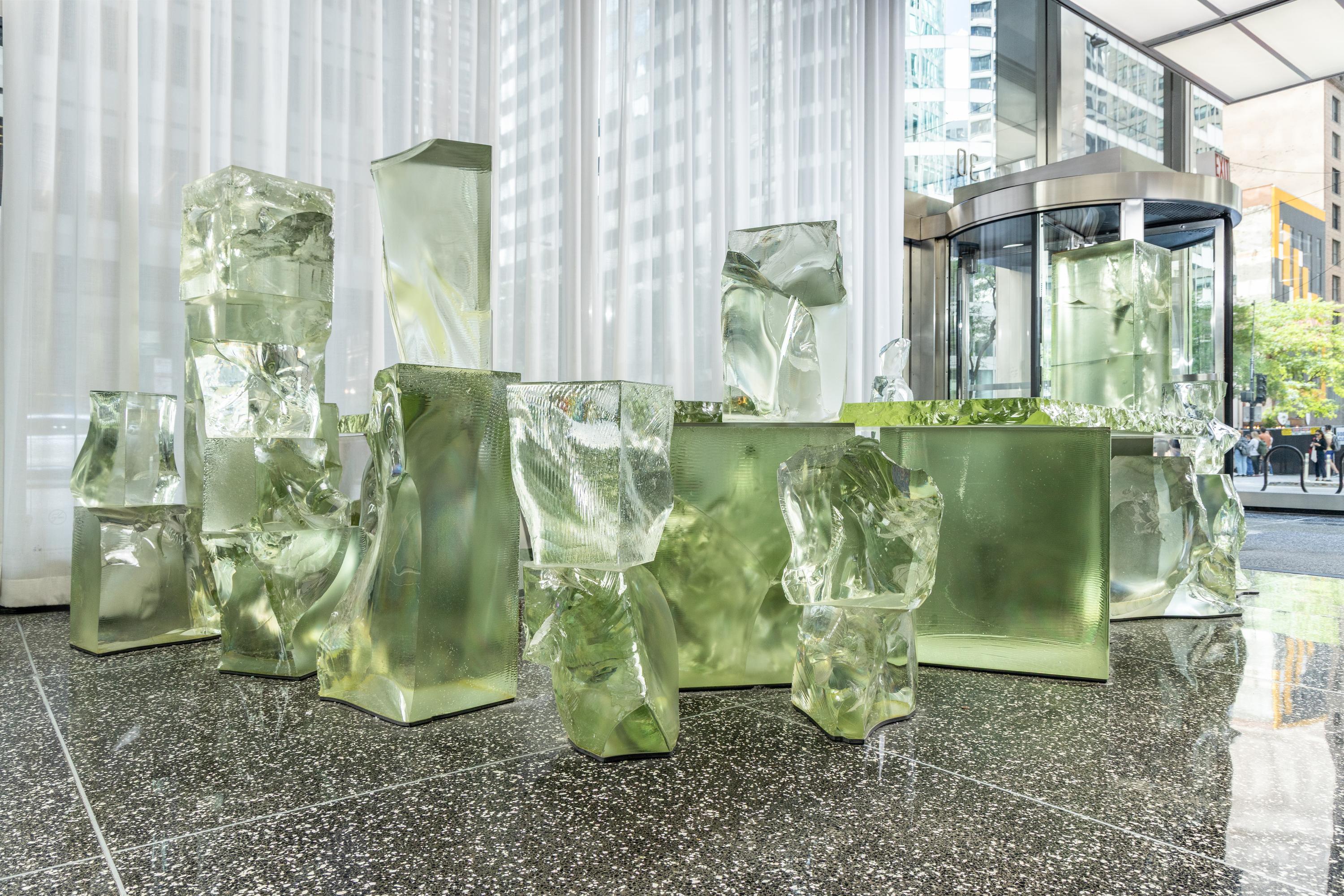
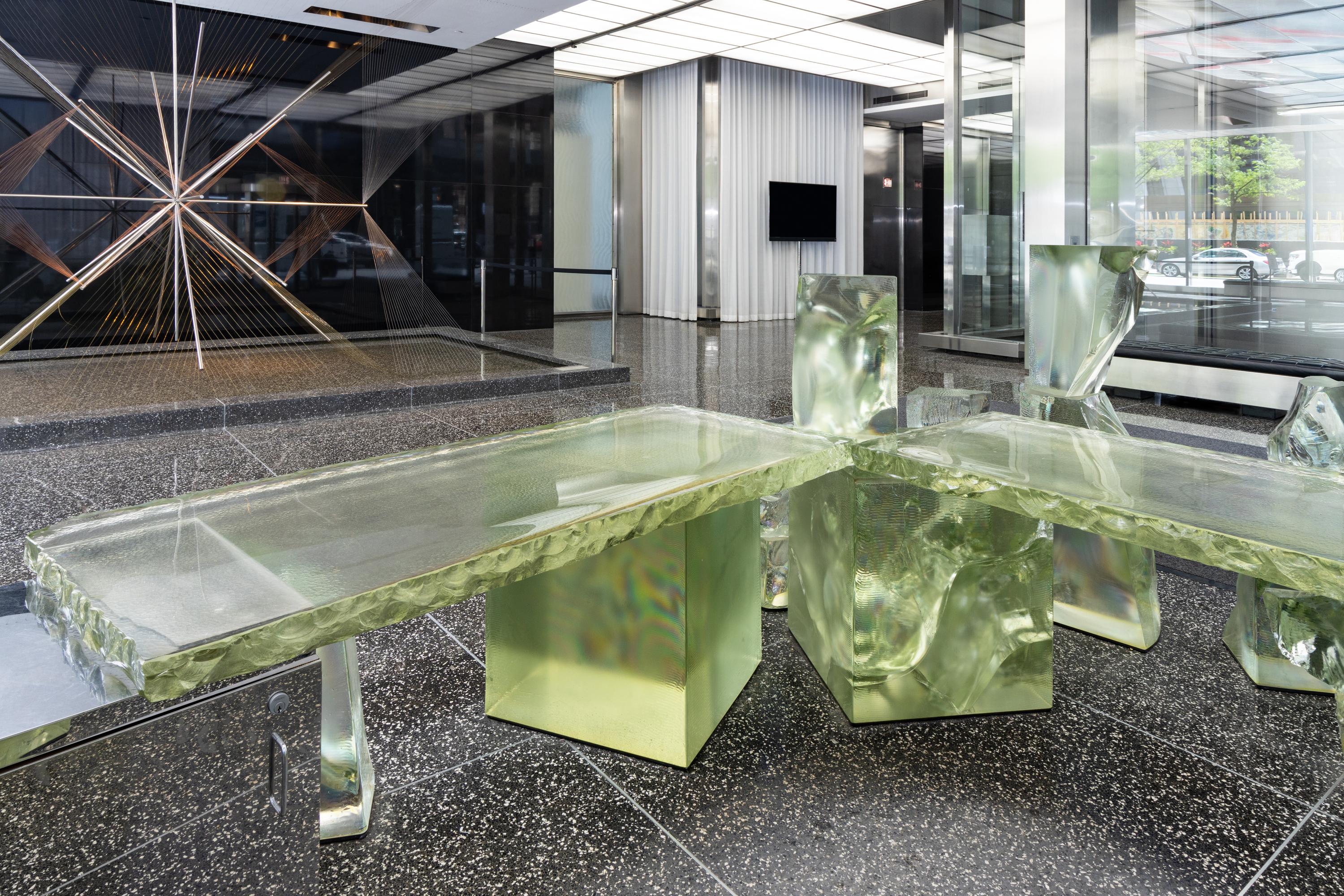
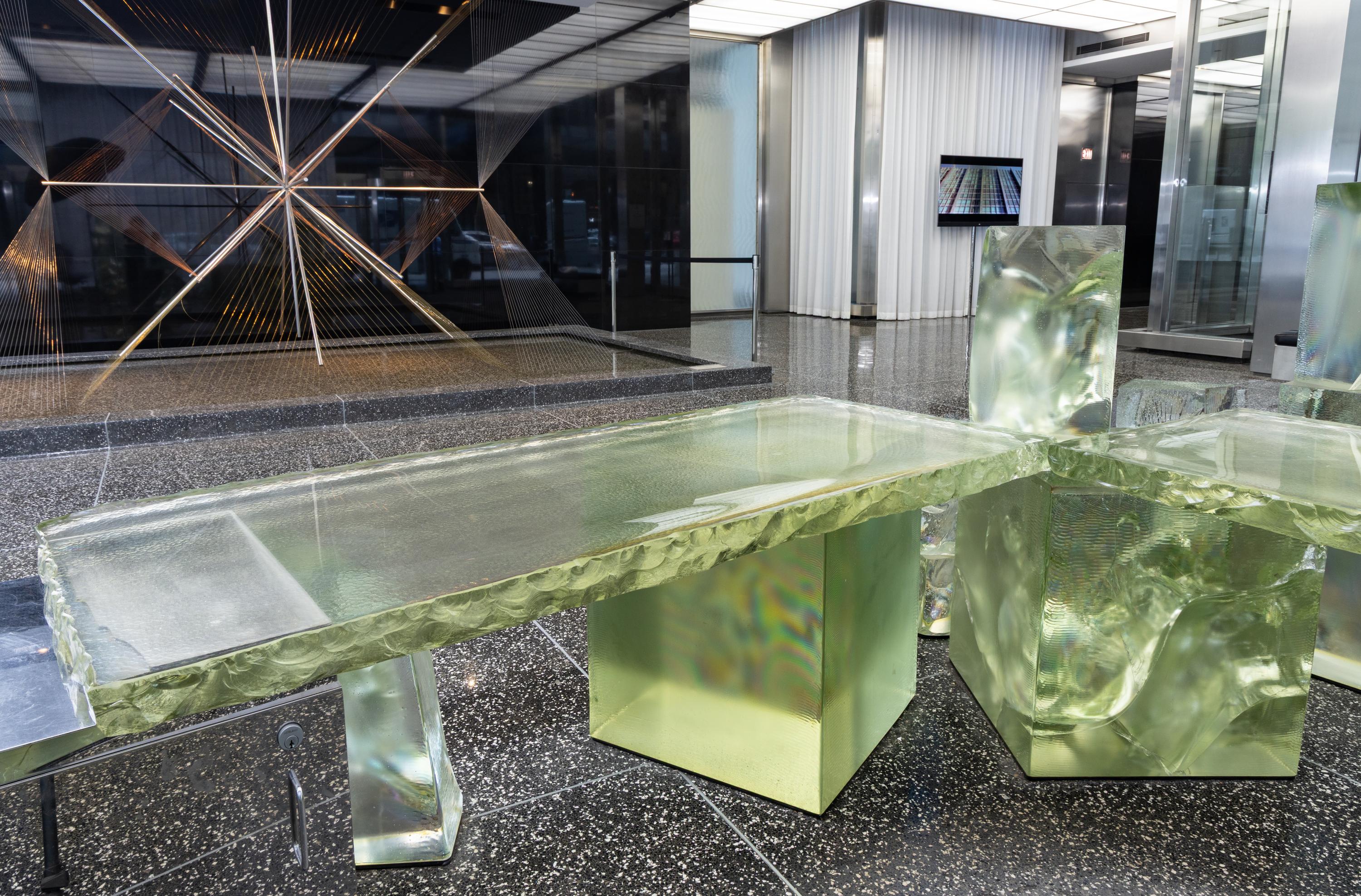
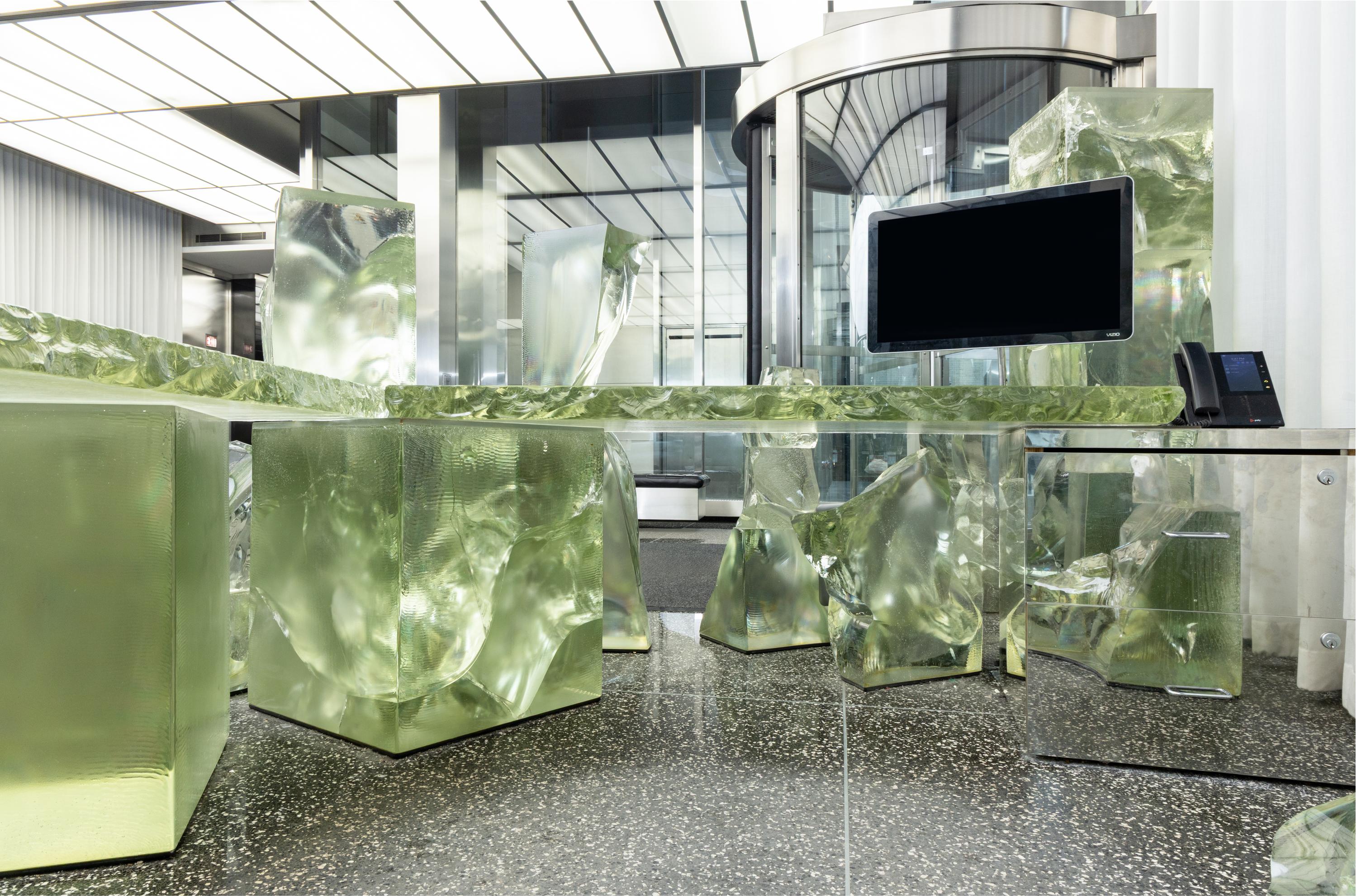
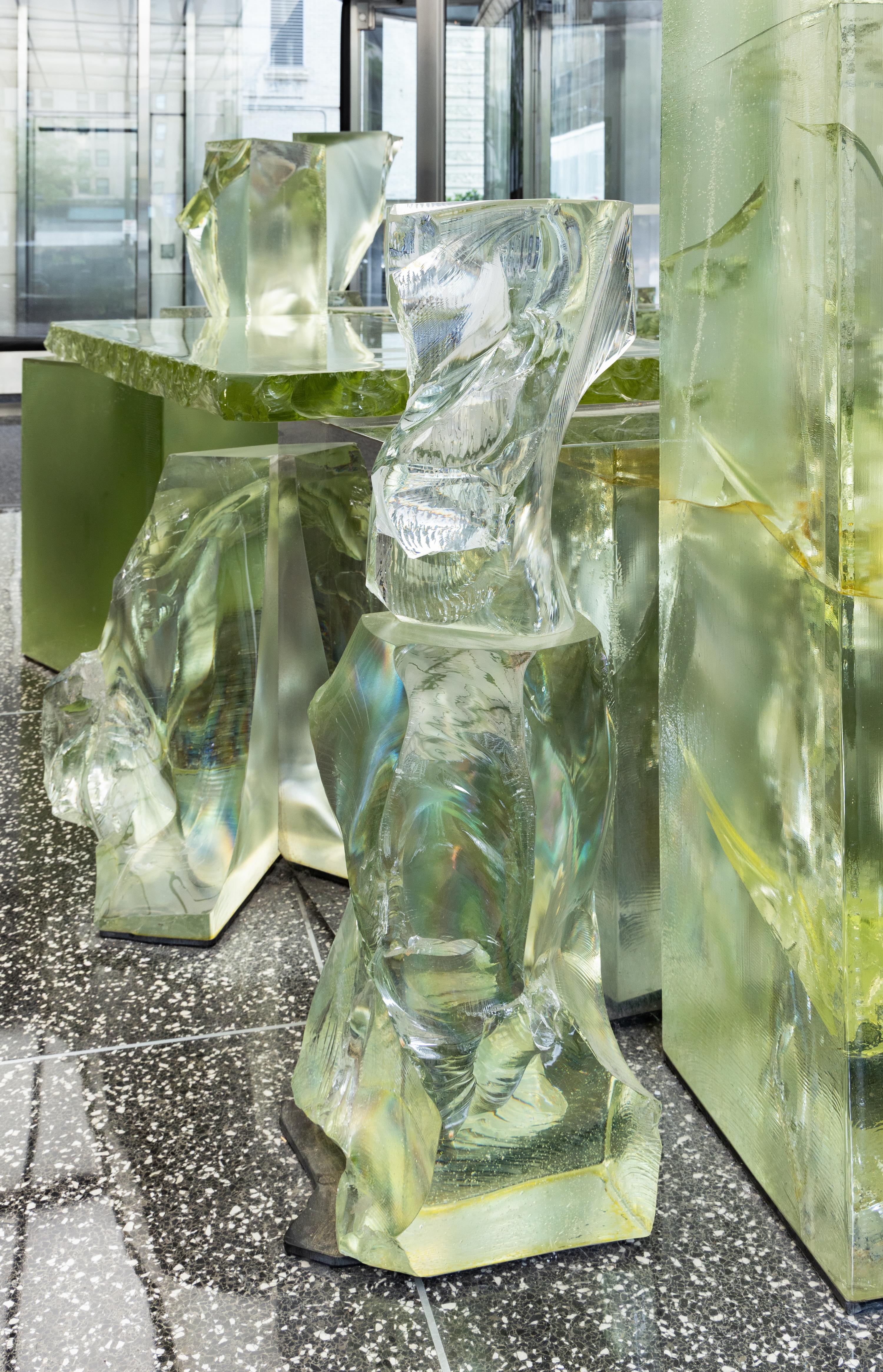
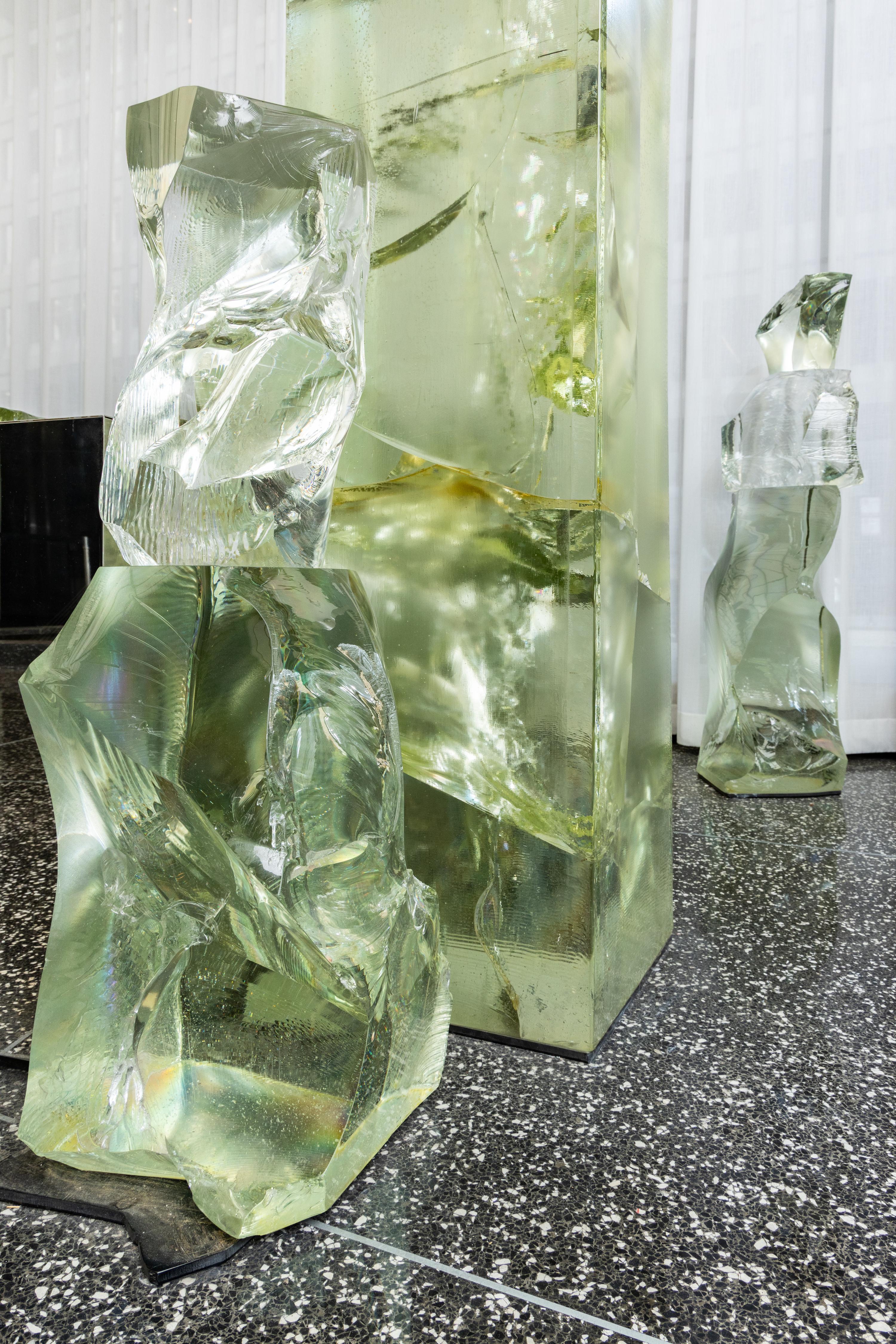
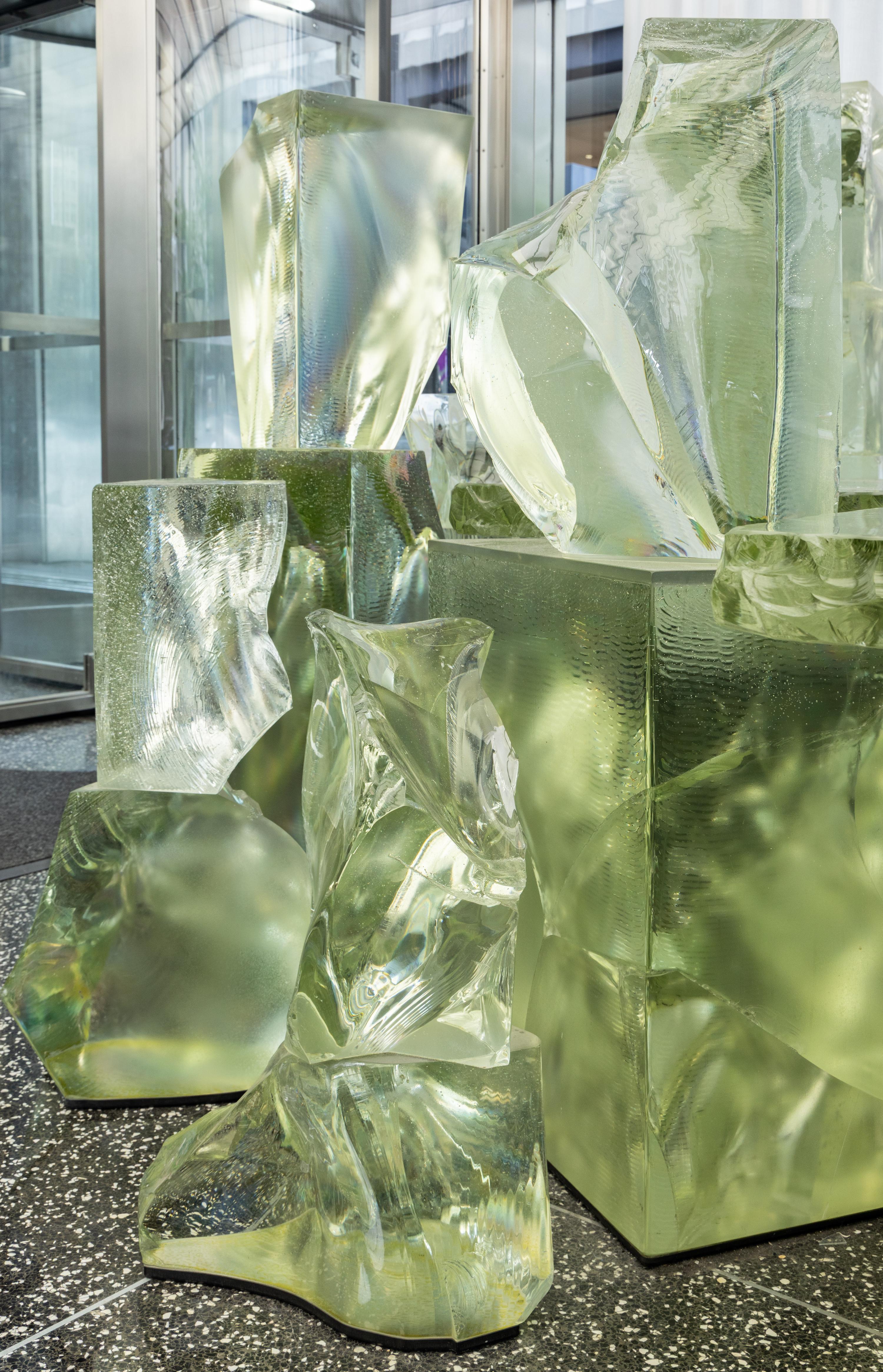
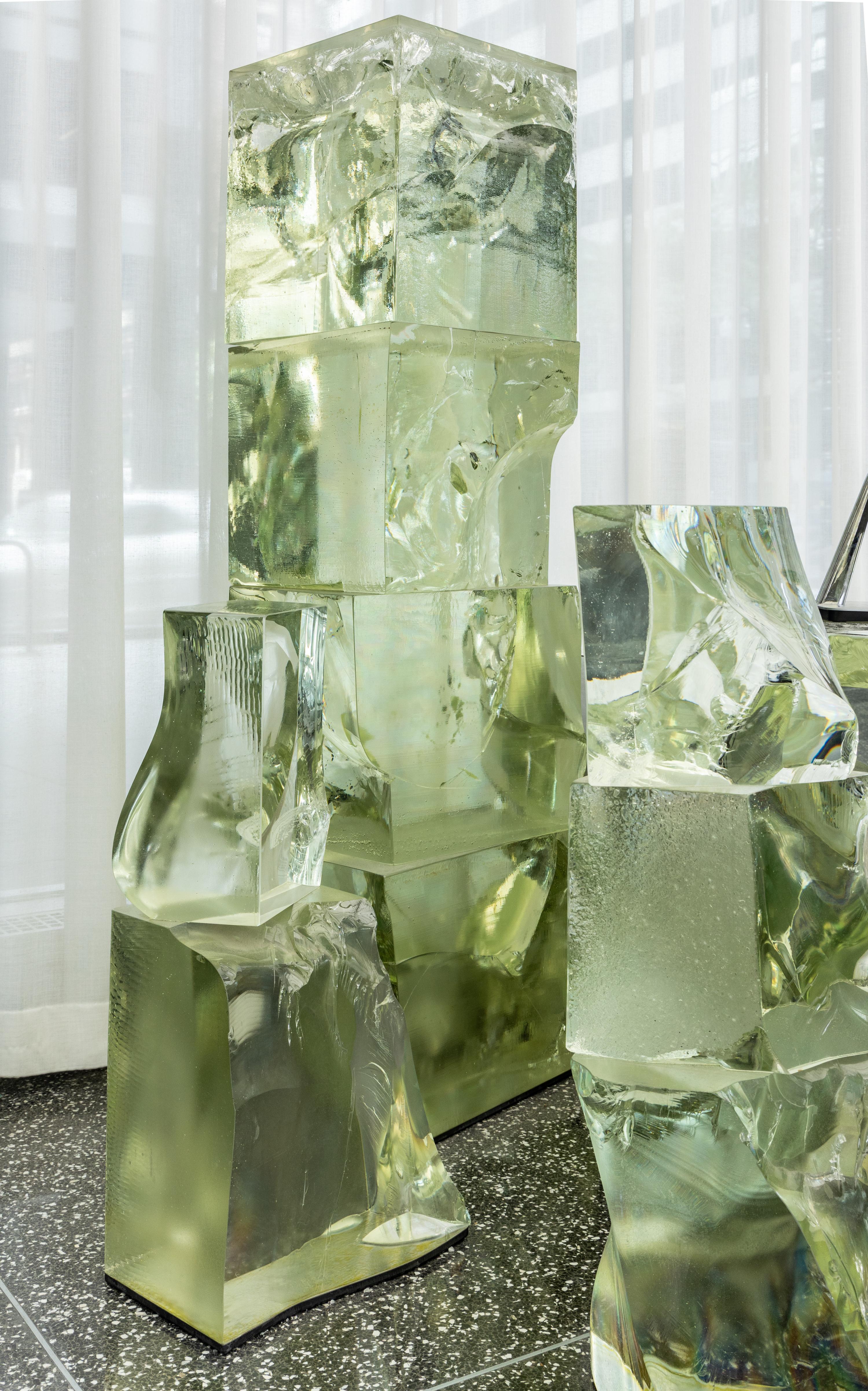
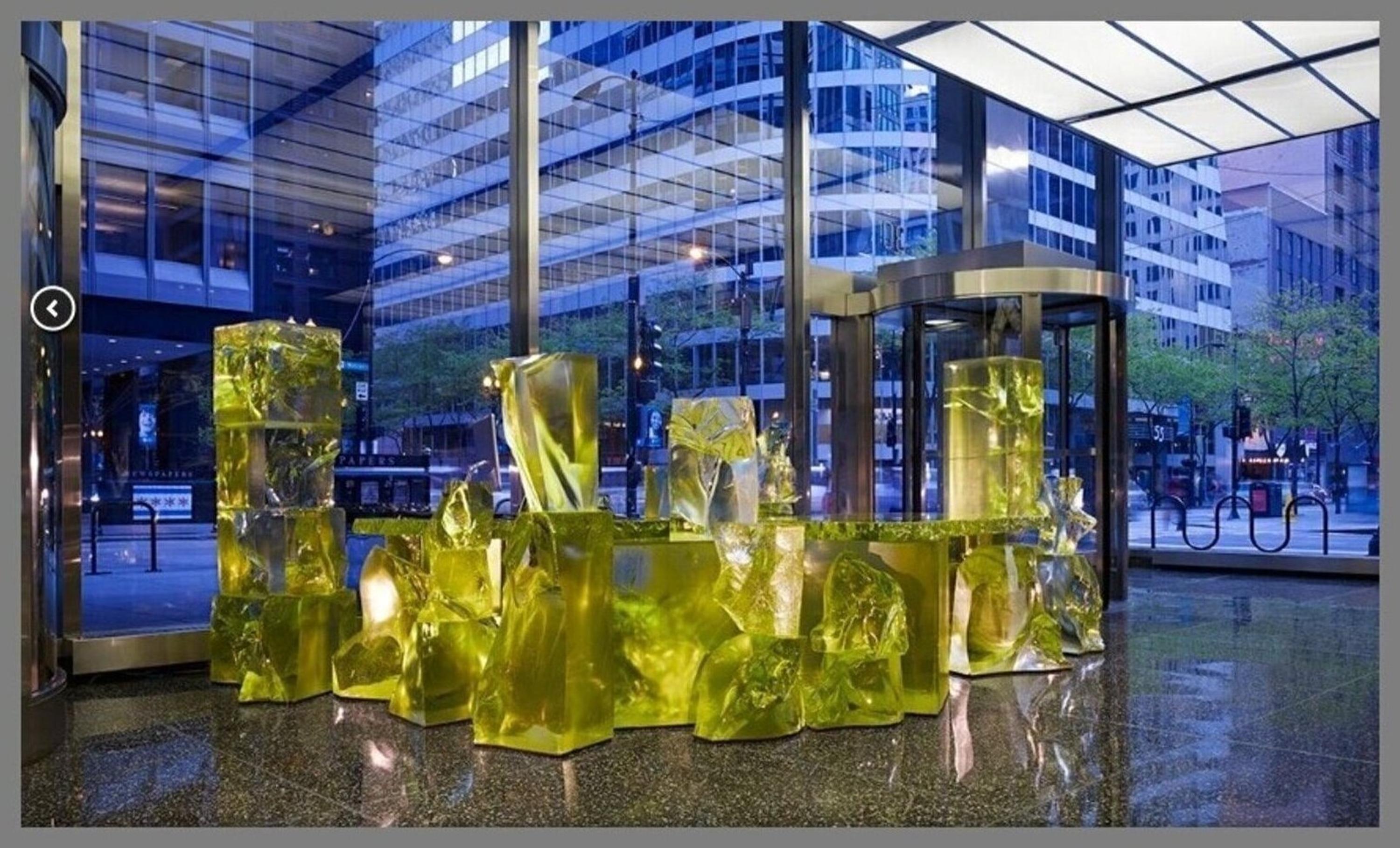
Consists of two main desktop slabs of glass with glass base supports and additional decorative forms; 16 pieces total with two mirrored cabinets.
_____
The contents of a desk may contain many secrets, but in this rare and expressive case, transparency itself is the allure. Those passing by or through Chicago’s Inland Steel Building are immediately confronted by a gleaming, jagged structure of green glass that commands the space. Anchored by two monumental slabs, the 16-piece composition catches and refracts light like a fractured glacier. Known colloquially as Icehenge, the work is Frank Gehry’s singular vision for the building’s lobby. Gehry first encountered the Inland Steel Building in the 1950s, an early experience that may help explain his lifelong
fascination with metal as a material. That sensibility would later define some of his most celebrated Chicago projects, including the Jay Pritzker Pavilion and BP Bridge in nearby Grant Park, where steel becomes fluid, sculptural, and expressive.
By the time Gehry became a partial owner of the Inland Steel Building in 2005, the 1958 modernist landmark was in need of restoration. Few figures were better suited to steward such an architectural treasure, though Gehry’s involvement was never likely to result in a purely conservative intervention. True to form, his renovation introduced an unexpected sculptural gesture.
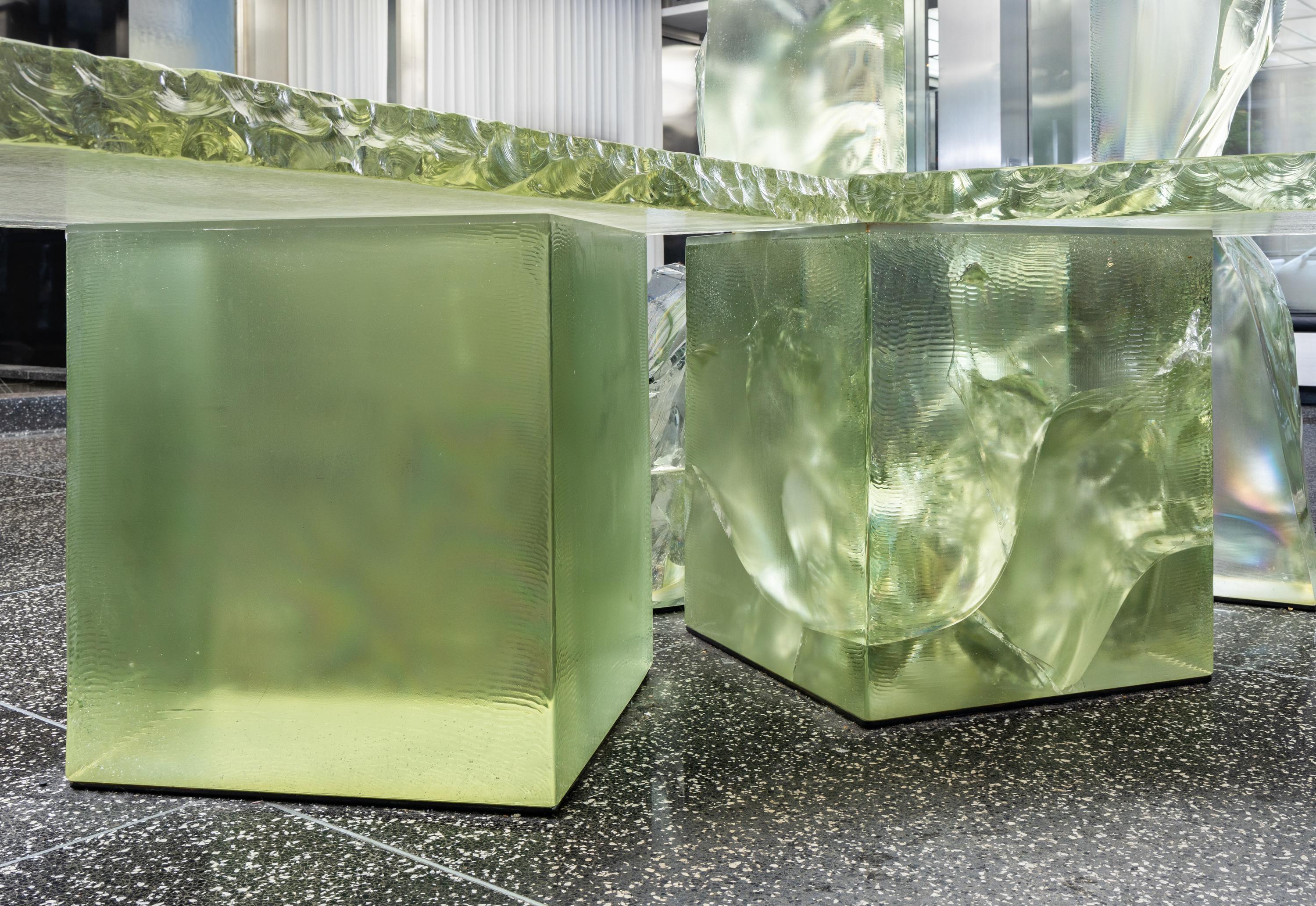
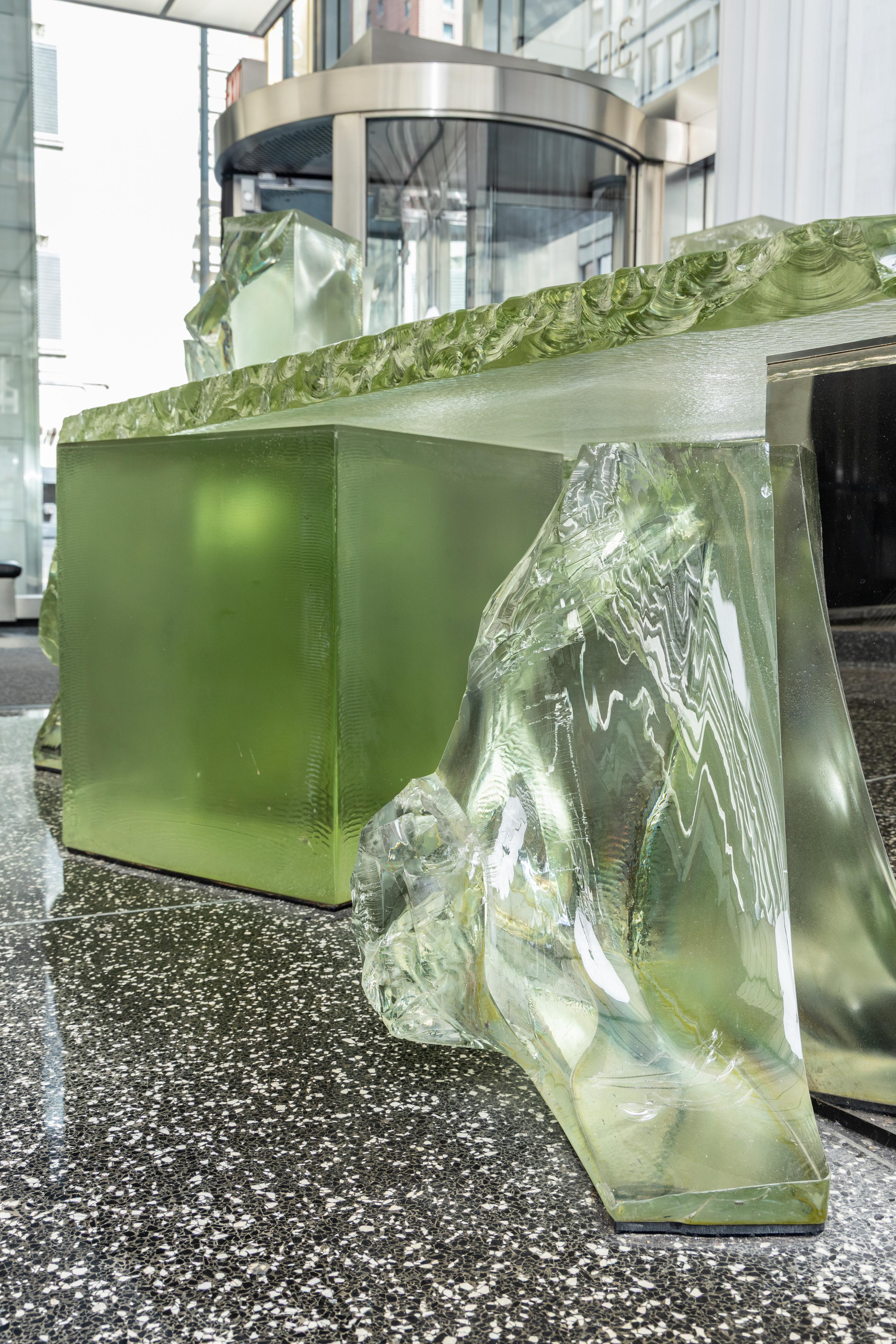
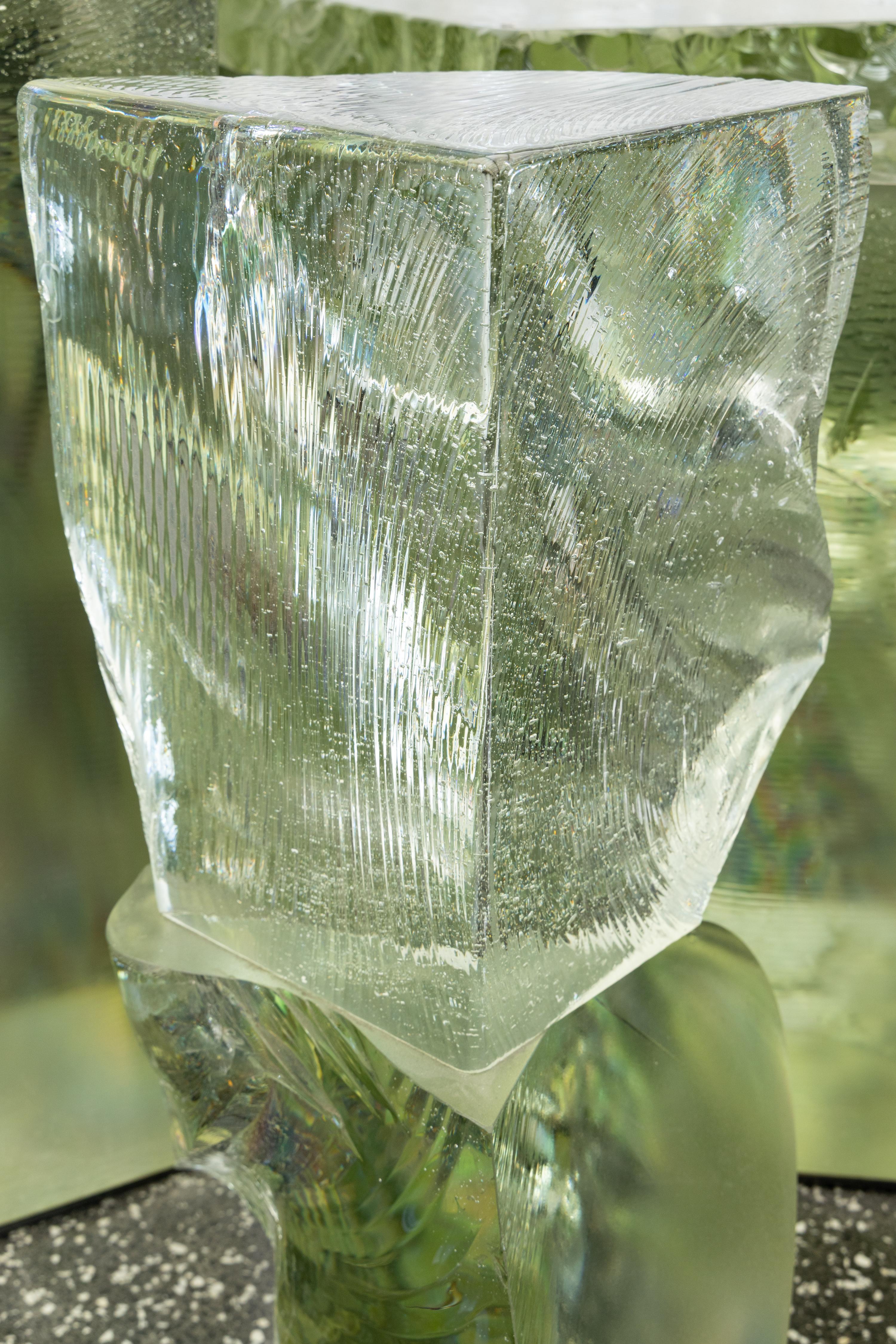
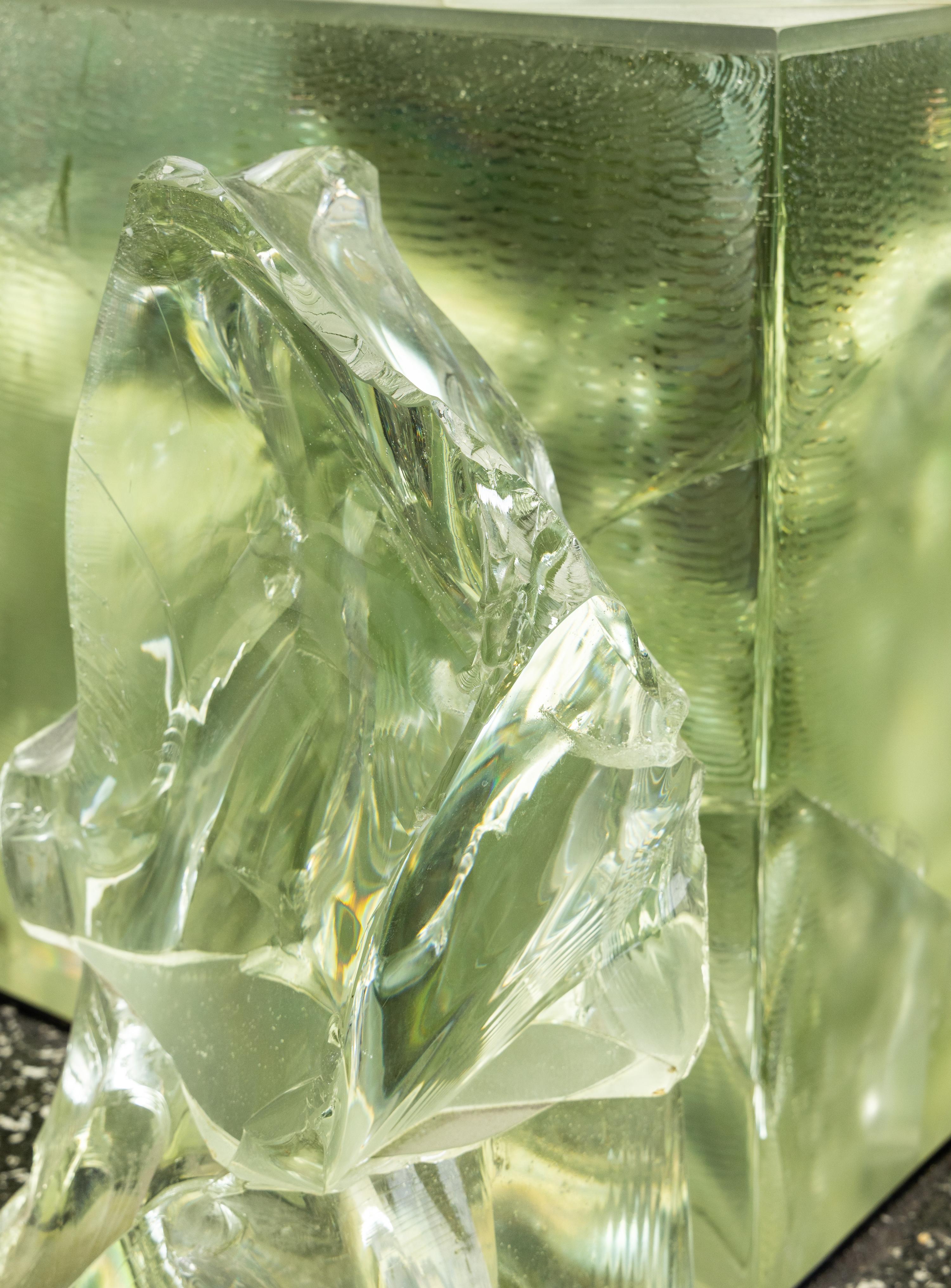
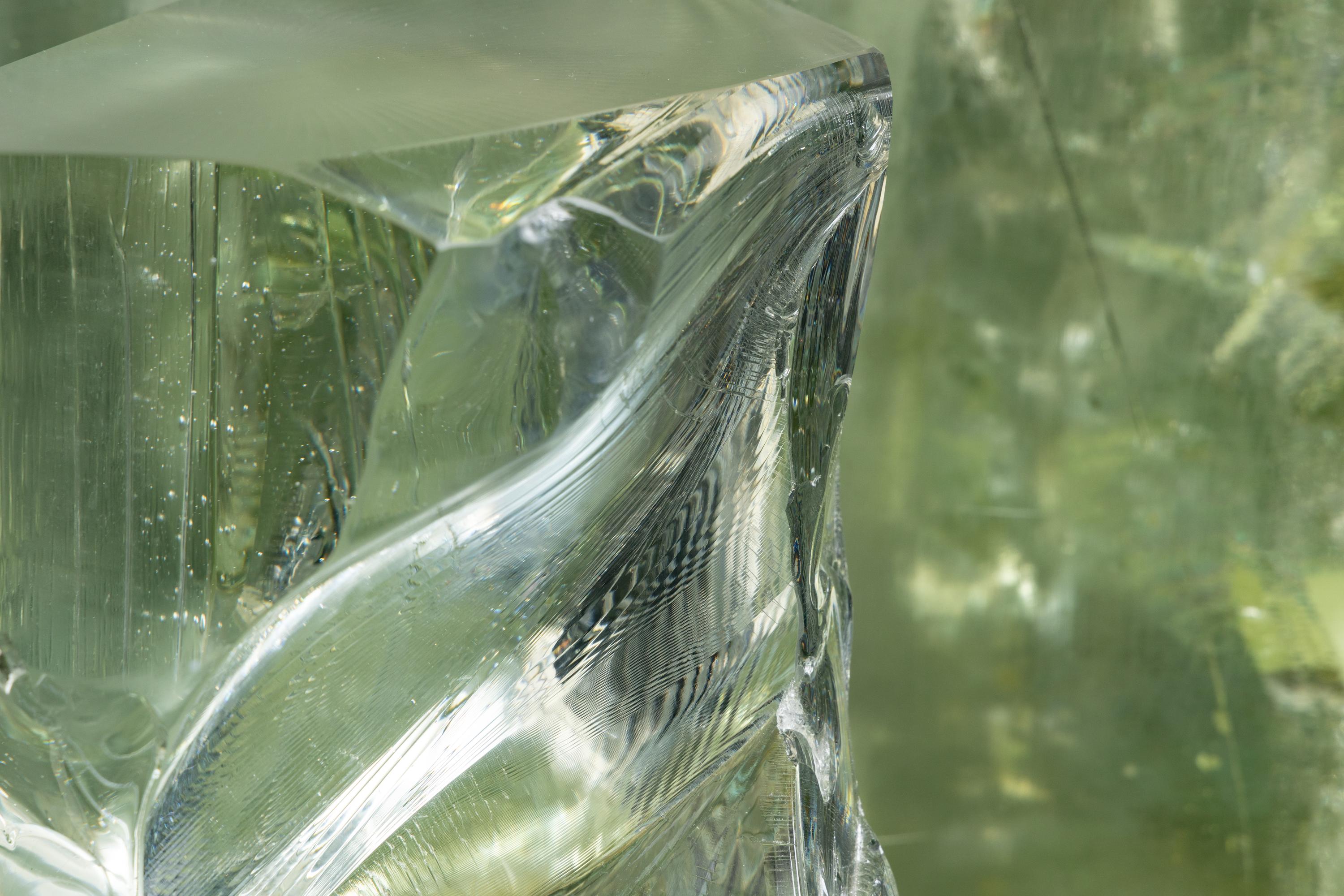
The idea for the desk was sparked by a rogue piece of glass Gehry encountered while developing another project. The possibility of stacking thick glass slabs at shifting angles, allowing light, texture, and material imperfections to become the focal point, proved irresistible. The resulting work possesses an almost internal luminosity. Rough-cut
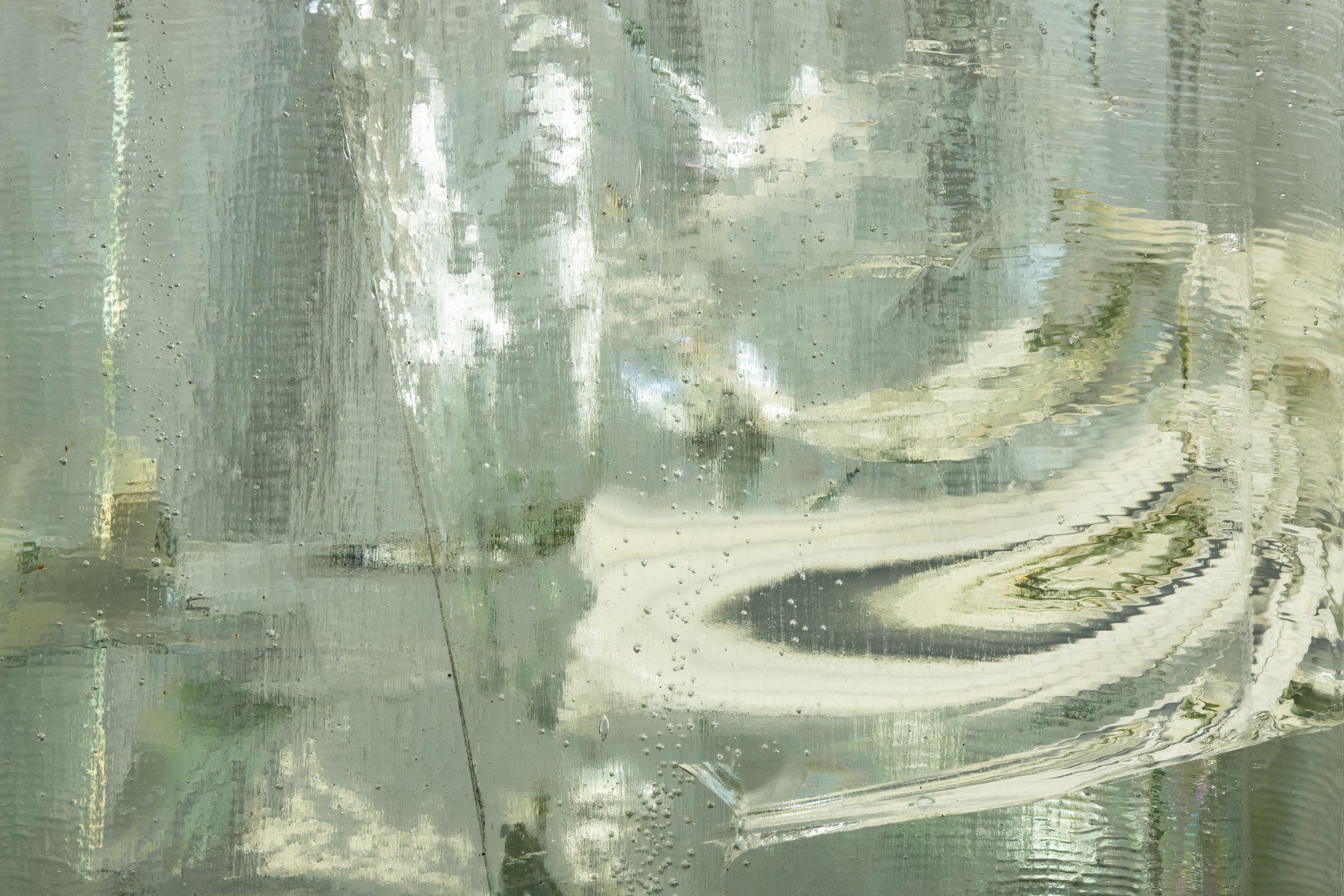
edges collide with polished surfaces, while suspended bubbles and flowing distortions deep inside the molten glass create mesmerizing depth and movement. Against the restraint of the modernist lobby, the work feels intentionally
provocative - Gehry at his finest.
Throughout his career, Gehry has embraced unconventional materials with little concern for strict functionalism, consistently challenging the orthodoxies of modernist design. That spirit was evident early on in the corrugated cardboard furniture that reimagined everyday materials as design objects, and in the chain-link fencing and sheet metal that transformed his Santa Monica home into one of the defining architectural statements of its era.
Viewed from outside the building, Icehenge echoes the pale green glazing of the Inland Steel façade, its stacked forms appearing playful yet monumental. Up close, however, the work reveals extraordinary complexity: liquid textures, undulating surfaces, and organic inclusions more commonly associated with studio art glass than furniture design.
The result is less a reception desk than a monumental sculptural installation. Carved from six-foot blocks of emerald glass and weighing approximately 15,000 pounds, the work was realized by the John Lewis Glass Studio in Oakland,
California. Although conceived specifically for its site, Gehry reportedly entertained the possibility of reconfiguring the 16 elements over time, allowing the work to evolve over time and in new settings. Different lighting conditions, architectural surroundings, or simplified functional contexts could dramatically transform its presence while
preserving the power of its composition.
Personal and experimental works by major architects like rarely appear on the market, and pieces of this scale and significance within Gehry’s oeuvre are exceptionally uncommon. Icehenge stands apart even within his body of work.
Occupying a space somewhere between furniture, sculpture, and architectural installation, Icehenge is a monumental meditation on light, material, and the restless imagination of one of the most influential architects of the modern era.
Additional Media:
"This is a story about a desk — not any desk, mind you, but a startling, Frank Gehry-designed security desk in the lobby of the Inland Steel Building, one of Chicago's great mid-20th century high-rises.
The U-shaped desk is best described as a piece of furniture that's been elevated to the level of art, or is simply an emblem of excess."
'It does look like an explosion in a glass factory, kind of,' Gehry said in a telephone interview from his Los Angeles office. 'If you actually had an explosion at a glass factory, apart from everyone getting killed, it would be pretty exciting visually.' . . . "
— Blair Kamin, Chicago Tribune | July 13, 2013
The transportation and shipping of this lot will be the responsibility of the buyer.
In overall good condition with no fundamental structural breaks, cracks, losses or repairs present. There are some internal areas of cracks, bubbling, variations in transparency and angularities that are inherent to the design and manufacturing of the sculptural blocks. Some rough-cut edges with textural surfaces are jagged and abrasive. A few corners of cube forms are chipped away, likely inherent to the original design.
Surface scratching is present to the two main blocks of the desk-top surfaces as well as scratches to the tops of the lower columns from items being placed through its use. The taller column with an additional top-plate attached measuring approximately 1/4 inch in thickness.
There are two cabinets that are mirrored with a chromed metal veneer which is scratched and peeling in a few areas. One top drawer of the mirrored plywood cabinet is loose and does not sit straight within the casing. The weight of the glass has caused some sagging to the cabinet frames.
Desk surface height: 29 3/4 inches.
Floor to underside of desk: 27 1/8 inches.
Thickness of desktop slab: 2 1/2 inches.
Overall first front-facing desktop slab: 32 1/2 x 74 inches.
Overall second desktop slab: 32 3/4 x 62 1/2 inches.
Overall composition:
The physical condition of lots in our auctions can vary due to age, normal wear and tear, previous damage, and restoration/repair. All lots are sold "AS IS," in the condition they are in at the time of the auction, and we and the seller make no representation or warranty and assume no liability of any kind as to a lot's condition. Any reference to condition in a catalogue description or a condition report shall not amount to a full accounting of condition. Condition reports prepared by Freeman's staff are provided as a convenience and may be requested from the Department prior to bidding.
The absence of a posted condition report on the Freeman's website or in our catalogues should not be interpreted as commentary on an item's condition. Prospective buyers are responsible for inspecting a lot or sending their agent or conservator to inspect the lot on their behalf, and for ensuring that they have requested, received and understood any condition report provided by Freeman's.
Please email Fineart@freemansauction.com for any additional information or questions you may have regarding this lot.