To request further details about this lot, please email adamveil@freemansauction.com
Please email adamveil@freemansauction.com for any additional information or questions you may have
Sale 6507
| Philadelphia
| Philadelphia
To request further details about this lot, please email adamveil@freemansauction.com
Please email adamveil@freemansauction.com for any additional information or questions you may have
Estimate$10,000 – $15,000
We wish to thank Roberta A. Mayer for her assistance cataloguing the present lot.
Provenance:
Private Collection, Pennsylvania.
Lot Note:
Although most popularly known for his exquisite stained-glass creations, Louis Comfort Tiffany first trained and worked as a painter of landscapes, still lifes, and genre scenes in both oil and watercolor. He first studied with landscapist George Inness and then trained with Leon-Adolphe-Auguste Belly in Paris, a specialist in Middle Eastern subjects. This education, combined with an 1869 visit to Spain and North Africa with artist Samuel Colman, stirred an enduring interest in strong color. On this 1869 trip, Colman also encouraged Tiffany to make watercolor sketches for later conversion into paintings. Throughout the 1870s, Tiffany exhibited his paintings widely, and in 1877, became one of the secessionist artists, along with John La Farge and Augustus Saint-Gaudens, who rebelled against the staid National Academy of Design and formed the Society of American Artists.
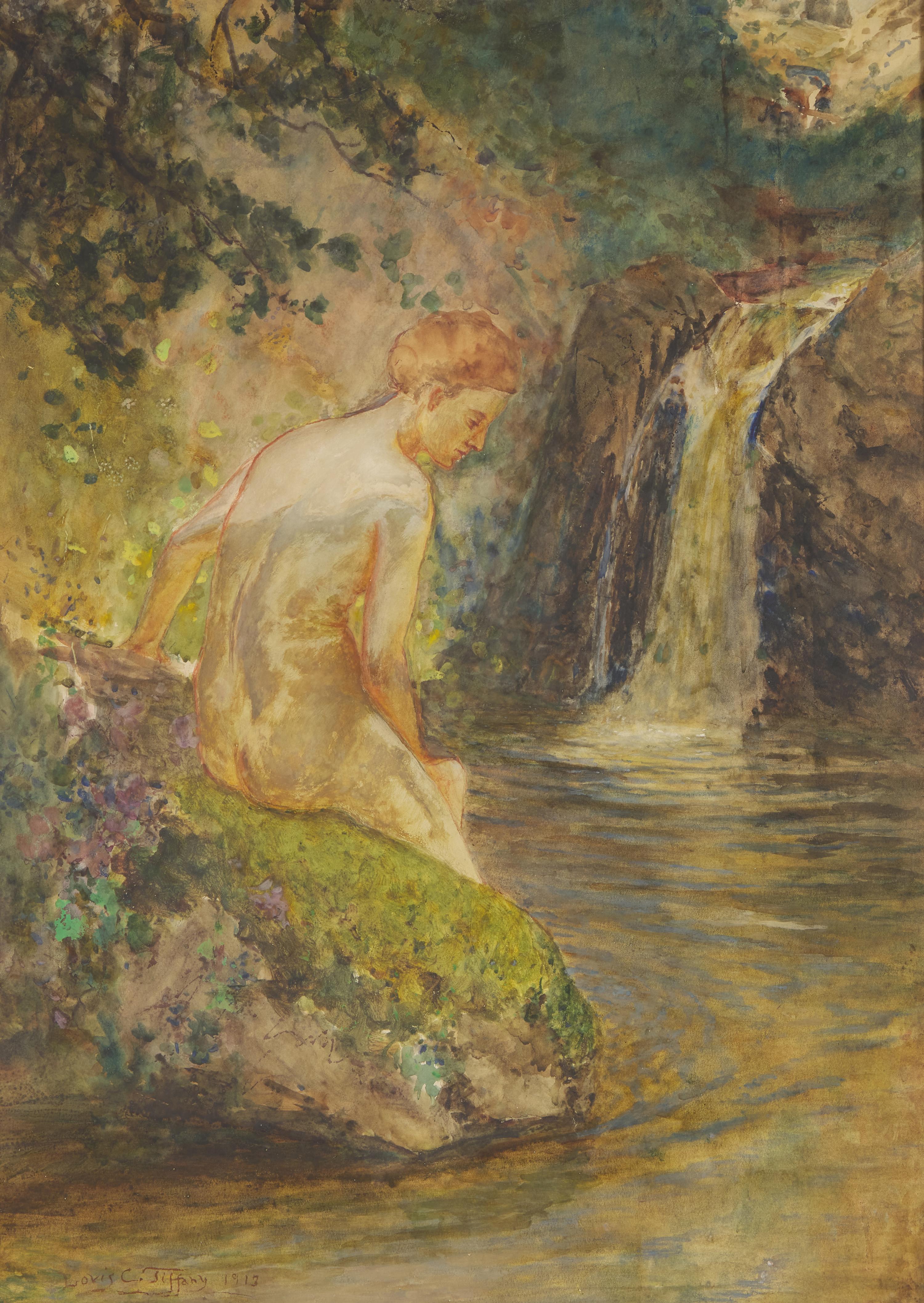
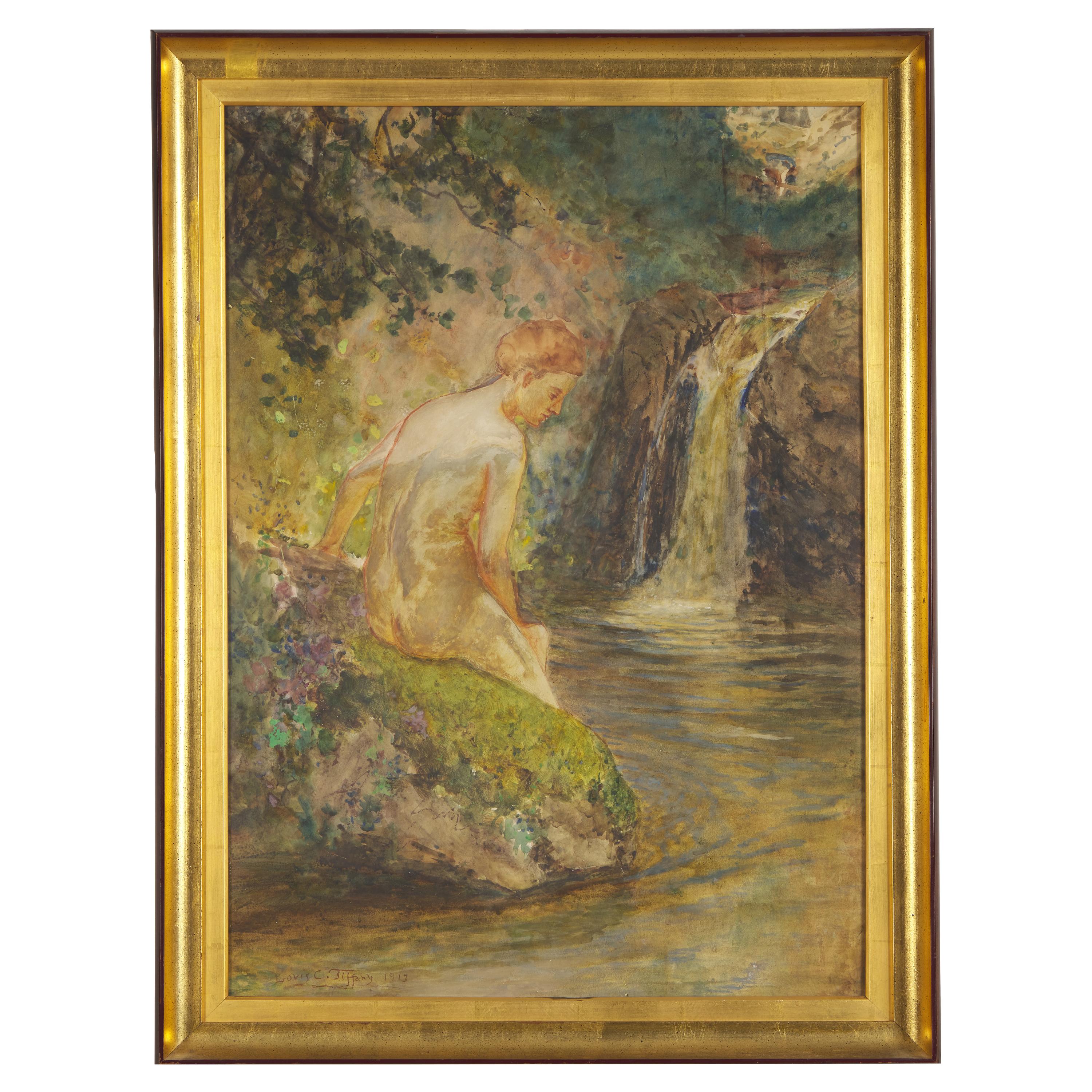
By the late 1870s, Tiffany began to shift his focus to decorative arts, interiors, and glassmaking, but he never fully turned away from painting as a medium for more personal expression. Woman by a Stream dates from his later period and reflects Tiffany's enduring fondness for the media of both painting and decoration, as well as the fusion of the two. The present composition relates to an earlier watercolor by the artist, titled The Bather, c. 1910 (location unknown), which was published as an illustration in the New York Herald in 1910. The Bather was a major work that was widely exhibited and described as “exquisitely colored.” (“Chicago Sees Water Colors,” The Christian Science Monitor, May 18, 1911, p. 19) Signed and dated to 1913, Woman by a Stream appears to be a later version of The Bather and not a preparatory work. It is possible that the present gouache and watercolor was executed as part of the design exploration that culminated with Tiffany’s The Bathers, a large leaded-glass window completed c. 1914 and installed in 1915 in the living hall of the artist’s country estate, Laurelton Hall, in Oyster Bay, New York. This leaded-glass window was unfortunately lost when Laurelton Hall was destroyed by fire in 1957.
Framed: 32 1/2 x 24 1/2 x 2 1/4 in.
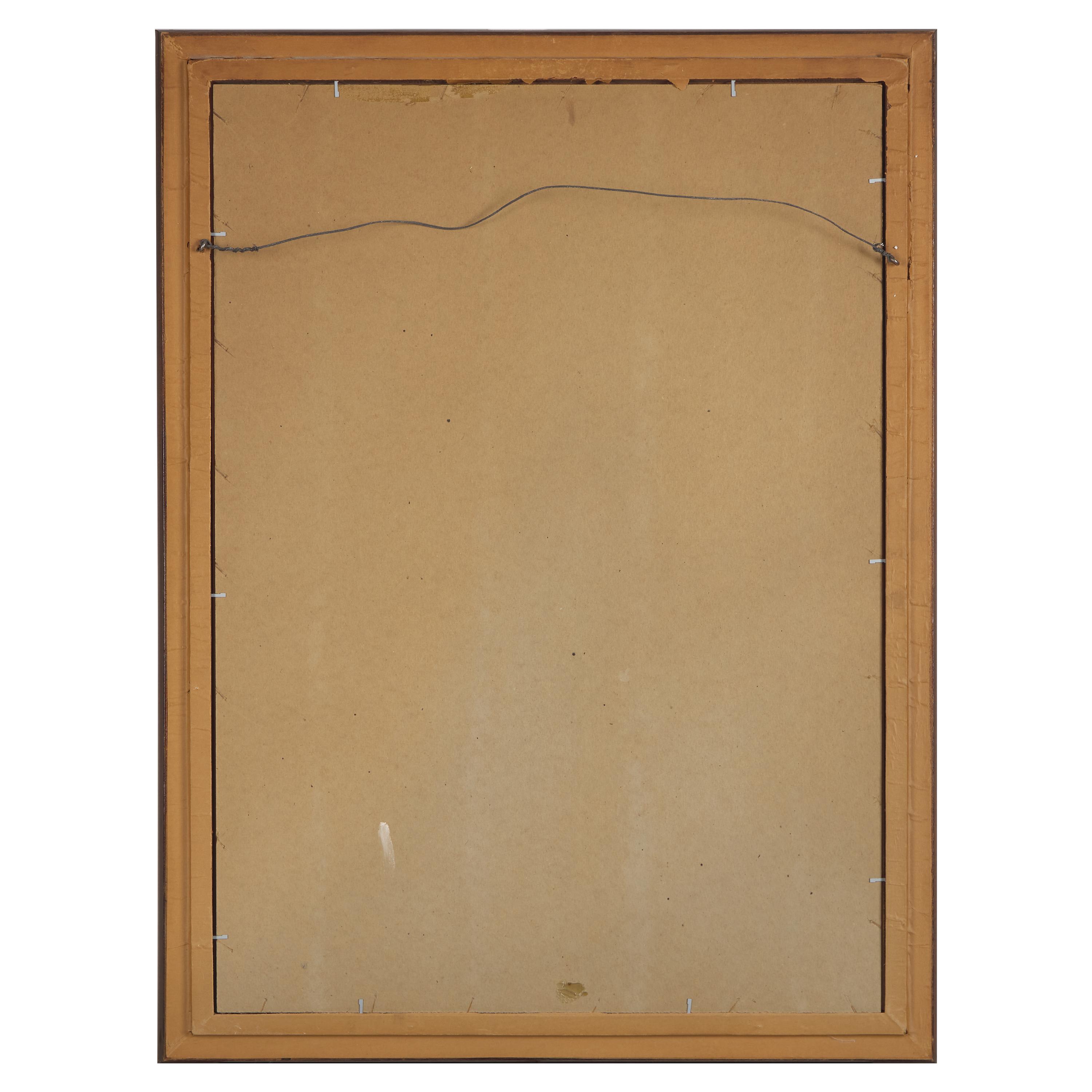
Sheet has been laid to the backing board. Minor abrasions to extreme edges present throughout. Minor diagonal crease to corner at upper left. Tear to sheet at upper right measuring approx. three inches. A diagonal crease to sheet at upper right corner measuring approximately 2 inches. Two pinholes to sheet, one at upper right corner and one at left extreme edge. A hole to sheet at lower left corner measuring approx. 1/8 in. Craquelure present in thicker areas of gouache, most notable in dark fields around waterfall and in green moss on rock. Additional images available upon request.
The physical condition of lots in our auctions can vary due to age, normal wear and tear, previous damage, and restoration/repair. All lots are sold "AS IS," in the condition they are in at the time of the auction, and we and the seller make no representation or warranty and assume no liability of any kind as to a lot's condition. Any reference to condition in a catalogue description or a condition report shall not amount to a full accounting of condition. Condition reports prepared by Freeman's staff are provided as a convenience and may be requested from the Department prior to bidding.
The absence of a posted condition report on the Freeman's website or in our catalogues should not be interpreted as commentary on an item's condition. Prospective buyers are responsible for inspecting a lot or sending their agent or conservator to inspect the lot on their behalf, and for ensuring that they have requested, received and understood any condition report provided by Freeman's.
Please email adamveil@freemansauction.com for any additional information or questions you may have regarding this lot.