To request further details about this lot, please email adamveil@freemansauction.com
Please email adamveil@freemansauction.com for any additional information or questions you may have
Sale 6507
| Philadelphia
| Philadelphia
To request further details about this lot, please email adamveil@freemansauction.com
Please email adamveil@freemansauction.com for any additional information or questions you may have
Estimate$8,000 – $12,000
We wish to thank Tara Leigh Tappert, Ph.D. for providing the following essay.
Provenance:
Private Collection, Vermont.
Lot Note:
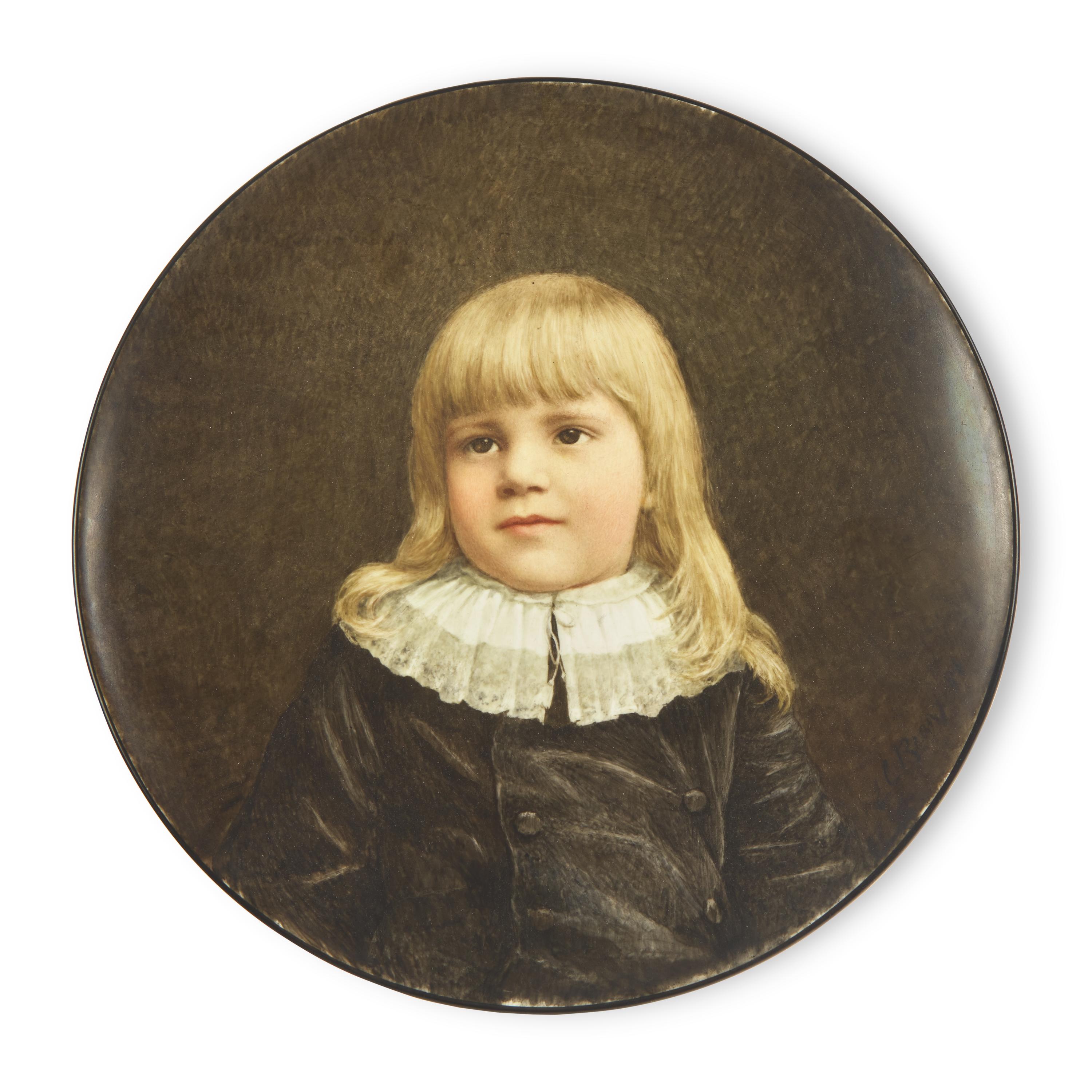
This plate depicts a bust-length portrait of a three- to five-year-old boy, whose head is slightly cocked as he looks to his right. Posed against a plain brown stippled background, the lad is portrayed in a double-breasted black velvet jacket and a white baroque-style cavalier laced collar tied at the neck with stings and tassels. Featured as fair skinned, with a peach tint to his cheeks and lips, the boy has light brown eyebrows, dark brown eyes, a Roman nose, a square-shaped face and soft chin, and the bottom of his left ear lobe is barely visible behind his softly curled shoulder length flaxen blond hair, with bangs cut in a Dutch boy style. The boy’s face retains the soft pudginess of a young child. The artist’s portrayal is almost theatric as if the boy is on stage under a spotlight. Visible sheens of light fall across his bangs and velvet jacket. A signature and date–E. C. Beaux 81–are signed in black at the middle right edge on the front of the plate. The signature represents her given name: Eliza Cecilia Beaux.
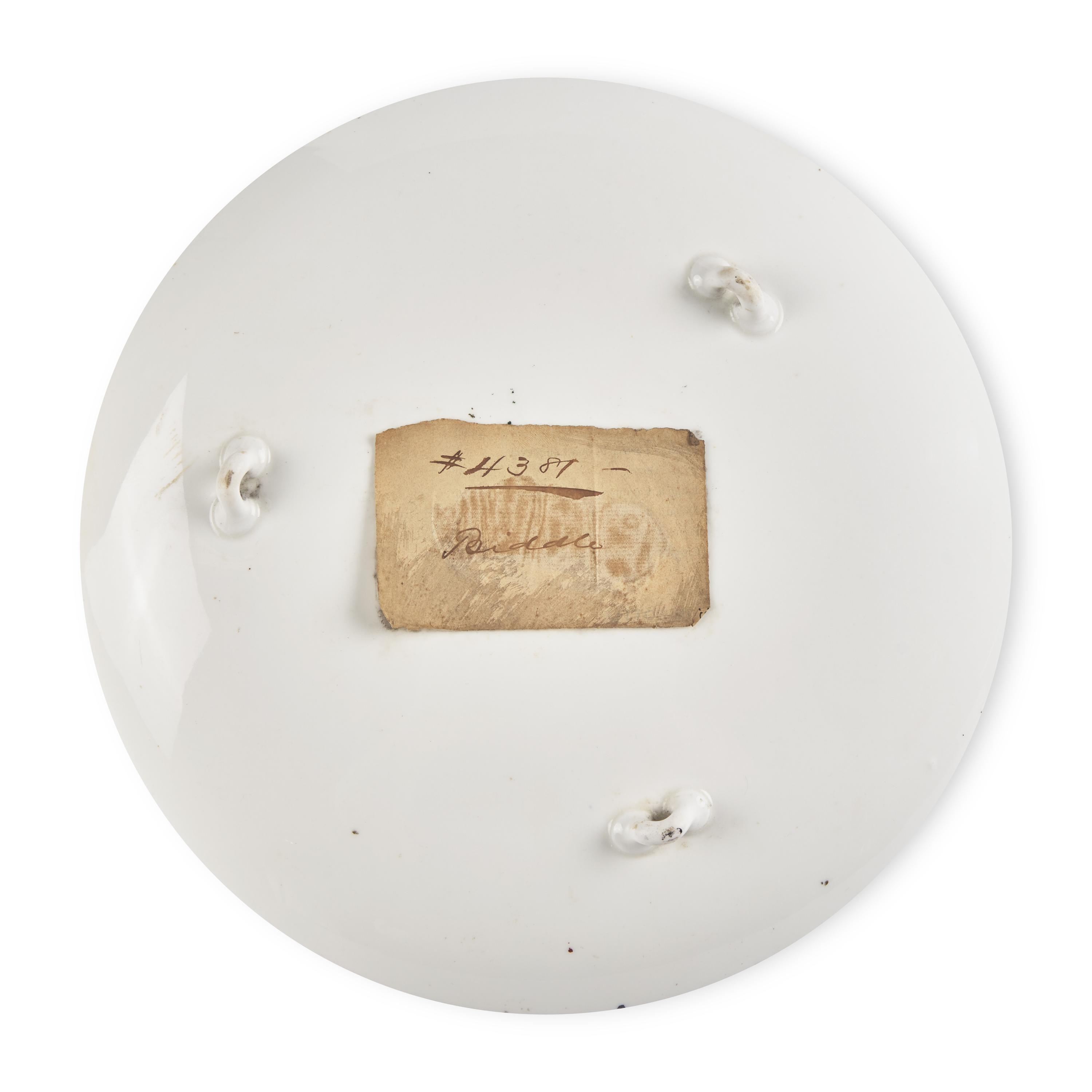
On the back of the plate is a paper label with a number #4381, and a name, Biddle. Further research may prove that the number represents an exhibition. The name is presumably the last name of the child depicted on the plate. Also, on the back of the plate are three lugs or loops, attached during the making of the plate (most likely at the leather hard stage). This clever design allows the artist or manufacturer to glaze a piece in its entirety as the lugs or loops act as feet and are the only small point of contact on the kiln shelf during firing.
China painting, a fashionable craftwork for women, popularized in America by the 1876 Philadelphia Centennial Exposition, was taken up by Cecilia Beaux just a few years later. Beaux's first art teacher, Catharine Ann Drinker, translated from French into English a treatise by the noted French ceramist, Camille Piton, entitled China Painting in America (1878). At the time of her translation Piton was living in Philadelphia, and Drinker urged Beaux to take china painting lessons with him. The ceramist managed and taught the craft at the National Art Training School, located on the "S.E. Cor. [of] Tenth and Walnut Streets," where he set up a kiln, and sold china-painting supplies –"china palettes, putois and Lacroix's colors." In March 1879, for a fee of ten dollars, Beaux "took a month's lessons in china painting" from him. Beaux commented that she learned "the ignoble art of over-glaze painting" and "quickly mastered" the skill which she at once "began adapting...to portraiture." Her reputation as a china painter began in Philadelphia, before spreading to "[m]others in the Far West." She produced portraits on large china plates that contained "a nearly life-sized head of a child (background, always different), full-modelling, flesh color and all, that parents nearly wept over."
Beaux used photographs and solar prints to produce her china plates, taking measurements and notes on color, as frequently the "golden-haired darlings" were brought to her "and placed as nearly as possible in the lighting of the photograph." Beaux wrote the color scheme on the print, indicating where to include the "most color, least color, greenish, pinkish, warm [or] cool" colors. For the china portraits of children who were not in the Philadelphia area, she relied on just a photograph and "a bit of ribbon the color of the boy's eyes, as well as a lock of hair."
One of her plates was of Clara Hoopes of Philadelphia. Beaux was asked to make the plate in 1882 from an old daguerreotype taken of Clara in 1853 when she was eight years old. Five years later, in 1887, Beaux made companion portraits of Margaretta and Cooper Wood of Pittsburgh,
Pennsylvania, the daughter and son of a vice president of the Pennsylvania Railroad.
Beaux later hated these plates, believing that their commercial success was a base use of her artistic talents. Yet at the time they were painted she took sufficient pride in them to include them in local exhibitions. She eventually felt this work required little creativity or originality, and she acknowledged her plates "with shame" and a "sad confession," hoping that some of them would wear out "their suspending wires" and be "dashed to pieces." When her autobiography, Background with Figures, was published in 1930, she denounced her china plates as "the lowest depth [she] ever reached in commercial art."
Even though Beaux dismissed the likenesses of children she painted on china plates, these somewhat formulaic and decorative portrayals from the late 1870s to the mid-1880s demonstrate an attention to detail, perspective, anatomy, as well as fabric, color and light. Beaux’s china paintings were foundational to her development as a high style portrait painter, demonstrating stylistic progression from the china plate to the canvas.
While china painting was a popular pastime for women in the late nineteenth and early twentieth centuries, and Cecilia Beaux is known to have produced numerous china paintings throughout the 1880s, existing examples of her portraits of children on china plates are now quite rare. Counting this porcelain plate of the Biddle Child, only six are known today. The Metropolitan Museum of Art owns The Bruce Boy (ca. 1879-1883) and The Bruce Child (1880). The remaining three are still privately owned. Two of the three previously documented plates have been on exhibition–Margaretta Wood (1887; at the Philadelphia Museum of Art, 1976) and Clara Hoopes (1882; at the National Portrait Gallery, 1995). The final known plate, Cooper Wood (1887) is illustrated in the Beaux files at the Pennsylvania Academy of the Fine Arts.
Diameter: 12 3/4 in.
The physical condition of lots in our auctions can vary due to age, normal wear and tear, previous damage, and restoration/repair. All lots are sold "AS IS," in the condition they are in at the time of the auction, and we and the seller make no representation or warranty and assume no liability of any kind as to a lot's condition. Any reference to condition in a catalogue description or a condition report shall not amount to a full accounting of condition. Condition reports prepared by Freeman's staff are provided as a convenience and may be requested from the Department prior to bidding.
The absence of a posted condition report on the Freeman's website or in our catalogues should not be interpreted as commentary on an item's condition. Prospective buyers are responsible for inspecting a lot or sending their agent or conservator to inspect the lot on their behalf, and for ensuring that they have requested, received and understood any condition report provided by Freeman's.
Please email adamveil@freemansauction.com for any additional information or questions you may have regarding this lot.