To request further details about this lot, please email adamveil@freemansauction.com
Please email adamveil@freemansauction.com for any additional information or questions you may have
Sale 6507
| Philadelphia
| Philadelphia
To request further details about this lot, please email adamveil@freemansauction.com
Please email adamveil@freemansauction.com for any additional information or questions you may have
Estimate$40,000 – $60,000
Provenance:
Jim Bishop Auction, Belvidere, New Jersey, c. 1978.
Acquired directly from the above sale.
Angela Gross Folk, New Jersey.
The Estate of Angela Gross Folk, New Jersey.
By descent to the present owner, New Jersey.
Exhibited:

Allentown, Allentown Art Museum, "The Pennsylvania School of Landscape Painting," September 16 – November 26, 1984 (traveling to the Corcoran Gallery, Washington, D.C.; Westmoreland Museum of Art, Greensburg; and the Brandywine Museum of Art, Doylestown).
Literature:
Thomas C. Folk, The Pennsylvania School of Landscape Painting: An Original American Impressionism, exhibition catalogue, Allentown, p. xxxii, pl. 20, illustrated.
Martha Young Hutson-Saxton, Walter Emerson Baum 1884-1956, Souderton, 1996, p. 73, Illustrated.
Thomas C. Folk, The Pennsylvania Impressionists, with a Forward by James A. Michener, Cranbury, 1997, pl. 42, illustrated.
Lot Note:
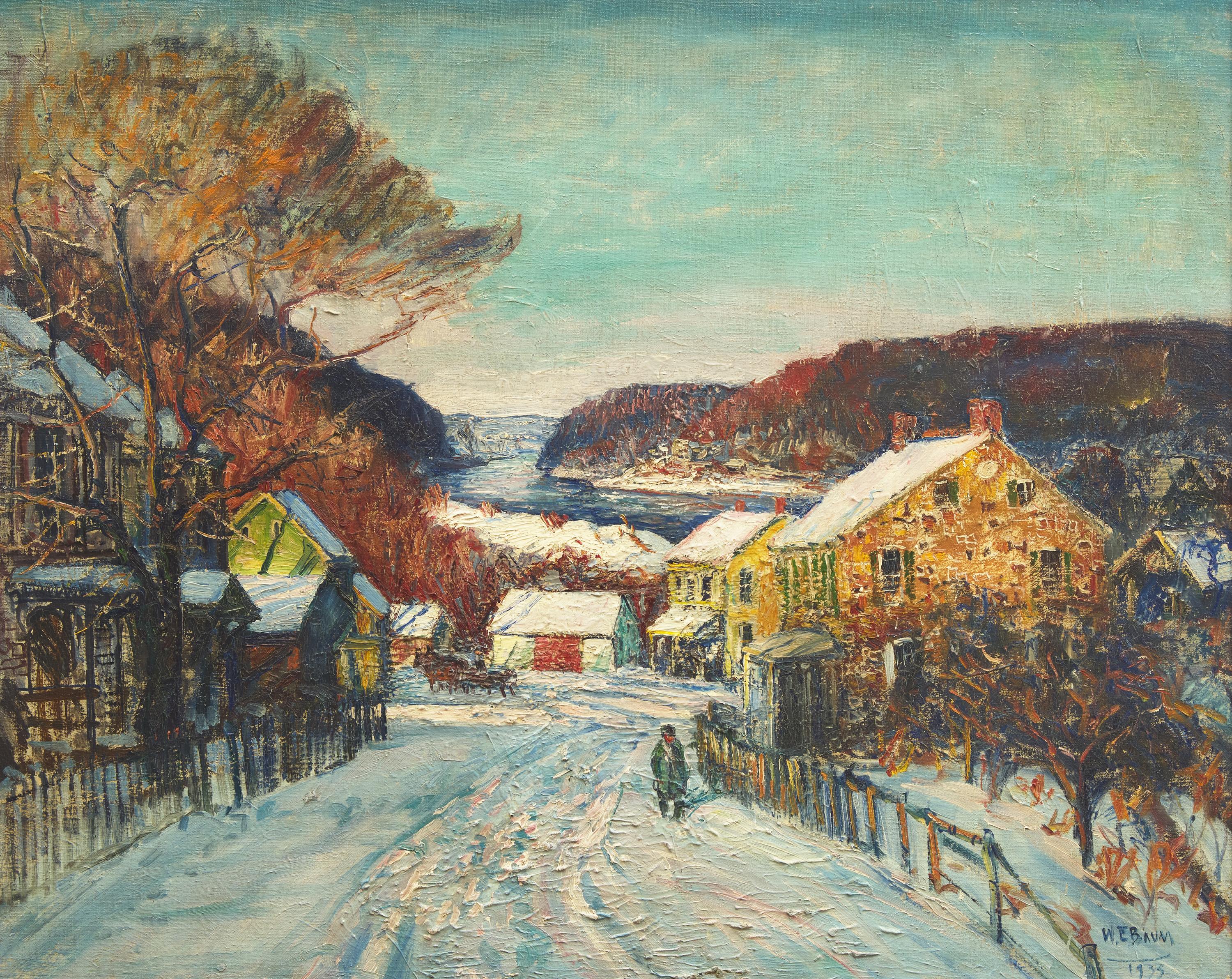
Late Afternoon (1933), a visual combination of local color with a breathtaking sense of wilderness, is arguably one of Walter Baum’s most accomplished winter scenes. The artist’s painterly rendition, recalling the bravado of Edward Redfield with its fast, muscly brushwork, endows the scene with texture and depth, the heavy snow and tumultuous flow of the river almost palpable. The painting is structured around the vertical line formed by the path and, further, the body of water, which leads the gaze up towards the far-reaching horizon, intersecting, in the middle tier of the composition, with the sprawling wooded hills as they spread horizontally beyond and over the hamlet, emphasizing the locus of community, the focal point of the painting.
In Late Afternoon, the local is embedded within the vastness of the landscape. The lone figure, treading along a snowy path that cuts through his village but continues on towards the winding river and the confines of the broader Bucks County countryside, anchors the sweeping pictorial narrative of the land in the realm of the familiar. Similarly, the detailed stone façade on the right side of the composition compels the eye to dwell, as it contrasts with the fuzzy, homogenous mass of the forests in the middle ground, conveying the charm and comfort of the community, even as the wide expanse surrounding it suggests its remoteness.
Fittingly, the painting initially belonged to esteemed collector, Angela Gross Folk, and was one of her very first fine art acquisitions. Angela long championed Baum along with all of the Pennsylvania Impressionists and proved instrumental, through her collecting, in giving the group their identity as a cohesive school of painting. She appreciated the deep attachment to the region and affection for the locales of Bucks County that bound all of these artists together, despite their varying approaches to aesthetics. Married to Dr. Gross, whom she met working as his medical stenographer for a number of years in Hoboken, NJ, the couple eventually relocated to Bernardsville, NJ, where they began attending auctions and house sales. Quickly, they acquired several artworks, including the present lot, with intention and a keen eye for underappreciated masterpieces by regional painters.
Framed: 38 1/2 x 46 1/2 x 3 in.
The physical condition of lots in our auctions can vary due to age, normal wear and tear, previous damage, and restoration/repair. All lots are sold "AS IS," in the condition they are in at the time of the auction, and we and the seller make no representation or warranty and assume no liability of any kind as to a lot's condition. Any reference to condition in a catalogue description or a condition report shall not amount to a full accounting of condition. Condition reports prepared by Freeman's staff are provided as a convenience and may be requested from the Department prior to bidding.
The absence of a posted condition report on the Freeman's website or in our catalogues should not be interpreted as commentary on an item's condition. Prospective buyers are responsible for inspecting a lot or sending their agent or conservator to inspect the lot on their behalf, and for ensuring that they have requested, received and understood any condition report provided by Freeman's.
Please email adamveil@freemansauction.com for any additional information or questions you may have regarding this lot.