To request further details about this lot, please email Antiquities@freemansauction.com

Jacob Coley
Senior Vice President, Head of Department, Antiquities and Ancient Art
Sale 6504
| Chicago
| Chicago
To request further details about this lot, please email Antiquities@freemansauction.com
Jacob Coley
Senior Vice President, Head of Department, Antiquities and Ancient Art
Estimate$60,000 – $80,000
Provenance:
Private Collection, Texas, late 1970s-early 1980s.
Sotheby’s, New York, Antiquities and Islamic Works of Art, 21 November 1985, Lot 138.
Private Collection, New York, 1985-2014.
Ariadne Galleries, New York and London, 2015 (Anonymous, pp. 16-17, no. 7).
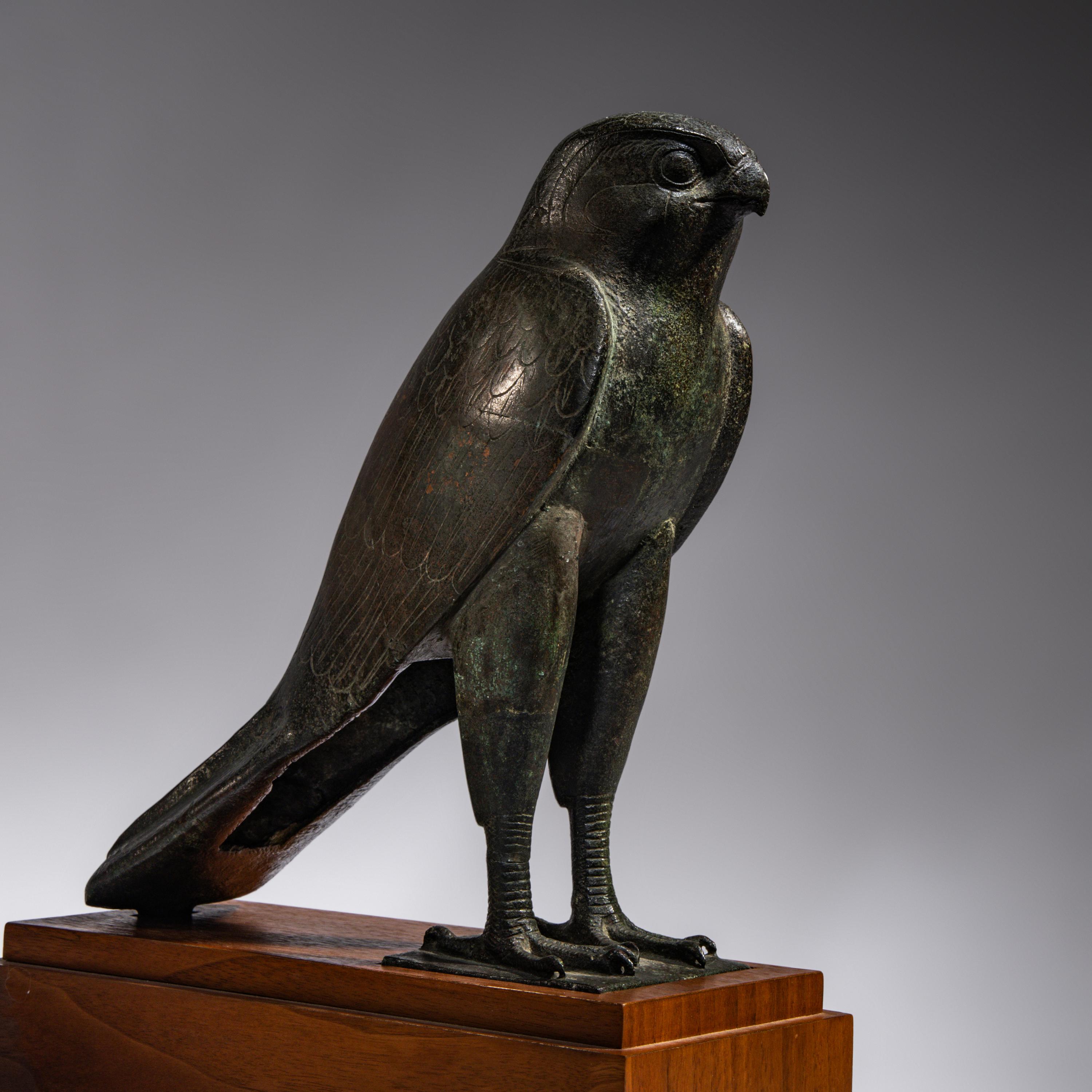
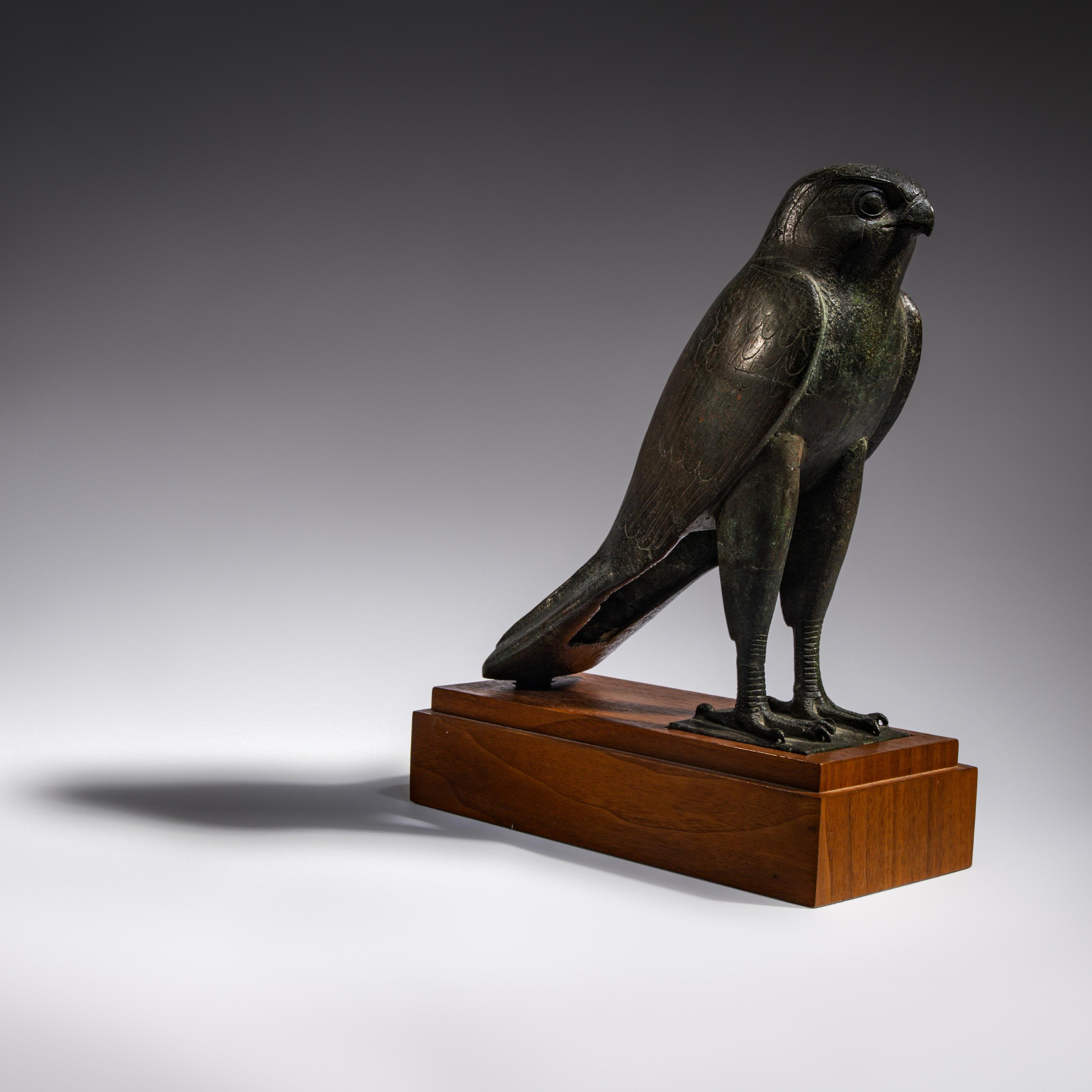
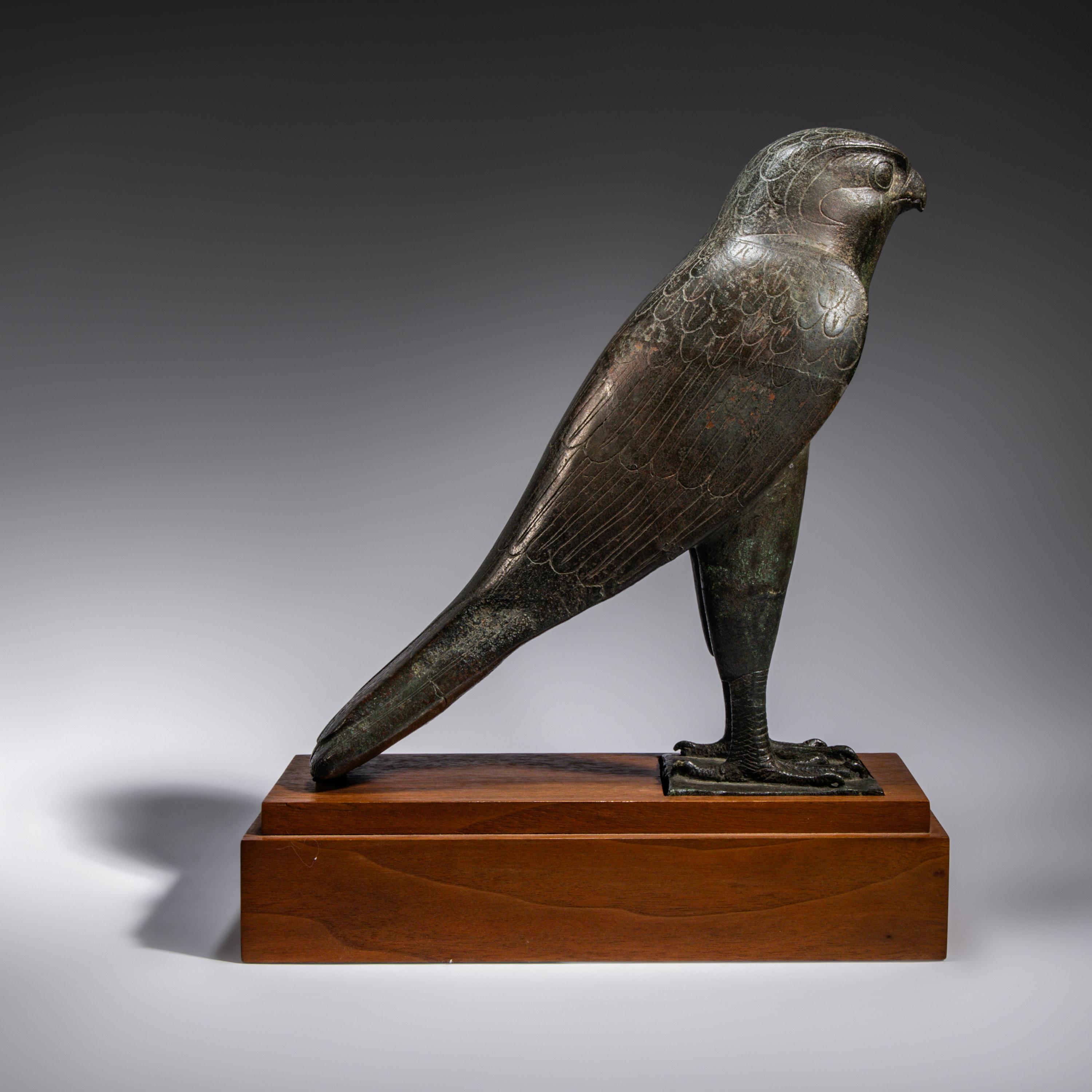
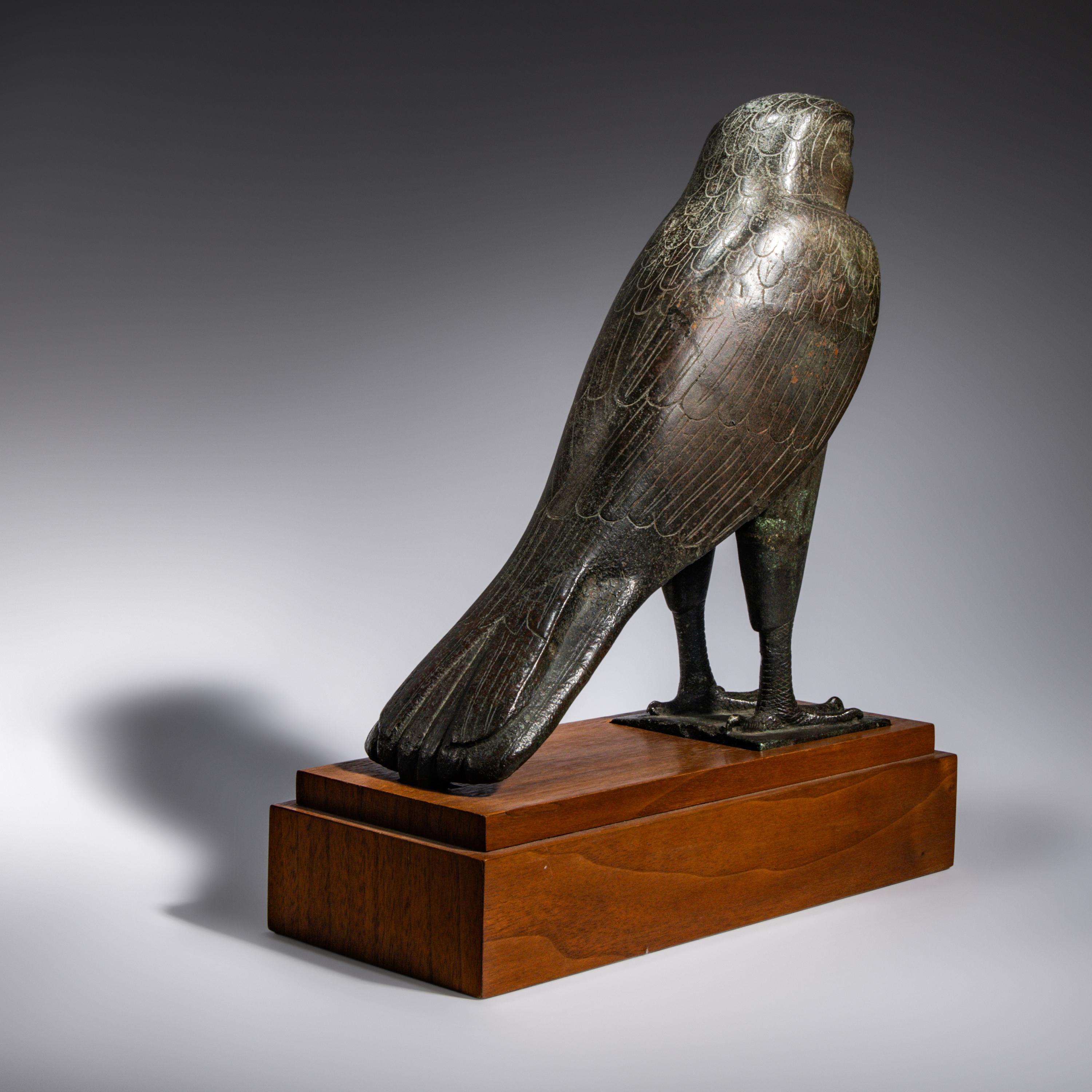
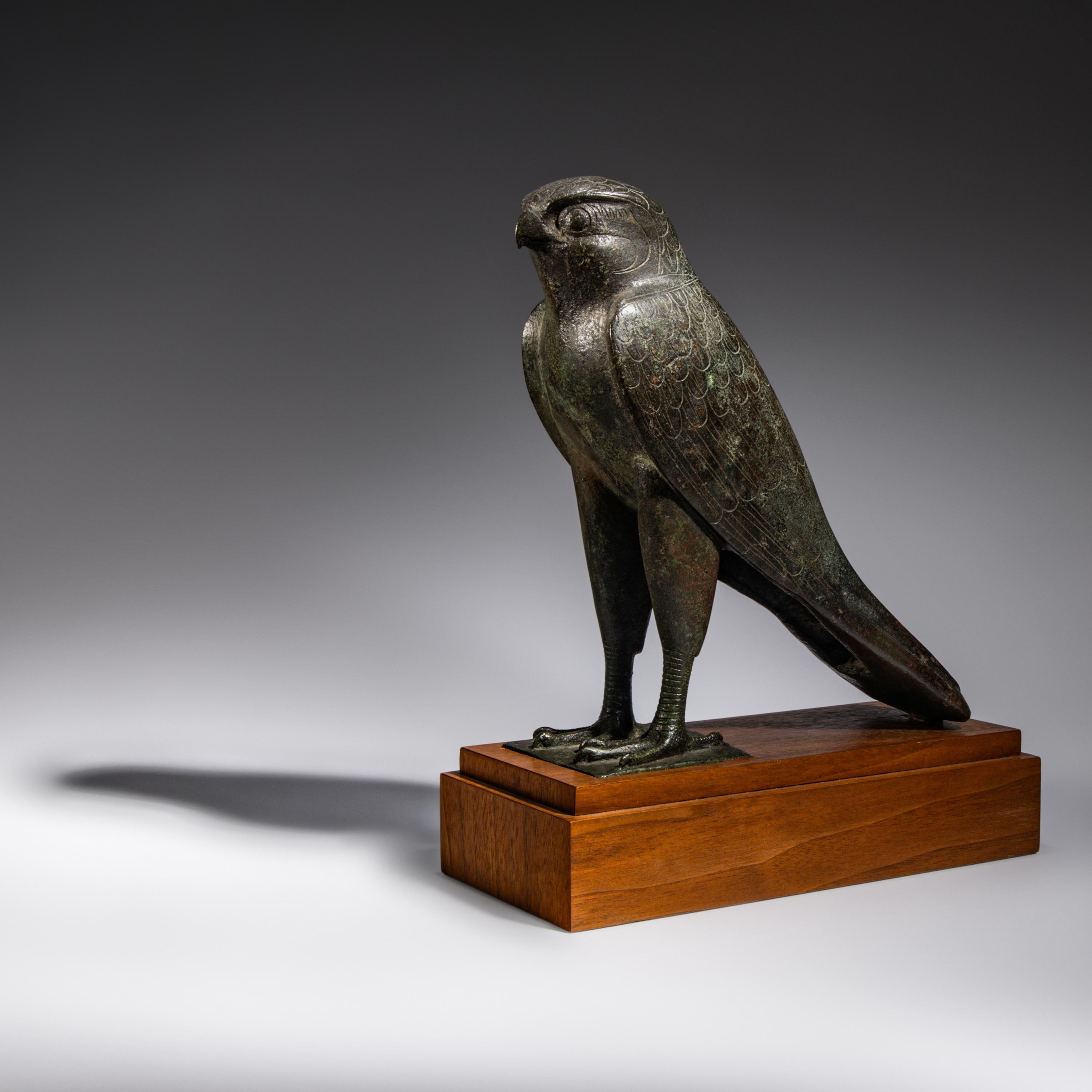
This substantial bronze depicts a falcon in a compact, upright stance, its feet set wide and its wings drawn close against a sweeping tail. The casting is hollow and of considerable quality, the walls even and well-controlled. Across the breast, wings, and flanks, the plumage is articulated in neat incised rows, each quill precisely differentiated from its neighbor, conferring a richness of surface that the patina now enhances rather than obscures. The face is alert and sharply observed: a pronounced supraorbital ridge throws the eyes into relief, their rounded forms enclosed by well-defined lids that terminate in fine canthi; below, the long facial stripe distinctive to the peregrine falcon is set back into the metal, and the culmen descends in a decisive hook. A rectangular void cut into the base of the figure identifies it as a falcon coffin, designed to receive a mummified bird in its interior, the opening once closed with a plaster seal. At 27 cm in height this is an ambitious work, among the larger examples of its class.
The religious significance of the falcon in ancient Egypt was rooted in its association with Horus, one of the oldest and most theologically complex gods in the Egyptian pantheon. Lord of the sky and divine model of kingship, Horus was worshipped across Egypt in numerous local forms throughout the Pharaonic and Late periods, and the bronze falcon coffin was one of the primary vehicles through which that worship found material expression. Sacred falcons were raised within temple precincts, mummified upon their deaths, and interred within bronze casings such as the present example, which were then dedicated at sanctuaries as votive offerings. This practice expanded dramatically during the Late Period as animal cults became a central feature of Egyptian religious life, attracting pilgrims from across the country who sought the intercession of the god through the offering of his sacred animal. The size and accomplished workmanship of the present bronze suggest it was a dedication of some consequence. For related examples see P. Jett, S. Sturman and T.D. Weisser, "A Study of the Egyptian Bronze Falcon Figures in The Walters Art Gallery," Studies in Conservation, vol. 30, no. 3 (1985); and R.S. Bianchi et al., Egyptian Bronzes, Fondation Gandur Pour L'Art, p. 222.
Inspected under UV light and 10x loupe. Repaired break at the proper right leg and a restored triangular section at the proper right wing (see report). Professionally cleaned surface. Areas of moderate to significant oxidation throughout, exhibiting cuprite, malachite, and olive-toned patina. Surface shows pitting, scratches, weathering, and localized rough surface, with some softening to the feathers' details. Minor bowing noted to the bronze platform. Inventory label “3657” affixed to the underside of the stand. Overall in good and attractive condition. See additional images. Height with stand 29.5 cm (11 5/8 inches).
This lot is currently located in New York. Collection is available in New York following the sale, or in Chicago in mid-June. Please contact Antiquities@freemansauction.com for further information.
The physical condition of lots in our auctions can vary due to age, normal wear and tear, previous damage, and restoration/repair. All lots are sold "AS IS," in the condition they are in at the time of the auction, and we and the seller make no representation or warranty and assume no liability of any kind as to a lot's condition. Any reference to condition in a catalogue description or a condition report shall not amount to a full accounting of condition. Condition reports prepared by Freeman's staff are provided as a convenience and may be requested from the Department prior to bidding.
The absence of a posted condition report on the Freeman's website or in our catalogues should not be interpreted as commentary on an item's condition. Prospective buyers are responsible for inspecting a lot or sending their agent or conservator to inspect the lot on their behalf, and for ensuring that they have requested, received and understood any condition report provided by Freeman's.
Please email Antiquities@freemansauction.com for any additional information or questions you may have regarding this lot.