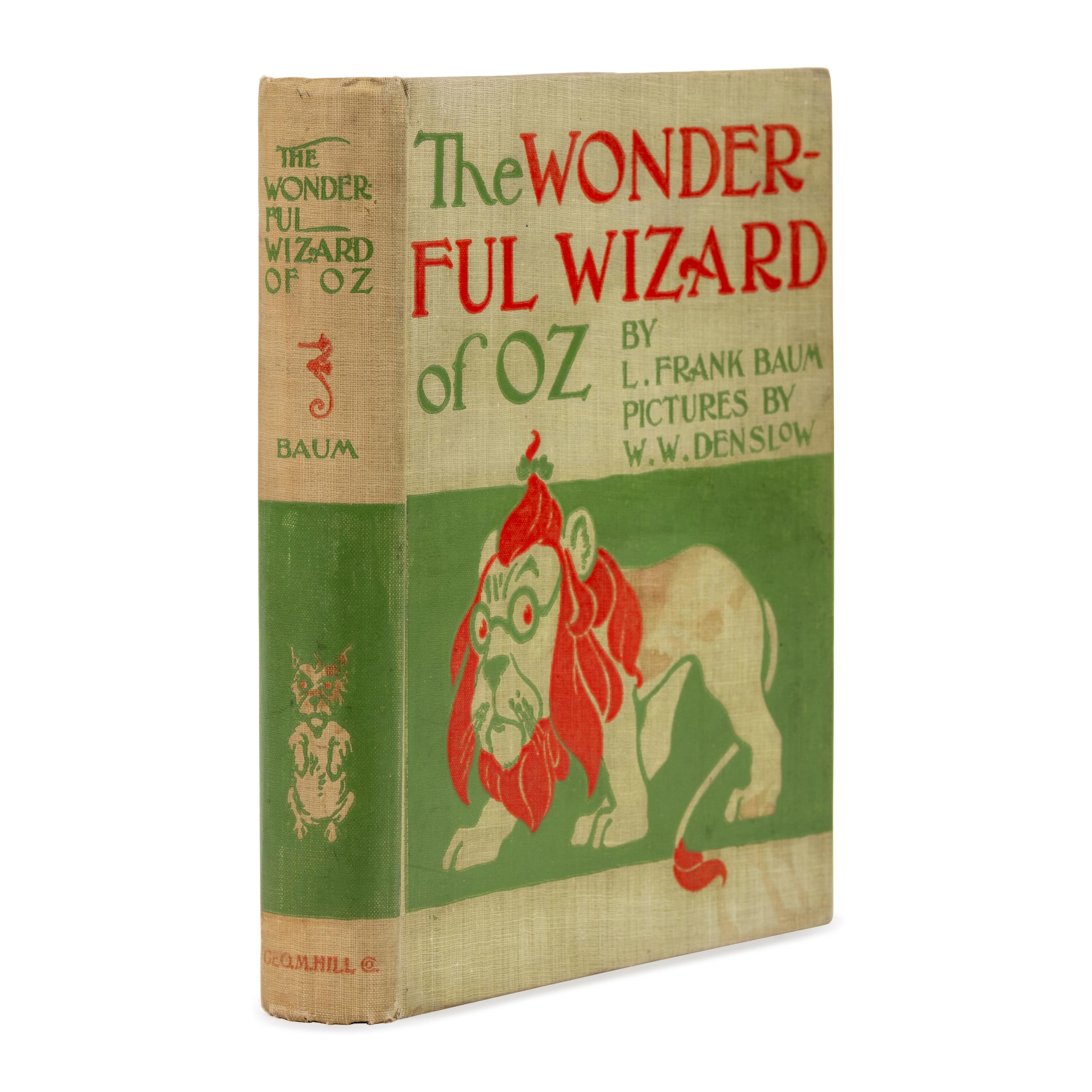
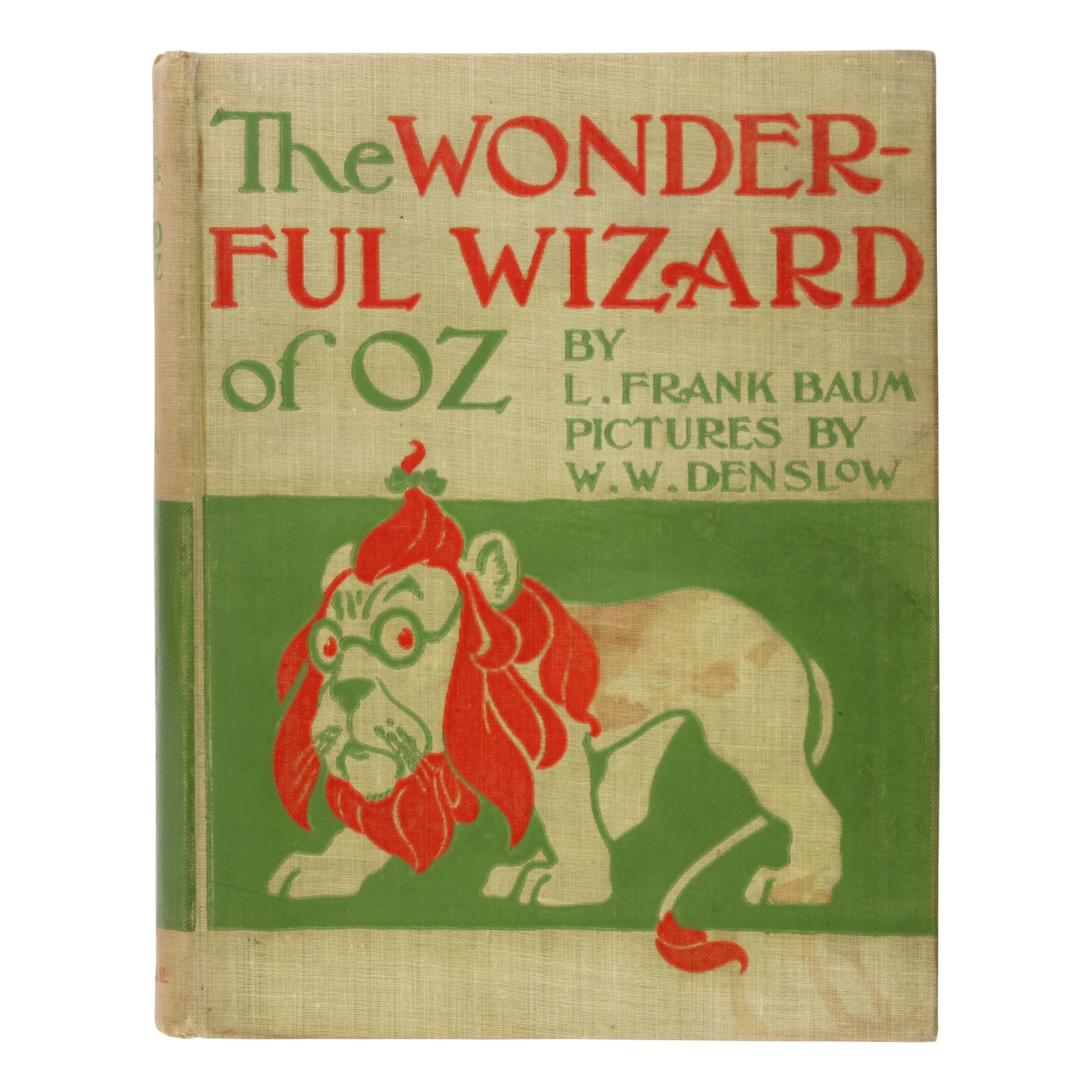
Baum, L. Frank (1856-1919). The Wizard of Oz. Chicago and New York: Geo. M. Hill Co., 1900.
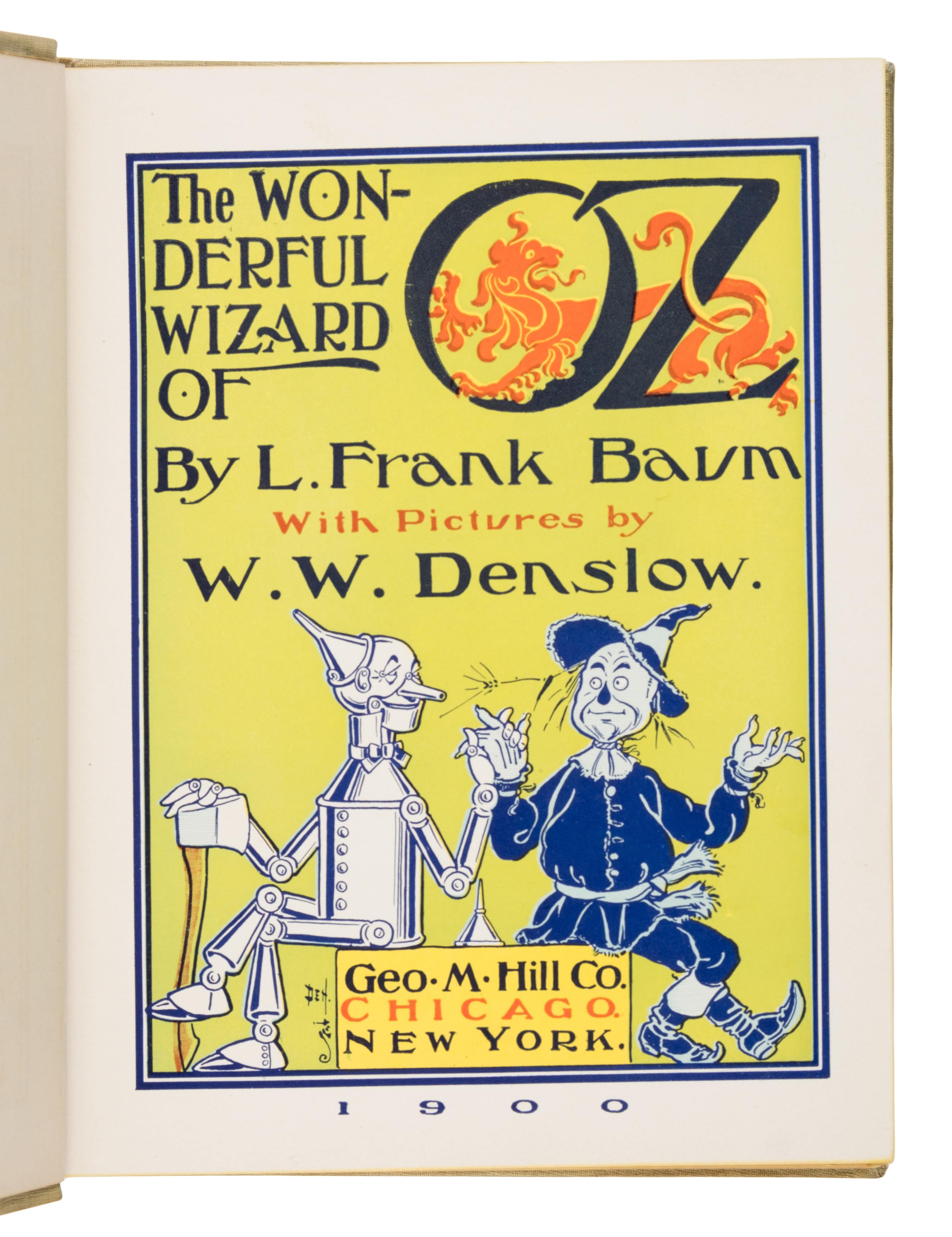
8vo. 24 color plates including the pictorial title, and color illustrations throughout, all by W.W. Denslow. Original pictorial green cloth [binding "C"] stamped in red and green (a few minor stains to upper cover, small split to rear joint, hinges tender); morocco-backed folding case.
FIRST EDITION, REILY'S STATE B with the following FIRST STATE points: ads on p. [2] enclosed in a single-rule box; verso of title-page with copyright showing imperfections to the type with long capital "R" descenders (described by some bibliographers as "rubber stamped"); uncorrected text on pp. 14, 81, and [227]; plates glossy on one side only; earliest state of plate facing pp. 34; colophon printed in 11 lines within a double-ruled box. Second state of plate facing p.92 without the red shading on the horizon.
The pictorial copyright notice originally conceived by Denslow was designed such that it appears on the verso of the introduction, rather than on the verso of the title-page as the law requires. The notice was subsequently set up on one of the Hill Company's small job printing presses, and printed on the back of the color-plate title pages before they were inserted (as seen in the present example). The copyright notice in later issues was letterpress printed.
In his introduction, Baum explained that the story was written “solely to please children of today,” noting that “the old-time fairy tale, having served its purpose, may now be classed as ‘historical.’” "For Baum, the dark world of European fairy stories seemed outdated amid the prosperity and opportunities of America's Gilded Age. His bright 'modernized fairy tale,' emphasizing self-reliance, positive attitudes, and rewards, struck home with readers... [that] had become as deeply embedded in American culture as the ageless tales of Cinderella and Sleeping Beauty" (Grolier).
L. Frank Baum’s path to literary success had been a long one. He began writing nearly twenty-five years before the publication of The Wonderful Wizard of Oz, founding a newspaper in Bradford, Pennsylvania; after leaving the paper, he “went on to manage opera houses, act in the theater, and establish a magazine for window dressers,” pursuing a variety of creative ventures before achieving lasting success as an author. In 1897, Baum published his first children’s book, Mother Goose in Prose, illustrated by Maxfield Parrish. Around that time, Baum met W. W. Denslow, a versatile artist who regularly supplied illustrations to New York journals. The two soon collaborated on a follow-up to Mother Goose, the popular Father Goose: His Book, whose unexpected success persuaded George M. Hill Company to publish The Wonderful Wizard of Oz, provided Baum and Denslow themselves financed the cost of the printing plates. The resulting volume was issued with an unusually elaborate design program—costly for a children’s book of the period—incorporating numerous color plates and decorative typographic elements integrated throughout Denslow’s illustrations.
The book proved an immediate success and launched what would become the celebrated Oz series, a popularity that, as Maurice Hungiville notes, “kept him writing Oz books for the rest of his life: and even beyond his life, for after he died in 1919 others were commissioned to write more books about the Wizard.” Baum himself explored the world of Oz across multiple media, envisioning projects such as a never-realized Oz amusement park on Pedloe Island off the California coast and founding the Oz Film Manufacturing Company in 1914, which produced the first two cinematic adaptations of the story, preceding the landmark 1939 film The Wizard of Oz starring Judy Garland. See Maurice Hungiville, The Wizard of Oz and Who He Was (1984). Bienvenue & Schmidt, pp.4-6; Blank, Peter Parley to Penrod pp.111-113; Grolier, One Hundred Books Famous in Children's Literature p.196; Reily, pp.33-40.
This lot is located in Chicago.