To request further details about this lot, please email Fineart@freemansauction.com
Please email Fineart@freemansauction.com for any additional information or questions you may have
Sale 6499
| New York
| New York
To request further details about this lot, please email Fineart@freemansauction.com
Please email Fineart@freemansauction.com for any additional information or questions you may have
Estimate$150,000 – $250,000
Published by Galerie Louise Leris, Paris, printed by Imprimerie Arnéra, Vallauris
Literature:
Bloch 1067, Baer 1279
Provenance:
Sold: Christie's New York, October 30, 2007, Lot 382
Renaissance Fine Arts, Baltimore
Acquired directly from the above by the present owner
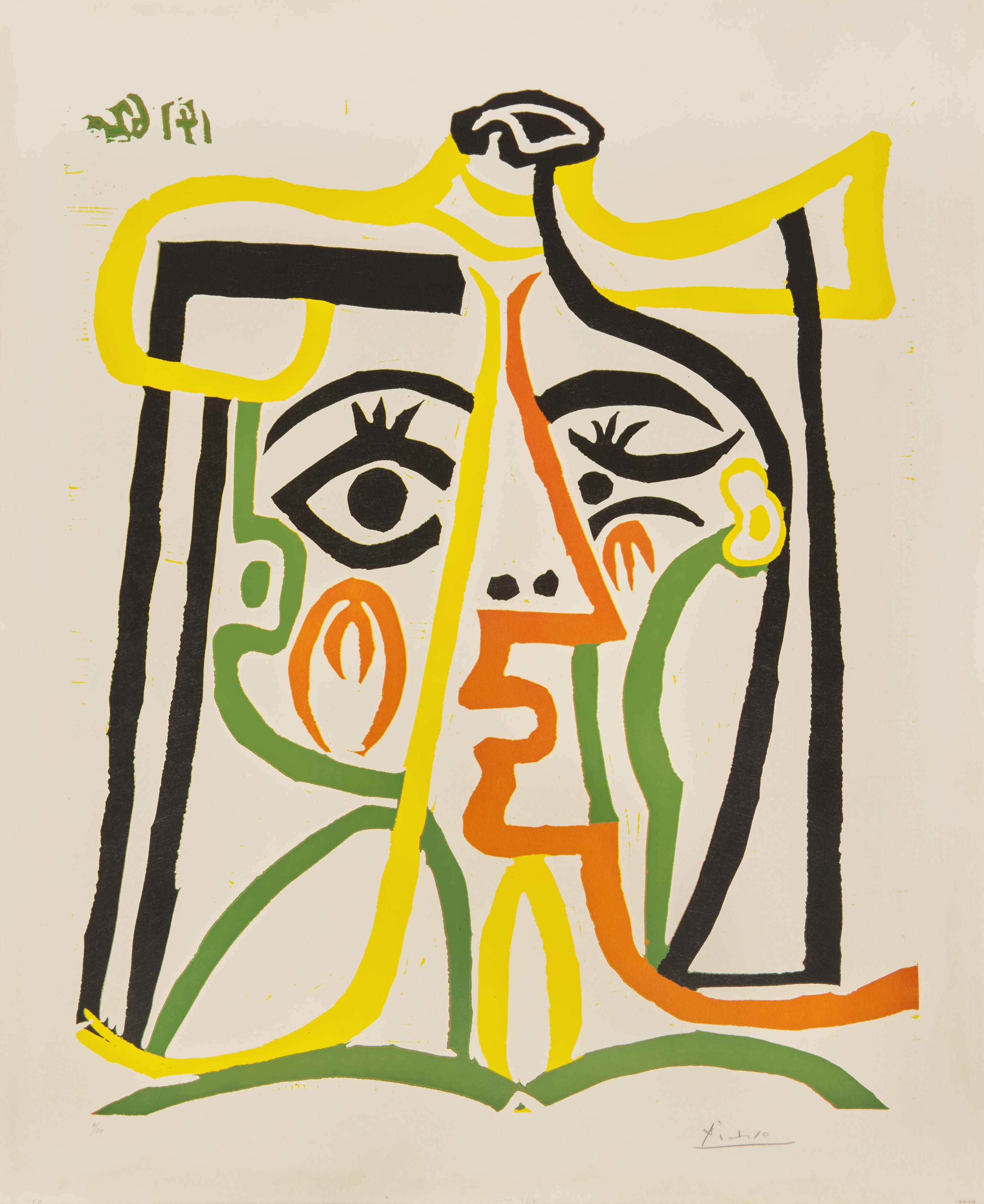
Created in 1962, Portrait de Jacqueline au chapeau de paille belongs to Pablo Picasso’s celebrated series of late linocuts produced in Vallauris in collaboration with master printer Hidalgo Arnéra. During this highly inventive period, Picasso revolutionized the medium through the reduction technique, carving successive stages of the composition into a single linoleum block and printing each color in sequence. This process allowed for a fluid, painterly approach while eliminating the need for multiple blocks, resulting in bold contours, vivid color, and a striking immediacy unique to his linocut practice.
The pliable nature of linoleum enabled Picasso to work with remarkable speed and freedom, aligning with his late-career urgency and experimental spirit. Compared to the more laborious processes of etching and lithography, linocut offered a directness that translated into simplified, graphic forms and luminous planes of color. The composition, carefully premeditated yet executed with apparent spontaneity, demonstrates Picasso’s mastery of both line and color balance, achieved through a sequence of precisely planned cuts and overprinting.
Jacqueline Roque, Picasso’s wife and principal muse in his final decades, appears here as both subject and symbol. Her features are distilled into a dynamic interplay of frontal and profile views, recalling Cubist strategies while pushing them toward a more graphic, almost mask-like abstraction. The bold division of the face, the asymmetry of expression, and the interplay of red, yellow, green, and black create a sense of shifting identity and emotional duality, animating the composition with psychological depth.
Produced late in Picasso’s career, this work exemplifies his conviction that printmaking was not merely reproductive but a primary artistic medium. Alongside recurring themes such as bullfights and still lifes, his portraits of Jacqueline stand among the most iconic images of this period. These linocuts, with their clarity, innovation, and expressive force, remain some of the most influential graphic works of the twentieth century, affirming Picasso’s enduring legacy as a relentless innovator across media.
Framed: 36 x 31 x 3 inches.
Sheet: 29 1/2 x 24 3/8 inches.
Please contact fineart@freemansauction.com for a detailed condition report.
The physical condition of lots in our auctions can vary due to age, normal wear and tear, previous damage, and restoration/repair. All lots are sold "AS IS," in the condition they are in at the time of the auction, and we and the seller make no representation or warranty and assume no liability of any kind as to a lot's condition. Any reference to condition in a catalogue description or a condition report shall not amount to a full accounting of condition. Condition reports prepared by Freeman's staff are provided as a convenience and may be requested from the Department prior to bidding.
The absence of a posted condition report on the Freeman's website or in our catalogues should not be interpreted as commentary on an item's condition. Prospective buyers are responsible for inspecting a lot or sending their agent or conservator to inspect the lot on their behalf, and for ensuring that they have requested, received and understood any condition report provided by Freeman's.
Please email Fineart@freemansauction.com for any additional information or questions you may have regarding this lot.