To request further details about this lot, please email morganmartin@freemansauction.com
Please email morganmartin@freemansauction.com for any additional information or questions you may have
Sale 6495
| Philadelphia
| Philadelphia
To request further details about this lot, please email morganmartin@freemansauction.com
Please email morganmartin@freemansauction.com for any additional information or questions you may have
Estimate$120,000 – $180,000
Provenance:
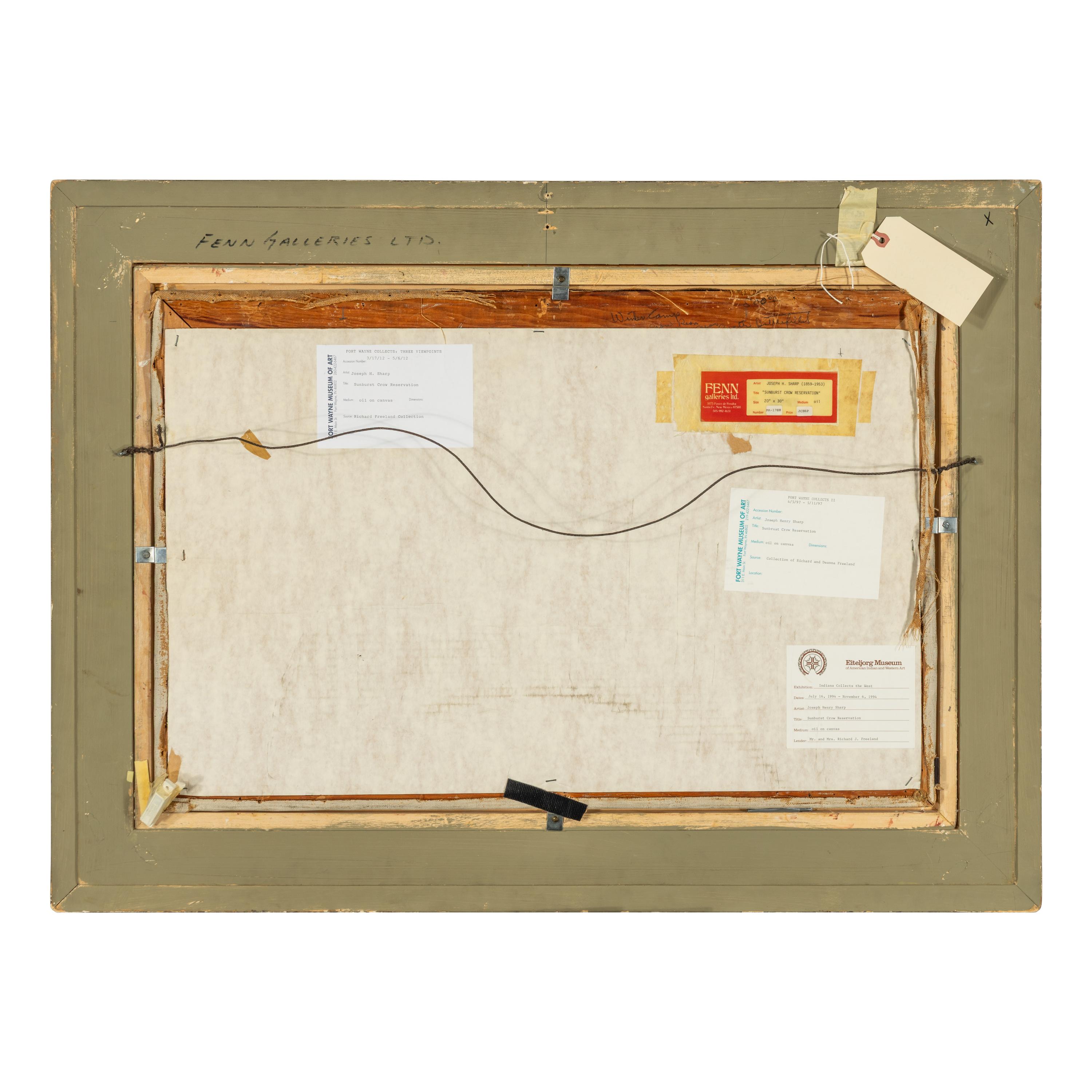
Fenn Galleries, Santa Fe, New Mexico.
Acquired from the above.
Exhibited:
Indianapolis, Indiana, Eiteljorg Museum of American Indian and Western Art, Indiana Collects the West, July 16-November 6, 1994
Fort Wayne, Indiana, Fort Wayne Museum of Art, Fort Wayne Collects II, April 5-May 11, 1997
Fort Wayne, Indiana, Fort Wayne Museum of Art, Fort Wayne Collects: Three Viewpoints, March 17-May 6, 2012
Literature:
(possibly) F. Fenn, The Beat of the Drum and the Whoop of the Dance: A Study of the Life and Work of Joseph Henry Sharp, Santa Fe, 1983, no. 948, p. 317, as Crow Camp Sunburst.
Joseph Henry Sharp made his first trip to the Crow Agency in Southern Montana in 1899 and immediately became enamored with the people of this stark but beautiful part of the country. In 1905, Sharp and his wife Addie had built a residence on the Agency, which he named his "Absarokee Hut" after the Crow people, and used it as a home base to travel and paint throughout the region, including the western portion of Montana, Wyoming, and the Dakotas. Much like birds, the Sharp's would migrate regularly north and south, though they did it in reverse order to modern day practice. The Sharp's would arrive in Montana in early fall in time for the Crow Fair and stay through the early portion of the winter before heading south to spend later winter in California and the summer in Taos.
To many, the bitter cold of Montana winters would have been a deterrence, but to Sharp it was an inspiration to execute his en plein air paintings through coagulating paint and shivering hands. In order to venture further from the Absarokee Hut to execute his paintings, Sharp retrofitted a sheepherder's wagon with a wooden stove and window, which he dubbed "The Prairie Dog," and used as a warming hut once his paints and hands had become too frozen to work. As Sharp declared, “At this season of the year, the Indians [at Crow Agency] have more time for posing…the snowy landscape, sage brush foothills, and winter foliage along the Little Big Horn River are more paintable.” (as quoted in F. Fenn, Teepee Smoke, Santa Fe, 2007, p. 166.) Because he was alowed to live on the Agency among the people, Sharp had ample and unparalleled access to experience and document the daily life and practices of the Crow. As Forrest Fenn describes it, “By merely walking out his door and looking across the river, he could observe hundreds of Crow, and frequently Sioux, Cheyenne, and Blackfeet, visiting from other reservations.” (Ibid, p. 170.)
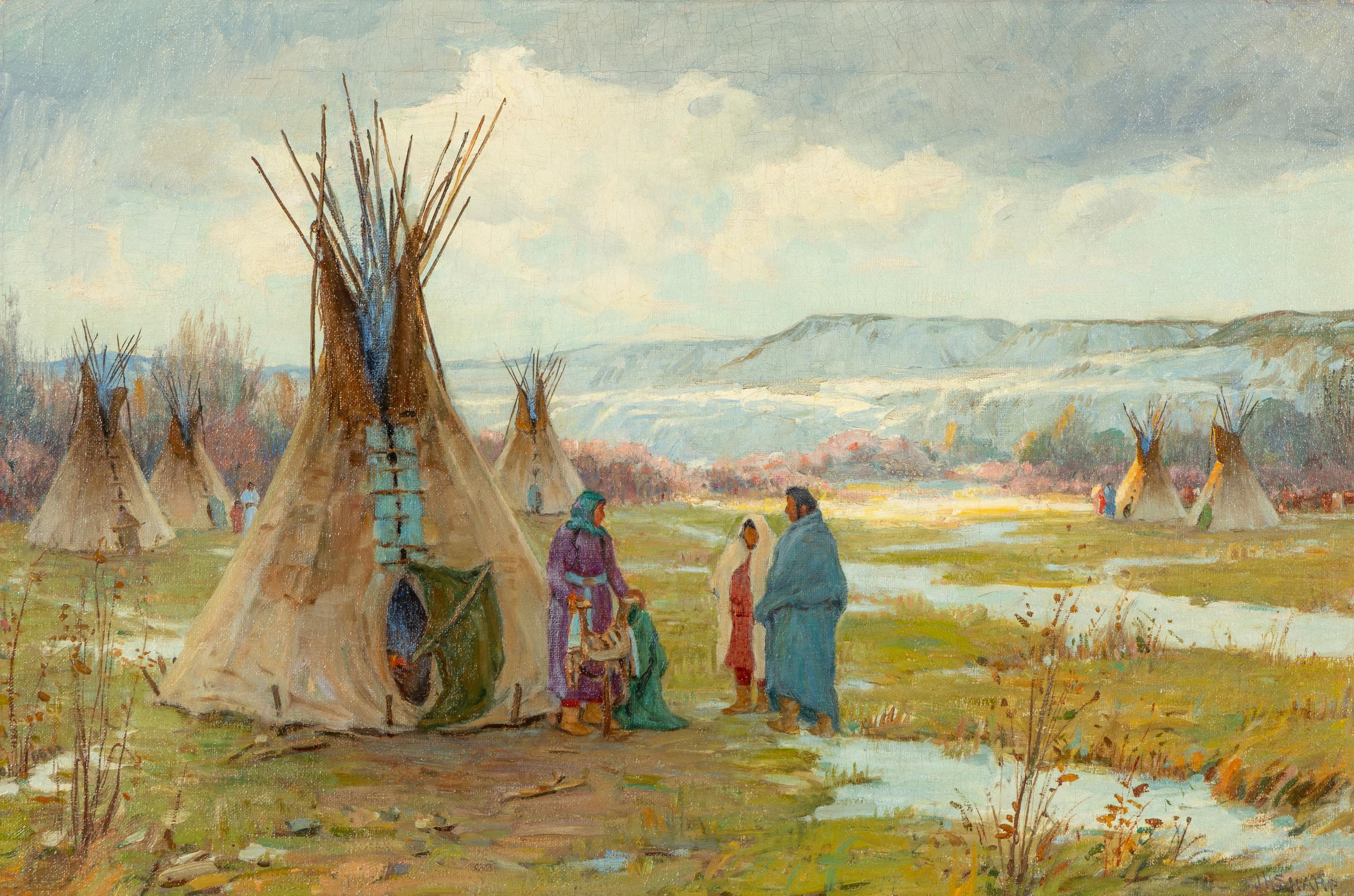
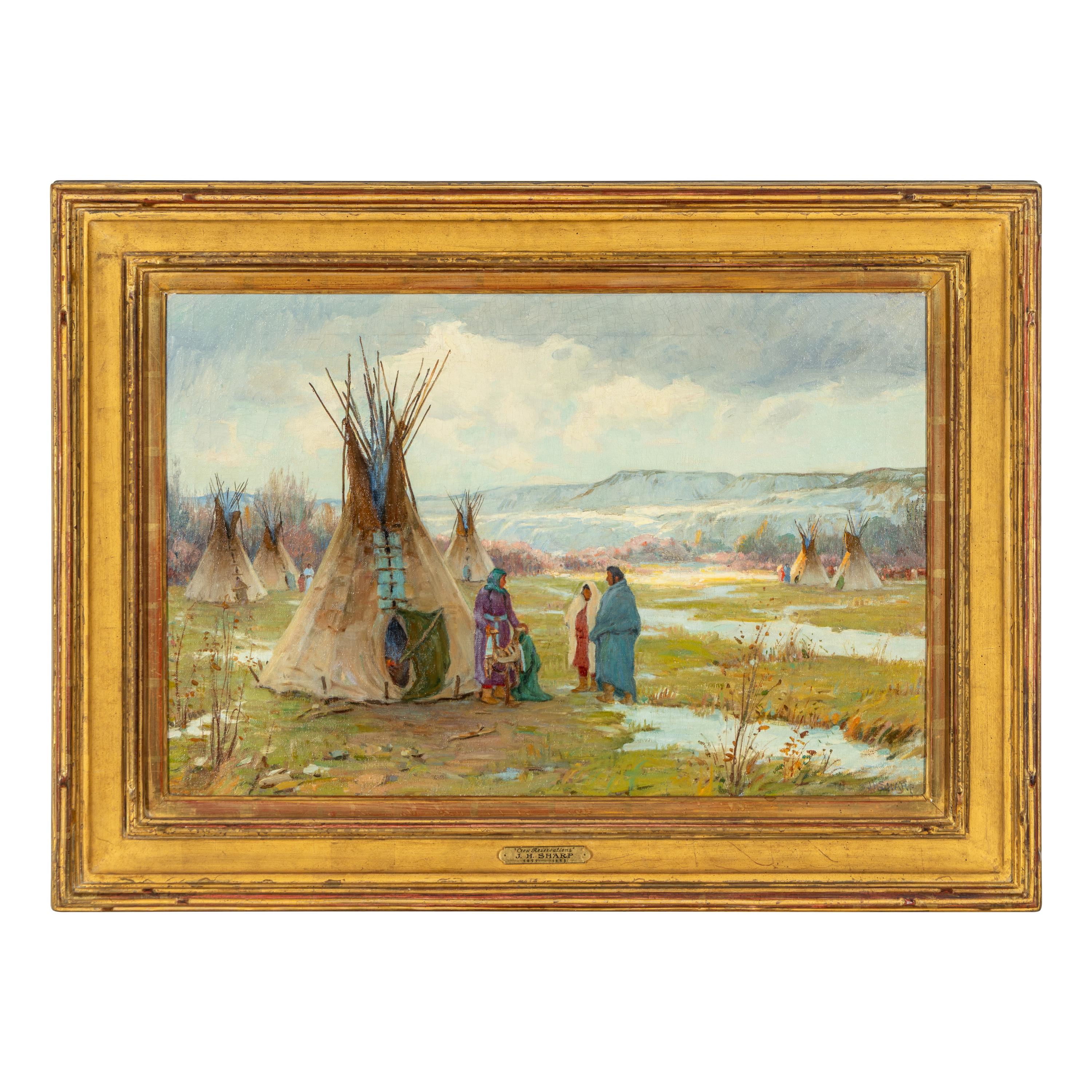
Sunburst Crow Reservation is a prime example of the scene that would have greeted Sharp as he left his home each morning. In this work, Sharp has rendered the distant Big Horn Mountain range dusted with an early winter snow and the valley in the foreground with still verdant grasses intermittently quilted with patches of accumulation. The scene is littered with teepees in the mid ground and three figures gathering to trade at the propped-open entrance of a teepee at center left. Sharp invigorates this depiction of the Crow encampment as they prepare for winter through the additions of pops bright colors throughout the composition; the primary figure wearing shades of amethyst and azure, in the distance a figure rendered with the flick of coral, and feathery brush strokes of pastel pinks to define the late fall bushes in the distance. Sharp has placed gentle strokes of ice blue over the poles coming out of the top of each teepee to denote the smoke of the fires keeping the residents warm, an imperative part of daily life for anyone living in this rugged climate. With the bright whites in the sky and lightening of the field, Sharp has captured the light if the sun breaking through the ominous clouds, dramatically infusing the scene with warmth, much like the friendship and generosity he received from the Crow people.
Framed: 28 1/2 x 38 1/2 x 2 1/2 inches.
The physical condition of lots in our auctions can vary due to age, normal wear and tear, previous damage, and restoration/repair. All lots are sold "AS IS," in the condition they are in at the time of the auction, and we and the seller make no representation or warranty and assume no liability of any kind as to a lot's condition. Any reference to condition in a catalogue description or a condition report shall not amount to a full accounting of condition. Condition reports prepared by Freeman's staff are provided as a convenience and may be requested from the Department prior to bidding.
The absence of a posted condition report on the Freeman's website or in our catalogues should not be interpreted as commentary on an item's condition. Prospective buyers are responsible for inspecting a lot or sending their agent or conservator to inspect the lot on their behalf, and for ensuring that they have requested, received and understood any condition report provided by Freeman's.
Please email morganmartin@freemansauction.com for any additional information or questions you may have regarding this lot.