To request further details about this lot, please email adriannewolkenberg@freemansauction.com
Please email adriannewolkenberg@freemansauction.com for any additional information or questions you may have
Sale 6494
| New York
| New York
To request further details about this lot, please email adriannewolkenberg@freemansauction.com
Please email adriannewolkenberg@freemansauction.com for any additional information or questions you may have
Estimate$12,000 – $18,000
Literature:
Basil Marros (1897-1954), an exhibition catalogue, Hellenic American Union, 1998, Athens, Greece, p. 103, illustrated.
The ART Magazine, Issue 14, January 1995, Athens, Greece, p. 50, illustrated
Lot Note:
Basil Marros was a Greek-born artist whose career unfolded between Europe and the United States. Born in the village of Melissa in the prefecture of Corinthia, he moved to San Francisco at the age of 16, entering the California College of Arts and Crafts before traveling to New York on a scholarship at the Art Students League. He later continued his training in Paris at the Académie Moderne under Fernand Léger and Émile-Othon Friesz, who taught him a strong sense of geometric shapes and warm coloration, respectively. This transatlantic formation shaped his work decisively. While in Paris, he turned early toward abstraction, and by the 1930s—at a time when realism dominated in the United States—he developed a personal visual language based on geometry and simplification.
After settling in New York, Marros became part of progressive artistic circles, exhibiting at the Society of Independent Artists and participating in group exhibitions alongside figures such as Marsden Hartley and Jackson Pollock. At the same time, he was involved in experimental theater, working as both stage designer and actor—an experience that shaped the constructed, almost scenographic quality of his painting. In 1938, Marros had his first one-man show at Delphic Studios.
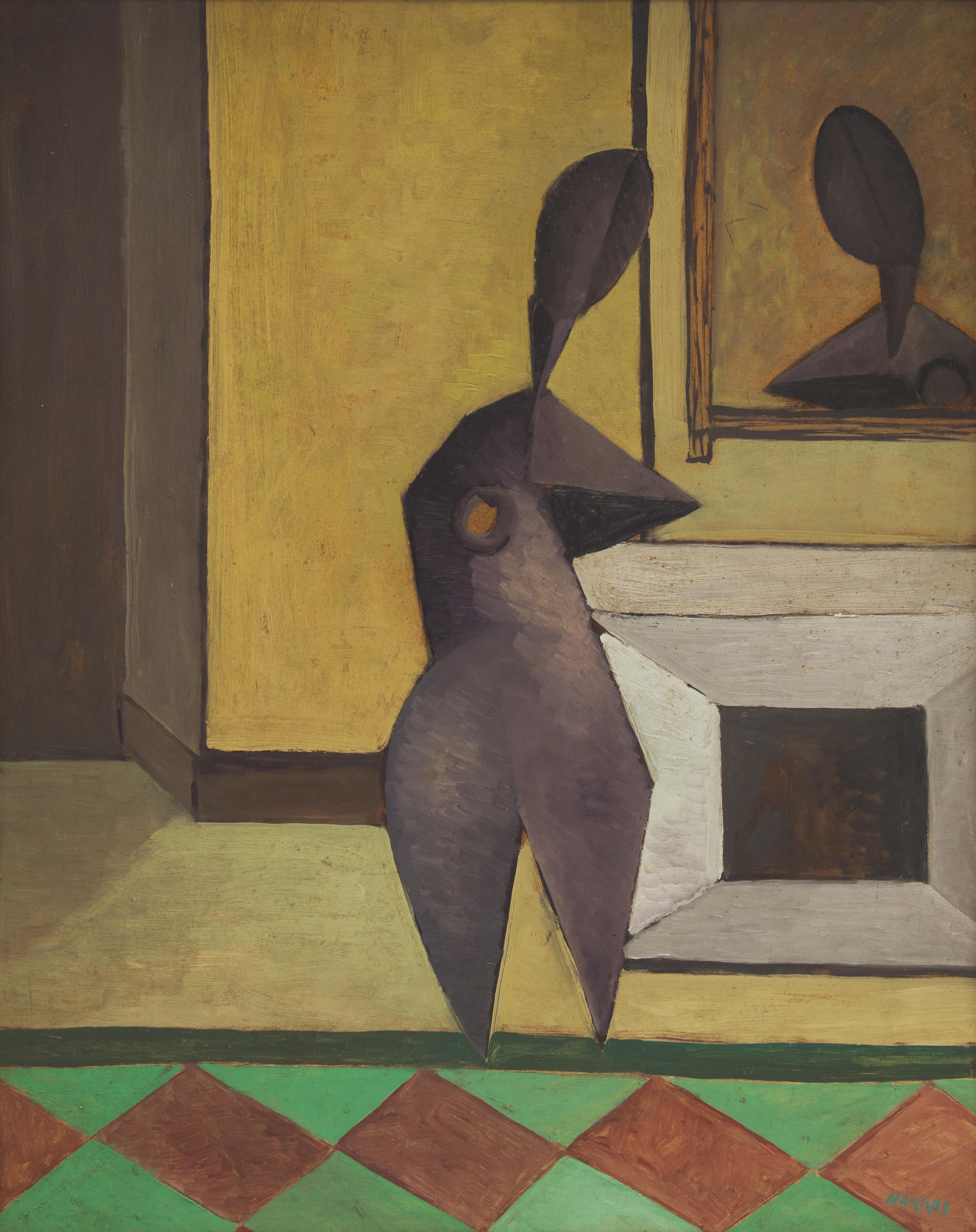
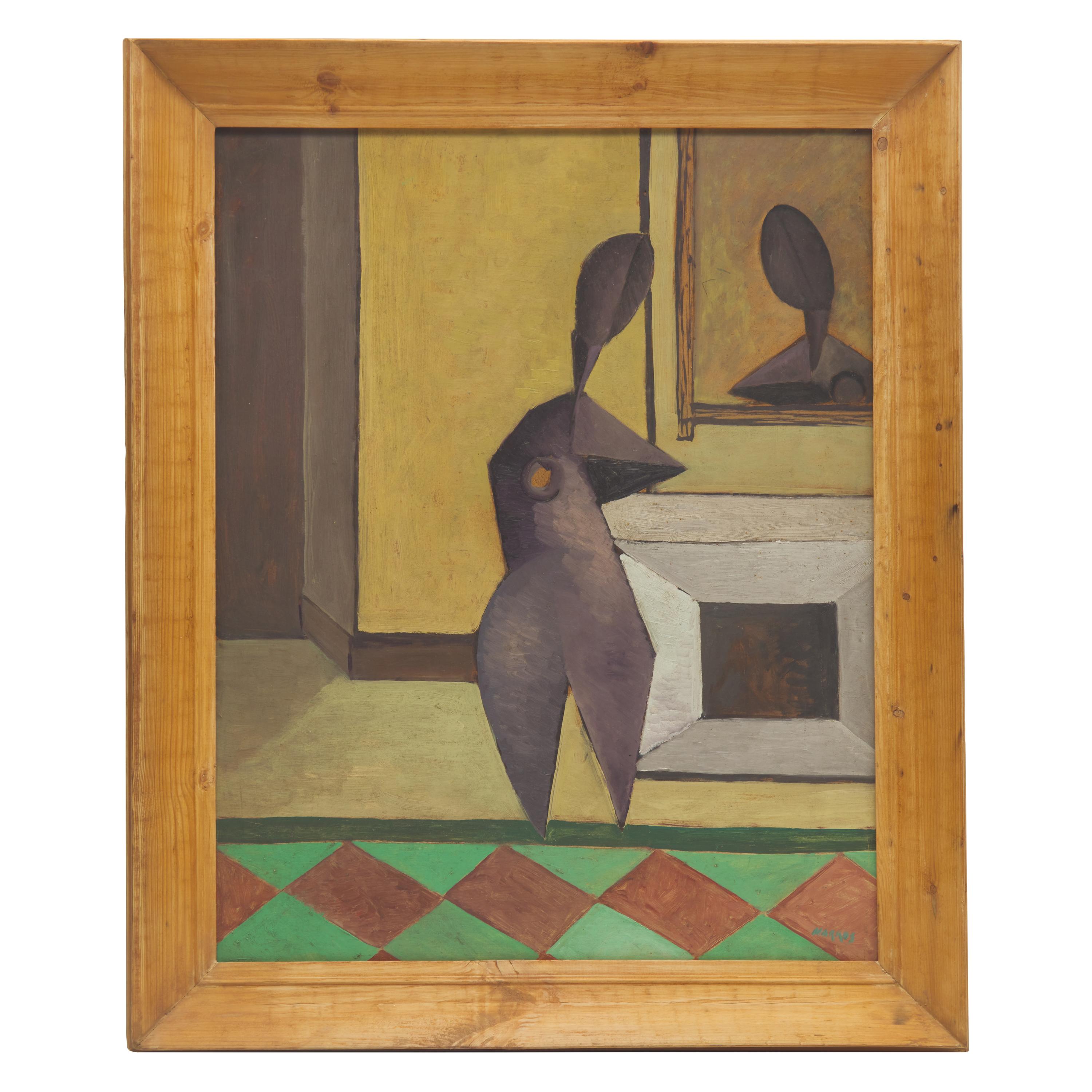
The works on offer, including Figures (Lot 40), date from this period, a key moment during which Marros turned toward simplified, geometric forms and controlled compositions. As seen in Reflection, he focused on interiors inhabited by anonymous, stylized figures. These are not descriptive spaces but constructed ones, where balance, geometry, and structure take precedence over narrative.
In the present work, the standing figure is reduced to an angular, almost abstract silhouette, built from flat planes and muted tones. It draws on both Cycladic idols and the metaphysical mannequins of Giorgio de Chirico, combining archaic memory with modernist structure. The mirror introduces a subtle doubling, reinforcing the sense of a staged, self-contained space—echoing the artist’s scenographic background—and contributing to the quiet unease of the scene. In Figures (Lot 40), the repetition of three figures creates a rhythmic, almost emblematic effect. This repetition introduces a slight visual disorientation, echoed by the eerie, stage-like setting reminiscent of de Chirico’s work, while also animating the composition. In both paintings, color remains restrained: earth tones, ochres, and muted greens are applied evenly to stabilize and anchor the image.
In 1942, Marros moved back to the West Coast, settling permanently in California, where he worked in connection with the U.S. Navy at the Alameda Base. He remained there until his death in San Leandro in 1954, having exhibited in both Europe and the United States, though remaining relatively little known in his native Greece during his lifetime. As the poet and critic Nanos Valaoritis puts it, Marros was "an important but sadly neglected modernist painting who rated about the world like Odysseus."
Framed: 33 x 27 x 3 in.
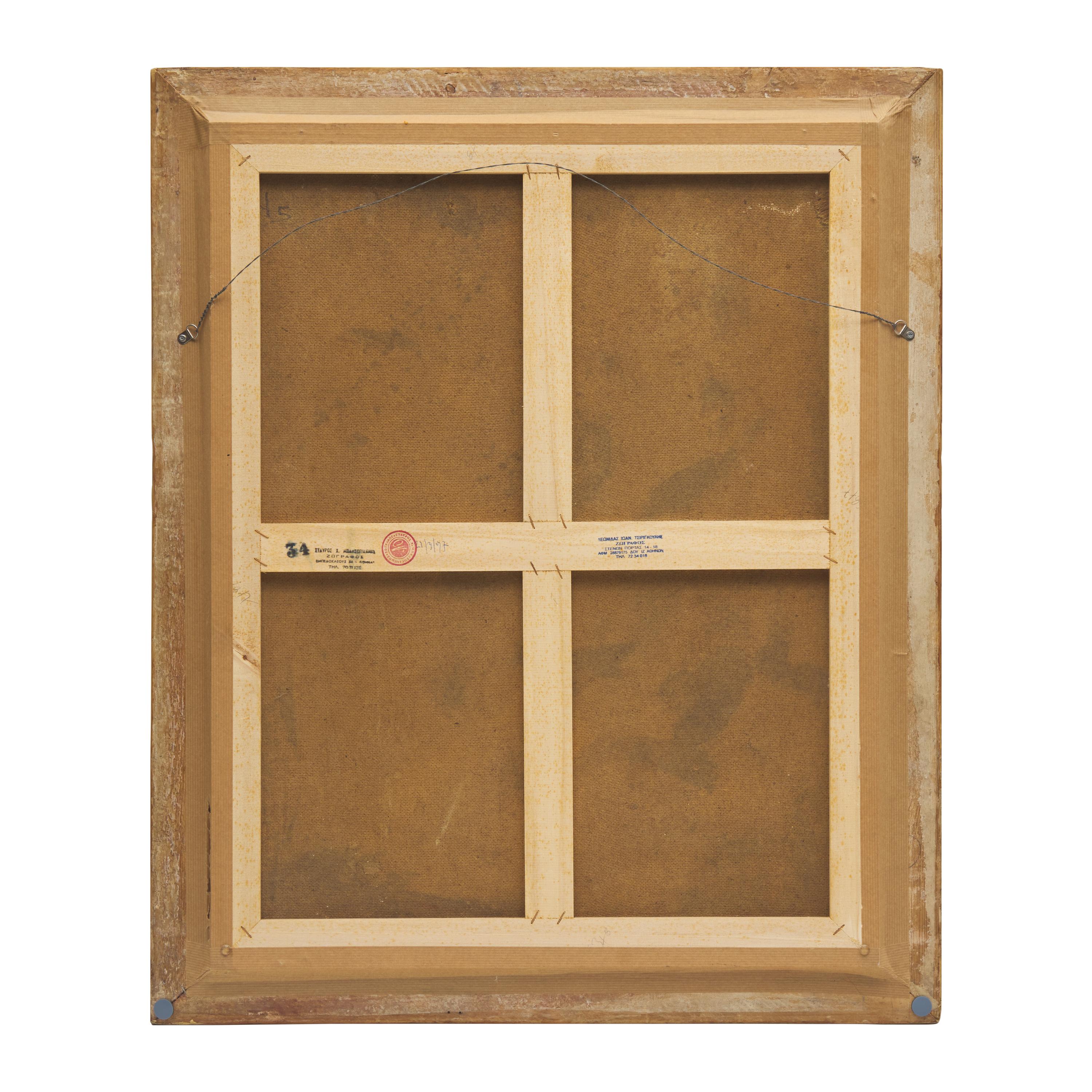
The painting is in overall good condition, with some scattered soiling visible in the lighter areas at right. There are a few scuffs throughout the surface, particularly at top left and top right and vertically at the bottom two edges. There is a small circular surface loss at top right in the vertical dark line. Under UV light, there is soiling across the middle of the painting that fluoresces. Additional images available upon request.
The physical condition of lots in our auctions can vary due to age, normal wear and tear, previous damage, and restoration/repair. All lots are sold "AS IS," in the condition they are in at the time of the auction, and we and the seller make no representation or warranty and assume no liability of any kind as to a lot's condition. Any reference to condition in a catalogue description or a condition report shall not amount to a full accounting of condition. Condition reports prepared by Freeman's staff are provided as a convenience and may be requested from the Department prior to bidding.
The absence of a posted condition report on the Freeman's website or in our catalogues should not be interpreted as commentary on an item's condition. Prospective buyers are responsible for inspecting a lot or sending their agent or conservator to inspect the lot on their behalf, and for ensuring that they have requested, received and understood any condition report provided by Freeman's.
Please email adriannewolkenberg@freemansauction.com for any additional information or questions you may have regarding this lot.