To request further details about this lot, please email adriannewolkenberg@freemansauction.com
Please email adriannewolkenberg@freemansauction.com for any additional information or questions you may have
Sale 6494
| New York
| New York
To request further details about this lot, please email adriannewolkenberg@freemansauction.com
Please email adriannewolkenberg@freemansauction.com for any additional information or questions you may have
Estimate$50,000 – $80,000
Provenance:
Galerie du Passage, Paris.
Sotheby's, New York, sale of June 12, 2009, lot 63.
Acquired directly from the above sale by the present owner.
Literature:
"Paris Notes," Vogue, August 1947, p. 157 (for a description of Bérard's decor).
Irene Lidova, "La Nuit du Panache," L'Officiel de la Mode, 1947, pp. 66-67, nos. 305-306 (for period images and descriptions of the event).
Jean-Claude Daufresne, Fêtes à Paris au XXe Siècle: Architectures Éphémères de 1919 à 1989, Paris, 2001, pp. 205-206.
Lot Note:
Christian Bérard emerged as a versatile creative figure in early twentieth-century France, working across painting, illustration and stage design. Shaped in part by the intimate, atmospheric work of Édouard Vuillard, he became closely involved with the Parisian avant-garde during the years between the wars. His wide-ranging collaborations brought him into close contact with figures such as Alberto Giacometti, Jean-Michel Frank, Coco Chanel, and Jean Cocteau. Moving easily between disciplines, Bérard became a ubiquitous figure in the Parisian theater scene before his life was cut short at the age of 46.
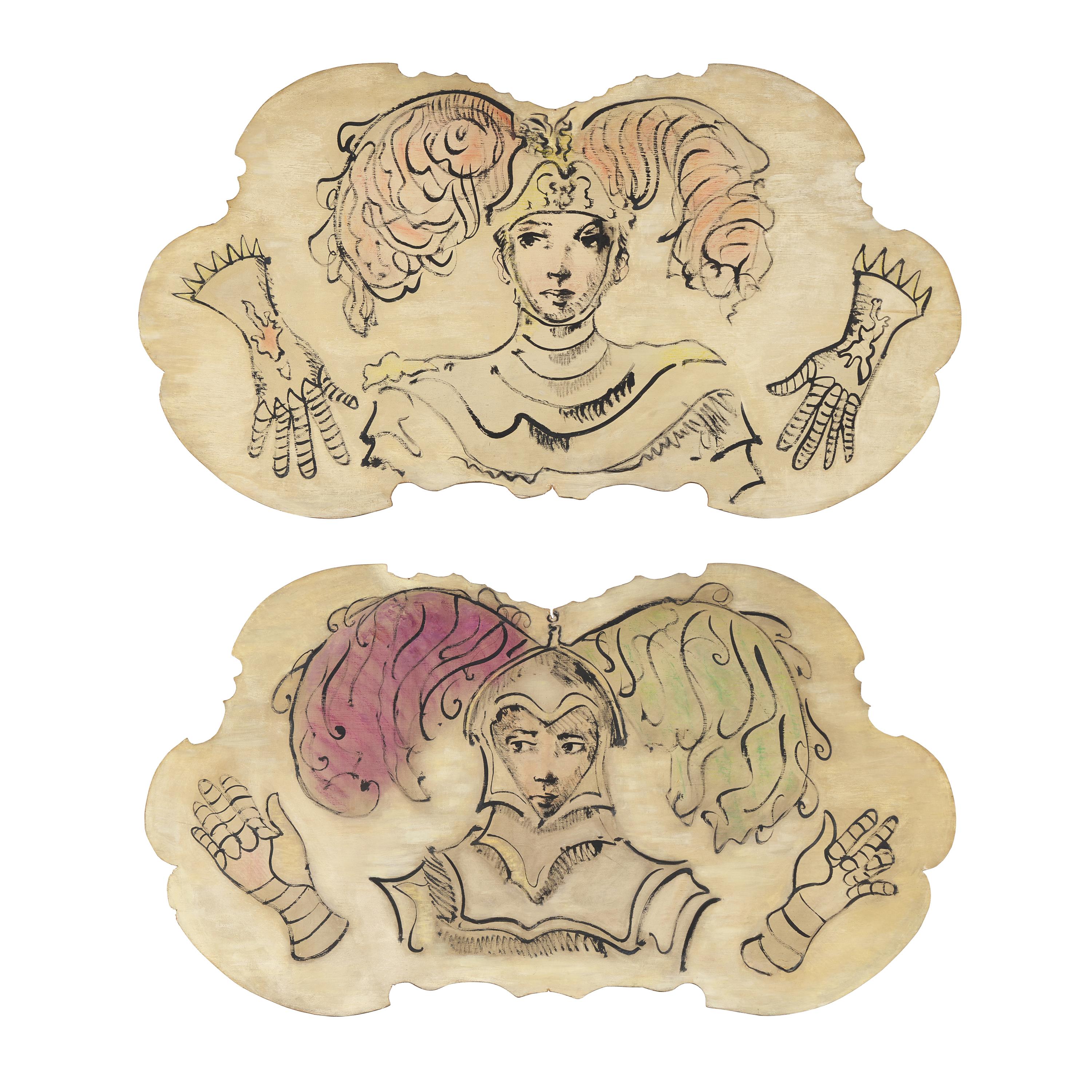
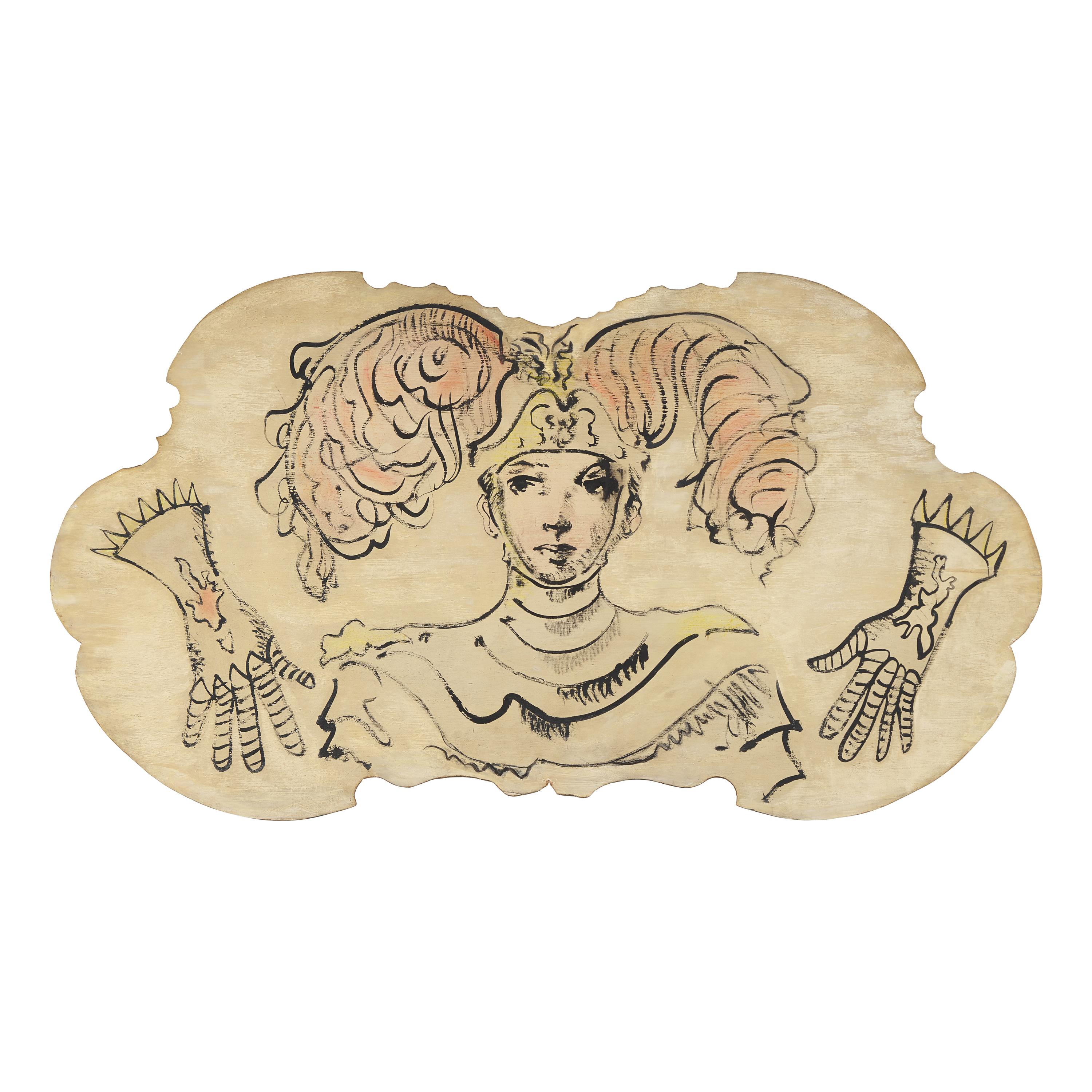
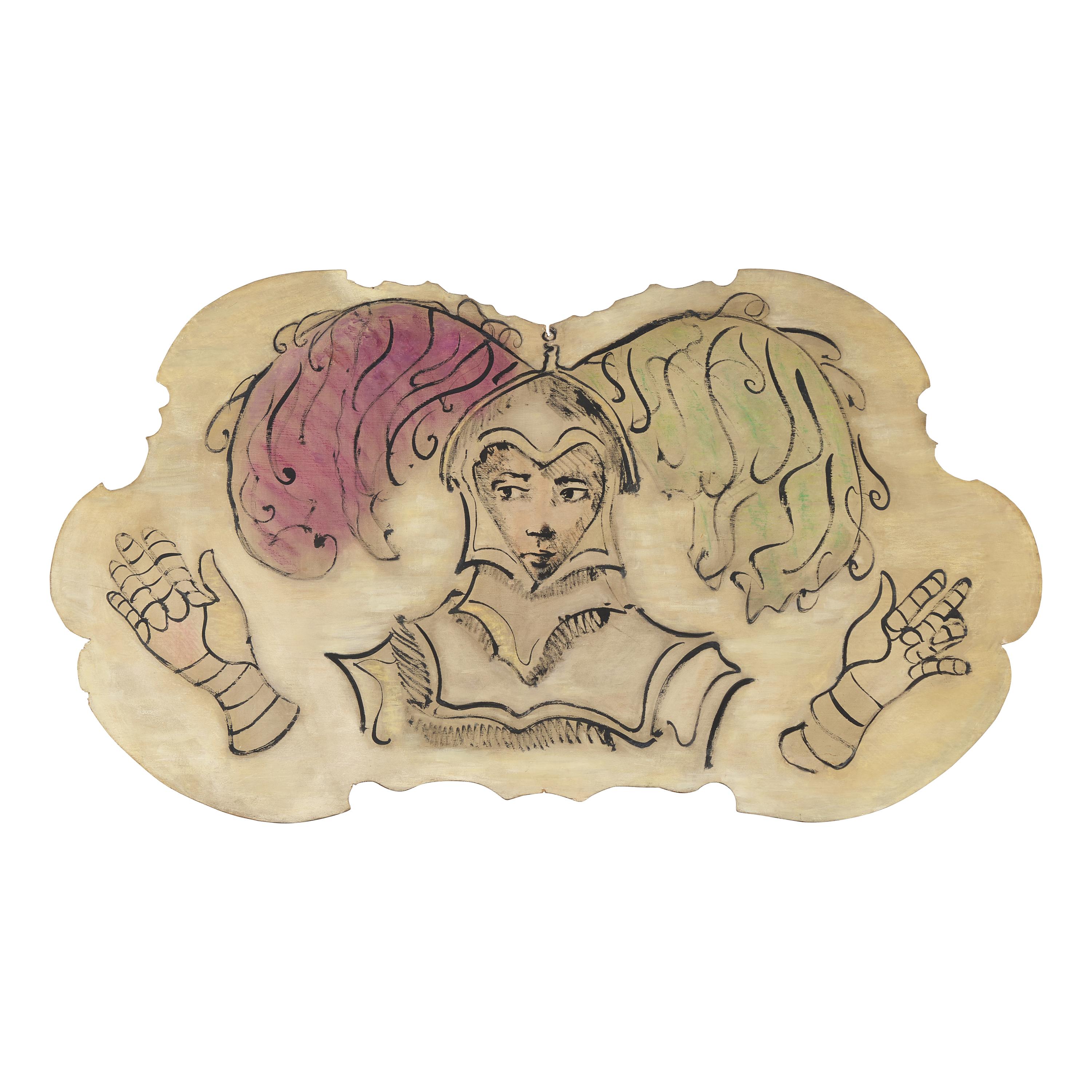
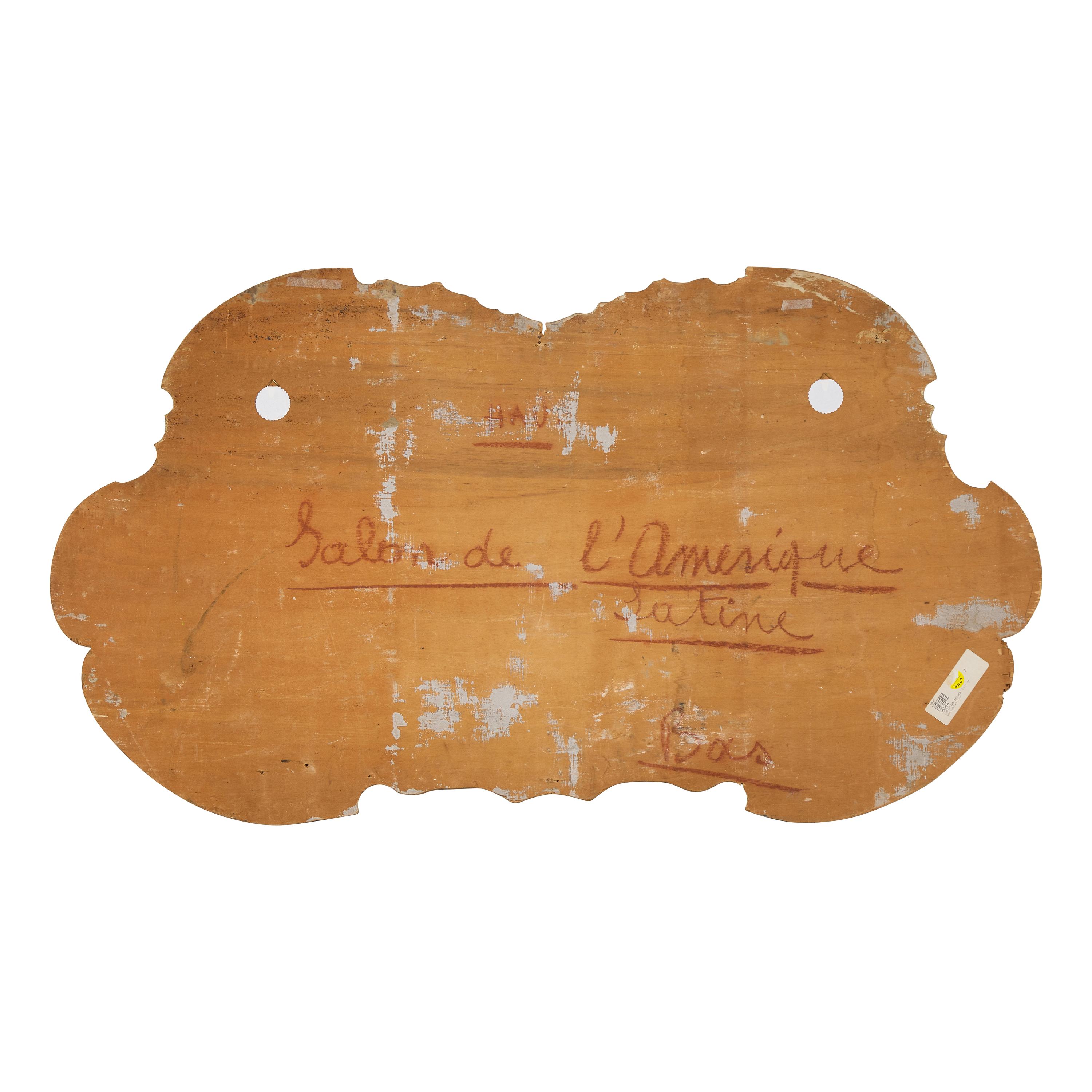
The pair of cartouches here relate to Bérard's set design compositions for the Ballet des Champs-Elysées, created for the "Bal du Panache" party which was held at the Maison de l' Amerique Latine, in Paris during the summer of 1947. Bérard conceived of the event, an idea supported by British ambassador Sir Alfred Duff Cooper for the benefit of the Marie-Thérèse Health Center in Malakoff. One of the first few large events hosted after the second World War, the party was seen as a vibrant return to a pre-war glittering Parisian social scene. The décor consisted of vined trellises, painted heraldry and white-plumed suits of armor, and female guests were encouraged to wear feathered hair ornaments. These particular cartouches were incorporated into the elaborate boiseries of the grand salon of Maison de l' Amerique Latine, and remain a rare momento of this ephemeral moment.
Both unframed.
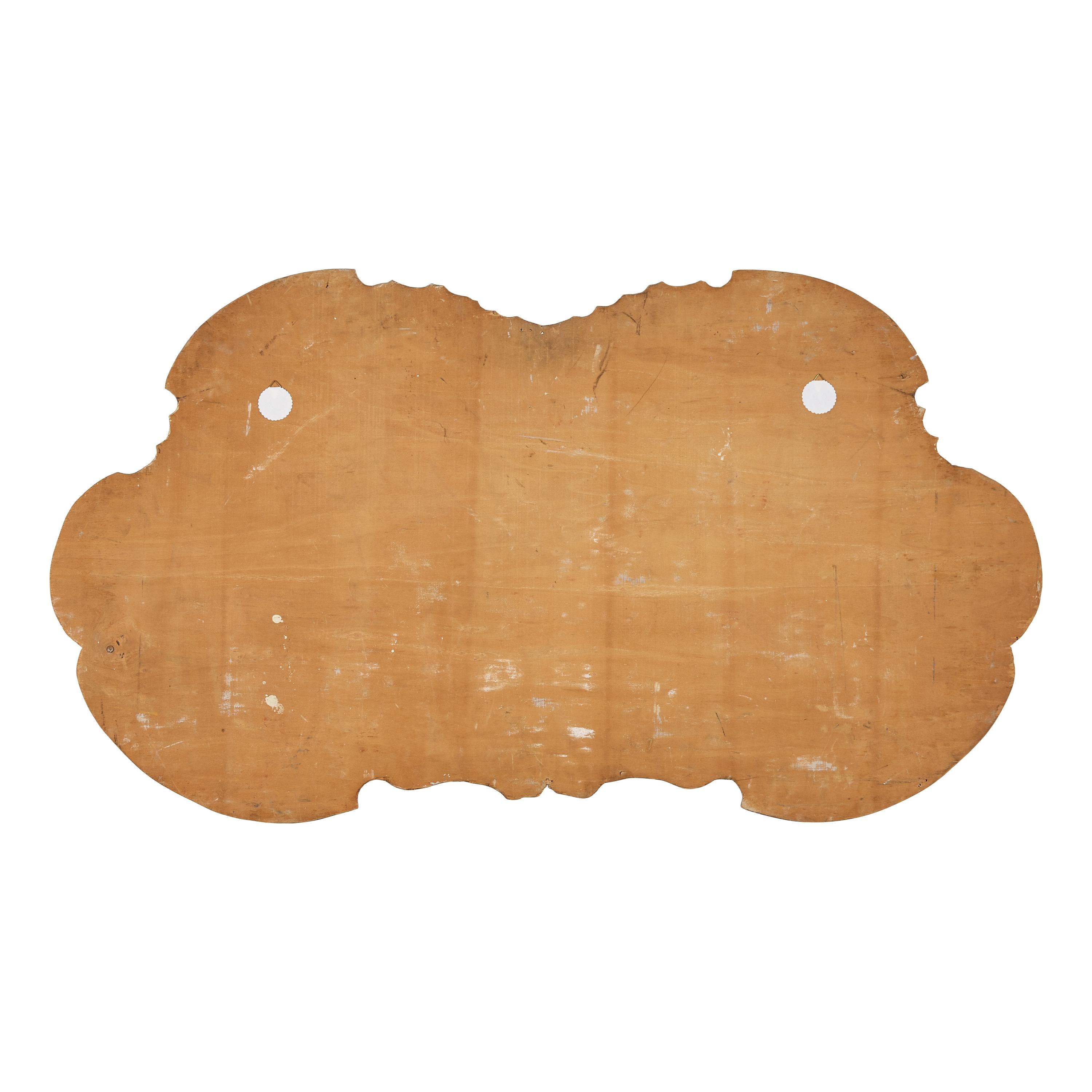
First: The panel is very thin (less than 1 in. thick). The surface of the panel is rugged with some more textured elements than others, however the paint surface remains stable. Small loss in one of the crevices of the top center arabesque. Some rubbing, and associated losses in the equivalent area at bottom center. We notice two splinters in the wood at bottom center left and center right (the first, about 3 in. long, the other 7 in. long): both appear textured, and have been repaired as seen under UV. The verso presents evidence of soiling, and scuffs. Light losses near the rounded edges (left and right, as well as the arabesques top and bottom). Some light punctures (likely from old nailing attempts) also visible at top and bottom, as well as as at upper left and upper right quadrants, as well as at bottom right.
Second: The panel is also very thin (less than 1 in. thick). The texture of the panel is smoother in comparison, although the lines of the wood are visible throughout, as the paint layer is relatively thin. Few smudges throughout, some of which appear to be part of the artist's method. We notice a few breaks and abrasions in the weakest areas of the panel such as at the crown (top center, which creates a dent of about 1 in. long), as well as at bottom center left (around the round edges: some splinters), at bottom center (small hole-shaped loss) and at center right: minor paint loss, with softening around. We notice a few losses in the paint at upper left (in the purple area), some of which appear carefully inpainting (as seen under UV light). Although some of the pigments, namely the whites, fluoresce no other sign of restoration. The verso is soiled, with old glue residue throughout. While we notice the counter-roof of the aforementioned splinters/losses, we also note more holes (evidence of past nailing attempts) such as at upper center, bottom left and at bottom center. Some more pronounced losses on the back of the panel visible at center left, and especially center right (layers of the panel missing, but the front is preserved).
Additional images available upon request.
The physical condition of lots in our auctions can vary due to age, normal wear and tear, previous damage, and restoration/repair. All lots are sold "AS IS," in the condition they are in at the time of the auction, and we and the seller make no representation or warranty and assume no liability of any kind as to a lot's condition. Any reference to condition in a catalogue description or a condition report shall not amount to a full accounting of condition. Condition reports prepared by Freeman's staff are provided as a convenience and may be requested from the Department prior to bidding.
The absence of a posted condition report on the Freeman's website or in our catalogues should not be interpreted as commentary on an item's condition. Prospective buyers are responsible for inspecting a lot or sending their agent or conservator to inspect the lot on their behalf, and for ensuring that they have requested, received and understood any condition report provided by Freeman's.
Please email adriannewolkenberg@freemansauction.com for any additional information or questions you may have regarding this lot.