To request further details about this lot, please email adriannewolkenberg@freemansauction.com
Please email adriannewolkenberg@freemansauction.com for any additional information or questions you may have
Sale 6494
| New York
| New York
To request further details about this lot, please email adriannewolkenberg@freemansauction.com
Please email adriannewolkenberg@freemansauction.com for any additional information or questions you may have
Estimate$50,000 – $70,000
A certificate for this work was issued in 1968 by Marguerite Duthuit, but is no longer extant. A letter of confirmation will be issued by Georges Matisse at the buyer’s request.
Provenance:
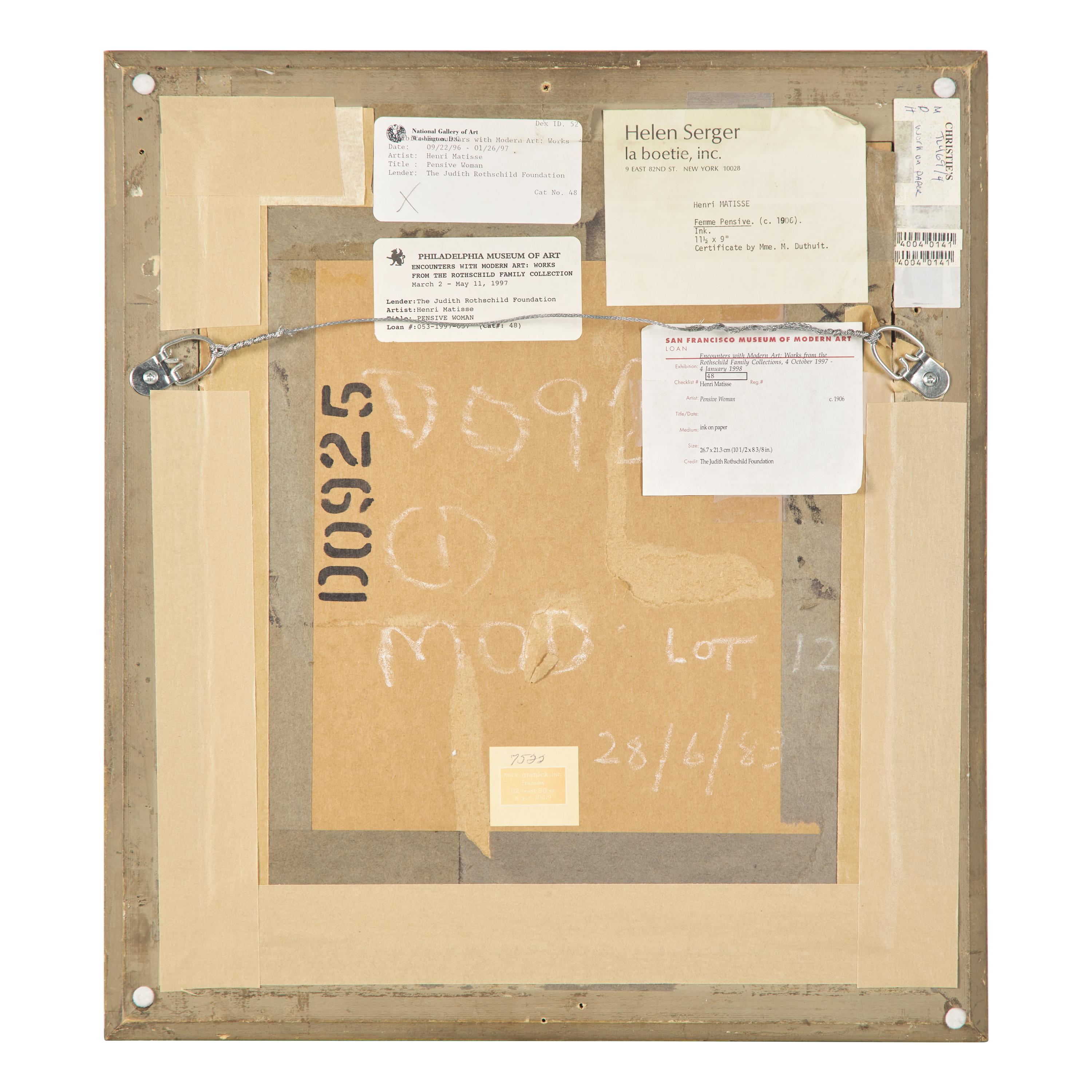
Me Martin, Versailles, sale of March 31, 1968.
Galerie Ile de France, Paris, by April 1968
Private Collection.
La Boetie, New York.
Henry Reed.
Kay Hillman, New York.
Acquired directly from the above in 1983.
Judith Rothschild.
The Judith Rothschild Foundation, New York.
Private Collection, New York.
Exhibited:
Washington, D.C., National Gallery of Art, Encounters with Modern Art: Works from the Rothschild Family Collections, September 22, 1996 - January 26, 1997, p. 174, illustrated (and traveling to Philadelphia Museum of Art, March 2 - May 11, 1997).
Literature:
Pierre Schneider, Matisse, New York: Rizzoli, New York, 1984, p. 230 (illus.).
Lot Note:
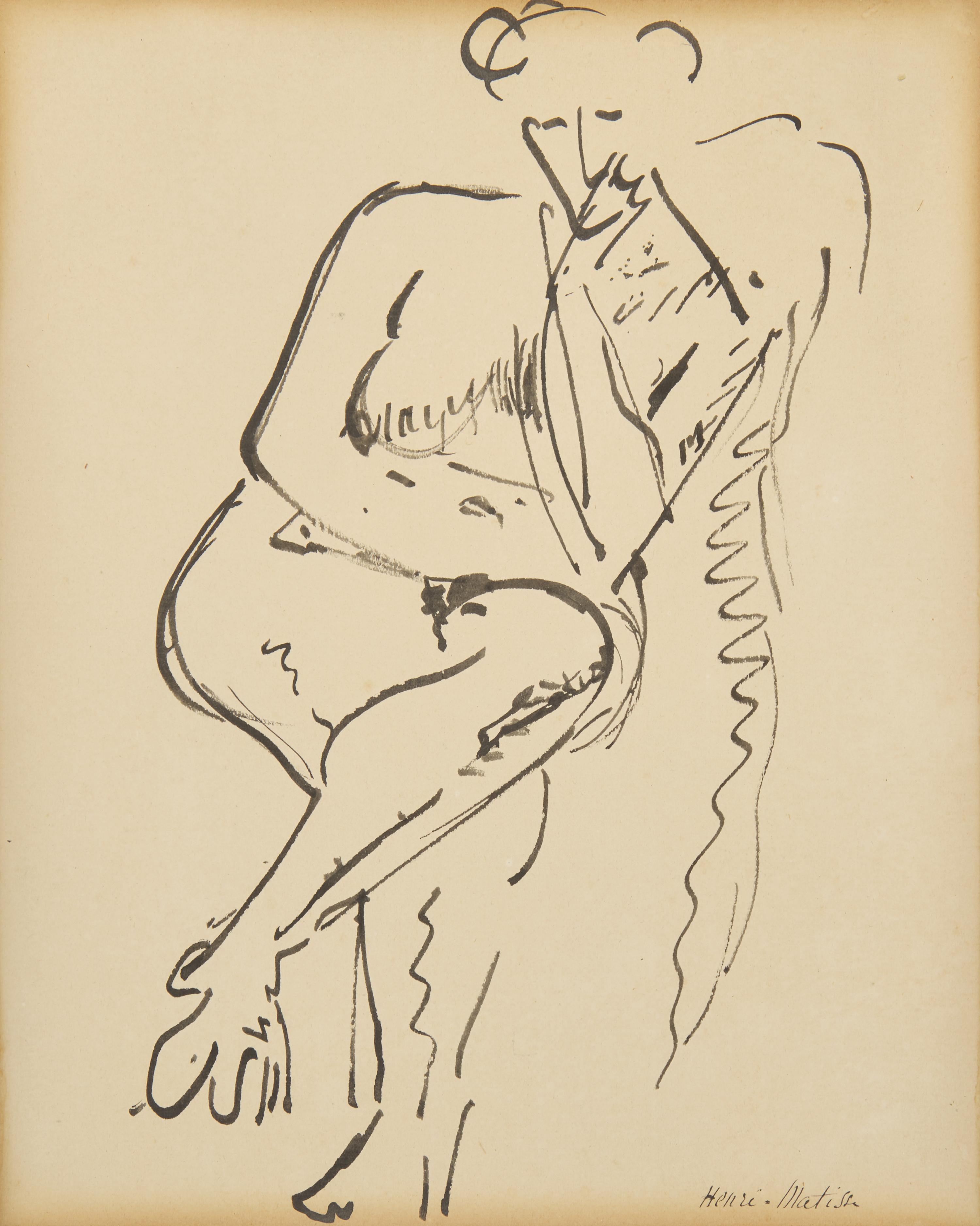
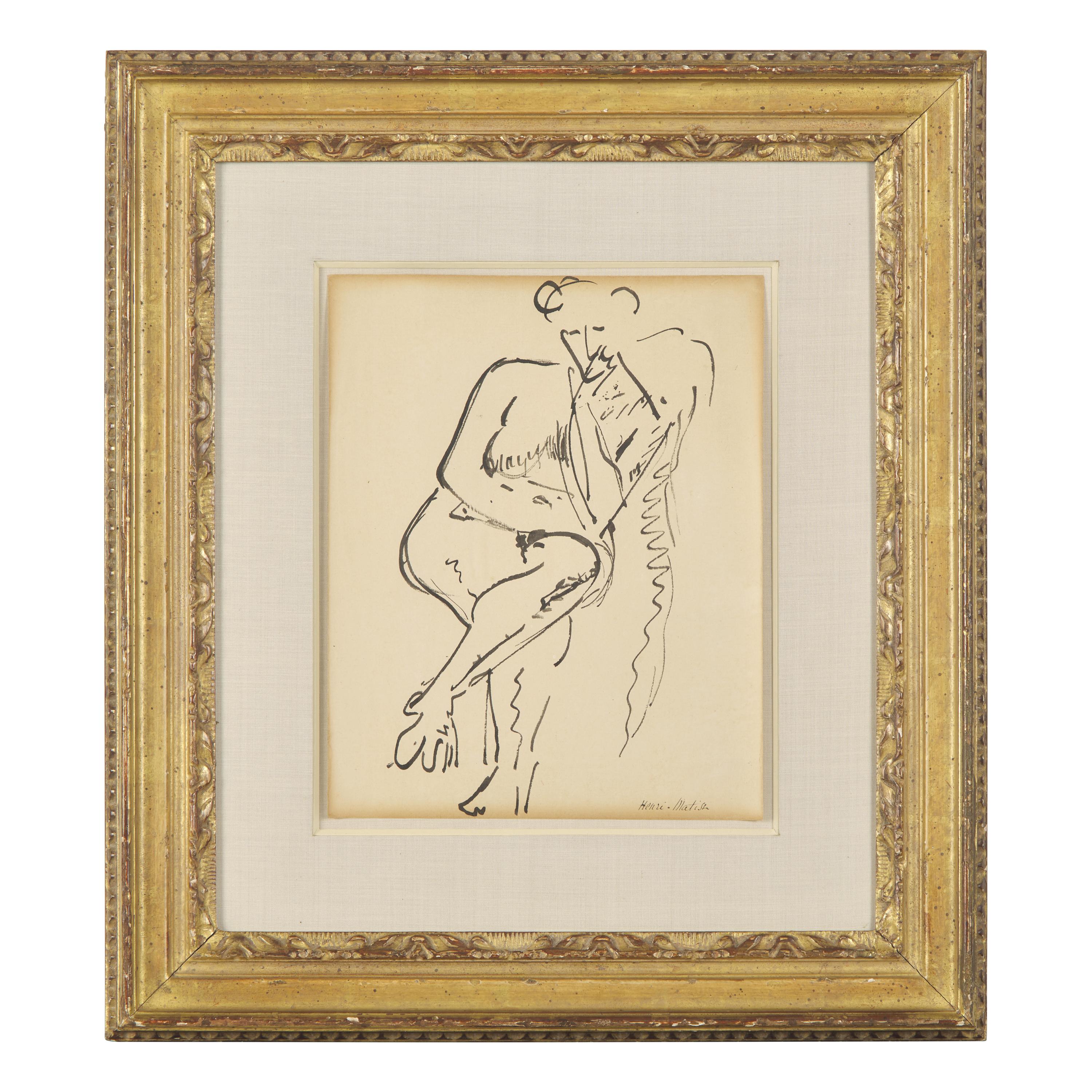
Henri Matisse executed the ink drawing Pensive Woman around 1906, at a crucial moment when he was gaining recognition in avant-garde circles, exhibiting his new “Fauve” paintings to the shock of many critics. Along with fellow painters André Derain and Maurice de Vlaminck, Matisse was experimenting with bold color and outline, culminating in his mural-sized painting Le Bonheur de Vivre, currently in the Barnes Foundation collection in Philadelphia, a vibrant early masterpiece that influenced generations of artists to come.
While drawing did not come as easily to Matisse as his explorations of color, he worked diligently in his early career to build his drawing skill because he saw it as fundamental to his practice. Much later in his career, in Notes of a Painter on his Drawing, in 1939, Matisse wrote: “My line drawing is the purest and most direct translation of my emotion. The simplification of the medium allows for that. … I have always seen drawing … above all as a means of expression of ultimate feelings and states of mind, but a means that is condensed in order to give more simplicity and spontaneity to the expression which should be conveyed directly to the spirit of the spectator.” Pensive Woman encapsulates this spontaneity, its quick lines moving freely around the paper, cascading down her shoulder in a river of movement and agility. The quiet, contemplative figure contrasts with the frenetic pace of the line, creating a tension that brings the work to life.
Framed: 20 x 18 x 2 in.
Please email adriannewolkenberg@freemansauction.com to request a condition report and additional images.
The physical condition of lots in our auctions can vary due to age, normal wear and tear, previous damage, and restoration/repair. All lots are sold "AS IS," in the condition they are in at the time of the auction, and we and the seller make no representation or warranty and assume no liability of any kind as to a lot's condition. Any reference to condition in a catalogue description or a condition report shall not amount to a full accounting of condition. Condition reports prepared by Freeman's staff are provided as a convenience and may be requested from the Department prior to bidding.
The absence of a posted condition report on the Freeman's website or in our catalogues should not be interpreted as commentary on an item's condition. Prospective buyers are responsible for inspecting a lot or sending their agent or conservator to inspect the lot on their behalf, and for ensuring that they have requested, received and understood any condition report provided by Freeman's.
Please email adriannewolkenberg@freemansauction.com for any additional information or questions you may have regarding this lot.